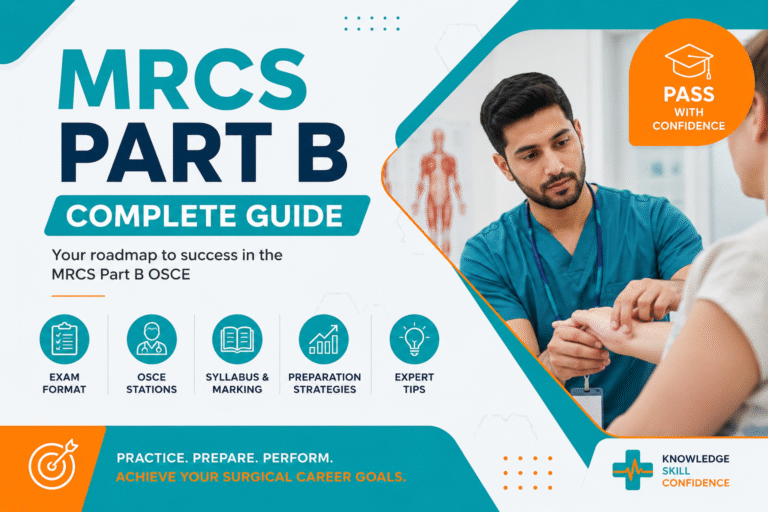

The Membership of the Royal Colleges of Surgeons (MRCS) Part B examination is the final step toward achieving the MRCS qualification and progressing in surgical training. Unlike Part A, which focuses on theoretical knowledge, MRCS Part B is a practical, clinically oriented exam designed to assess communication skills, clinical competence, surgical knowledge, and professionalism.
This complete guide covers the MRCS Part B exam format, syllabus, preparation strategies, study resources, common mistakes, and expert tips to help you pass successfully on your first attempt.
What is the MRCS Part B Exam?
MRCS Part B is an Objective Structured Clinical Examination (OSCE) that evaluates a candidate’s practical and clinical abilities required for safe surgical practice. The exam tests how candidates apply their knowledge in real-life clinical situations rather than simply recalling facts.
The examination is conducted by the four Royal Colleges of Surgeons in the UK and is internationally recognized for surgical training and career progression.
MRCS Part B Exam Format
The MRCS Part B examination consists of multiple OSCE stations that assess different clinical and professional skills. Candidates rotate through timed stations where they perform specific tasks under observation.
Key Features of the Exam
- Objective Structured Clinical Examination (OSCE)
- Multiple timed stations
- Focus on clinical application and communication
- Assessment by experienced surgical examiners
- Simulated patient interactions and practical demonstrations
The exam usually includes stations covering anatomy, pathology, surgical procedures, communication skills, physical examination, and critical care scenarios.
MRCS Part B Syllabus
The MRCS Part B syllabus is designed to assess the practical clinical skills, surgical knowledge, communication abilities, and professional behavior required for safe surgical practice. Unlike Part A, which focuses mainly on theoretical knowledge, Part B evaluates how candidates apply their understanding in real clinical situations through Objective Structured Clinical Examination (OSCE) stations. The syllabus covers a wide range of topics including applied surgical anatomy, clinical examination skills, procedural skills, pathology, critical care, patient safety, communication skills, and perioperative management. Candidates are expected to demonstrate competence in history taking, physical examination, interpreting clinical findings, explaining procedures, obtaining informed consent, and managing emergency surgical scenarios. Strong knowledge of anatomy and surgical principles, combined with confident communication and structured clinical approaches, is essential for success in the MRCS Part B examination.
Anatomy Stations
Anatomy stations are one of the most important components of the MRCS Part B examination because they assess how well candidates can apply anatomical knowledge in clinical and surgical settings. Candidates may be required to identify anatomical structures using models, images, specimens, or radiological scans while also explaining their clinical relevance and surgical importance. The exam commonly focuses on head and neck anatomy, upper and lower limb anatomy, thorax and abdomen, neuroanatomy, and applied surgical anatomy. A strong understanding of anatomical relationships, nerve supply, blood vessels, and surgical landmarks is essential for success in these stations.
Clinical Examination Stations
Clinical examination stations test a candidate’s ability to perform systematic physical examinations while communicating effectively with patients and examiners. Candidates are expected to demonstrate proper examination techniques, identify clinical signs, and present findings in a structured and confident manner. Commonly tested examinations include abdominal, cardiovascular, respiratory, peripheral vascular, and neurological examinations. Examiners assess not only technical skills but also professionalism, patient comfort, hygiene, and time management during the examination process.
Procedural Skills Stations
Procedural skills stations evaluate a candidate’s ability to safely perform basic surgical techniques and practical procedures commonly encountered in clinical practice. These stations focus on precision, aseptic technique, patient safety, and correct instrument handling. Candidates may be asked to demonstrate suturing techniques, knot tying, catheterization, wound management, and the use of basic surgical instruments. Success in these stations requires repeated hands-on practice and familiarity with standard surgical procedures under timed conditions.
Communication Skills Stations
Communication skills are a major part of the MRCS Part B examination because surgeons must communicate effectively with patients, relatives, and healthcare teams. These stations assess empathy, professionalism, clarity, and ethical decision-making. Candidates may encounter scenarios involving breaking bad news, obtaining informed consent, explaining surgical procedures, managing difficult or anxious patients, and handling ethical dilemmas. Examiners expect candidates to remain calm, respectful, and patient-centered while using clear and understandable language throughout the interaction.
Applied Surgical Science and Critical Care
Applied surgical science and critical care stations assess a candidate’s understanding of perioperative care, emergency surgical management, and critical clinical decision-making. Candidates should be familiar with essential topics such as sepsis management, shock and trauma, fluid and electrolyte balance, postoperative complications, and critical care principles. These stations often test the ability to recognize deteriorating patients, prioritize management steps, and demonstrate safe surgical judgment in emergency situations.
Best Preparation Strategy for MRCS Part B
Preparing for MRCS Part B requires a structured and practical approach that combines theoretical revision with regular clinical practice. Since the examination is OSCE-based, candidates must focus not only on knowledge but also on presentation skills, communication, and confidence under pressure. Consistent practice, mock examinations, and exposure to real clinical scenarios are essential for achieving success in the exam.
Understand the Exam Pattern
Before beginning preparation, candidates should become familiar with the MRCS Part B exam structure, OSCE station format, and marking criteria. Understanding how stations are conducted and what examiners expect can significantly improve performance and reduce anxiety on exam day. Knowing the timing and objectives of each station helps candidates develop a structured approach during the examination.
Practice Clinical Examinations Regularly
Clinical examination skills are central to MRCS Part B success. Candidates should regularly practice examinations with colleagues, mentors, or study groups to improve confidence, fluency, and presentation style. Focus should be placed on maintaining a clear examination sequence, communicating findings effectively, presenting diagnoses logically, and managing time efficiently during each station.
Improve Communication Skills
Many candidates underestimate the importance of communication stations, but these carry significant marks in the examination. Practicing patient interactions can help improve confidence, empathy, and professionalism. Candidates should focus on maintaining eye contact, using simple and understandable language, demonstrating empathy, and remaining calm in stressful situations. Effective communication often creates a positive impression even in challenging scenarios.
Attend MRCS Part B Courses
Structured MRCS Part B preparation courses can provide valuable guidance and practical experience. These courses often include mock OSCE stations, anatomy demonstrations, communication practice, and examiner-style feedback. Attending a preparation course helps candidates understand common station formats and identify areas requiring further improvement before the exam.
Use Mock Exams
Mock exams are one of the most effective preparation methods for the MRCS Part B examination because they closely simulate real OSCE conditions and help candidates become comfortable with the exam environment. Regular mock practice improves time management, communication skills, clinical examination techniques, and confidence under pressure. By practicing different station scenarios, candidates can identify weak areas, refine their presentation style, and develop a more structured approach to answering questions. Mock exams also help candidates become familiar with examiner expectations, station timing, and rapid transitions between tasks. Consistent practice through mock examinations can significantly reduce exam anxiety and improve overall performance on the actual MRCS Part B exam
Recommended Books for MRCS Part B
Choosing the right study resources is an important part of successful MRCS Part B preparation. Since the examination focuses on clinical application, communication skills, anatomy, and practical surgical techniques, candidates should use a combination of textbooks, revision guides, and OSCE-focused materials. Popular books recommended by successful candidates include OSCEs for the MRCS Part B for station-based practice, Bailey & Love’s Short Practice of Surgery for core surgical knowledge, and Clinical Examination by Talley and O’Connor for examination techniques and patient assessment. Applied anatomy textbooks are also highly valuable because anatomy forms a major component of the exam. In addition to textbooks, candidates should regularly practice with mock stations, anatomy models, question banks, and clinical discussion groups to strengthen practical skills and improve exam confidence.
Popular MRCS Part B Books
Several books are highly recommended for MRCS Part B preparation because they provide a strong combination of clinical knowledge, practical examination skills, and OSCE-focused practice. OSCEs for the MRCS Part B is widely used for practicing common station scenarios and improving structured responses during the examination. Bailey & Love’s Short Practice of Surgery remains one of the most trusted resources for core surgical principles and clinical management. Clinical Examination by Talley and O’Connor is valuable for mastering systematic physical examination techniques and presenting findings clearly. Many candidates also rely on applied surgical anatomy textbooks to strengthen anatomical knowledge, which is heavily tested in the exam. Combining these books with mock exams, question banks, anatomy atlases, and regular clinical practice can greatly improve preparation and boost confidence before the MRCS Part B examination.
Conclusion
MRCS Part B is a challenging but achievable examination for candidates who prepare strategically and practice consistently. The exam is designed to assess whether future surgeons can apply clinical knowledge safely and effectively in real-world scenarios. By understanding the exam structure, mastering clinical examinations, improving communication skills, and practicing OSCE stations regularly, candidates can significantly improve their chances of success. With dedication, structured preparation, and confidence, passing MRCS Part B on the first attempt is entirely possible.