
Fellowship in Neuro Critical Care Medicine
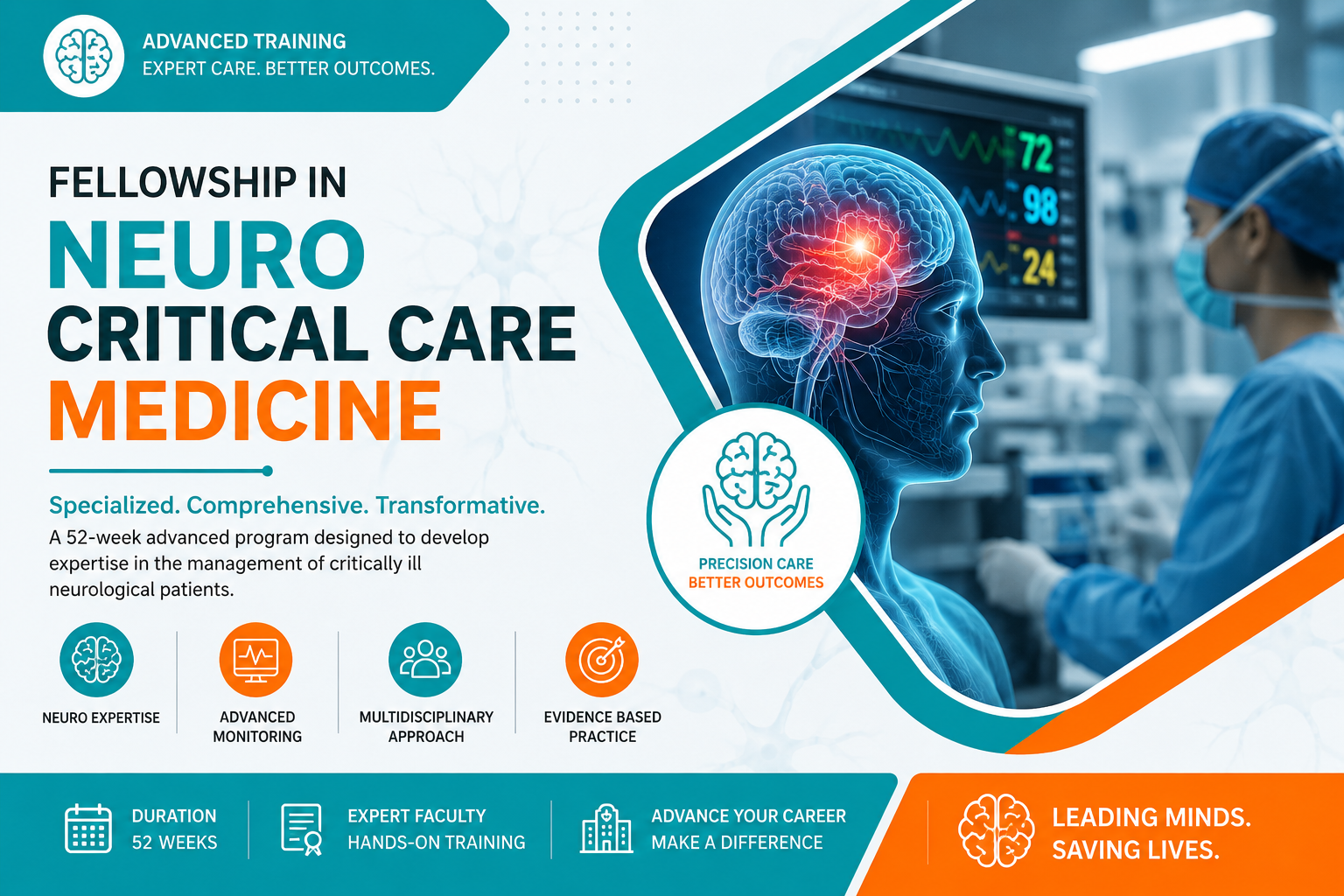

The Fellowship in Neuro Critical Care Medicine is a comprehensive 52-week advanced training program designed for healthcare professionals seeking expertise in the management of critically ill neurological patients. The curriculum covers neuroanatomy, neuromonitoring, stroke care, traumatic brain injury, seizures, CNS infections, neuromuscular emergencies, brain death determination, and advanced ICU management. Through evidence-based learning, clinical case discussions, and research-focused training, participants develop the specialized skills required to provide high-quality neurocritical care and improve patient outcomes in intensive care settings.
The Fellowship in Neuro Critical Care Medicine is a comprehensive 52-week advanced training program designed for physicians, intensivists, neurologists, anesthesiologists, emergency medicine specialists, and healthcare professionals seeking specialized expertise in the care of critically ill neurological patients. As neurological disorders such as stroke, traumatic brain injury, status epilepticus, intracranial hemorrhage, and neuromuscular respiratory failure continue to be major causes of mortality and disability worldwide, the demand for highly trained neurocritical care professionals is rapidly increasing.
This fellowship provides an in-depth understanding of the principles and practices of neurocritical care, integrating advanced neuroscience with critical care medicine. Participants will develop the knowledge and clinical skills required to assess, monitor, and manage patients with life-threatening neurological conditions in intensive care settings. The program emphasizes evidence-based practice, multidisciplinary collaboration, and patient-centered care to ensure optimal outcomes for complex neurological cases.
The curriculum begins with foundational concepts in neuroanatomy, neurophysiology, neurological examination, and critical care principles. Learners gain a strong understanding of cerebral circulation, intracranial dynamics, brain function, and neurological assessment techniques. Advanced training in neuromonitoring technologies, including intracranial pressure monitoring, cerebral perfusion assessment, electroencephalography (EEG), and multimodal monitoring, enables participants to make informed clinical decisions in high-acuity situations.
A major focus of the fellowship is the management of acute neurological emergencies. Participants learn contemporary approaches to ischemic stroke, including thrombolysis, mechanical thrombectomy, post-reperfusion care, and prevention of secondary brain injury. The program also covers intracerebral hemorrhage, subarachnoid hemorrhage, cerebral edema, hydrocephalus, and vasospasm management. Through case-based learning and clinical scenarios, learners gain practical expertise in managing these complex conditions in neuro intensive care units.
The fellowship provides extensive training in the management of traumatic brain injury (TBI), one of the most challenging areas of critical care medicine. Participants learn the principles of trauma assessment, neuroimaging interpretation, intracranial pressure control, sedation strategies, neurosurgical interventions, and rehabilitation planning. Emphasis is placed on reducing secondary neurological damage and improving long-term functional outcomes.
Specialized modules address seizure disorders, status epilepticus, and refractory neurological emergencies requiring continuous EEG monitoring and advanced therapeutic interventions. Learners also explore critical care approaches to central nervous system infections, including bacterial meningitis, viral encephalitis, neurotuberculosis, and fungal infections. Comprehensive instruction in antimicrobial stewardship and infection prevention ensures safe and effective patient management.
The program further examines neuromuscular and neuroimmunological emergencies such as Guillain-Barré syndrome, myasthenic crisis, autoimmune encephalitis, and demyelinating disorders. Participants gain expertise in respiratory support, immunotherapy, plasma exchange, and multidisciplinary care approaches necessary for managing these complex conditions.
Critical care support strategies form an integral component of the fellowship. Learners receive advanced training in airway management, mechanical ventilation, hemodynamic monitoring, fluid therapy, sedation, analgesia, and cardiovascular stabilization. The curriculum emphasizes maintaining cerebral perfusion and oxygenation while preventing complications associated with prolonged intensive care treatment.
Ethical and legal aspects of neurocritical care are also explored in depth. Participants learn standardized approaches to brain death determination, organ donation processes, end-of-life care discussions, and communication with patients’ families. These topics help clinicians navigate challenging clinical situations while maintaining professional and ethical standards.
In addition to clinical excellence, the fellowship promotes leadership, quality improvement, and research skills. Learners are introduced to clinical research methodology, critical appraisal of medical literature, healthcare quality initiatives, and emerging technologies in neurocritical care. Through research projects and case presentations, participants develop the ability to contribute to advancements in neurological intensive care practice.
Upon successful completion of the Fellowship in Neuro Critical Care Medicine, graduates will possess advanced competencies in diagnosing, monitoring, and managing critically ill neurological patients. They will be equipped to work in neuro intensive care units, tertiary care hospitals, academic medical centers, trauma centers, and specialized neurological care facilities. The fellowship serves as an excellent pathway for healthcare professionals seeking to enhance their expertise, improve patient outcomes, and advance their careers in the rapidly evolving field of neurocritical care medicine.
- 12 Sections
- 82 Lessons
- 52 Weeks
- Foundations of Neuro Critical Care MedicineThis module introduces learners to the principles, scope, and practice of neuro critical care medicine. Students will gain an understanding of neurological emergencies, intensive care unit (ICU) organization, patient safety, ethical considerations, multidisciplinary care, and evidence-based approaches used in managing critically ill neurological patients.7
- Neuroanatomy and Neurophysiology for Critical CareThis module provides a detailed review of neuroanatomy and neurophysiology relevant to critically ill neurological patients. Learners will understand the structure and function of the central and peripheral nervous systems and apply this knowledge to clinical decision-making in neurocritical care settings.5
- Neurological Examination and MonitoringThis module focuses on advanced neurological assessment techniques and monitoring technologies used in neurocritical care. Students will learn to interpret neurological findings and integrate monitoring data into patient management plans.7
- Airway, Ventilation, and Hemodynamic SupportThis module explores critical care interventions required for neurological patients, including airway management, mechanical ventilation, cardiovascular stabilization, and shock management. Special emphasis is placed on optimizing cerebral oxygenation and perfusion.7
- Acute Ischemic Stroke ManagementThis module covers the diagnosis, emergency treatment, and critical care management of acute ischemic stroke. Learners will understand reperfusion therapies, stroke unit protocols, and post-stroke intensive care management.7
- Hemorrhagic Stroke and Subarachnoid HemorrhageThis module focuses on the management of intracerebral hemorrhage and subarachnoid hemorrhage. Students will learn strategies for controlling bleeding, preventing complications, and optimizing neurological outcomes.7
- Traumatic Brain InjuryThis module provides comprehensive training in the assessment and management of traumatic brain injury (TBI). Learners will understand mechanisms of injury, neuroimaging interpretation, intracranial pressure control, and long-term outcomes.7
- Neurocritical Care in Seizures and Status EpilepticusThis module examines seizure emergencies and advanced management of status epilepticus. Students will learn diagnostic approaches, EEG interpretation, and treatment protocols for refractory seizures.7
- Central Nervous System InfectionsThis module addresses the diagnosis and management of severe neurological infections requiring intensive care. Learners will gain expertise in treating meningitis, encephalitis, brain abscesses, and related complications.7
- Neuromuscular Emergencies and NeuroimmunologyThis module focuses on critically ill patients with neuromuscular disorders and autoimmune neurological diseases. Students will learn diagnostic approaches and critical care interventions for respiratory and neurological deterioration.7
- Brain Death, Organ Donation, and Ethical PracticeThis module explores brain death determination, ethical decision-making, organ donation processes, and communication with patients' families. Emphasis is placed on legal frameworks and compassionate care.7
- Advanced Neurocritical Care Practice and ResearchThis final module integrates advanced clinical practice, leadership, quality improvement, and research methodologies. Learners will develop skills needed to lead neurocritical care teams and contribute to advancements in the specialty.7
You might be intersted in
-
167 Students
-
52 Weeks
-
132 Students
-
52 Weeks
-
124 Students
-
52 Weeks
-
123 Students
-
52 Weeks