
Fellowship in Behavioural Health
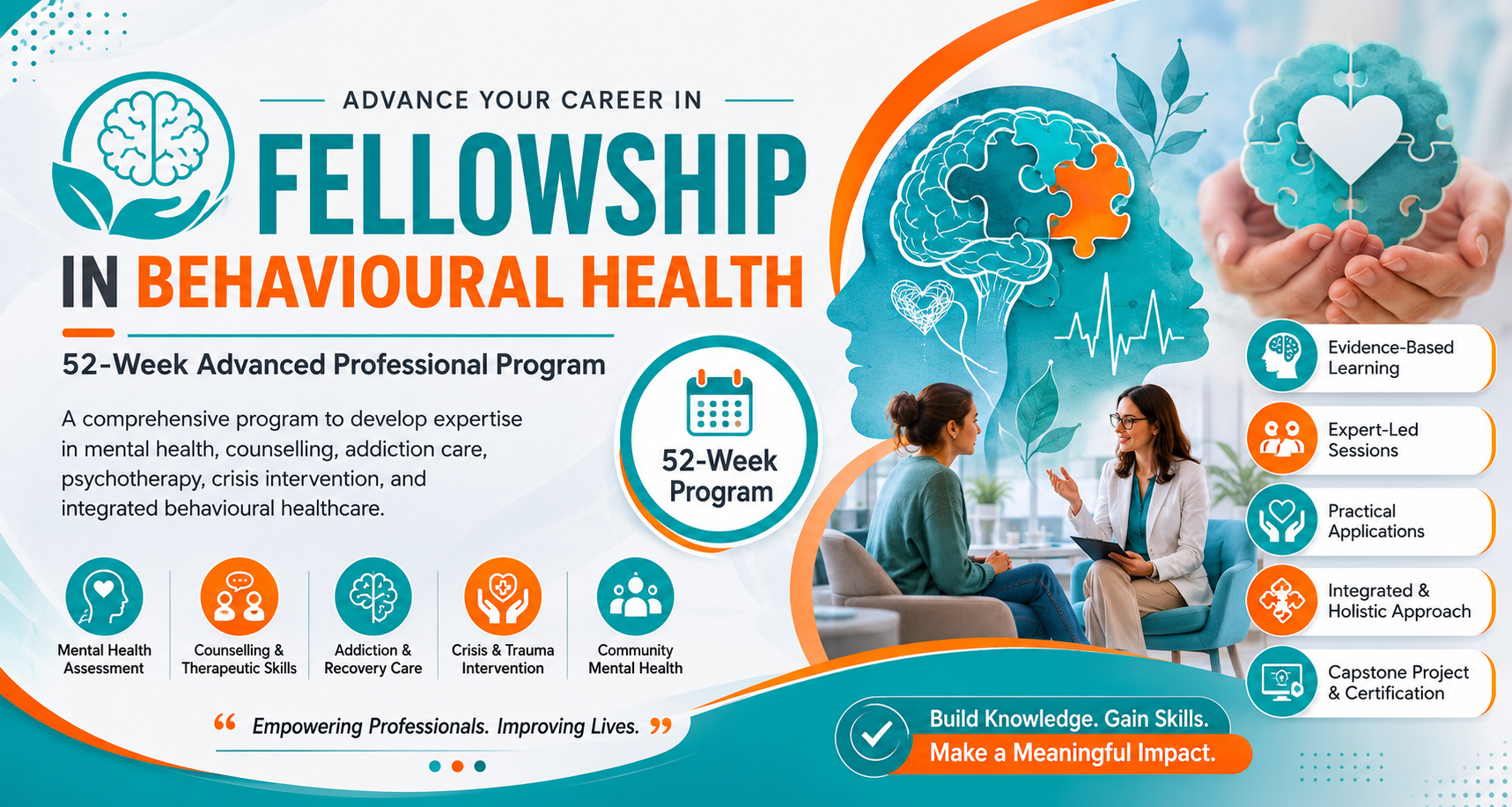

The Fellowship in Behavioural Health is a comprehensive 52-week advanced training program designed for healthcare professionals seeking expertise in mental health, behavioural sciences, counselling, addiction management, and psychosocial interventions. The curriculum covers psychological development, psychiatric assessment, therapeutic communication, evidence-based psychotherapies, crisis intervention, community mental health, and integrated behavioural healthcare. Participants will develop the knowledge and practical skills required to assess, manage, and support individuals with behavioural and mental health challenges across diverse clinical and community settings.
The Fellowship in Behavioural Health is a comprehensive 52-week advanced training program designed for healthcare professionals who wish to develop specialized expertise in mental health, behavioural sciences, counselling, psychological assessment, and evidence-based interventions. As mental health challenges continue to rise globally, there is an increasing need for healthcare providers who can effectively address behavioural, emotional, cognitive, and psychosocial issues across diverse populations.
This fellowship provides an interdisciplinary approach to understanding human behaviour and mental well-being, integrating knowledge from psychology, psychiatry, neuroscience, public health, and behavioural medicine. Participants will gain a thorough understanding of the biological, psychological, social, and environmental factors that influence behaviour and mental health outcomes.
The curriculum begins with foundational concepts in behavioural health, human development, and neurobiology, enabling learners to understand how behavioural patterns emerge and evolve throughout the lifespan. Participants will develop competencies in conducting comprehensive behavioural health assessments, mental status examinations, risk evaluations, and diagnostic processes using evidence-based frameworks.
A major focus of the program is the identification, assessment, and management of common and complex mental health conditions. Learners will explore anxiety disorders, depression, bipolar disorder, trauma-related conditions, psychotic disorders, personality disorders, and behavioural challenges affecting children, adolescents, adults, and older adults. Special emphasis is placed on recognizing early warning signs, understanding disease progression, and implementing appropriate intervention strategies.
The fellowship also provides in-depth training in counselling and psychotherapeutic approaches. Participants will learn therapeutic communication techniques, motivational interviewing, cognitive behavioural therapy principles, interpersonal interventions, family-centred approaches, and group-based therapeutic strategies. These skills enable healthcare professionals to establish effective therapeutic relationships and support patients in achieving positive behavioural and mental health outcomes.
Given the growing burden of substance use disorders and behavioural addictions, the program includes dedicated training in addiction science, assessment, treatment planning, relapse prevention, and recovery-oriented care. Learners will gain insight into evidence-based approaches for supporting individuals experiencing substance-related and behavioural health challenges.
Crisis management and trauma-informed care are integral components of behavioural health practice. The fellowship equips participants with practical skills to manage psychiatric emergencies, suicide risk, crisis intervention scenarios, psychological trauma, domestic violence situations, and acute behavioural health concerns while ensuring patient safety and dignity.
The program further explores the integration of behavioural health services within primary care, specialty healthcare, and community settings. Participants will understand collaborative care models, behavioural medicine principles, health behaviour change strategies, and approaches to addressing mental health needs within broader healthcare systems. Community-based mental health promotion, prevention programs, and public health initiatives are also covered to prepare learners for population-focused behavioural health practice.
Ethical, legal, and cultural considerations are emphasized throughout the fellowship. Learners will examine confidentiality, informed consent, patient rights, mental health legislation, professional ethics, and culturally competent care to ensure responsible and inclusive practice across diverse communities.
The final phase of the program focuses on research methodology, evidence-based practice, quality improvement, and professional development. Participants will critically evaluate scientific literature, apply research findings to clinical practice, and complete a capstone project that demonstrates their ability to address real-world behavioural health challenges through evidence-based solutions.
Upon successful completion of the Fellowship in Behavioural Health, participants will possess advanced knowledge and practical skills in behavioural assessment, mental health management, counselling, crisis intervention, addiction care, and integrated behavioural healthcare. Graduates will be well-prepared to contribute to hospitals, mental health centres, rehabilitation facilities, community health programs, educational institutions, corporate wellness initiatives, and multidisciplinary healthcare teams dedicated to improving psychological well-being and quality of life.
Learning Outcomes
By the end of this fellowship, participants will be able to:
- Understand the foundations and principles of behavioural health practice.
- Conduct comprehensive behavioural and mental health assessments.
- Recognize and manage common and complex mental health disorders.
- Apply evidence-based counselling and therapeutic communication techniques.
- Support individuals experiencing substance use and addictive behaviours.
- Implement crisis intervention and trauma-informed care strategies.
- Integrate behavioural health services within clinical and community settings.
- Promote mental wellness and preventive behavioural health initiatives.
- Address ethical, legal, and cultural considerations in behavioural health practice.
- Critically evaluate research and apply evidence-based approaches to patient care.
- Design and implement behavioural health improvement projects.
- Collaborate effectively within multidisciplinary healthcare teams.
Target Audience
This fellowship is ideal for:
- Medical Practitioners
- Physicians and General Practitioners
- Psychologists
- Psychiatrists
- Nurses and Nurse Practitioners
- Social Workers
- Counsellors and Therapists
- Public Health Professionals
- Allied Healthcare Professionals
- Rehabilitation Specialists
- Community Health Workers
- Healthcare Administrators interested in behavioural health services
Career Opportunities
Graduates may pursue roles such as:
- Behavioural Health Specialist
- Mental Health Practitioner
- Clinical Counsellor
- Behavioural Health Coordinator
- Addiction and Recovery Specialist
- Community Mental Health Professional
- Patient Support and Wellness Consultant
- Integrated Care Coordinator
- Healthcare Educator
- Mental Health Program Manager
- Behavioural Health Research Associate
- Public Health and Mental Wellness Consultant
This fellowship offers a strong foundation for healthcare professionals seeking to advance their expertise in behavioural health and contribute meaningfully to the promotion of mental wellness, prevention of behavioural disorders, and delivery of compassionate, evidence-based care.
- 16 Sections
- 96 Lessons
- 52 Weeks
- Foundations of Behavioural HealthThis module introduces learners to the principles and scope of behavioural health, emphasizing the relationship between mental health, emotional well-being, substance use, and physical health. Participants will explore the historical evolution of behavioural health, biopsychosocial models, determinants of mental health, and the role of healthcare professionals in promoting psychological wellness across diverse populations.6
- Human Behaviour and Psychological DevelopmentThis module examines human behaviour through developmental, cognitive, emotional, and social perspectives. Learners will understand how biological, psychological, and environmental factors influence behaviour from infancy through older adulthood.6
- Neurobiology of BehaviourThis module explores the neurobiological foundations of behaviour, including brain anatomy, neurotransmitters, neural pathways, and their influence on emotions, cognition, and behavioural responses. Participants will gain insight into the biological basis of mental health disorders.6
- Psychiatric Assessment and DiagnosisThis module focuses on comprehensive behavioural health assessment techniques, including interviewing skills, mental status examination, risk assessment, and diagnostic frameworks. Learners will develop competencies in identifying mental health conditions using evidence-based approaches.6
- Common Mental Health DisordersParticipants will study the epidemiology, clinical presentation, diagnosis, and management of common mental health disorders. Emphasis is placed on early recognition and interdisciplinary treatment approaches.6
- Severe and Persistent Mental IllnessThis module provides an in-depth understanding of serious psychiatric conditions, their impact on functioning, and long-term management strategies. Learners will explore recovery-oriented care and rehabilitation approaches.6
- Substance Use and Addictive BehavioursThis module addresses substance use disorders and behavioural addictions. Learners will understand risk factors, assessment methods, treatment options, relapse prevention, and harm-reduction strategies.6
- Counselling and Therapeutic CommunicationParticipants will develop essential counselling and communication skills for effective behavioural health practice. The module emphasizes empathy, active listening, rapport building, and patient-centered interactions.6
- Psychotherapeutic ApproachesThis module introduces evidence-based psychotherapies used in behavioural health. Learners will understand therapeutic models, indications, techniques, and outcome evaluation.6
- Child and Adolescent Behavioural HealthThis module focuses on mental health concerns affecting children and adolescents. Learners will explore developmental psychopathology, behavioural disorders, family dynamics, and school-based interventions.6
- Adult and Geriatric Behavioural HealthParticipants will study behavioural health issues affecting adults and older adults, including age-related psychological changes, chronic illness, dementia, and healthy aging strategies.6
- Crisis Intervention and Trauma CareThis module equips learners with skills to manage behavioural health emergencies and trauma-related conditions. Emphasis is placed on crisis stabilization, safety planning, and trauma-informed care.6
- Behavioural Health in Medical SettingsLearners will explore the integration of behavioural health within primary care and specialty healthcare settings. The module highlights collaborative care models and behavioural medicine approaches.6
- Community and Public Behavioural HealthThis module examines behavioural health from a population perspective, focusing on prevention, health promotion, community outreach, and reducing mental health disparities.6
- Legal, Ethical, and Cultural IssuesParticipants will study legal frameworks, ethical decision-making, cultural competence, patient rights, confidentiality, and advocacy in behavioural health practice.6
- Research, Evidence-Based Practice, and Capstone ProjectThe final module focuses on research methodology, critical appraisal of evidence, quality improvement, and application of knowledge through a behavioural health capstone project. Learners will demonstrate competencies acquired throughout the fellowship.6
You might be intersted in
-
132 Students
-
52 Weeks
-
124 Students
-
52 Weeks
-
133 Students
-
52 Weeks
-
94 Students
-
52 Weeks