Introduction
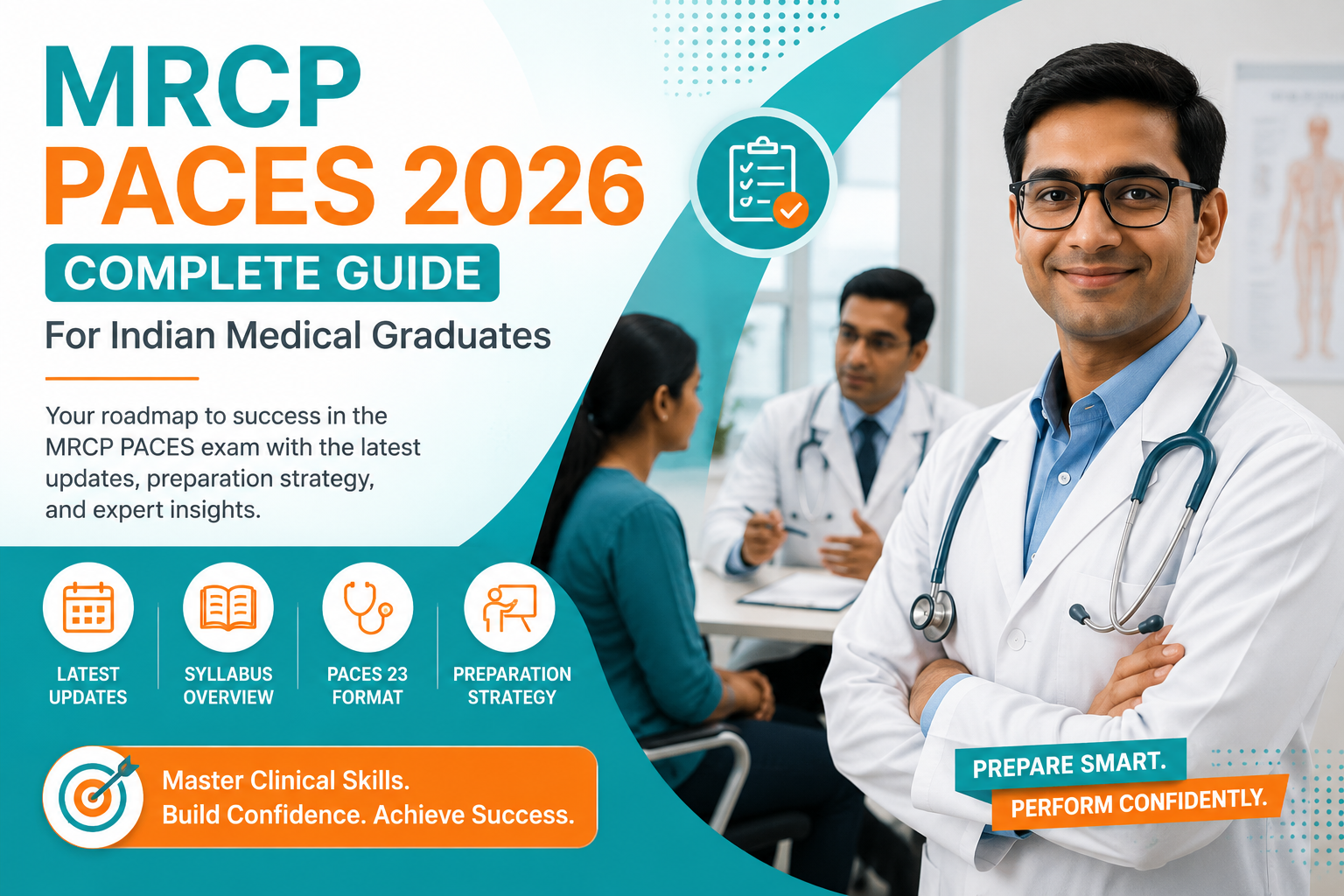
For Indian medical graduates, the MRCP PACES (Practical Assessment of Clinical Examination Skills) is often considered the most challenging stage of the MRCP journey. Unlike written examinations that mainly test theoretical knowledge, PACES evaluates how effectively a doctor performs in real clinical situations. Candidates are assessed on communication, bedside manners, clinical examination techniques, decision-making, and professionalism under pressure.
The updated PACES 23 format focuses more on real-world patient interaction and integrated clinical reasoning. Because of these changes, Indian doctors preparing for the exam need a clear strategy that combines medical knowledge with practical communication and examination skills.
This guide explains the latest PACES format, exam structure, preparation timeline, booking process, and the key skills required for success. Whether you are planning MRCP preparation after MBBS or comparing career pathways like MRCP vs PLAB, this article will help you understand the latest updates with confidence.
Why Is MRCP Highly Valued for Indian Doctors?
The MRCP (UK) qualification is recognized worldwide as a symbol of advanced clinical competence and professional excellence. In recent years, more Indian doctors have started choosing MRCP because it offers international career opportunities and strong clinical training standards.
Unlike many traditional postgraduate pathways, MRCP focuses heavily on evidence-based medicine, practical patient care, and structured clinical decision-making. Passing PACES demonstrates that a doctor can work at standards comparable to UK medical trainees.
For Indian doctors, MRCP can provide several career advantages:
- Opportunities for consultant and specialist positions in leading hospital groups such as Apollo Hospitals, Fortis Healthcare, and Max Healthcare
- A smoother pathway toward registration with the General Medical Council for doctors planning to work in the UK
- Better recognition in private healthcare systems that value international qualifications
- Access to global teaching, research, and academic opportunities
Today, MRCP is viewed not only as an examination but also as a long-term career investment for doctors seeking international exposure and structured clinical growth.
Understanding PACES 23: The New Examination Format
The PACES examination has evolved significantly in recent years. The updated PACES 23 structure focuses more on integrated clinical consultations rather than isolated examination tasks.
Candidates are now expected to behave like senior medical trainees managing real patient encounters. Examiners assess clinical reasoning, communication, professionalism, patient safety, and time management together.
PACES 23 Station Breakdown
Station 1
- Communication (10 minutes)
- Respiratory Examination (10 minutes)
Station 2
- Clinical Consultation (20 minutes)
Station 3
- Cardiovascular Examination (10 minutes)
- Abdominal Examination (10 minutes)
Station 4
- Communication Skills (10 minutes)
- Neurology Examination (10 minutes)
Station 5
- Clinical Consultation (20 minutes)
The major change is the addition of longer consultation-based stations. Candidates must now combine:
- History taking
- Focused clinical examination
- Diagnostic reasoning
- Management planning
- Communication with empathy and professionalism
This means rote memorization alone is no longer enough. Doctors must demonstrate safe and patient-centered clinical thinking in real time.
Mastering 7 Core Clinical Skills
PACES assesses seven integrated skills across all stations. You must consistently demonstrate competence across them to pass.
| Skill | Focus Area |
| Skill A | Physical examination – accuracy and fluency |
| Skill B | Eliciting clinical signs |
| Skill C | Clinical diagnosis |
| Skill D | Clinical management planning |
| Skill E | Communication skills |
| Skill F | Differential diagnosis reasoning |
| Skill G | Patient welfare and professionalism |
A key insight: candidates often fail not due to knowledge gaps, but because communication or professionalism is inconsistent.
Eligibility and Booking Challenges for Indian Candidates
To appear for PACES, candidates must first clear MRCP Part 1 within the allowed eligibility period. Many mentors also recommend completing Part 2 written before attempting PACES because strong theoretical knowledge improves confidence during clinical discussions.
Booking Challenges in India
India has several PACES centers, including:
- Chennai
- Delhi
- Kolkata
- Mumbai
- Kochi
- Pune
However, available seats are limited and competition is extremely high.
Practical Booking Tips
- Keep your Royal College profile updated before booking opens
- Monitor official announcements regularly
- Register immediately once applications go live
- Consider nearby international centers if Indian seats fill quickly
Proper planning reduces stress and allows candidates to focus on preparation rather than logistics.
Phase-by-Phase PACES Preparation Strategy
Success in PACES depends on consistent bedside practice rather than last-minute studying. A structured six-month plan can help candidates build confidence gradually.
Phase 1: Foundation Stage (Months 1–2)
During the first phase, focus on mastering examination techniques until they become natural and automatic.
Key Goals
- Practice system examinations daily
- Develop a consistent examination sequence
- Improve fluency in presenting findings
- Build confidence in basic clinical communication
Important systems to practice include:
- Cardiovascular examination
- Respiratory examination
- Neurological examination
- Abdominal examination
When examination routines become automatic, candidates can focus more effectively on clinical reasoning during the exam.
Phase 2: Exposure to Clinical Pathology (Months 3–4)
This stage focuses on improving bedside recognition skills and clinical presentation techniques.
Areas to Focus On
Seek exposure to patients with:
- Valvular heart disease
- Rheumatoid arthritis
- Cranial nerve palsies
- Chronic kidney disease
- Neuromuscular disorders
Practice Goals
- Present cases in concise Royal College style
- Practice identifying clinical signs quickly
- Use mock mark sheets during peer practice
- Simulate timed stations regularly
This phase transforms theoretical knowledge into practical bedside confidence.
Phase 3: Polish and Performance (Months 5–6)
The final stage focuses heavily on communication, professionalism, and consultation skills.
Key Areas to Practice
- Explaining diagnoses in simple language
- Shared decision-making
- Managing difficult conversations calmly
- Simulating full PACES stations repeatedly
- Maintaining professional body language
Remember, PACES rewards safe and organized doctors more than candidates who simply recite textbook information.
The Communication Gap for Indian Candidates
Many Indian doctors possess excellent medical knowledge but struggle during PACES because communication expectations in the UK healthcare system differ from common clinical practices in India.
Common Challenges
- Using excessive medical terminology
- Speaking mainly to relatives instead of patients
- Limited focus on patient autonomy
- Inadequate explanation of procedures and consent
Essential Communication Skills
Candidates should practice:
- Explaining investigations clearly
- Taking informed consent properly
- Breaking bad news empathetically
- Asking permission before examination
- Respecting patient privacy and dignity
In PACES, communication is directly linked to patient safety and professionalism.
Why Structured Clinical Training Improves PACES Success
Although self-study can help build knowledge, structured clinical mentoring often improves performance significantly.
Hospital-based training programs provide:
- Exposure to real patients and clinical signs
- Supervised bedside teaching
- Communication-focused feedback
- Regular mock PACES examinations
- Guidance from experienced MRCP-qualified clinicians
Programs such as Texila American University offer clinical training pathways specifically designed for international doctors preparing for PACES.
These structured programs can help candidates develop confidence in:
- Clinical consultation stations
- Bedside presentation skills
- Professional communication
- Real-time clinical reasoning
For many candidates, guided mentorship shortens the learning curve considerably.
Conclusion: Your Journey Toward Global Clinical Practice
MRCP PACES is more than an examination. It represents the transition from theoretical medicine to internationally recognized clinical practice.
For Indian doctors, success in PACES requires a combination of:
- Strong clinical knowledge
- Consistent bedside practice
- Effective communication
- Structured preparation
- Confidence under pressure
With the right strategy, disciplined preparation, and proper mentorship, PACES can become an achievable milestone rather than a stressful barrier.
The key to success lies in continuous practice, patient-centered communication, and developing the mindset of a safe and confident physician ready for global healthcare standards.
Frequently Asked Questions (FAQs)
Is MRCP recognized in India?
Yes, MRCP is highly respected in India, especially in corporate hospitals and private healthcare institutions.
Can I attempt PACES after MBBS?
Candidates must first clear MRCP Part 1 before becoming eligible for PACES.
Is PACES difficult for Indian doctors?
PACES can be challenging because it focuses heavily on communication and practical clinical skills. However, proper preparation significantly improves success rates.
How long should I prepare for PACES?
Most candidates benefit from a structured preparation period of around six months.
Is structured coaching necessary for PACES?
Not mandatory, but structured hospital-based training and mock practice often improve confidence and exam performance considerably.