
Fellowship in Preventive Oncology
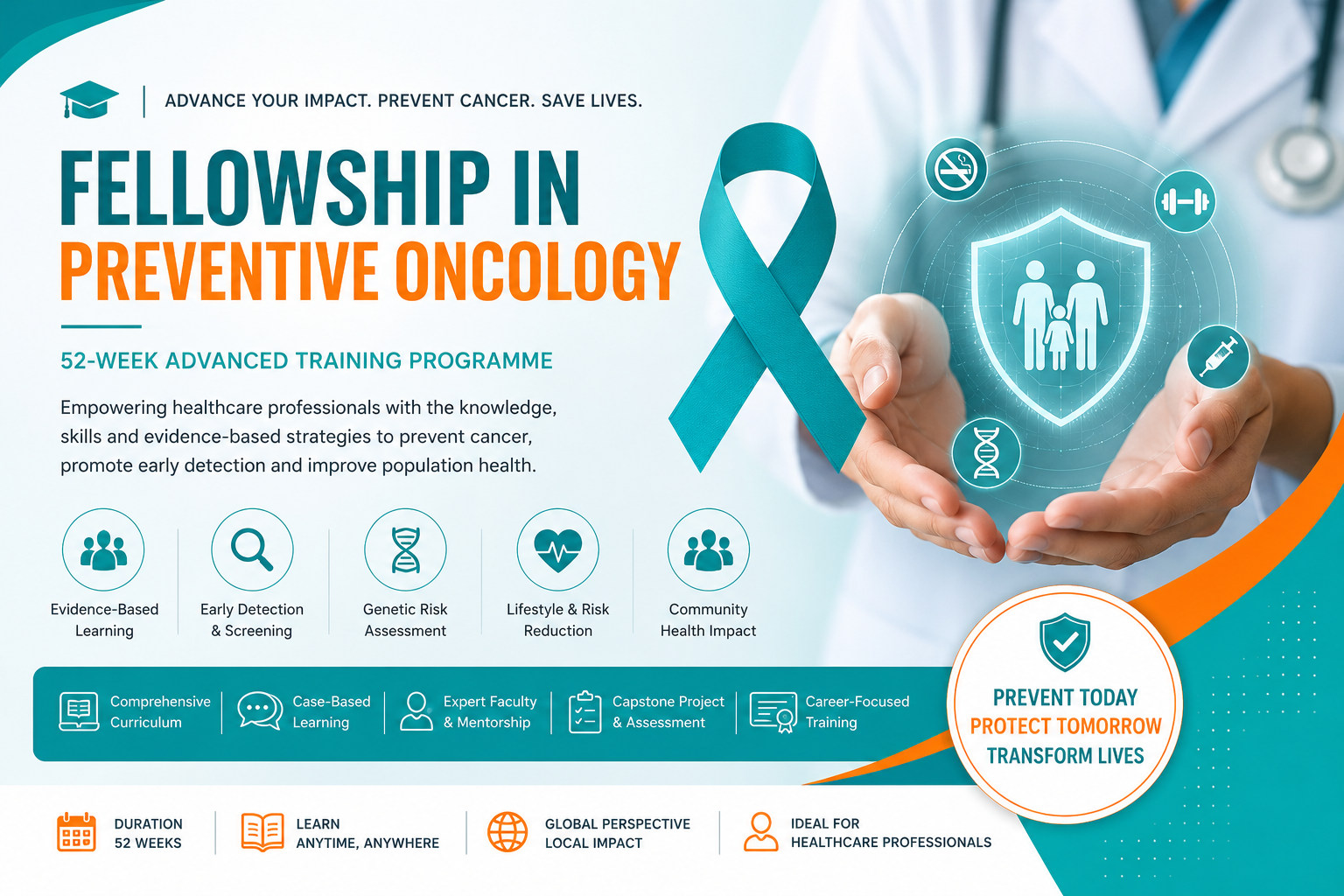

The Fellowship in Preventive Oncology is a comprehensive 52-week programme designed to equip healthcare professionals with advanced knowledge and practical skills in cancer prevention, early detection, risk assessment, screening, genetic counselling, lifestyle modification, and community-based cancer control. The curriculum integrates evidence-based preventive strategies, public health principles, and emerging technologies to prepare learners for leadership roles in reducing the global burden of cancer through proactive and patient-centred care.
The Fellowship in Preventive Oncology is a comprehensive 52-week advanced training programme designed for healthcare professionals who aspire to play a pivotal role in reducing the global burden of cancer through prevention, early detection, risk assessment, and public health interventions. With cancer incidence continuing to rise worldwide, there is an increasing demand for clinicians who possess specialised expertise in identifying risk factors, implementing evidence-based preventive strategies, and promoting early diagnosis to improve patient outcomes.
This fellowship provides an in-depth understanding of cancer epidemiology, carcinogenesis, genetics, lifestyle medicine, environmental and occupational risk factors, and community-based prevention programmes. Learners will develop the knowledge and practical skills required to identify individuals at high risk, provide personalised preventive counselling, recommend appropriate screening protocols, and contribute to multidisciplinary cancer prevention initiatives.
The curriculum combines theoretical learning with case-based discussions, clinical applications, research methodology, and public health approaches. Participants will explore the latest advances in cancer screening, genetic counselling, vaccination programmes, biomarker-based risk assessment, artificial intelligence in oncology, and precision prevention strategies. Special emphasis is placed on evidence-based practice, enabling learners to integrate current clinical guidelines into routine patient care.
Throughout the programme, participants will gain expertise in preventing common cancers, including breast, cervical, colorectal, lung, prostate, liver, and oral cancers. They will also learn the importance of nutrition, physical activity, smoking cessation, alcohol reduction, infection control, occupational safety, and environmental health in lowering cancer risk. The fellowship further highlights preventive oncology across different age groups and high-risk populations, ensuring a holistic and patient-centred approach.
The programme also focuses on community oncology and public health, preparing healthcare professionals to design and implement cancer awareness campaigns, population screening initiatives, vaccination programmes, and health promotion activities. Learners will understand national and international cancer prevention guidelines while developing leadership and communication skills required for multidisciplinary collaboration.
Research forms an integral component of the fellowship. Participants will learn research methodology, biostatistics, evidence appraisal, and quality improvement techniques to contribute effectively to preventive oncology research and clinical innovation. Exposure to emerging technologies, including molecular diagnostics, genomics, digital health, and artificial intelligence, ensures graduates remain prepared for the evolving landscape of cancer prevention.
By the end of the fellowship, learners will be proficient in conducting comprehensive cancer risk assessments, interpreting screening recommendations, counselling patients and families, implementing preventive interventions, and supporting healthcare systems in delivering high-quality cancer prevention services. Graduates will be equipped to work in hospitals, oncology centres, preventive health clinics, primary care settings, public health organisations, academic institutions, and research centres.
Programme Highlights
- 52-week comprehensive fellowship in Preventive Oncology
- Advanced curriculum aligned with current oncology and public health practices
- Comprehensive training in cancer epidemiology and carcinogenesis
- Evidence-based cancer prevention and risk reduction strategies
- Cancer screening and early detection protocols
- Hereditary cancer syndromes and genetic counselling
- Lifestyle medicine for cancer prevention
- HPV and Hepatitis B vaccination strategies
- Occupational and environmental cancer prevention
- Prevention of breast, cervical, colorectal, prostate, lung, liver, and oral cancers
- Public health approaches to cancer control
- Community outreach and cancer awareness programme planning
- Research methodology and evidence-based practice
- Introduction to artificial intelligence and precision prevention in oncology
- Case-based discussions and clinical applications
- Capstone project with practical implementation
Learning Outcomes
Upon successful completion of the programme, learners will be able to:
- Understand the biological mechanisms of cancer development and prevention.
- Identify modifiable and non-modifiable cancer risk factors.
- Conduct comprehensive cancer risk assessments.
- Recommend appropriate screening and early detection strategies.
- Provide effective patient counselling on lifestyle modifications.
- Interpret genetic risk and support hereditary cancer counselling.
- Promote vaccination and infection control measures to reduce cancer risk.
- Develop community-based cancer prevention initiatives.
- Apply evidence-based clinical guidelines in preventive oncology.
- Design and evaluate cancer prevention programmes.
- Critically appraise research and integrate emerging technologies into practice.
- Collaborate effectively within multidisciplinary oncology teams.
Who Should Enrol?
This fellowship is suitable for:
- Medical graduates (MBBS or equivalent)
- General physicians
- Oncologists and oncology trainees
- Family medicine practitioners
- Internal medicine specialists
- Community medicine and public health professionals
- Preventive medicine specialists
- Gynaecologists
- Surgeons involved in cancer care
- Nursing professionals in oncology and preventive care
- Allied healthcare professionals involved in cancer prevention
- Researchers interested in oncology and public health
Career Opportunities
Graduates of the Fellowship in Preventive Oncology can pursue roles such as:
- Preventive Oncology Specialist
- Cancer Prevention Physician
- Oncology Screening Programme Coordinator
- Public Health Oncology Consultant
- Cancer Risk Assessment Specialist
- Genetic Counselling Support Professional
- Community Oncology Programme Manager
- Clinical Research Associate in Oncology
- Academic Faculty in Preventive Oncology
- Healthcare Quality and Cancer Prevention Consultant
The Fellowship in Preventive Oncology empowers healthcare professionals with the advanced knowledge, clinical expertise, and leadership skills needed to drive cancer prevention initiatives. By combining preventive medicine, public health, genetics, screening, lifestyle intervention, and research, this programme prepares graduates to make a meaningful impact in reducing cancer incidence and improving population health through proactive, evidence-based care.
- 12 Sections
- 72 Lessons
- 52 Weeks
- Foundations of Preventive OncologyThis module introduces learners to the principles of preventive oncology, including the global burden of cancer, cancer epidemiology, risk factors, and the importance of prevention across the continuum of care. Participants will gain an understanding of cancer biology, carcinogenesis, levels of prevention, and the role of healthcare professionals in reducing cancer incidence through evidence-based preventive strategies.6
- Cancer Risk Factors and Prevention StrategiesThis module focuses on modifiable and non-modifiable cancer risk factors. Learners will explore lifestyle, environmental, occupational, infectious, and hereditary contributors to cancer development while learning evidence-based interventions to reduce cancer risk through behavioural and medical approaches.6
- Genetics and Hereditary Cancer SyndromesThis module provides comprehensive knowledge of hereditary cancers, genetic counselling, and molecular diagnostics. Participants will understand genetic susceptibility, screening recommendations for high-risk populations, and ethical aspects of genetic testing in preventive oncology.6
- Cancer Screening and Early DetectionThis module covers evidence-based cancer screening programs and early detection methods. Learners will understand screening guidelines, diagnostic pathways, and interpretation of screening results for common cancers while appreciating the benefits and limitations of population-based screening.6
- Preventive Vaccination and Infection ControlThis module explores the role of vaccination and infection prevention in reducing cancer incidence. Participants will learn about HPV, Hepatitis B, and other oncogenic infections, vaccination strategies, and public health interventions.6
- Lifestyle Medicine in Cancer PreventionThis module emphasizes lifestyle interventions that significantly reduce cancer risk. Learners will develop skills to counsel individuals regarding healthy nutrition, exercise, stress management, weight control, and cessation of harmful habits.6
- Occupational and Environmental OncologyThis module examines environmental pollutants, occupational hazards, radiation exposure, and industrial carcinogens. Participants will learn workplace safety standards and preventive strategies to minimise carcinogenic exposure.6
- Women's Cancer PreventionThis module focuses on prevention and early detection of cancers affecting women. Learners will understand risk assessment, screening recommendations, hormonal influences, and preventive strategies for breast, cervical, ovarian, and endometrial cancers.6
- Men's Cancer PreventionThis module addresses preventive strategies for cancers commonly affecting men. Participants will explore prostate, testicular, and colorectal cancer prevention through screening, lifestyle interventions, and risk stratification.6
- Community Oncology and Health PromotionThis module equips learners with the skills to design and implement community-based cancer prevention initiatives. Topics include health education, behavioural change communication, awareness campaigns, and policy advocacy.6
- Research, Evidence-Based Practice, and Emerging TechnologiesThis module develops research competencies relevant to preventive oncology. Learners will critically appraise scientific literature, understand clinical trials, biomarkers, artificial intelligence applications, and emerging technologies supporting early detection and prevention.6
- Clinical Practice, Leadership, and Capstone ProjectThe final module integrates theoretical knowledge with practical application through supervised clinical exposure, multidisciplinary collaboration, quality improvement initiatives, leadership development, and a capstone project focused on preventive oncology practice.6
You might be intersted in
-
0 Students
-
52 Weeks
-
133 Students
-
52 Weeks
-
129 Students
-
52 Weeks
-
184 Students
-
52 Weeks