
Fellowship in Preventive and Noninvasive Cardiology
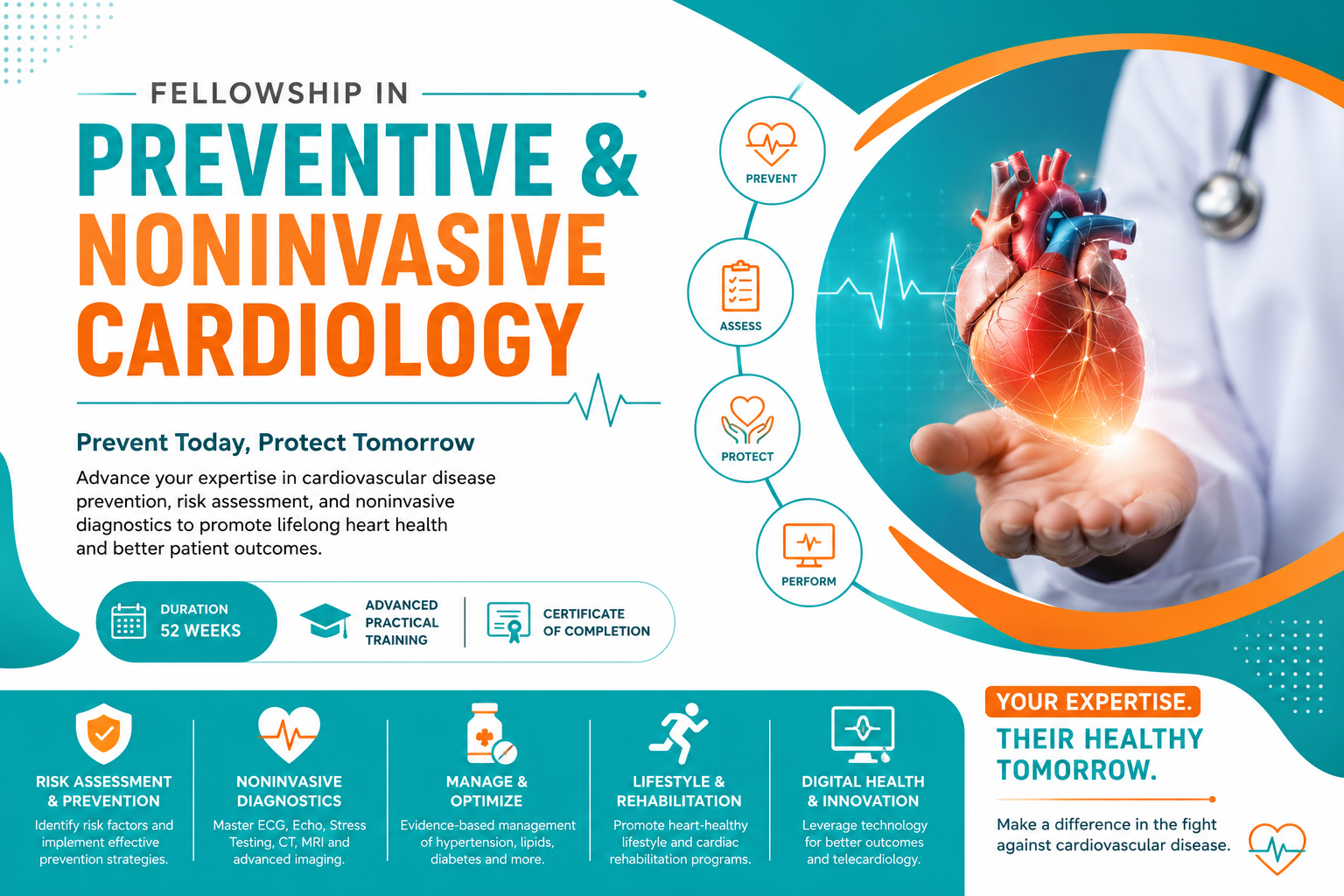

The Fellowship in Preventive and Noninvasive Cardiology is a comprehensive 52-week program designed to equip healthcare professionals with advanced knowledge and practical skills in cardiovascular disease prevention, risk assessment, lifestyle medicine, noninvasive cardiac diagnostics, echocardiography, ECG interpretation, cardiac imaging, and preventive pharmacology. The course emphasizes evidence-based clinical practice, early detection, patient-centred care, and modern preventive strategies to reduce cardiovascular morbidity and improve long-term heart health outcomes.
Fellowship in Preventive & Noninvasive Cardiology
Cardiovascular diseases (CVDs) remain the leading cause of mortality worldwide, making prevention and early diagnosis essential components of modern healthcare. The Fellowship in Preventive & Noninvasive Cardiology is a comprehensive 52-week advanced training program designed to equip physicians and healthcare professionals with the knowledge and clinical skills required to prevent, detect, assess, and manage cardiovascular diseases using evidence-based preventive strategies and state-of-the-art noninvasive diagnostic techniques.
This fellowship provides an in-depth understanding of cardiovascular risk assessment, lifestyle modification, preventive pharmacology, hypertension management, lipid disorders, diabetes-related cardiovascular disease, and comprehensive cardiac rehabilitation. Participants will also gain expertise in interpreting electrocardiograms (ECGs), ambulatory rhythm monitoring, echocardiography, stress testing, cardiac CT, cardiac MRI, coronary artery calcium scoring, and other advanced noninvasive imaging modalities that play a crucial role in early diagnosis and patient management.
The curriculum combines theoretical learning with practical clinical applications, enabling learners to confidently evaluate cardiovascular risk, develop individualized prevention plans, and interpret noninvasive cardiac investigations in accordance with current international guidelines. The program also explores emerging technologies such as wearable cardiac devices, digital health, artificial intelligence in cardiology, and telecardiology, preparing participants for the evolving landscape of cardiovascular care.
Throughout the fellowship, learners will strengthen their clinical decision-making abilities through case-based discussions, evidence-based practice, and multidisciplinary approaches to patient management. Special emphasis is placed on reducing cardiovascular morbidity and mortality through timely intervention, patient education, behavioural modification, and comprehensive preventive care.
Upon successful completion, graduates will possess the competencies needed to establish preventive cardiology clinics, contribute to multidisciplinary cardiovascular teams, and improve patient outcomes through early diagnosis, risk reduction, and noninvasive cardiovascular assessment.
Course Highlights
- 52-week comprehensive fellowship program
- Evidence-based curriculum aligned with current international cardiology guidelines
- Advanced cardiovascular risk assessment and prevention strategies
- Training in ECG interpretation and ambulatory rhythm monitoring
- Fundamentals of transthoracic and stress echocardiography
- Cardiac CT, cardiac MRI, coronary calcium scoring, and vascular imaging
- Lifestyle medicine and cardiovascular disease prevention
- Hypertension, dyslipidaemia, diabetes, and cardiometabolic risk management
- Cardiac rehabilitation principles and exercise prescription
- Patient counselling and preventive healthcare strategies
- Digital health, wearable technologies, and telecardiology
- Clinical case discussions and capstone project
- Final assessment and certification
Learning Outcomes
By the end of this fellowship, participants will be able to:
- Understand the epidemiology and pathophysiology of cardiovascular diseases.
- Perform comprehensive cardiovascular risk assessment using validated tools.
- Develop personalised prevention and treatment strategies.
- Interpret electrocardiograms and ambulatory cardiac monitoring reports.
- Perform systematic interpretation of echocardiographic findings.
- Understand indications and clinical applications of cardiac CT and cardiac MRI.
- Manage hypertension, dyslipidaemia, diabetes, obesity, and metabolic syndrome according to evidence-based guidelines.
- Prescribe lifestyle interventions including nutrition, exercise, smoking cessation, and weight management.
- Apply preventive pharmacology in cardiovascular disease prevention.
- Design comprehensive cardiac rehabilitation programmes.
- Utilise digital health technologies and wearable cardiac monitoring devices.
- Practice evidence-based preventive cardiology in clinical settings.
Who Should Enrol?
This fellowship is ideal for:
- MBBS Doctors
- MD/DNB General Medicine Physicians
- Cardiologists
- Internal Medicine Specialists
- Family Physicians
- General Practitioners
- Preventive Medicine Specialists
- Emergency Physicians
- Critical Care Physicians
- Medical Officers
- Healthcare Professionals involved in cardiovascular care
- Physicians seeking advanced training in preventive cardiology
Career Opportunities
Graduates of this fellowship can pursue careers as:
- Preventive Cardiologist
- Noninvasive Cardiology Specialist
- Consultant Physician
- Cardiovascular Risk Assessment Specialist
- Cardiac Rehabilitation Physician
- Lifestyle Medicine Consultant
- Preventive Health Consultant
- Clinical Research Associate in Cardiology
- Hospital Consultant
- Academic Faculty
- Corporate Wellness Physician
- Telecardiology Consultant
Skills You Will Gain
- Cardiovascular risk stratification
- ECG interpretation
- Echocardiography fundamentals
- Cardiac imaging interpretation
- Preventive pharmacology
- Lifestyle medicine counselling
- Hypertension management
- Lipid management
- Diabetes and cardiometabolic care
- Cardiac rehabilitation planning
- Clinical decision-making
- Evidence-based cardiovascular care
- Patient education and counselling
- Digital cardiology applications
- Research methodology and clinical audit
Why Choose This Fellowship?
The Fellowship in Preventive & Noninvasive Cardiology bridges the gap between early disease detection and effective cardiovascular prevention. With increasing emphasis on preventive healthcare, this programme equips clinicians with practical expertise in risk assessment, advanced noninvasive diagnostics, lifestyle intervention, and evidence-based management. Its comprehensive curriculum, focused on real-world clinical practice and emerging technologies, prepares healthcare professionals to deliver high-quality, patient-centred cardiovascular care while contributing to the reduction of heart disease burden in diverse healthcare settings.
- 12 Sections
- 74 Lessons
- 52 Weeks
- Foundations of Preventive and Noninvasive CardiologyThis module introduces the principles of cardiovascular disease prevention and the role of noninvasive cardiology in modern clinical practice. Learners will understand the epidemiology of cardiovascular diseases, risk factors, preventive strategies, evidence-based guidelines, and the importance of early diagnosis using noninvasive techniques.6
- Cardiovascular Anatomy, Physiology and PathophysiologyThis module provides a comprehensive understanding of cardiac anatomy, coronary circulation, electrophysiology, and cardiovascular physiology. Learners will explore mechanisms of cardiovascular diseases including atherosclerosis, hypertension, heart failure, and arrhythmias.7
- Cardiovascular Risk AssessmentThis module focuses on identifying cardiovascular risk through clinical assessment, biomarkers, imaging, and validated risk prediction tools. Learners will gain expertise in individualized cardiovascular risk stratification.6
- Lifestyle Medicine in Cardiovascular PreventionThis module emphasizes lifestyle interventions that significantly reduce cardiovascular risk. Participants will learn dietary counselling, exercise prescription, smoking cessation, stress management, sleep optimization, and weight management strategies.6
- Hypertension and Vascular PreventionThis module covers diagnosis, evaluation, and management of hypertension along with vascular health preservation. Learners will understand evidence-based treatment protocols and prevention of hypertension-related complications.6
- Dyslipidemia and Preventive PharmacologyThis module discusses lipid disorders, pharmacological therapies, and preventive medications used to reduce cardiovascular risk. Learners will understand individualized lipid management according to current international guidelines.6
- Diabetes and Cardiometabolic HealthThis module explores the close relationship between diabetes, obesity, metabolic syndrome, and cardiovascular disease. Learners will develop competency in integrated cardiometabolic risk reduction.6
- Electrocardiography and Cardiac Rhythm AssessmentThis module develops competency in ECG interpretation and rhythm analysis. Learners will identify normal and abnormal findings associated with ischemia, arrhythmias, and structural heart disease.6
- Echocardiography and Cardiac UltrasoundThis module introduces transthoracic and stress echocardiography as essential noninvasive diagnostic tools. Learners will understand chamber assessment, ventricular function, valvular disease, and hemodynamic evaluation.6
- Advanced Noninvasive Cardiac ImagingThis module covers advanced imaging techniques including CT coronary angiography, cardiac MRI, nuclear cardiology, and vascular imaging for diagnosis and risk stratification.7
- Prevention of Common Cardiovascular DiseasesThis module focuses on prevention and early detection of coronary artery disease, heart failure, atrial fibrillation, stroke, peripheral arterial disease, and valvular heart disease.6
- Cardiac Rehabilitation, Research and Clinical PracticeThe final module integrates preventive cardiology into clinical practice through cardiac rehabilitation, patient education, quality improvement, digital health, and research methodology. Learners will complete case discussions and a capstone project demonstrating comprehensive knowledge in preventive and noninvasive cardiology.6
You might be intersted in
-
0 Students
-
52 Weeks
-
129 Students
-
52 Weeks
-
139 Students
-
52 Weeks
-
184 Students
-
52 Weeks