
Fellowship in Anorectal & Proctology
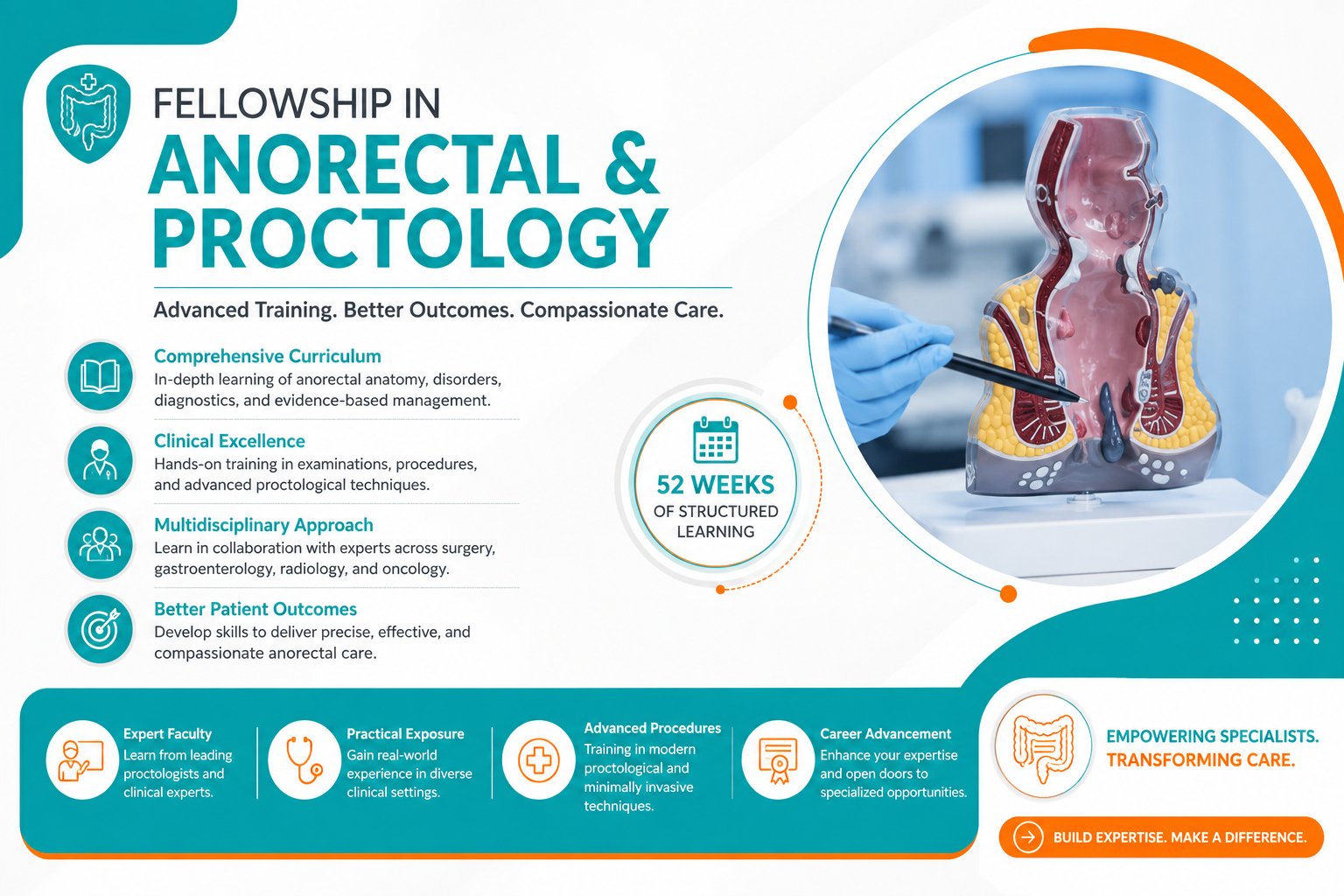

The Fellowship in Anorectal & Proctology is a comprehensive 52-week program designed to develop advanced knowledge and clinical skills in diagnosing and managing anorectal disorders, including hemorrhoids, anal fissures, fistulas, abscesses, constipation, fecal incontinence, rectal prolapse, and anorectal cancers.
The Fellowship in Anorectal & Proctology is a comprehensive 52-week advanced clinical training program designed for medical professionals who want to develop specialized knowledge and practical expertise in the diagnosis, evaluation, and management of anorectal and proctological disorders. The program provides a structured learning pathway covering fundamental anatomy and physiology, clinical examination, diagnostic investigations, conservative treatment, office-based procedures, surgical principles, postoperative care, and complex case management.
Throughout the fellowship, learners explore common and advanced anorectal conditions including hemorrhoids, anal fissures, perianal and anorectal abscesses, anal fistulas, pilonidal disease, constipation, fecal incontinence, rectal prolapse, pelvic floor disorders, inflammatory and infectious proctitis, anorectal trauma, and anorectal neoplasms. The curriculum emphasizes systematic clinical assessment, appropriate differential diagnosis, investigation selection, evidence-based treatment planning, and recognition of conditions requiring specialist or multidisciplinary intervention.
A strong focus is placed on clinical proctological examination, including perianal inspection, digital rectal examination, anoscopy, proctoscopy, and interpretation of relevant investigations. Learners are introduced to diagnostic modalities such as anorectal manometry, endoanal ultrasound, MRI, CT, defecography, colonoscopy, biopsy, and histopathological assessment, helping them understand how diagnostic findings influence clinical decision-making.
The fellowship also covers the principles of managing hemorrhoidal disease and anal fissures, including lifestyle modification, medical therapy, office-based interventions, botulinum toxin treatment, and surgical approaches. Advanced modules address anorectal abscesses and fistulas, including fistula classification, imaging, drainage principles, seton techniques, fistulotomy, sphincter-preserving approaches, recurrent fistula management, and postoperative care.
Learners will also gain an understanding of functional anorectal disorders, including chronic constipation, obstructed defecation, pelvic floor dysfunction, and fecal incontinence. The program explores dietary and pharmacological management, pelvic floor rehabilitation, biofeedback, anorectal manometry, sphincter repair, and advanced treatment options. Rectal prolapse and related pelvic floor disorders are addressed through clinical evaluation, imaging, conservative management, and surgical principles.
The program further introduces learners to infectious and inflammatory anorectal disorders, including infectious proctitis, sexually transmitted anorectal infections, inflammatory bowel disease-associated perianal disease, Crohn’s-related fistulizing disease, and ulcerative proctitis. Special attention is given to identifying red-flag symptoms and suspicious lesions that may indicate anorectal malignancy, with coverage of biopsy, staging, multidisciplinary cancer management, and follow-up.
An important component of the fellowship is perioperative and procedural care. Learners study patient selection, preoperative assessment, anesthesia considerations, infection prevention, pain management, wound care, postoperative bleeding, urinary retention, infection, and other potential complications. The curriculum also introduces advanced proctological procedures and emphasizes appropriate patient selection, procedural safety, complication recognition, and postoperative monitoring.
The fellowship incorporates pediatric and geriatric proctology, providing an understanding of age-specific anorectal conditions and individualized treatment considerations. Learners also explore multidisciplinary collaboration with colorectal surgery, gastroenterology, radiology, pathology, gynecology, urology, oncology, and pelvic floor rehabilitation specialists.
Case-based learning forms an important part of the program. Participants work through common and complex clinical scenarios involving anal pain, rectal bleeding, recurrent fistula, difficult hemorrhoids, chronic constipation, fecal incontinence, rectal prolapse, pelvic floor disorders, and suspected anorectal cancer. This approach helps develop clinical reasoning, treatment planning, patient counseling, and complication-management skills.
By the end of the 52-week fellowship, participants will have developed a structured approach to evaluating anorectal complaints and managing a broad range of proctological conditions. The final stage includes supervised clinical practice, case presentations, clinical assessments, evidence-based decision-making, research or case-report presentation, viva, and final fellowship evaluation.
Key Learning Areas:
- Anorectal anatomy and physiology
- Comprehensive proctological examination
- Diagnostic investigations and imaging
- Hemorrhoid diagnosis and management
- Acute and chronic anal fissures
- Anorectal abscess and fistula management
- Constipation and defecatory disorders
- Fecal incontinence
- Rectal prolapse and pelvic floor disorders
- Infectious and inflammatory proctology
- Pilonidal and perianal disorders
- Anorectal trauma
- Benign and malignant anorectal lesions
- Advanced proctological procedures
- Perioperative and postoperative care
- Pediatric and geriatric proctology
- Multidisciplinary case management
- Clinical case-based learning and evidence-based practice
The Fellowship in Anorectal & Proctology is suitable for healthcare professionals seeking advanced academic and clinical exposure in proctological medicine. It aims to strengthen clinical decision-making, procedural understanding, patient assessment, and comprehensive management skills across a wide spectrum of anorectal disorders.
- 8 Sections
- 48 Lessons
- 52 Weeks
- Foundations of Anorectal & Proctological PracticeThis module introduces the scope of anorectal medicine and proctology, including common conditions, clinical terminology, patient assessment, professional communication, and principles of evidence-based proctological practice. Learners will understand the role of a proctologist and develop a structured approach to anorectal complaints.6
- Applied Anatomy of the Anorectal RegionThis module provides a detailed understanding of the anatomy of the anal canal, rectum, pelvic floor, sphincter complex, vascular structures, lymphatic drainage, and surrounding pelvic tissues. Anatomical knowledge is emphasized for accurate diagnosis and safe procedural practice.6
- Physiology of Defecation and ContinenceThis module explores the physiological mechanisms responsible for bowel storage, defecation, anal continence, rectal sensation, and pelvic floor coordination. Learners will understand how abnormalities in these mechanisms contribute to constipation, incontinence, obstructed defecation, and other functional disorders.6
- Clinical Examination in ProctologyThis module develops practical skills for performing systematic anorectal examinations. Learners will study inspection, digital rectal examination, anoscopy, proctoscopy, and interpretation of common clinical findings while maintaining patient comfort, dignity, safety, and appropriate infection-control practices.6
- Diagnostic Investigations in ProctologyThis module covers laboratory, endoscopic, physiological, radiological, and pathological investigations used in anorectal disease. Learners will develop an evidence-based approach to selecting appropriate investigations and interpreting their clinical significance.6
- Hemorrhoidal DiseaseThis module provides comprehensive coverage of hemorrhoidal disease, including anatomy, pathophysiology, classification, clinical presentation, differential diagnosis, conservative management, office-based procedures, and surgical treatment. Learners will understand how to individualize treatment according to disease severity.6
- Anal FissureThis module focuses on acute and chronic anal fissures, including their causes, clinical diagnosis, differential diagnosis, conservative management, pharmacological therapy, and surgical options. Learners will also study atypical fissures and the conditions that should be investigated when they occur.6
- Anorectal AbscessThis module examines anorectal abscesses, their anatomical classifications, clinical presentations, diagnostic approaches, and principles of urgent treatment. Learners will develop an understanding of drainage techniques, antibiotic indications, postoperative care, and prevention of complications.6
You might be intersted in
-
133 Students
-
52 Weeks
-
129 Students
-
52 Weeks
-
139 Students
-
52 Weeks
-
184 Students
-
52 Weeks