
Fellowship in Stroke and Interventional Neurology
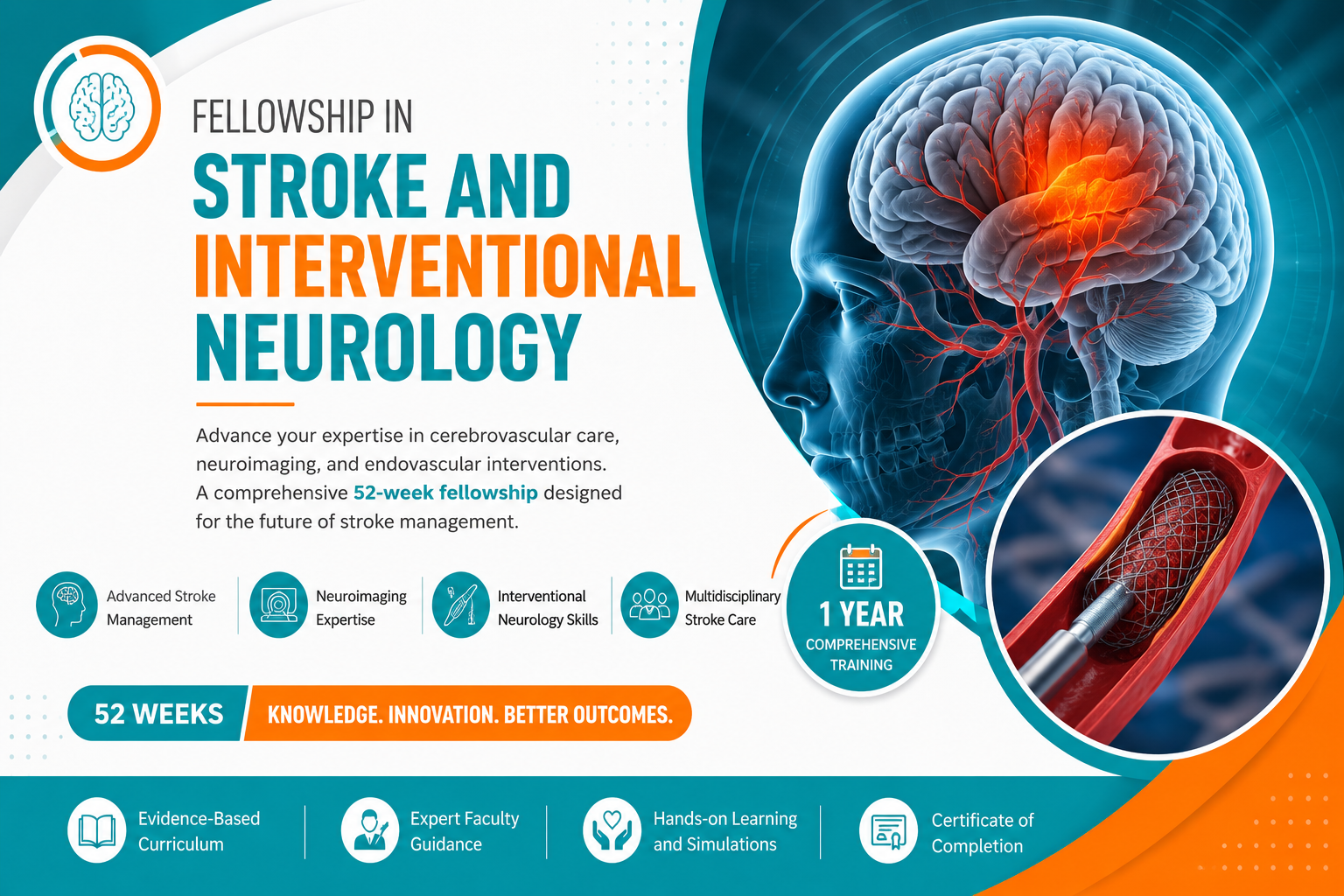

The Fellowship in Stroke and Interventional Neurology is a comprehensive 52-week advanced training program designed to equip healthcare professionals with specialized knowledge and practical skills in the diagnosis, treatment, and management of cerebrovascular diseases. The program provides an in-depth understanding …
The Fellowship in Stroke and Interventional Neurology is a comprehensive 52-week advanced training program designed to equip healthcare professionals with specialized knowledge and practical skills in the diagnosis, treatment, and management of cerebrovascular diseases. The program provides an in-depth understanding of acute ischemic stroke, hemorrhagic stroke, neurovascular disorders, and the latest advances in endovascular therapies. It prepares learners to deliver evidence-based stroke care while developing expertise in neuroimaging, interventional procedures, neurocritical care, rehabilitation, and long-term patient management.
Stroke remains one of the leading causes of death and long-term disability worldwide. Advances in neurointerventional techniques such as mechanical thrombectomy, cerebral angiography, carotid artery stenting, and aneurysm embolization have transformed the management of acute stroke and other neurovascular conditions. This fellowship is designed to bridge the gap between traditional neurological practice and rapidly evolving interventional stroke therapies by integrating clinical neurology, neuroimaging, and minimally invasive neurovascular procedures into a structured learning experience.
Throughout the program, learners develop a strong foundation in cerebrovascular anatomy, cerebral hemodynamics, stroke pathophysiology, neurovascular imaging, and evidence-based clinical decision-making. The curriculum covers emergency stroke evaluation, thrombolytic therapy, mechanical thrombectomy, cerebral aneurysms, arteriovenous malformations, carotid artery disease, hemorrhagic stroke management, neurocritical care, and stroke rehabilitation. Participants also gain knowledge of modern neurointerventional devices, catheter-based techniques, procedural planning, complication management, and post-procedure patient care.
A major focus of the fellowship is the interpretation of advanced neuroimaging techniques including computed tomography (CT), magnetic resonance imaging (MRI), CT angiography, MR angiography, perfusion imaging, digital subtraction angiography (DSA), and vascular ultrasound. Learners acquire the skills to identify large vessel occlusions, intracranial hemorrhage, cerebral aneurysms, vascular malformations, and other neurovascular abnormalities that guide timely intervention.
The fellowship emphasizes multidisciplinary stroke care by integrating the roles of neurologists, neurointerventional specialists, emergency physicians, neurosurgeons, neuroradiologists, rehabilitation experts, nurses, and allied healthcare professionals. Participants learn standardized stroke pathways, emergency stroke code activation, patient selection for intervention, peri-procedural management, intensive care principles, and coordinated rehabilitation strategies that improve functional outcomes and reduce long-term disability.
Hands-on learning is supported through case-based discussions, procedural simulations, neuroimaging interpretation sessions, clinical scenario analysis, multidisciplinary team meetings, and supervised exposure to neurointerventional workflows. Learners build confidence in clinical reasoning, procedural planning, complication prevention, and evidence-based decision-making while applying international stroke management guidelines in diverse healthcare settings.
The curriculum also develops competencies in clinical research, quality improvement, medical ethics, patient safety, healthcare leadership, and scientific communication. Participants gain experience in interpreting current literature, understanding landmark stroke trials, designing research projects, and implementing quality initiatives that enhance stroke services and neurovascular care.
Upon successful completion of the fellowship, graduates will be able to evaluate and manage acute and chronic cerebrovascular disorders, interpret advanced neurovascular imaging, participate effectively in stroke intervention programs, contribute to multidisciplinary stroke teams, support neurointerventional procedures, and deliver comprehensive patient-centered care across emergency, inpatient, critical care, rehabilitation, and outpatient settings.
This fellowship is ideal for neurologists, physicians, neurosurgeons, emergency medicine specialists, internal medicine practitioners, critical care physicians, neuroradiologists, anesthesiologists, stroke fellows, postgraduate medical trainees, nurse practitioners, physician associates, and other healthcare professionals seeking advanced expertise in stroke medicine and interventional neurology. The program also benefits clinicians involved in comprehensive stroke centers, neurocritical care units, emergency departments, and academic institutions focused on cerebrovascular disease.
By combining advanced theoretical knowledge, clinical application, neuroimaging expertise, procedural understanding, and research-oriented learning, the Fellowship in Stroke and Interventional Neurology prepares healthcare professionals to meet the growing global demand for specialists capable of delivering high-quality, evidence-based stroke and neurovascular care using the latest diagnostic and interventional techniques.
- 12 Sections
- 73 Lessons
- 52 Weeks
- Foundations of Stroke and Interventional NeurologyThis introductory module provides a comprehensive overview of stroke medicine and interventional neurology. Learners develop a strong understanding of cerebrovascular anatomy, cerebral circulation, stroke epidemiology, and the burden of neurological diseases worldwide. The module also introduces stroke classification, current treatment pathways, multidisciplinary stroke care, and the evolving role of neurointerventional procedures in improving patient outcomes.7
- Neurovascular Anatomy and NeuroimagingThis module focuses on detailed neurovascular anatomy and the interpretation of imaging studies essential for stroke diagnosis and intervention. Learners gain expertise in CT, MRI, angiography, perfusion imaging, and vascular ultrasound while understanding imaging protocols used in emergency stroke care and neurointerventional planning.6
- Stroke Pathophysiology and Risk FactorsThis module explores the biological mechanisms underlying ischemic and hemorrhagic stroke. Learners examine vascular pathology, thrombosis, embolism, atherosclerosis, hypertension, cardiac disorders, metabolic diseases, and genetic influences contributing to stroke risk while understanding preventive strategies.6
- Acute Stroke Evaluation and Emergency CareThis module develops competency in the rapid assessment and stabilization of acute stroke patients. Learners master neurological examination, stroke scales, emergency imaging protocols, thrombolysis eligibility, prehospital stroke systems, and emergency department management.6
- Endovascular Stroke InterventionThis module provides in-depth training in mechanical thrombectomy and endovascular stroke therapies. Learners understand patient selection, vascular access techniques, thrombectomy devices, procedural planning, complication management, and evidence-based intervention protocols.6
- Cerebral Aneurysms and Vascular MalformationsThis module focuses on the diagnosis and interventional treatment of intracranial aneurysms and vascular malformations. Learners study aneurysm morphology, AVMs, dural fistulas, embolization techniques, and advanced endovascular devices used in neurovascular interventions.6
- Carotid and Extracranial Vascular InterventionThis module covers the evaluation and management of extracranial cerebrovascular disease. Learners gain expertise in carotid artery stenting, angioplasty, vertebral artery interventions, patient selection, imaging interpretation, and complication management.6
- Hemorrhagic Stroke and Neurocritical CareThis module emphasizes comprehensive management of intracerebral hemorrhage, subarachnoid hemorrhage, cerebral edema, elevated intracranial pressure, and neurocritical care. Learners integrate intensive care principles with interventional neurology.6
- Neurointerventional Devices and TechnologiesThis module introduces the latest technologies and devices used in neurointerventional procedures. Learners understand catheter systems, guidewires, balloons, stents, embolic materials, robotic interventions, and emerging innovations in cerebrovascular treatment.6
- Stroke Rehabilitation and RecoveryThis module highlights multidisciplinary rehabilitation following stroke. Learners understand physical rehabilitation, occupational therapy, speech therapy, cognitive recovery, psychological care, community reintegration, and long-term follow-up.6
- Research, Ethics, and Clinical TrialsThis module develops research competence in cerebrovascular medicine. Learners study clinical trial methodology, evidence-based practice, neurointerventional registries, ethics, informed consent, quality improvement, and guideline development.6
- Advanced Clinical Practice and Fellowship CapstoneThe final module integrates theoretical knowledge with supervised clinical training and advanced procedural exposure. Learners participate in stroke units, neurointerventional suites, multidisciplinary discussions, case presentations, procedural simulations, and complete a capstone research or quality improvement project demonstrating competency in stroke and interventional neurology.6
You might be intersted in
-
0 Students
-
52 Weeks
-
133 Students
-
52 Weeks
-
129 Students
-
52 Weeks
-
139 Students
-
52 Weeks