
Fellowship in Palliative Care Nursing
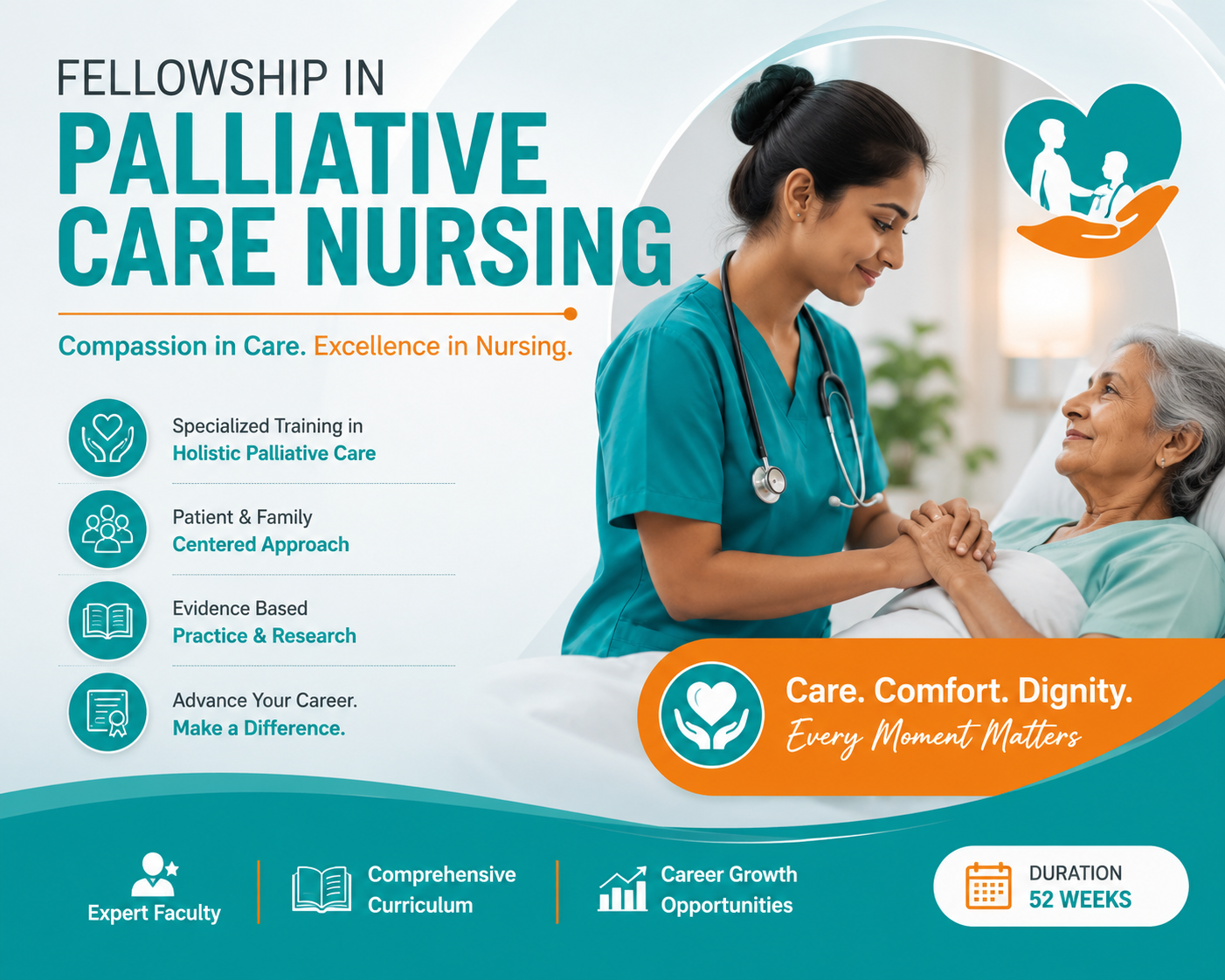

The Fellowship in Palliative Care Nursing is a comprehensive 52-week advanced training program designed to equip registered nurses and healthcare professionals with the knowledge, clinical skills, and compassionate approach required to provide high-quality palliative and end-of-life care. The program emphasizes …
The Fellowship in Palliative Care Nursing is a comprehensive 52-week advanced training program designed to equip registered nurses and healthcare professionals with the knowledge, clinical skills, and compassionate approach required to provide high-quality palliative and end-of-life care. The program emphasizes holistic patient management, focusing on improving the quality of life of individuals living with life-limiting illnesses and supporting their families throughout the continuum of care.
Palliative care is a rapidly growing specialty that addresses the physical, emotional, psychological, social, and spiritual needs of patients facing serious illnesses such as cancer, heart failure, chronic kidney disease, chronic respiratory disorders, neurological conditions, dementia, and other progressive diseases. This fellowship prepares nurses to become confident practitioners capable of delivering evidence-based, patient-centered care across hospitals, hospices, community health centers, home care settings, and long-term care facilities.
Throughout the 52-week curriculum, learners gain a strong foundation in palliative care principles, comprehensive patient assessment, pain and symptom management, communication skills, psychosocial support, ethical decision-making, and interdisciplinary collaboration. The course integrates theoretical knowledge with practical clinical applications, enabling participants to manage complex symptoms, provide comfort-focused care, and advocate for patients’ dignity and preferences.
The fellowship also focuses on developing advanced communication skills essential for discussing difficult diagnoses, advance care planning, treatment goals, and end-of-life decisions with patients and families. Learners will understand the importance of cultural sensitivity, empathy, and effective counseling in supporting individuals through challenging healthcare journeys.
A significant component of the program is dedicated to pain management using both pharmacological and non-pharmacological approaches. Participants will learn evidence-based strategies for assessing and managing pain, dyspnea, nausea, fatigue, delirium, anxiety, depression, and other distressing symptoms commonly experienced by patients with advanced illnesses.
The curriculum explores palliative care across different patient populations, including adults, older adults, and children. Learners will gain insight into disease-specific palliative interventions for oncology, cardiology, nephrology, neurology, respiratory medicine, geriatrics, and pediatric care. Home-based palliative care, hospice services, caregiver education, bereavement support, and community healthcare models are also covered in detail to prepare professionals for diverse clinical environments.
In addition to clinical competencies, the fellowship develops leadership, research, quality improvement, and evidence-based practice skills. Participants will learn to contribute to multidisciplinary healthcare teams, implement patient safety initiatives, participate in clinical research, and lead quality improvement projects aimed at enhancing palliative care services.
The final phase of the program includes supervised clinical training, case discussions, competency assessments, and a capstone project. This practical experience allows learners to apply their knowledge in real healthcare settings while working alongside experienced palliative care professionals.
Upon successful completion of the Fellowship in Palliative Care Nursing, graduates will possess the expertise to provide compassionate, ethical, and holistic care to patients with serious illnesses while supporting families through every stage of the care journey. They will be prepared to take on advanced nursing roles in hospitals, cancer centers, hospices, rehabilitation facilities, community health organizations, home healthcare agencies, and academic institutions.
Learning Outcomes
By the end of this fellowship, participants will be able to:
- Understand the principles and philosophy of palliative care nursing.
- Perform comprehensive physical, psychological, social, and spiritual assessments.
- Assess and manage pain using evidence-based pharmacological and non-pharmacological interventions.
- Effectively manage common symptoms associated with advanced illnesses.
- Deliver compassionate end-of-life nursing care while maintaining patient dignity.
- Communicate effectively with patients, families, and multidisciplinary healthcare teams.
- Support caregivers through education, counseling, and bereavement care.
- Apply ethical and legal principles in complex clinical decision-making.
- Provide home-based, hospice, and community palliative care services.
- Implement evidence-based nursing practices and quality improvement initiatives.
- Demonstrate leadership and professionalism in palliative care settings.
Career Opportunities
Graduates of the Fellowship in Palliative Care Nursing can pursue rewarding careers in:
- Palliative Care Nurse
- Hospice Nurse
- Oncology Nurse
- Home Healthcare Nurse
- Community Health Nurse
- End-of-Life Care Specialist
- Pain Management Nurse
- Geriatric Care Nurse
- Pediatric Palliative Care Nurse
- Clinical Nurse Educator
- Nursing Supervisor
- Quality Improvement Coordinator
- Palliative Care Program Coordinator
- Healthcare Consultant
- Research Nurse
Who Should Enroll?
This fellowship is suitable for:
- Registered Nurses (RNs)
- B.Sc. Nursing Graduates
- GNM-qualified Nurses
- Nurse Practitioners
- Critical Care Nurses
- Oncology Nurses
- Community Health Nurses
- Hospice Care Professionals
- Healthcare Professionals interested in palliative care
- Nursing educators seeking specialization
Why Choose This Fellowship?
This program combines comprehensive theoretical instruction with practical clinical training to develop highly skilled palliative care nurses. Learners benefit from an industry-relevant curriculum, evidence-based practices, patient-centered learning, experienced faculty guidance, and real-world clinical exposure. Upon completion, graduates will be well prepared to deliver compassionate, holistic care and make meaningful contributions to improving the quality of life for patients and families facing serious illness.
- 12 Sections
- 72 Lessons
- 52 Weeks
- Foundations of Palliative Care NursingThis module introduces learners to the philosophy, principles, and scope of palliative care nursing. Students will understand the evolution of palliative care, ethical and legal considerations, interdisciplinary teamwork, patient-centered care, and the role of nurses in improving quality of life for patients with life-limiting illnesses.6
- Anatomy, Physiology, and Disease ProcessesThis module provides an understanding of normal body systems and the pathophysiology of life-limiting illnesses. Learners will study disease progression, chronic illnesses, and the physiological changes that influence palliative care interventions.6
- Comprehensive Patient AssessmentStudents will develop skills in holistic patient assessment, focusing on physical, psychological, social, cultural, and spiritual dimensions. Emphasis is placed on identifying symptoms, assessing quality of life, and developing individualized care plans.6
- Pain and Symptom ManagementThis module focuses on evidence-based approaches to pain relief and symptom control. Learners will gain expertise in pharmacological and non-pharmacological management strategies to improve patient comfort and quality of life.6
- Nursing Care for Advanced IllnessesStudents will learn specialized nursing care for patients with advanced cancer, heart failure, respiratory diseases, renal disease, neurological disorders, and other chronic illnesses requiring palliative care.6
- Psychological and Emotional SupportThis module explores emotional responses to serious illness and equips learners with counseling and communication techniques to support patients and families experiencing distress, anxiety, depression, and grief.6
- Communication Skills in Palliative CareEffective communication is essential in palliative care. This module teaches strategies for delivering difficult news, discussing prognosis, facilitating advance care planning, and managing sensitive conversations with empathy.6
- End-of-Life CareLearners will study comprehensive end-of-life nursing care, recognizing signs of dying, symptom management during the final stages of life, dignity therapy, and supporting families through the dying process.6
- Pediatric and Geriatric Palliative CareThis module addresses age-specific palliative care needs in children and older adults. Students will understand developmental considerations, family-centered care, and disease-specific management across different age groups.6
- Home-Based and Community Palliative CareStudents will explore community-based service delivery, home care nursing, caregiver education, hospice care, telehealth, and coordination of multidisciplinary services outside hospital settings.6
- Leadership, Research, and Quality ImprovementThis module develops leadership and evidence-based practice skills. Learners will study healthcare quality improvement, nursing leadership, research methodology, patient safety, and ethical decision-making in palliative care.6
- Clinical Practicum and Capstone ProjectThe final module provides supervised clinical practice in palliative care settings. Students will integrate theoretical knowledge into real-world patient care, demonstrate clinical competencies, complete case studies, and present a capstone project reflecting comprehensive palliative nursing practice.6
You might be intersted in
-
0 Students
-
52 Weeks
-
133 Students
-
52 Weeks
-
129 Students
-
52 Weeks
-
139 Students
-
52 Weeks