
Fellowship in Oral Pathology
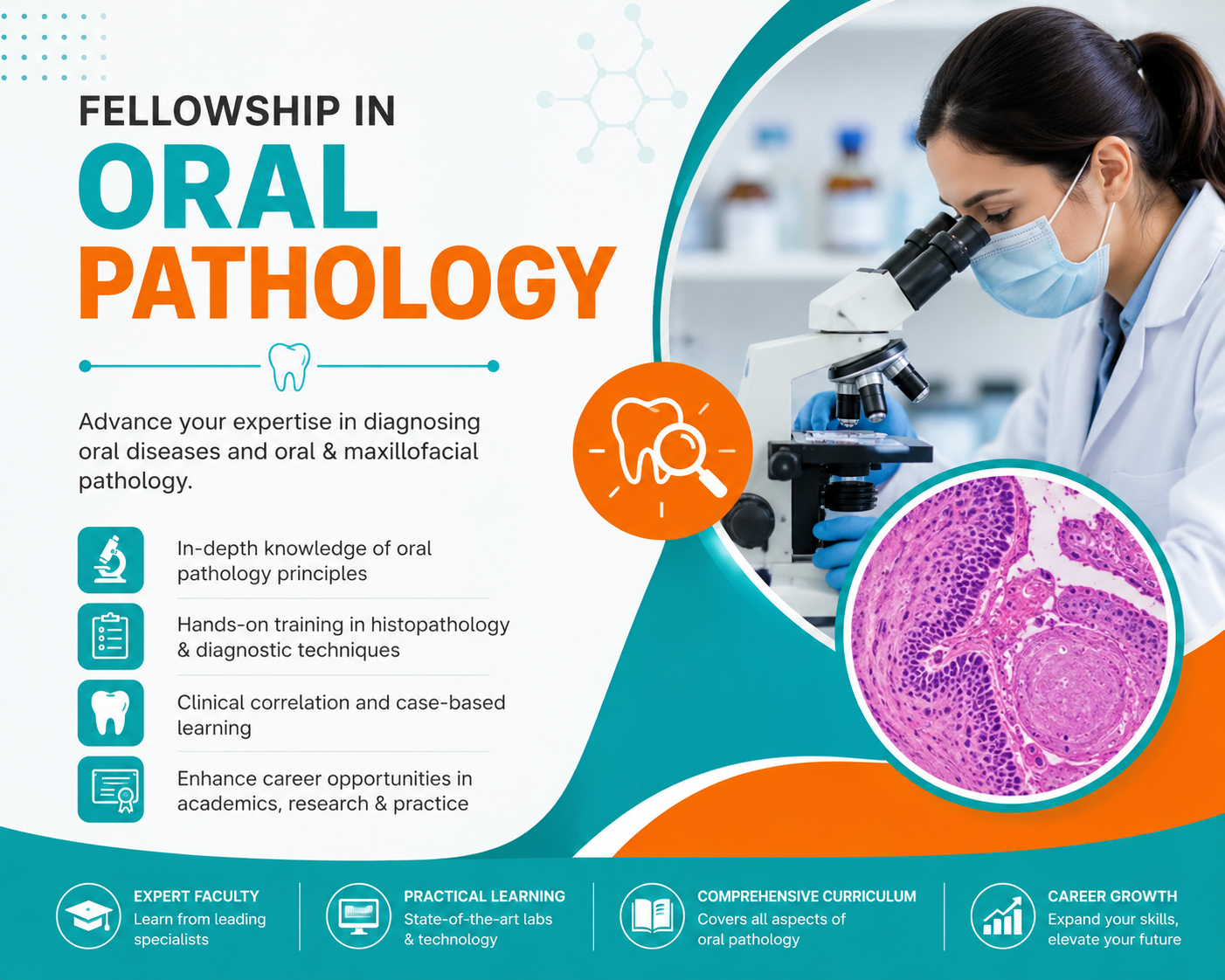

The Fellowship in Oral Pathology is a comprehensive 52-week advanced training program designed to develop expertise in the diagnosis, interpretation, and management of diseases affecting the oral and maxillofacial region. The curriculum covers oral histopathology, microbiology, developmental disorders, odontogenic lesions, oral cancer, salivary gland pathology, molecular diagnostics, research methodology, and clinical case-based learning, preparing healthcare professionals for careers in clinical practice, academia, diagnostic laboratories, and oral pathology research.
The Fellowship in Oral Pathology is a comprehensive 52-week advanced academic and clinical training program designed to provide healthcare professionals with in-depth knowledge and practical expertise in the diagnosis, investigation, and management of diseases affecting the oral and maxillofacial region. The fellowship integrates fundamental pathology, oral medicine, histopathology, molecular diagnostics, laboratory sciences, and evidence-based clinical practice to prepare participants for specialized roles in clinical dentistry, diagnostic laboratories, academic institutions, research organizations, and multidisciplinary healthcare settings.
Oral diseases represent a significant global health burden, ranging from common inflammatory and infectious conditions to complex developmental abnormalities, autoimmune disorders, potentially malignant lesions, and oral cancers. Early detection and accurate diagnosis are essential for improving patient outcomes, reducing disease progression, and supporting effective treatment planning. Oral pathologists play a critical role in identifying disease processes through clinical evaluation, microscopic examination, biopsy interpretation, and collaboration with dental surgeons, oral medicine specialists, oncologists, radiologists, and other healthcare professionals.
This fellowship begins with a strong foundation in oral anatomy, histology, embryology, physiology, general pathology, microbiology, and immunology, enabling learners to understand the normal structure and function of oral tissues before exploring disease processes. Participants gain detailed knowledge of cellular injury, inflammation, tissue repair, immunopathology, and the biological mechanisms responsible for oral diseases.
The curriculum provides extensive coverage of infectious diseases affecting the oral cavity, including bacterial, viral, fungal, and opportunistic infections. Learners study the oral microbiome, host-pathogen interactions, infection control practices, laboratory diagnosis, and antimicrobial therapies while understanding the oral manifestations of systemic infectious diseases.
Participants explore developmental and genetic disorders involving the teeth, jaws, salivary glands, and oral soft tissues. The program examines congenital anomalies, hereditary syndromes, craniofacial developmental disorders, developmental cysts, tooth abnormalities, and advances in molecular genetics that influence diagnosis and patient management.
A major component of the fellowship focuses on dental and periodontal pathology, including dental caries, pulp and periapical diseases, periodontal disorders, inflammatory lesions, and reactive conditions affecting the supporting structures of the teeth. Students develop the ability to correlate clinical findings with microscopic features and radiographic presentations for accurate diagnosis.
The program offers detailed instruction in odontogenic cysts, odontogenic tumors, fibro-osseous lesions, and jaw bone diseases. Learners study the classification, pathogenesis, clinical features, radiographic characteristics, histopathological appearance, differential diagnosis, and treatment approaches for a wide variety of benign and malignant lesions affecting the maxillofacial region.
Special emphasis is placed on oral potentially malignant disorders and oral cancer, which remain among the most significant health challenges worldwide. Participants learn to recognize early warning signs of oral squamous cell carcinoma, epithelial dysplasia, leukoplakia, erythroplakia, oral submucous fibrosis, and other high-risk lesions. The curriculum covers molecular mechanisms of carcinogenesis, cancer biomarkers, staging systems, biopsy interpretation, and multidisciplinary approaches to cancer diagnosis and management.
The fellowship also includes comprehensive training in salivary gland pathology, oral soft tissue lesions, bone pathology, autoimmune diseases, metabolic disorders, hematological conditions, and systemic diseases that present with oral manifestations. Students gain valuable experience in clinicopathological correlation, allowing them to integrate patient history, clinical examination, imaging studies, and laboratory findings into a complete diagnostic assessment.
An important feature of the program is advanced laboratory training in diagnostic oral pathology. Participants learn biopsy techniques, tissue fixation, specimen processing, histopathological staining, oral cytology, immunohistochemistry, molecular diagnostic methods, digital pathology, and quality assurance practices. These skills prepare graduates to interpret tissue specimens accurately and produce high-quality diagnostic reports.
The fellowship emphasizes research methodology and evidence-based practice to develop analytical thinking and scientific inquiry. Learners receive training in epidemiology, biostatistics, scientific writing, literature review, research ethics, systematic reviews, and clinical audit. Emerging technologies, including artificial intelligence, digital pathology, molecular biomarkers, genomic medicine, and precision diagnostics, are introduced to prepare participants for the future of oral healthcare.
Clinical learning is reinforced through case-based discussions, multidisciplinary meetings, biopsy interpretation sessions, histopathology slide reviews, tumor board participation, laboratory rotations, and supervised clinical exposure. These experiences enable learners to strengthen diagnostic reasoning, improve communication with multidisciplinary teams, and enhance patient-centered decision-making.
Throughout the fellowship, participants develop competencies in critical thinking, ethical practice, laboratory management, professional communication, and lifelong learning. The program encourages adherence to international diagnostic standards, patient safety principles, quality improvement initiatives, and evidence-based clinical protocols.
Upon successful completion of the Fellowship in Oral Pathology, graduates will be equipped to diagnose and interpret a broad spectrum of oral and maxillofacial diseases, perform and evaluate oral biopsies, utilize advanced laboratory techniques, contribute to multidisciplinary patient care, participate in oral cancer screening and prevention programs, conduct independent research, and apply emerging diagnostic technologies in clinical practice. This fellowship provides a strong academic and professional foundation for careers in oral pathology, oral medicine, diagnostic laboratory services, dental education, clinical research, and specialized healthcare institutions.
- 10 Sections
- 71 Lessons
- 52 Weeks
- Foundations of Oral PathologyThis introductory module provides learners with a comprehensive understanding of oral pathology as a specialized branch of dentistry and oral healthcare. Participants will explore the normal anatomy and histology of the oral cavity, developmental biology of oral tissues, principles of disease mechanisms, and the relationship between systemic health and oral diseases. The module establishes a strong scientific foundation by integrating oral anatomy, physiology, microbiology, immunology, and pathology. Students will develop the ability to recognize normal oral structures and distinguish them from pathological alterations while understanding the role of oral pathologists in diagnosis, research, patient care, and multidisciplinary clinical practice.10
- 1.1Introduction to Oral Pathology
- 1.2Scope and Role of Oral Pathologists
- 1.3Anatomy of the Oral Cavity
- 1.4Oral Histology
- 1.5Embryology of Oral and Maxillofacial Structures
- 1.6Oral Physiology
- 1.7Cell Injury and Cellular Adaptation
- 1.8Inflammation and Healing
- 1.9Immunology in Oral Diseases
- 1.10Principles of Histopathology
- Oral Microbiology and Infectious DiseasesThis module focuses on microorganisms responsible for oral diseases and their pathological effects. Students will study bacterial, viral, fungal, and parasitic infections affecting the oral cavity, including opportunistic infections in immunocompromised patients. The module covers mechanisms of microbial pathogenesis, host immune responses, laboratory diagnosis, antimicrobial therapy, infection control measures, and preventive strategies. Learners will gain expertise in recognizing infectious oral lesions and interpreting microbiological findings for accurate diagnosis and treatment planning.10
- 2.1Oral Microbiome
- 2.2Bacterial Infections
- 2.3Viral Diseases of the Oral Cavity
- 2.4Fungal Infections
- 2.5Tuberculosis and Oral Manifestations
- 2.6Sexually Transmitted Oral Diseases
- 2.7HIV and Oral Lesions
- 2.8Opportunistic Infections
- 2.9Infection Control in Oral Practice
- 2.10Laboratory Diagnosis of Oral Infections
- Developmental and Genetic DisordersThis module explores congenital, hereditary, and developmental abnormalities affecting oral and maxillofacial structures. Students learn the genetic basis of craniofacial anomalies, developmental disturbances of teeth, salivary glands, and oral soft tissues. The module emphasizes clinical presentation, molecular pathology, diagnostic approaches, and management strategies while introducing recent advances in molecular genetics and personalized medicine.6
- Dental and Periodontal PathologyThis module examines diseases affecting teeth, supporting tissues, and periodontal structures. Students study dental caries, pulp diseases, periodontal diseases, periapical lesions, and associated inflammatory conditions. Emphasis is placed on disease progression, histopathological findings, diagnostic imaging, preventive strategies, and evidence-based management of common dental pathologies.7
- Oral Cysts and Odontogenic TumorsThis module provides an in-depth understanding of odontogenic cysts and tumors. Students learn their classification, pathogenesis, radiographic appearance, histopathological characteristics, differential diagnosis, and management. The module integrates clinical, radiological, and microscopic findings to enable accurate diagnosis and treatment planning.7
- Oral Potentially Malignant DisordersThis module focuses on premalignant oral lesions and disorders that increase the risk of oral cancer. Students develop expertise in recognizing early warning signs, grading epithelial dysplasia, understanding carcinogenesis, and implementing preventive interventions. The module emphasizes early diagnosis and screening strategies that improve patient outcomes.6
- Oral and Maxillofacial OncologyThis module provides comprehensive knowledge of benign and malignant oral neoplasms. Students study oral squamous cell carcinoma, salivary gland tumors, bone tumors, lymphomas, and metastatic lesions. The curriculum includes molecular pathology, tumor staging, biomarkers, histopathological diagnosis, multidisciplinary treatment planning, and follow-up care.6
- Salivary Gland and Soft Tissue PathologyThis module explores diseases affecting salivary glands and oral soft tissues. Students examine inflammatory, autoimmune, reactive, and neoplastic disorders through clinical evaluation, imaging, cytology, and histopathology. Learners develop diagnostic skills essential for differentiating common and rare lesions.6
- Bone Pathology and Systemic DiseasesThis module covers diseases affecting jaw bones and systemic disorders with oral manifestations. Students learn about metabolic bone diseases, fibro-osseous lesions, osteomyelitis, osteoporosis, endocrine disorders, hematological diseases, and autoimmune conditions. Emphasis is placed on correlating systemic diseases with oral pathology.6
- Diagnostic Oral PathologyThis module develops advanced diagnostic competencies in oral pathology. Students gain proficiency in biopsy techniques, specimen processing, microscopic examination, cytology, immunohistochemistry, molecular diagnostics, and clinicopathological correlation. Emphasis is placed on accurate reporting and quality assurance in diagnostic laboratories.7
You might be intersted in
-
0 Students
-
52 Weeks
-
133 Students
-
52 Weeks
-
129 Students
-
52 Weeks
-
139 Students
-
52 Weeks