
Fellowship in Laryngology
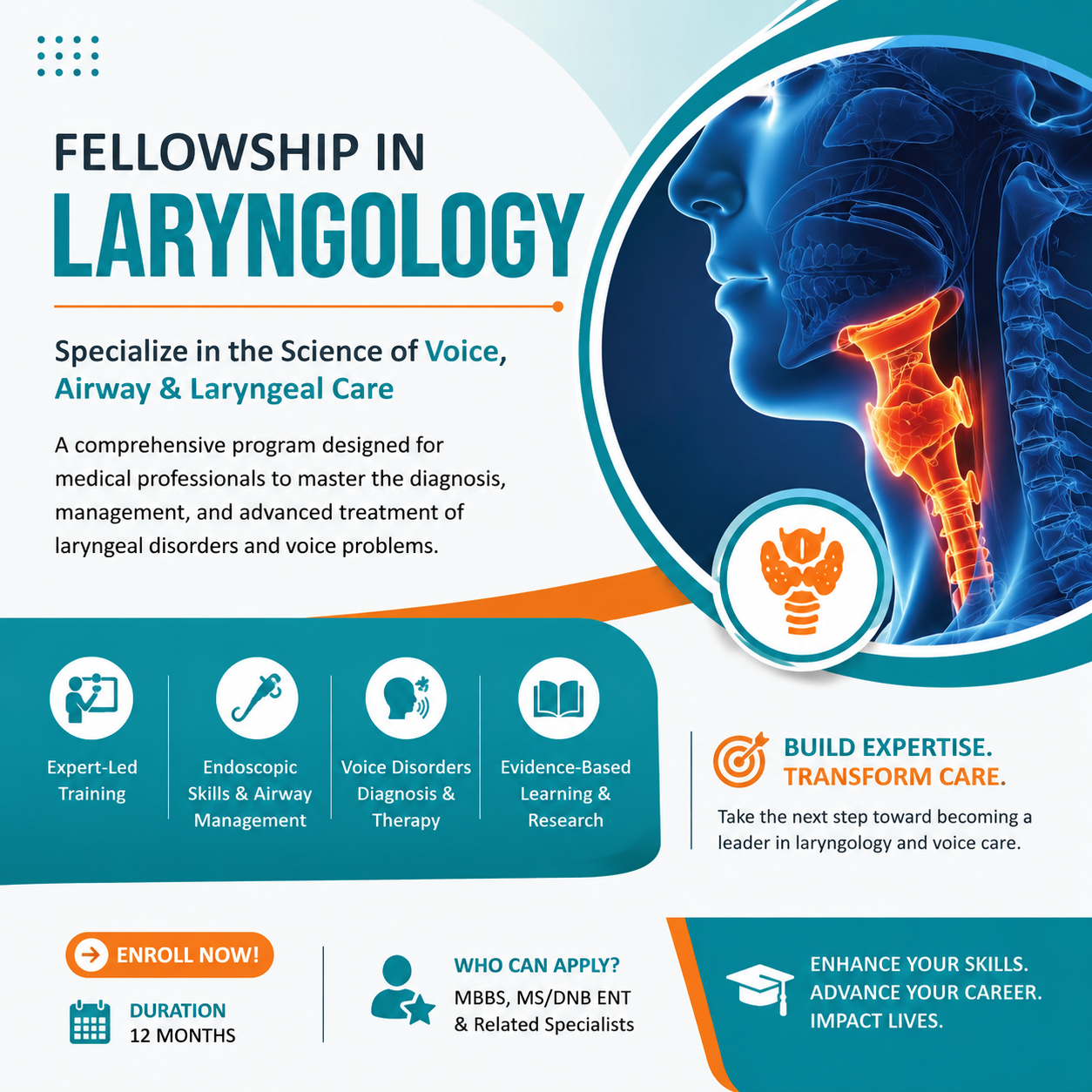

The Fellowship in Laryngology is a comprehensive 52-week advanced training program designed for medical professionals seeking expertise in the diagnosis and management of voice, airway, and swallowing disorders. The curriculum combines foundational knowledge with hands-on clinical skills in laryngeal examination, office-based procedures, microlaryngeal surgery, airway management, pediatric laryngology, voice rehabilitation, and laryngeal oncology. Through evidence-based learning, multidisciplinary collaboration, and practical case discussions, participants develop the competencies required to deliver high-quality patient care and excel in modern laryngology practice.
The Fellowship in Laryngology is a comprehensive 52-week advanced training program designed for ENT specialists, otolaryngologists, head and neck surgeons, and medical professionals seeking specialized expertise in the diagnosis and management of disorders affecting the larynx, voice, airway, and swallowing. The program combines evidence-based theoretical learning with practical clinical training to prepare healthcare professionals for the growing demand for advanced laryngology services in hospitals, specialty clinics, academic institutions, and multidisciplinary healthcare settings.
Laryngology is a highly specialized field within otolaryngology that focuses on conditions affecting the voice box (larynx), vocal cords, upper airway, and swallowing mechanism. Patients with voice disorders, breathing difficulties, chronic cough, swallowing dysfunction, and laryngeal tumors require accurate diagnosis and comprehensive management using modern diagnostic technologies and minimally invasive treatment approaches. This fellowship provides participants with the knowledge and clinical skills required to evaluate and manage both common and complex laryngeal disorders while delivering patient-centered, evidence-based care.
Throughout the 52-week curriculum, participants begin by developing a strong understanding of laryngeal anatomy, embryology, physiology, biomechanics of voice production, and swallowing function. A thorough foundation in these subjects enables learners to accurately recognize pathological changes and understand disease mechanisms. Fellows also become proficient in clinical history taking, physical examination, and interpretation of diagnostic investigations used in contemporary laryngology practice.
The program offers extensive training in advanced diagnostic techniques, including flexible and rigid laryngoscopy, videostroboscopy, acoustic voice analysis, aerodynamic assessment, Fiberoptic Endoscopic Evaluation of Swallowing (FEES), and imaging of the larynx and upper airway. Participants learn how to evaluate patients presenting with hoarseness, dysphonia, dysphagia, airway obstruction, chronic cough, and other laryngeal symptoms using standardized clinical protocols and evidence-based guidelines.
A significant component of the fellowship focuses on the diagnosis and management of voice disorders. Learners study benign vocal fold lesions such as nodules, polyps, cysts, Reinke’s edema, granulomas, and hemorrhage, along with neurological voice disorders including unilateral and bilateral vocal fold paralysis, spasmodic dysphonia, and muscle tension dysphonia. The curriculum emphasizes multidisciplinary treatment approaches involving speech-language therapists, voice therapists, and rehabilitation specialists to optimize patient outcomes.
The fellowship also provides comprehensive education in airway disorders and swallowing dysfunction. Participants gain expertise in managing laryngotracheal stenosis, pediatric airway abnormalities, tracheostomy care, aspiration disorders, neurological dysphagia, and upper airway obstruction. Training includes both conservative and surgical treatment strategies, ensuring fellows are equipped to manage airway emergencies as well as long-term rehabilitation.
Learners receive detailed instruction in office-based laryngology procedures that have become integral to modern clinical practice. Topics include injection laryngoplasty, vocal fold augmentation, office laser procedures, steroid injections, botulinum toxin therapy, office biopsy techniques, and minimally invasive interventions performed under local anesthesia. These procedures improve patient outcomes while reducing the need for hospitalization and general anesthesia.
Advanced operative laryngology forms another essential component of the program. Fellows learn the principles and techniques of microlaryngoscopy, phonomicrosurgery, CO₂ laser surgery, laryngeal framework surgery, airway reconstruction, and other microsurgical procedures. The curriculum emphasizes patient selection, surgical planning, intraoperative decision-making, postoperative care, and complication management to promote safe and effective surgical practice.
The fellowship also covers laryngeal oncology, providing participants with a comprehensive understanding of premalignant lesions, early and advanced laryngeal cancers, staging systems, biopsy techniques, organ preservation strategies, surgical oncology, radiation therapy, chemotherapy, and long-term surveillance. Learners develop the ability to collaborate effectively within multidisciplinary cancer teams to deliver comprehensive care and improve quality of life for patients with laryngeal malignancies.
Special emphasis is placed on pediatric laryngology, where participants study congenital airway anomalies, laryngomalacia, pediatric dysphonia, subglottic stenosis, swallowing disorders, and age-specific surgical interventions. Fellows learn the unique anatomical and physiological considerations required when treating infants and children with airway and voice disorders.
In addition to clinical expertise, the program promotes professional development through training in medical ethics, clinical documentation, research methodology, biostatistics, quality improvement, patient safety, and evidence-based medicine. Participants engage in journal reviews, case presentations, multidisciplinary discussions, and research projects that strengthen their analytical and academic capabilities while fostering lifelong learning.
By the completion of the fellowship, graduates will be able to independently assess patients with voice, airway, and swallowing disorders, perform comprehensive laryngeal examinations, interpret advanced diagnostic investigations, develop individualized treatment plans, perform office-based procedures, assist in advanced laryngeal surgeries, manage airway emergencies, and contribute effectively to multidisciplinary healthcare teams.
The Fellowship in Laryngology equips healthcare professionals with the advanced clinical knowledge, procedural skills, surgical understanding, and research competencies needed to excel in modern laryngology practice. Graduates are well prepared for rewarding careers in tertiary care hospitals, ENT specialty centers, academic institutions, voice clinics, airway centers, and multidisciplinary head and neck services, while delivering high-quality, patient-centered care that improves voice, breathing, swallowing, and overall quality of life.
- 12 Sections
- 72 Lessons
- 52 Weeks
- Foundations of LaryngologyThis module introduces the fundamentals of laryngology, including the anatomy, physiology, embryology, and biomechanics of the larynx. Learners will develop a strong understanding of normal voice production, swallowing, and airway function while becoming familiar with clinical terminology, examination techniques, and evidence-based practice in laryngology.6
- Clinical Evaluation and Diagnostic TechniquesThis module focuses on comprehensive patient evaluation, including history taking, voice assessment, airway examination, and diagnostic imaging. Fellows will gain expertise in flexible and rigid laryngoscopy, videostroboscopy, acoustic voice analysis, and swallowing assessments for accurate diagnosis.6
- Voice DisordersThis module explores the diagnosis and management of common and complex voice disorders. Fellows will learn the pathophysiology, clinical presentation, and multidisciplinary treatment approaches for benign and neurological voice conditions.6
- Airway DisordersThis module provides in-depth knowledge of upper airway diseases affecting breathing and phonation. Fellows will study congenital and acquired airway disorders and develop skills in emergency airway management and airway reconstruction principles.6
- Swallowing DisordersThis module covers dysphagia evaluation and management. Fellows will understand swallowing physiology, neurological causes of dysphagia, aspiration prevention, and rehabilitation techniques through multidisciplinary care.6
- Benign Laryngeal DiseasesThis module emphasizes benign inflammatory, infectious, and structural diseases of the larynx. Fellows will learn both medical and surgical management strategies for common laryngeal conditions.6
- Laryngeal OncologyThis module focuses on the diagnosis, staging, and treatment of benign and malignant laryngeal tumors. Fellows will understand multidisciplinary cancer care, organ preservation strategies, and postoperative rehabilitation.6
- Office-Based Laryngology ProceduresThis module introduces minimally invasive office-based interventions used in modern laryngology. Fellows will develop competency in patient selection, procedural techniques, and complication management.6
- Operative LaryngologyThis module develops surgical skills in microlaryngeal procedures and advanced airway surgery. Fellows will learn operative planning, instrumentation, and postoperative management.6
- Pediatric LaryngologyThis module focuses on congenital and acquired laryngeal disorders in children. Fellows will understand pediatric airway assessment, congenital anomalies, and age-specific treatment approaches.6
- Voice Rehabilitation and Multidisciplinary CareThis module highlights collaborative management involving speech-language pathologists, physiotherapists, and psychologists. Fellows will learn rehabilitation strategies that optimize voice and swallowing outcomes following medical or surgical treatment.6
- Research, Ethics, and Fellowship CapstoneThe final module prepares fellows for independent clinical practice by integrating research methodology, clinical audit, medical ethics, quality improvement, and advanced case discussions. Fellows will complete a capstone project demonstrating comprehensive knowledge and practical competence in laryngology.6
You might be intersted in
-
0 Students
-
52 Weeks
-
133 Students
-
52 Weeks
-
129 Students
-
52 Weeks
-
139 Students
-
52 Weeks