
Fellowship in interventional headache neurology
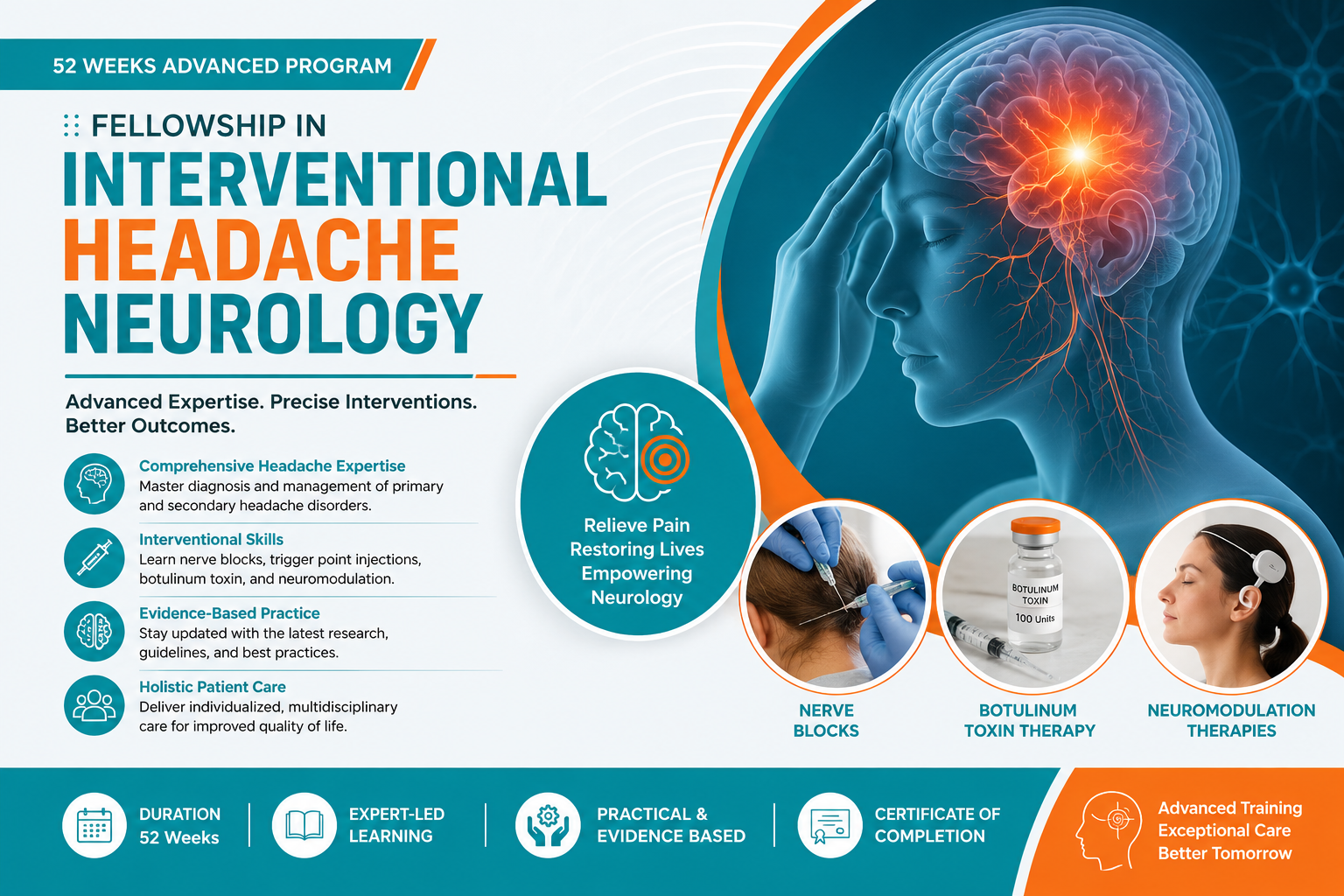

The Fellowship in Interventional Headache Neurology is a comprehensive 52-week advanced training program designed to equip healthcare professionals with specialized expertise in the diagnosis, evaluation, and minimally invasive management of headache disorders. The course covers headache pathophysiology, migraine medicine, interventional procedures, nerve blocks, botulinum toxin therapy, neuromodulation, evidence-based treatment strategies, and multidisciplinary patient care, preparing learners to deliver advanced headache management in modern neurological practice.
The Fellowship in Interventional Headache Neurology is a comprehensive 52-week advanced training program designed to equip neurologists, physicians, pain specialists, anesthesiologists, emergency medicine practitioners, rehabilitation professionals, and other healthcare providers with specialized expertise in the diagnosis, evaluation, and interventional management of headache disorders. The fellowship integrates evidence-based headache medicine with advanced procedural techniques, enabling healthcare professionals to provide comprehensive care for patients suffering from acute, chronic, and refractory headache conditions.
Headache disorders are among the leading causes of disability worldwide, significantly affecting quality of life, productivity, and psychological well-being. Conditions such as migraine, chronic migraine, tension-type headache, cluster headache, trigeminal autonomic cephalalgias, occipital neuralgia, medication-overuse headache, and secondary headache disorders require accurate diagnosis and individualized treatment strategies. While pharmacological therapies remain an essential component of management, many patients continue to experience persistent symptoms despite conventional treatment. Interventional headache neurology has emerged as a rapidly advancing subspecialty, offering minimally invasive procedures that improve pain control, reduce disability, and enhance patient outcomes.
This fellowship begins with a strong foundation in headache neuroanatomy, pain physiology, trigeminovascular mechanisms, and the neurobiology of headache disorders. Participants develop a thorough understanding of the International Classification of Headache Disorders (ICHD-3), enabling accurate diagnosis of primary and secondary headache conditions. The curriculum emphasizes comprehensive clinical assessment, neurological examination, differential diagnosis, headache disability assessment, and recognition of red flag symptoms requiring urgent intervention.
Learners gain extensive knowledge of migraine pathophysiology, chronic and episodic migraine, tension-type headache, cluster headache, trigeminal autonomic cephalalgias, new daily persistent headache, occipital neuralgia, cervicogenic headache, and less common headache syndromes. The program also covers secondary headaches associated with vascular disorders, infections, intracranial pressure abnormalities, trauma, metabolic diseases, and systemic illnesses, ensuring clinicians develop the expertise needed to evaluate complex neurological presentations.
A major component of the fellowship focuses on evidence-based pharmacological management of headache disorders. Participants study acute and preventive migraine therapies, triptans, gepants, ditans, CGRP monoclonal antibodies, botulinum toxin therapy, preventive medications, and individualized treatment selection based on patient characteristics, comorbidities, and clinical guidelines. The program also explores medication-overuse headache, adverse drug reactions, and long-term treatment optimization.
The distinguishing feature of this fellowship is its extensive focus on interventional headache procedures. Learners are introduced to the principles of procedural headache medicine, patient selection, informed consent, anatomical landmarks, sterile techniques, procedural safety, complication prevention, and post-procedural care. Detailed instruction is provided on commonly performed peripheral nerve blocks, including greater occipital nerve block, lesser occipital nerve block, supraorbital nerve block, supratrochlear nerve block, auriculotemporal nerve block, trigeminal nerve block, and sphenopalatine ganglion block. Participants also study trigger point injections, ultrasound-guided interventions, cervical procedures, pulsed radiofrequency techniques, and other minimally invasive treatment options for refractory headache disorders.
The fellowship further explores advanced procedural therapies such as botulinum toxin injections for chronic migraine using standardized injection protocols, as well as peripheral nerve stimulation, occipital nerve stimulation, and emerging neuromodulation technologies. Participants gain a comprehensive understanding of indications, contraindications, procedural techniques, expected outcomes, complication management, and patient follow-up for these innovative therapies.
Special emphasis is placed on headache management in diverse patient populations, including children, adolescents, older adults, pregnant patients, individuals with systemic illnesses, oncology patients, and those with neurological comorbidities. Learners also explore the interaction between headache disorders and psychiatric conditions, sleep disorders, vestibular dysfunction, cervical spine disorders, and chronic pain syndromes, promoting a holistic and multidisciplinary approach to patient care.
Throughout the program, participants strengthen their clinical reasoning through case-based discussions, procedural planning exercises, clinical audits, journal reviews, and evidence-based practice. The curriculum also develops competencies in interpreting current research, applying international clinical guidelines, measuring patient outcomes, utilizing headache disability assessment tools, and participating in multidisciplinary headache clinics.
The fellowship concludes with advanced case presentations, clinical competency assessments, and a capstone research or quality improvement project that allows learners to integrate theoretical knowledge with practical clinical decision-making. Graduates will be equipped to evaluate complex headache disorders, perform appropriate interventional procedures, optimize pharmacological therapy, manage procedural complications, and deliver patient-centered care using the latest advances in headache medicine.
Upon successful completion of the Fellowship in Interventional Headache Neurology, graduates will possess advanced knowledge and procedural competence in modern headache diagnosis and intervention. They will be prepared to work in neurology departments, headache clinics, pain management centers, interventional neurology practices, rehabilitation facilities, multidisciplinary neuroscience units, academic institutions, and research organizations. The fellowship also provides a strong foundation for clinicians seeking to expand their expertise in headache medicine, contribute to clinical research, and improve outcomes for patients living with disabling headache disorders through evidence-based, minimally invasive neurological care.
- 12 Sections
- 74 Lessons
- 52 Weeks
- Foundations of Headache MedicineThis introductory module provides a comprehensive understanding of headache medicine, including the epidemiology, burden, classification, and pathophysiology of primary and secondary headache disorders. Learners will explore the neurobiology of pain pathways, trigeminovascular mechanisms, and current international diagnostic criteria. The module establishes the clinical framework necessary for advanced headache diagnosis and interventional treatment planning while emphasizing patient-centered assessment and evidence-based neurological practice.8
- 1.1Introduction to Headache Medicine
- 1.2Epidemiology and Global Burden of Headache Disorders
- 1.3International Classification of Headache Disorders (ICHD-3)
- 1.4Neuroanatomy of Headache Pathways
- 1.5Pain Physiology and Trigeminovascular System
- 1.6Neurotransmitters in Headache Disorders
- 1.7Clinical Approach to Headache Patients
- 1.8Red Flags and Secondary Headaches
- Clinical Evaluation and Diagnostic TechniquesThis module develops expertise in comprehensive headache assessment through structured history taking, neurological examination, diagnostic reasoning, and appropriate use of imaging and laboratory investigations. Learners will understand how to distinguish primary headaches from life-threatening secondary conditions while mastering diagnostic algorithms and headache disability assessment tools.6
- Primary Headache DisordersThis module provides in-depth knowledge of the diagnosis, mechanisms, and management of primary headache disorders. Learners will understand migraine variants, tension-type headaches, trigeminal autonomic cephalalgias, and other uncommon primary headaches while applying evidence-based therapeutic strategies tailored to individual patients.7
- Secondary Headache DisordersThis module focuses on identifying secondary headache disorders that require urgent diagnosis and intervention. Learners will evaluate vascular, infectious, traumatic, inflammatory, metabolic, and structural causes of headache while developing skills for emergency neurological assessment and referral.6
- Pharmacological Management of Headache DisordersThis module explores evidence-based pharmacological therapies used in headache medicine. Learners will understand acute and preventive medications, medication selection, adverse effects, contraindications, and individualized treatment plans for various headache disorders.6
- Principles of Interventional Headache NeurologyThis module introduces minimally invasive interventional procedures for headache management. Learners will understand patient selection, anatomical landmarks, indications, contraindications, safety measures, procedural planning, and evidence supporting various interventions used in refractory headache disorders.6
- Peripheral Nerve BlocksThis module provides hands-on theoretical knowledge of peripheral nerve block techniques used in headache medicine. Learners will understand procedural anatomy, injection techniques, expected outcomes, complications, and clinical applications for chronic headache disorders.5
- Advanced Interventional ProceduresThis module focuses on advanced headache interventions including ultrasound-guided procedures, radiofrequency techniques, trigger point injections, and emerging minimally invasive therapies. Learners will understand procedural planning, patient safety, and outcome evaluation.6
- Botulinum Toxin and NeuromodulationThis module explores advanced treatment options for chronic migraine and refractory headache disorders. Learners will master botulinum toxin protocols, peripheral nerve stimulation, non-invasive neuromodulation devices, and implantable technologies while understanding patient selection and long-term outcomes.6
- Special Populations and Complex Headache CasesThis module addresses headache management in pediatric, geriatric, pregnant, and medically complex patients. Learners will understand special diagnostic considerations, pharmacological precautions, procedural modifications, and multidisciplinary approaches for these populations.6
- Research, Evidence-Based Practice, and Multidisciplinary CareThis module develops research literacy and clinical leadership in headache neurology. Learners will critically evaluate scientific literature, interpret clinical trials, apply evidence-based medicine, collaborate within multidisciplinary teams, and participate in quality improvement initiatives.6
- Clinical Practice, Case-Based Learning, and Capstone ProjectThe final module integrates theoretical knowledge with advanced clinical application through comprehensive case discussions, procedural planning, complication management, and a capstone project. Learners will demonstrate competency in diagnosing complex headache disorders, selecting appropriate interventional treatments, interpreting outcomes, and delivering evidence-based patient care in specialized headache clinics.6
You might be intersted in
-
0 Students
-
52 Weeks
-
133 Students
-
52 Weeks
-
129 Students
-
52 Weeks
-
139 Students
-
52 Weeks