
Fellowship In Critical Care Nursing
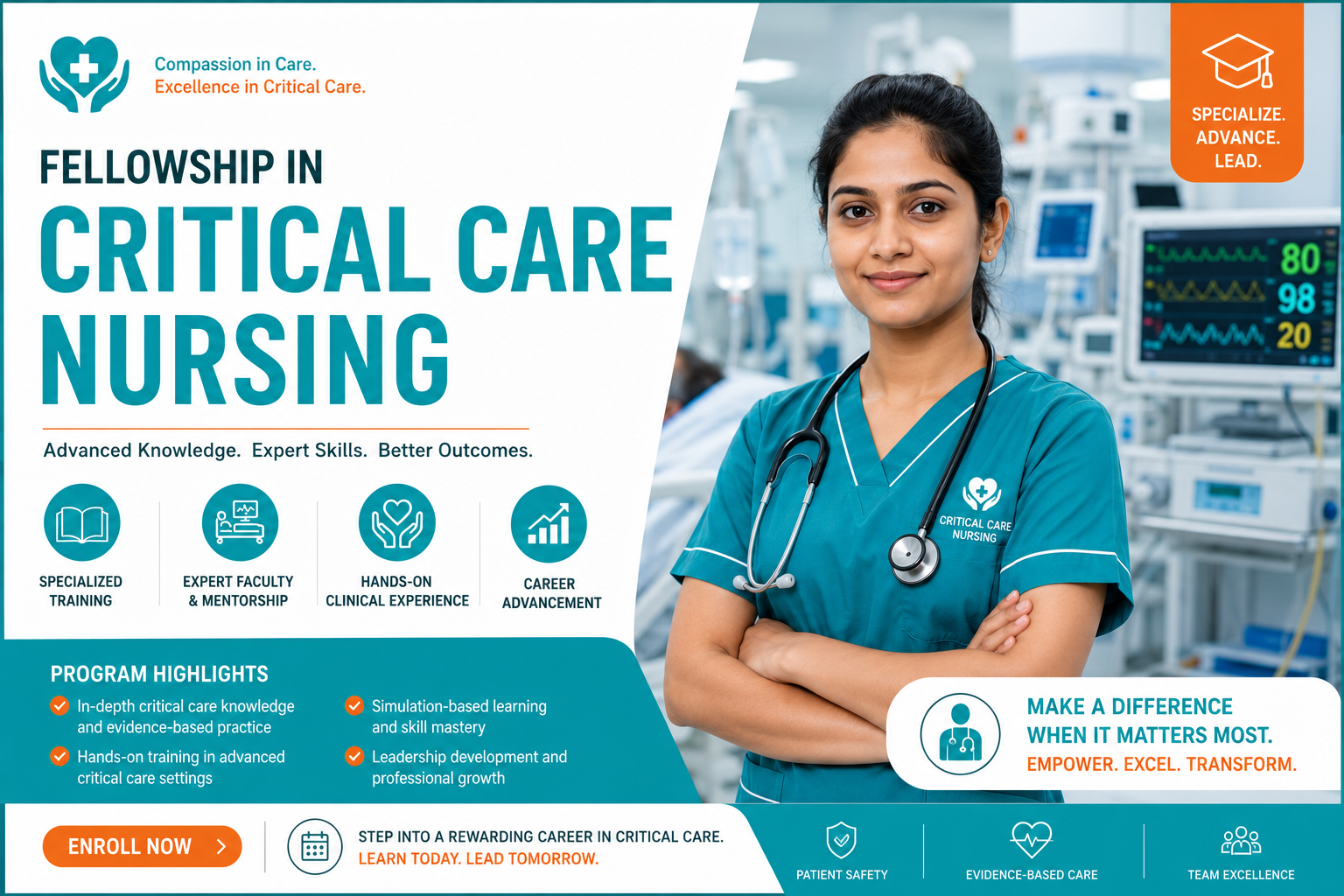

The Fellowship in Critical Care Nursing is a comprehensive 52-week advanced training program designed to equip registered nurses with specialized knowledge, clinical skills, and professional competencies required to function effectively in intensive care units (ICUs) and other high-acuity critical care …
The Fellowship in Critical Care Nursing is a comprehensive 52-week advanced training program designed to equip registered nurses with specialized knowledge, clinical skills, and professional competencies required to function effectively in intensive care units (ICUs) and other high-acuity critical care environments. This program bridges the gap between foundational nursing education and the complex demands of modern critical care practice, focusing on evidence-based care, advanced monitoring techniques, emergency interventions, and multidisciplinary collaboration.
Throughout the fellowship, learners are immersed in a structured curriculum that integrates theoretical learning with practical clinical exposure. The program begins with foundational concepts of critical care nursing, including ICU organization, infection control, patient safety, ethical practice, and communication within high-pressure healthcare teams. As the course progresses, participants develop a deep understanding of advanced anatomy, physiology, and pathophysiology, enabling them to interpret complex clinical conditions and anticipate patient deterioration.
A strong emphasis is placed on comprehensive patient assessment and continuous monitoring, where learners are trained to perform systematic evaluations, interpret vital signs and hemodynamic data, and respond promptly to critical changes in patient status. The program also provides extensive training in cardiovascular and respiratory critical care, including management of shock states, cardiac emergencies, respiratory failure, airway management, and mechanical ventilation.
Specialized modules cover neurological critical care, renal and metabolic emergencies, endocrine crises, and trauma management, ensuring that nurses are prepared to handle a wide range of life-threatening conditions. The fellowship also includes in-depth study of critical care pharmacology, focusing on the safe administration of high-risk medications such as vasopressors, sedatives, inotropes, and emergency drugs commonly used in ICU settings.
A key component of the program is the management of sepsis and multi-organ dysfunction syndrome (MODS), where learners gain skills in early recognition, timely intervention, and adherence to international treatment protocols. The curriculum also explores infection prevention strategies, antimicrobial stewardship, and advanced isolation practices to reduce hospital-acquired infections in critically ill patients.
In addition, the fellowship provides exposure to specialized critical care areas, including cardiac ICUs, surgical ICUs, pediatric and neonatal critical care, and oncology critical care units. This ensures that participants gain a holistic understanding of diverse patient populations and complex care requirements.
The final phase of the program focuses on clinical practicum, leadership, research, and quality improvement in nursing practice. Learners engage in supervised ICU rotations, case-based discussions, and hands-on training while also developing skills in clinical documentation, audit participation, and evidence-based decision-making. Emphasis is placed on leadership development, teamwork, and effective communication within critical care teams.
By the end of the fellowship, participants will be fully prepared to function as competent critical care nursing professionals capable of delivering safe, efficient, and high-quality care to critically ill patients. Graduates will possess the confidence and clinical judgment required to work in ICU settings, emergency departments, and specialty critical care units, making them valuable contributors to modern healthcare systems.
- 12 Sections
- 84 Lessons
- 52 Weeks
- Foundations of Critical Care NursingThis module introduces learners to the principles, scope, and responsibilities of critical care nursing. Participants will gain an understanding of intensive care unit (ICU) environments, patient safety standards, ethical considerations, infection prevention strategies, and interdisciplinary collaboration. The module establishes the knowledge base required for advanced critical care practice and prepares nurses for evidence-based decision-making in high-acuity settings.7
- 1.1Introduction to Critical Care Nursing
- 1.2ICU Structure and Organization
- 1.3Roles and Responsibilities of Critical Care Nurses
- 1.4Patient Safety and Quality Improvement
- 1.5Infection Prevention and Control Practices
- 1.6Ethical and Legal Considerations in Critical Care
- 1.7Communication and Team Collaboration
- Advanced Anatomy, Physiology, and PathophysiologyThis module focuses on the anatomy, physiology, and pathophysiological processes affecting critically ill patients. Learners will develop a deeper understanding of organ system functions and disease mechanisms that commonly lead to ICU admissions. The knowledge gained will support accurate assessment and effective clinical interventions.7
- Comprehensive Patient Assessment and MonitoringThis module equips nurses with advanced assessment skills necessary for critically ill patients. Participants will learn systematic evaluation techniques, interpretation of monitoring data, recognition of clinical deterioration, and documentation practices. Emphasis is placed on timely identification of life-threatening conditions.7
- Hemodynamic Monitoring and Cardiovascular CareThis module explores advanced cardiovascular monitoring and management techniques used in critical care settings. Learners will interpret hemodynamic parameters, manage cardiac emergencies, and participate in evidence-based cardiovascular interventions to improve patient outcomes.7
- Respiratory Critical Care and Mechanical VentilationThis module provides in-depth training in respiratory assessment, oxygen therapy, airway management, and mechanical ventilation. Learners will develop competencies in managing patients with respiratory failure and understanding ventilator settings, alarms, and troubleshooting techniques.7
- Neurological Critical Care NursingThis module focuses on the assessment and management of patients with neurological emergencies and critical neurological disorders. Learners will understand intracranial pressure monitoring, stroke care, neurotrauma management, and neurological rehabilitation principles.7
- Renal, Endocrine, and Metabolic Critical CareThis module addresses the care of critically ill patients with renal dysfunction, endocrine disorders, and metabolic imbalances. Nurses will learn to identify complications, monitor laboratory findings, and assist with advanced treatment modalities.7
- Trauma and Emergency Critical CareThis module covers nursing management of trauma patients and emergency situations requiring intensive care. Learners will gain expertise in rapid assessment, stabilization, and multidisciplinary trauma care practices.7
- Critical Care PharmacologyThis module focuses on medications commonly used in critical care environments. Learners will understand pharmacokinetics, medication administration, infusion therapies, adverse effects, and safe medication practices.7
- Sepsis, Infection Management, and Multi-Organ DysfunctionThis module examines severe infections, sepsis syndromes, and multi-organ dysfunction. Learners will develop skills in early recognition, evidence-based treatment strategies, and comprehensive nursing management.7
- Specialized Critical Care NursingThis module introduces specialty critical care areas including cardiac, pediatric, neonatal, and surgical intensive care. Learners will gain exposure to unique patient populations and specialized nursing interventions.7
- Professional Practice, Research, and Clinical PracticumThe final module integrates theoretical knowledge with supervised clinical practice. Learners will participate in ICU rotations, quality improvement initiatives, research appraisal, and leadership activities to demonstrate competency in critical care nursing.7
You might be intersted in
-
167 Students
-
52 Weeks
-
88 Students
-
52 Weeks
-
78 Students
-
52 Weeks
-
120 Students
-
52 Weeks