
Fellowship in cardiopulmonary physiotherapy
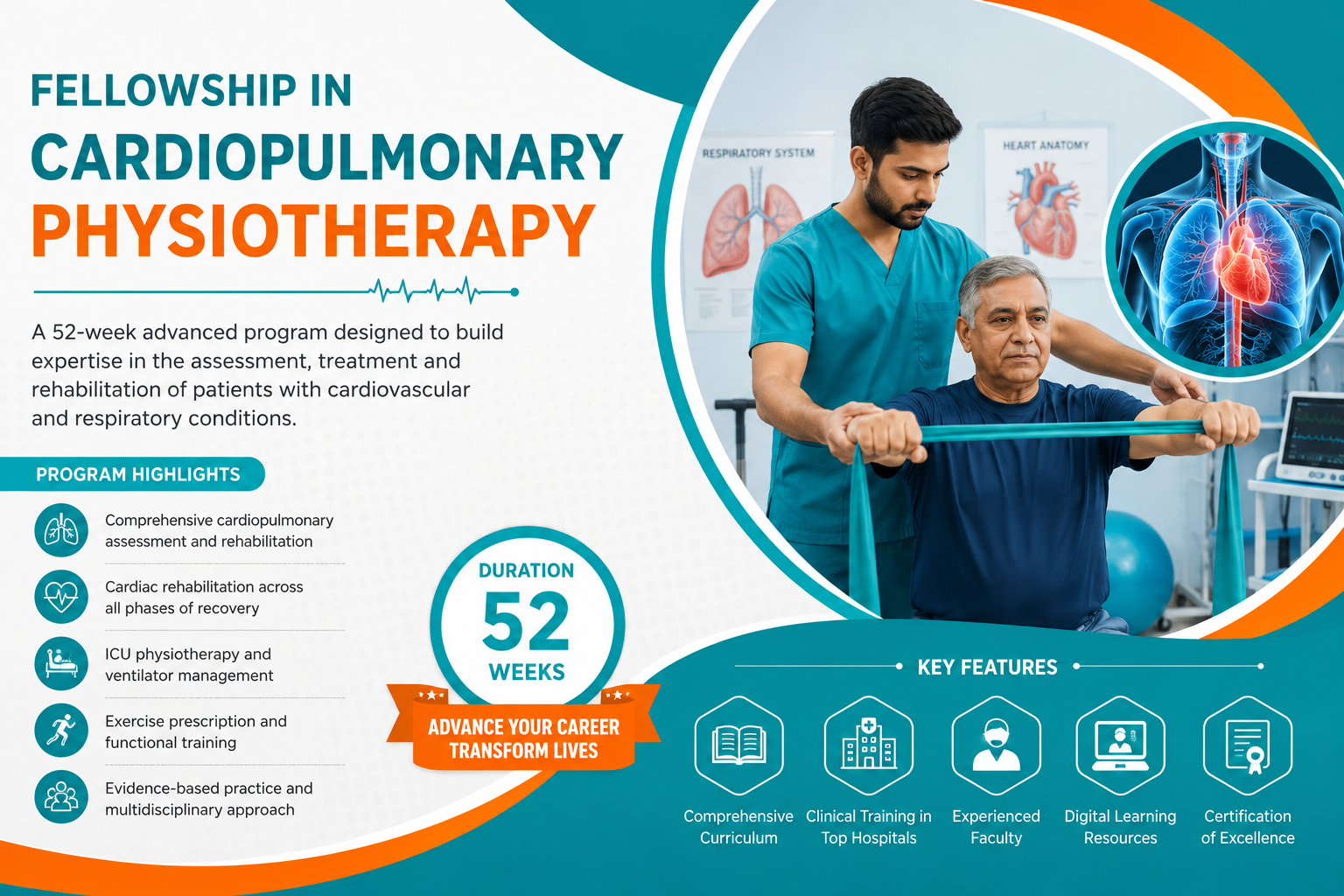

The Fellowship in Cardiopulmonary Physiotherapy is a comprehensive 52-week advanced training program designed to equip physiotherapists with specialized knowledge and practical skills in the assessment, treatment, and rehabilitation of patients with cardiovascular and respiratory disorders. The curriculum covers cardiopulmonary assessment, respiratory physiotherapy techniques, cardiac and pulmonary rehabilitation, critical care physiotherapy, exercise prescription, ICU management, and evidence-based clinical practice. Through hands-on clinical training and multidisciplinary learning, graduates develop the expertise required to improve patient outcomes, enhance functional capacity, and deliver high-quality cardiopulmonary rehabilitation across acute, chronic, and community healthcare settings.
The Fellowship in Cardiopulmonary Physiotherapy is a comprehensive 52-week advanced training program designed for physiotherapists seeking to specialize in the prevention, assessment, treatment, and rehabilitation of patients with cardiovascular and respiratory disorders. As the global burden of heart and lung diseases continues to rise, there is an increasing demand for skilled physiotherapists who can deliver evidence-based rehabilitation, improve functional capacity, enhance quality of life, and support long-term recovery across a variety of healthcare settings.
This fellowship combines advanced theoretical knowledge with intensive clinical training to prepare learners for independent practice in hospitals, cardiac rehabilitation centers, pulmonary rehabilitation units, intensive care units (ICUs), outpatient clinics, sports medicine facilities, and community healthcare organizations. The curriculum emphasizes patient-centered care, multidisciplinary collaboration, clinical reasoning, and evidence-based decision-making to ensure graduates are equipped with the competencies required in modern cardiopulmonary rehabilitation.
Throughout the program, participants gain a deep understanding of cardiovascular and respiratory anatomy, physiology, pathophysiology, diagnostic procedures, and therapeutic interventions. They develop expertise in respiratory physiotherapy techniques, airway clearance methods, breathing retraining, exercise prescription, cardiac rehabilitation, pulmonary rehabilitation, mechanical ventilation support, early mobilization in critical care, and long-term disease management. The course also integrates current clinical guidelines, rehabilitation technologies, digital health applications, and research methodologies to prepare graduates for leadership roles in clinical practice and academia.
Course Objectives
The fellowship aims to:
- Develop advanced clinical knowledge in cardiopulmonary physiotherapy.
- Build expertise in comprehensive cardiovascular and respiratory assessment.
- Master evidence-based respiratory physiotherapy techniques and airway clearance methods.
- Train participants in cardiac rehabilitation across all phases of recovery.
- Enhance competency in pulmonary rehabilitation for chronic respiratory diseases.
- Develop skills in ICU physiotherapy, mechanical ventilation, and early mobilization.
- Improve exercise prescription and functional rehabilitation planning.
- Strengthen clinical reasoning and evidence-based decision-making.
- Promote multidisciplinary teamwork and effective patient communication.
- Prepare graduates for leadership, research, and teaching roles in cardiopulmonary physiotherapy.
What You Will Learn
During this 52-week fellowship, learners will gain practical and theoretical expertise in:
- Cardiovascular and respiratory anatomy and physiology
- Clinical assessment and functional evaluation
- Pulmonary function testing
- ECG interpretation for physiotherapists
- Respiratory physiotherapy techniques
- Airway clearance and secretion management
- Breathing exercises and respiratory muscle training
- Cardiac rehabilitation programs
- Pulmonary rehabilitation strategies
- Exercise physiology and therapeutic exercise prescription
- ICU physiotherapy and ventilator management
- Early mobilization of critically ill patients
- Management of COPD, asthma, heart failure, coronary artery disease, and pulmonary hypertension
- Postoperative cardiothoracic rehabilitation
- Pediatric and geriatric cardiopulmonary rehabilitation
- Post-COVID and Long COVID rehabilitation
- Tele-rehabilitation and digital healthcare technologies
- Research methodology and evidence-based practice
- Clinical audits and quality improvement
Clinical Training
A key feature of the fellowship is its extensive supervised clinical experience. Participants rotate through multiple healthcare settings where they apply theoretical knowledge to real patient care under the guidance of experienced clinicians.
Clinical exposure includes:
- Cardiology departments
- Pulmonary medicine units
- Intensive Care Units (ICUs)
- Coronary Care Units (CCUs)
- Cardiothoracic surgery wards
- Pulmonary rehabilitation centers
- Cardiac rehabilitation clinics
- General medical wards
- Outpatient physiotherapy departments
- Community rehabilitation programs
Learners participate in patient assessments, treatment planning, rehabilitation sessions, multidisciplinary rounds, case discussions, and clinical presentations to build confidence and professional competence.
Skills You Will Develop
By the end of the program, participants will be able to:
- Perform comprehensive cardiopulmonary assessments.
- Interpret clinical findings and diagnostic reports.
- Design individualized rehabilitation programs.
- Deliver effective airway clearance and breathing interventions.
- Prescribe safe and progressive exercise programs.
- Manage patients before and after cardiac or thoracic surgery.
- Provide physiotherapy for mechanically ventilated patients.
- Support ICU recovery through early mobilization.
- Educate patients and caregivers on disease management and lifestyle modification.
- Utilize rehabilitation technologies and digital health tools.
- Conduct clinical research and critically evaluate scientific literature.
- Work effectively within multidisciplinary healthcare teams.
Career Opportunities
Graduates of the Fellowship in Cardiopulmonary Physiotherapy are well prepared for advanced clinical and academic roles in healthcare. Career opportunities include:
- Cardiopulmonary Physiotherapist
- Cardiac Rehabilitation Specialist
- Pulmonary Rehabilitation Physiotherapist
- Critical Care Physiotherapist
- ICU Physiotherapist
- Cardiothoracic Physiotherapist
- Respiratory Care Physiotherapist
- Clinical Rehabilitation Specialist
- Hospital Physiotherapy Consultant
- Rehabilitation Program Coordinator
- Research Associate
- Clinical Educator and Academic Faculty
- Community Rehabilitation Specialist
- Tele-rehabilitation Consultant
- Healthcare Quality Improvement Specialist
Employment opportunities are available in:
- Multispecialty hospitals
- Cardiac specialty hospitals
- Pulmonary rehabilitation centers
- Intensive Care Units
- Government healthcare institutions
- Rehabilitation hospitals
- Sports medicine centers
- Home healthcare services
- Academic institutions
- Research organizations
- Corporate wellness programs
- Community health centers
Who Should Enroll?
This fellowship is ideal for:
- Bachelor of Physiotherapy (BPT) graduates
- Master of Physiotherapy (MPT) graduates
- Licensed physiotherapists
- Rehabilitation professionals
- Critical care physiotherapists
- Cardiac rehabilitation professionals
- Pulmonary rehabilitation therapists
- Physiotherapy educators seeking advanced specialization
Assessment and Certification
Assessment is continuous throughout the program and includes written examinations, practical skill assessments, Objective Structured Clinical Examinations (OSCEs), case presentations, reflective portfolios, clinical logbooks, research assignments, and a final capstone project. Successful participants who meet all academic and clinical requirements will be awarded the Fellowship in Cardiopulmonary Physiotherapy, recognizing advanced competence in cardiopulmonary rehabilitation and evidence-based physiotherapy practice.
Why Choose This Fellowship?
This program is designed to meet the evolving needs of modern healthcare by integrating advanced clinical education with practical experience. Learners benefit from a comprehensive curriculum, expert faculty guidance, supervised clinical rotations, multidisciplinary exposure, and training in the latest rehabilitation technologies. Upon completion, graduates possess the specialized knowledge, practical skills, and professional confidence needed to deliver high-quality cardiopulmonary physiotherapy services across acute care, rehabilitation, and community healthcare settings while contributing to improved patient outcomes and advancing the profession.
- 12 Sections
- 73 Lessons
- 52 Weeks
- Foundations of Cardiopulmonary PhysiotherapyThis module introduces learners to the fundamental principles of cardiopulmonary physiotherapy, including the anatomy and physiology of the cardiovascular and respiratory systems. Students will develop a strong understanding of disease mechanisms, patient assessment, professional ethics, and evidence-based physiotherapy practice. The module establishes the scientific foundation required for advanced cardiopulmonary rehabilitation and clinical decision-making.6
- Clinical Assessment and Diagnostic TechniquesThis module focuses on comprehensive patient assessment techniques used in cardiopulmonary physiotherapy. Learners will gain practical skills in history taking, physical examination, respiratory assessment, cardiovascular evaluation, functional capacity testing, and interpretation of diagnostic investigations to formulate individualized treatment plans.6
- Respiratory Physiotherapy TechniquesStudents will learn therapeutic interventions for respiratory disorders, including airway clearance techniques, breathing exercises, secretion management, lung expansion strategies, and oxygen therapy. The module emphasizes evidence-based respiratory care across acute and chronic conditions.6
- Cardiovascular Physiotherapy and RehabilitationThis module provides comprehensive training in cardiac rehabilitation, exercise prescription, monitoring, and risk management for patients with cardiovascular diseases. Learners will understand rehabilitation phases and individualized treatment planning for cardiac patients.6
- Pulmonary RehabilitationThis module explores pulmonary rehabilitation programs for chronic respiratory diseases. Students will learn multidisciplinary approaches to improve exercise tolerance, respiratory function, and quality of life through individualized rehabilitation strategies.6
- Critical Care and ICU PhysiotherapyLearners will develop competencies in managing critically ill patients in intensive care settings. The module covers ventilator management, early mobilization, respiratory support techniques, and interdisciplinary ICU care to reduce complications and improve patient outcomes.7
- Cardiopulmonary Physiotherapy in Special PopulationsThis module focuses on specialized rehabilitation approaches for pediatric, geriatric, neurological, surgical, and oncology patients with cardiopulmonary conditions. Students will adapt interventions according to patient-specific needs and functional limitations.6
- Exercise Physiology and Therapeutic ExerciseStudents will study exercise physiology, fitness assessment, endurance training, resistance exercises, and aerobic conditioning. The module emphasizes individualized exercise planning to enhance cardiopulmonary health and functional independence.6
- Management of Cardiopulmonary DisordersThis module covers physiotherapy management of common cardiopulmonary diseases using current clinical guidelines and evidence-based interventions. Students will develop clinical reasoning skills for effective rehabilitation planning.6
- Advanced Therapeutic TechnologiesLearners will explore modern rehabilitation technologies, digital monitoring systems, respiratory devices, tele-rehabilitation, and wearable technologies used in cardiopulmonary physiotherapy practice.6
- Research, Leadership, and Quality ImprovementThis module develops research methodology, leadership, quality improvement, healthcare management, and professional development skills necessary for advanced clinical practice and academic growth.6
- Clinical Internship and Capstone ProjectThe final module provides supervised clinical training in hospitals and rehabilitation centers. Learners will integrate theoretical knowledge with clinical practice while completing a capstone project demonstrating competency in cardiopulmonary physiotherapy.6
You might be intersted in
-
0 Students
-
52 Weeks
-
133 Students
-
52 Weeks
-
129 Students
-
52 Weeks
-
139 Students
-
52 Weeks