Australia remains one of the most sought-after destinations for internationally qualified healthcare professionals, including doctors, nurses, pharmacists, physiotherapists, dentists, and allied health practitioners. However, one of the most important steps toward professional registration is meeting the English Language Skills (ELS) standard set by the Australian Health Practitioner Regulation Agency (AHPRA).
In 2026, AHPRA introduced significant updates to its English language requirements, causing many healthcare professionals to wonder: “Is my English test score still valid?” If you have already taken IELTS, OET, PTE Academic, TOEFL iBT, or Cambridge English exams, understanding these changes is crucial before submitting your registration application.
This guide explains the latest AHPRA English language updates, who is affected, whether your current score remains valid, and what actions you should take.
Why Did AHPRA Change the English Language Requirements?
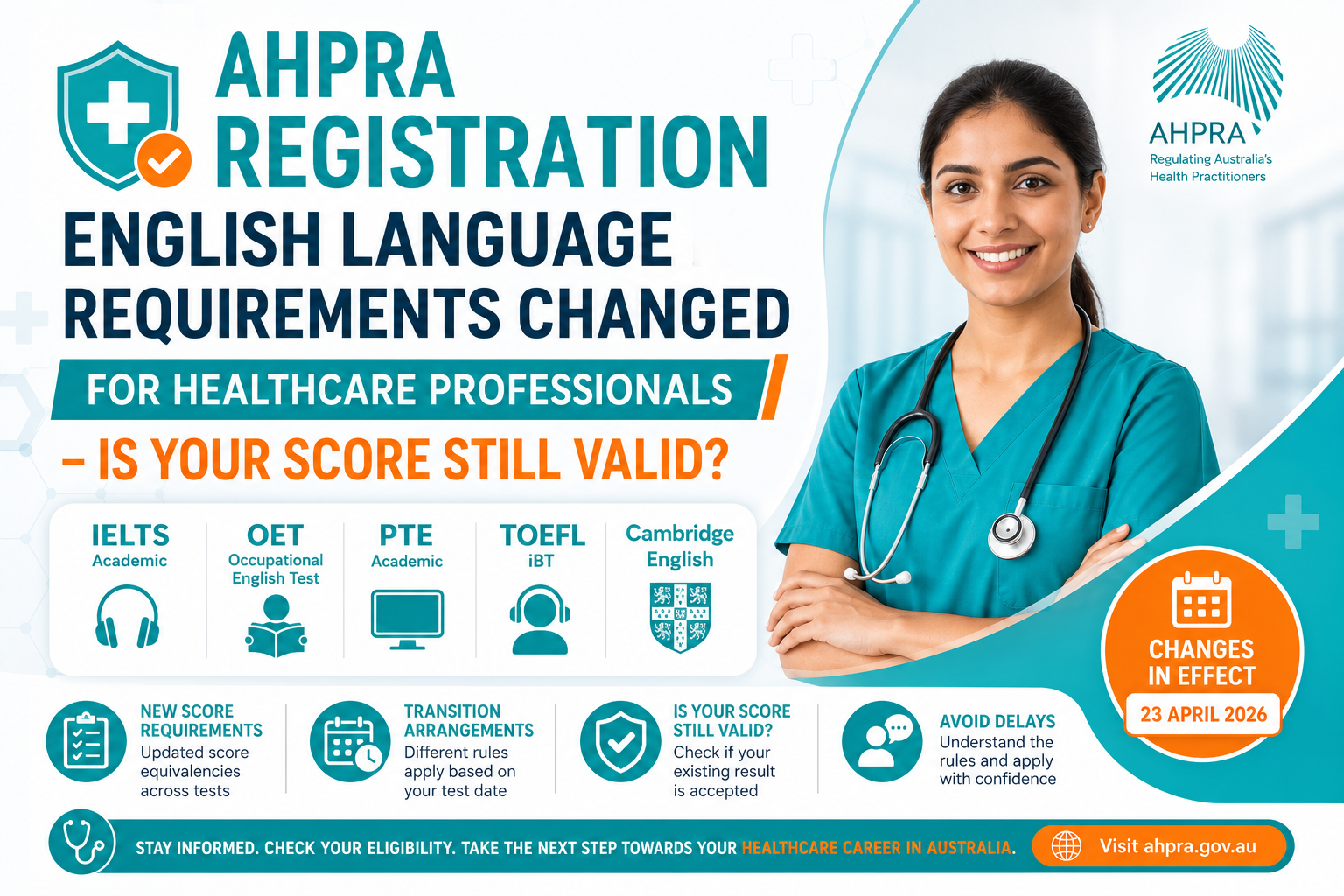
Effective from 23 April 2026, AHPRA and the National Boards updated the minimum scores required for accepted English language tests. The changes were introduced to align with the latest score concordance research published by testing organizations and the updated English language standards adopted by Australia’s Department of Home Affairs for migration purposes. Importantly, AHPRA clarified that the actual level of English proficiency required for safe healthcare practice has not changed; only the score equivalencies across different testing systems have been adjusted.
The goal is to ensure fairness and consistency among all accepted English language tests while maintaining patient safety and professional communication standards. AHPRA updated its English Language Skills (ELS) registration standard to ensure greater consistency, fairness, and accuracy across all accepted English language tests used by healthcare professionals seeking registration in Australia. The changes were introduced following updated research on score equivalencies between tests such as IELTS, OET, PTE Academic, TOEFL iBT, and Cambridge English examinations. As testing organizations periodically review and recalibrate their scoring systems, AHPRA revised the required scores to better align equivalent levels of English proficiency across different exams. Importantly, the update does not mean that healthcare professionals are expected to demonstrate a higher level of English than before. Instead, the changes ensure that candidates taking different English language tests are assessed against a comparable standard of communication skills necessary for safe and effective healthcare practice. The revised requirements also align more closely with contemporary regulatory expectations and support AHPRA’s commitment to maintaining patient safety, professional communication, and high-quality healthcare services throughout Australia
Which English Tests Does AHPRA Accept?
To demonstrate English language proficiency for registration, AHPRA accepts several internationally recognized English language examinations that assess a healthcare professional’s ability to communicate effectively in clinical and professional settings. These include the International English Language Testing System (IELTS Academic), the Occupational English Test (OET), which is specifically designed for healthcare professions, the Pearson Test of English (PTE Academic), TOEFL iBT, and Cambridge English qualifications, including C1 Advanced and C2 Proficiency. Applicants can choose the test that best suits their learning style and professional background, provided they achieve the minimum scores required under AHPRA’s English Language Skills registration standard. In addition, certain medical practitioners may be able to satisfy English language requirements through alternative pathways, such as successful completion of the Professional and Linguistic Assessments Board (PLAB) test in the United Kingdom or the New Zealand Registration Examination (NZREX), subject to specific eligibility criteria and registration requirements. These approved pathways help ensure that all registered healthcare professionals possess the communication skills necessary to provide safe, effective, and patient-centered care in Australia.
The Most Important Date: 23 April 2026
One of the most critical factors in determining whether your English language test score remains valid for AHPRA registration is the date on which you completed the examination. AHPRA introduced its revised English Language Skills (ELS) standard on 23 April 2026, creating a clear distinction between scores obtained before and after this date. Candidates who sat an approved English language test on or before 22 April 2026 will generally have their results assessed according to the previous score requirements, provided the results are still within AHPRA’s accepted validity period. In most cases, these candidates can continue to use their existing scores for registration without needing to retake the test. However, applicants who completed their English language test on or after 23 April 2026 must meet the updated score requirements outlined in the revised ELS standard. For candidates who choose to combine scores from two test sittings, AHPRA permits score combining from a maximum of two attempts completed within a 12-month period, provided both tests are from the same testing provider. If one sitting occurred before the implementation date and the second after, each result will be assessed according to the score requirements that were in effect when that particular test was taken. Understanding this transition date is essential, as it determines which scoring framework applies to your application and whether your existing English language test results remain acceptable for registration.
What Changed in the English Test Scores?
The 2026 update to AHPRA’s English Language Skills (ELS) standard introduced several adjustments to the score requirements for accepted English language tests. While the overall level of English proficiency expected from healthcare professionals has not increased, the score equivalencies across different testing systems have been recalibrated to better reflect current research and international benchmarking standards. For IELTS Academic, the requirements remain largely unchanged, requiring an overall score of 7.0, with minimum scores of 7.0 in Listening, Reading, and Speaking, and 6.5 in Writing. This slight flexibility in the Writing component provides applicants with more options while still ensuring strong communication skills. One of the most significant changes affects the Occupational English Test (OET), where the traditional letter-grade system has transitioned to numerical scoring for tests taken on or after 23 April 2026. Previously, candidates needed Grade B in Listening, Reading, and Speaking, along with Grade C+ in Writing. Under the revised framework, candidates must achieve scores of 350 in Listening and Writing and 360 in Reading and Speaking. Similarly, PTE Academic, TOEFL iBT, and Cambridge English examinations have undergone score recalibrations to align more accurately with IELTS equivalencies and contemporary language assessment standards. As a result, healthcare professionals planning to register with AHPRA should carefully review the latest score requirements applicable to their chosen test before submitting an application.
Are Your Existing Scores Still Valid?
For many internationally qualified healthcare professionals, existing English language test results may still be valid despite the changes introduced in 2026. AHPRA’s transition arrangements were designed to ensure that candidates who completed their English language tests before the implementation of the new standards are not unfairly disadvantaged. Your score may continue to be accepted if the test was completed within AHPRA’s approved validity period, you achieved the minimum score requirements that applied at the time of testing, and your application falls within the transition provisions established by AHPRA. Additionally, applicants must still satisfy any profession-specific registration requirements relevant to their field of practice. The updated English language standards do not automatically invalidate previously accepted results; instead, AHPRA assesses test scores according to the rules that were in effect when the examination was taken. Therefore, many candidates who successfully met the previous requirements may still use their existing scores for registration, provided all other eligibility criteria are met. Understanding these transition arrangements is essential to determine whether a retest is necessary or whether your current English language results remain suitable for AHPRA registration.
How Long Are English Test Results Valid?
For most healthcare professionals applying for registration in Australia, English language test results are generally considered valid for two years from the date of the test. This validity period applies to accepted examinations such as IELTS Academic, OET, PTE Academic, TOEFL iBT, and Cambridge English. However, AHPRA recognizes that some applicants may continue to develop and maintain their English language proficiency through professional practice or academic study conducted in English. As a result, the English Language Skills standard includes specific pathways that may allow applicants to rely on older test results if they can demonstrate continuous employment, education, or professional practice in an English-speaking environment and meet other eligibility requirements. Because these provisions vary depending on an applicant’s circumstances and registration pathway, healthcare professionals should carefully review the relevant AHPRA requirements before submitting an application. Ensuring that your test results remain valid and meet the applicable standards can help prevent delays and improve the likelihood of a smooth registration process.
Common Mistakes Healthcare Professionals Should Avoid
When applying for AHPRA registration, many healthcare professionals unintentionally make mistakes that can delay their application or even result in additional testing requirements. One of the most common errors is assuming that previously obtained English language test scores automatically meet the new 2026 requirements. In reality, AHPRA assesses results based on the date the test was taken, so applicants should carefully review which scoring framework applies to their situation. Another frequent mistake is attempting to combine scores from different test providers, such as using IELTS and PTE Academic results together. AHPRA only permits score combining from a maximum of two sittings of the same test provider, making mixed-test combinations unacceptable. Candidates should also be aware that AHPRA does not accept remotely proctored or at-home versions of English language tests; all examinations must be completed at approved testing centres to be considered valid for registration purposes. Additionally, many applicants overlook the importance of transition arrangements introduced alongside the April 2026 changes. Those who completed tests around the implementation period should carefully examine the transition rules to determine whether the previous or revised score requirements apply. Taking the time to understand these requirements can help healthcare professionals avoid unnecessary complications and ensure a smoother registration process with AHPRA.
What Should You Do Next?
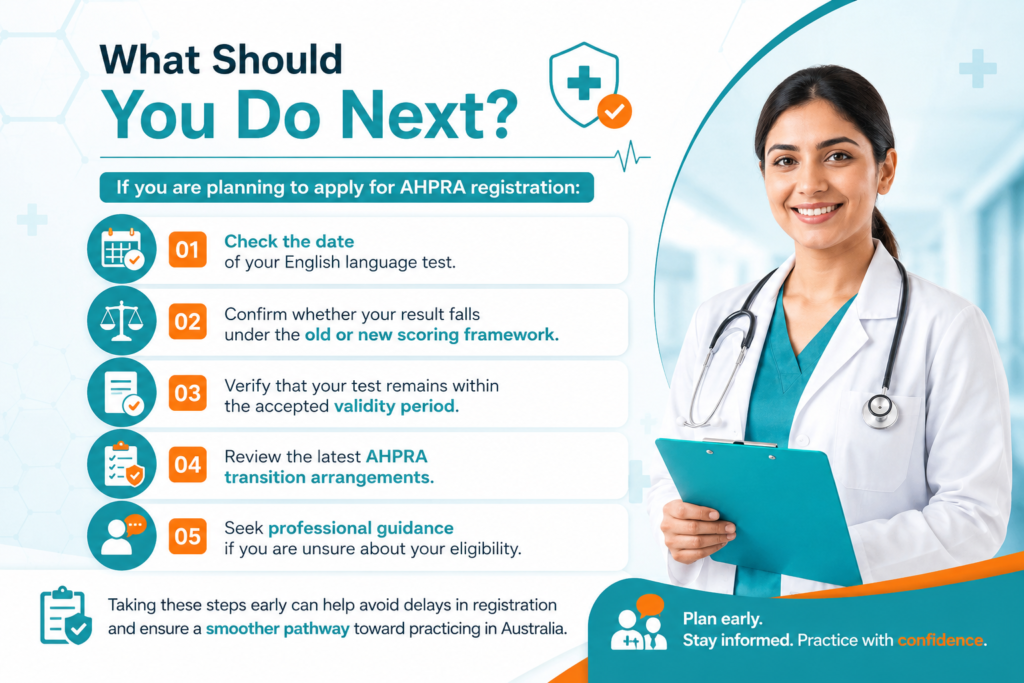
Taking these steps early can help avoid delays in registration and ensure a smoother pathway toward practicing in Australia.
Conclusion
The changes to AHPRA’s English Language Skills (ELS) standard introduced in 2026 have raised many questions among internationally qualified healthcare professionals planning to work in Australia. While the updated requirements may initially seem complex, it is important to understand that AHPRA has not increased the overall level of English proficiency expected from applicants. Instead, the changes primarily involve revised score equivalencies and updated assessment frameworks designed to ensure consistency across accepted English language tests such as IELTS Academic, OET, PTE Academic, TOEFL iBT, and Cambridge English examinations. The key factor in determining whether your existing score remains valid is the date on which you completed your test, as AHPRA has established clear transition arrangements to protect candidates who sat their examinations before the new standards came into effect on 23 April 2026. Healthcare professionals should carefully review their test dates, score reports, validity periods, and any applicable score-combining rules before submitting a registration application. Understanding these requirements can help avoid unnecessary delays, additional testing costs, and potential registration complications. As Australia continues to welcome skilled healthcare professionals from around the world, staying informed about AHPRA’s latest registration standards is essential for a successful migration and career pathway. By taking the time to verify your eligibility and ensure compliance with the updated English language requirements, you can move forward with confidence and focus on achieving your professional goals in the Australian healthcare system.