
Fellowship in Skull Base Surgery
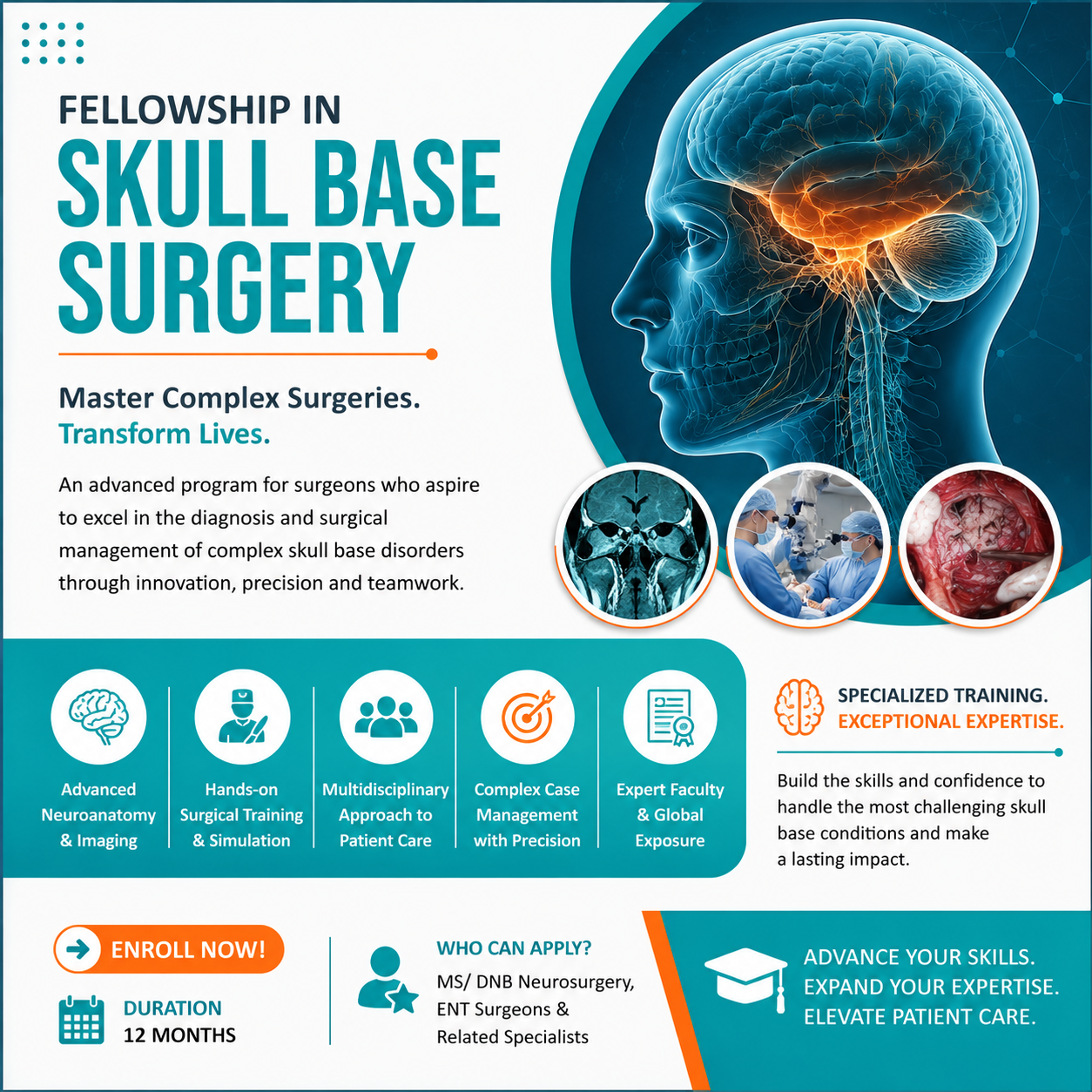

The Fellowship in Skull Base Surgery is a comprehensive 52-week advanced training program designed for neurosurgeons, ENT surgeons, and related specialists seeking expertise in the diagnosis and surgical management of complex skull base disorders. The curriculum covers skull base anatomy, advanced imaging, endoscopic and open surgical approaches, microsurgical techniques, vascular surgery, reconstruction, perioperative care, complication management, and research. Through multidisciplinary learning, case-based discussions, and hands-on clinical exposure, participants develop the skills required to perform safe, precise, and evidence-based skull base procedures while improving patient outcomes.
The Fellowship in Skull Base Surgery is a comprehensive 52-week advanced training program designed for neurosurgeons, otolaryngologists (ENT surgeons), head and neck surgeons, and other qualified medical professionals seeking specialized expertise in the diagnosis and surgical management of complex skull base disorders. The fellowship combines in-depth theoretical education, multidisciplinary clinical training, advanced surgical techniques, and evidence-based practice to prepare participants for the challenges of modern skull base surgery.
The skull base is one of the most anatomically complex regions of the human body, containing vital neurovascular structures, cranial nerves, and the interface between the brain, face, and upper cervical spine. Surgical management of lesions in this region requires exceptional anatomical knowledge, meticulous microsurgical skills, and expertise in both open and minimally invasive endoscopic approaches. This fellowship is designed to equip participants with these competencies through a structured curriculum spanning 52 weeks.
The program begins with the fundamentals of skull base surgery, introducing the history, evolution, principles, and multidisciplinary nature of the specialty. Fellows develop a strong understanding of skull base anatomy, including the anterior, middle, and posterior cranial fossae, cranial nerves, cerebral vasculature, temporal bone anatomy, and surrounding structures. This detailed anatomical foundation enables safe surgical planning and precise operative execution.
A significant component of the fellowship focuses on advanced diagnostic imaging and preoperative assessment. Participants learn to interpret CT scans, MRI, MR angiography, CT angiography, digital subtraction angiography, and neuronavigation imaging. They develop the ability to evaluate complex skull base lesions, formulate surgical strategies, assess operative risks, and plan individualized treatment pathways based on evidence-based clinical guidelines.
The curriculum provides extensive training in the management of a wide range of skull base pathologies, including meningiomas, vestibular schwannomas, pituitary adenomas, craniopharyngiomas, chordomas, chondrosarcomas, glomus tumors, cerebrospinal fluid leaks, vascular lesions, congenital abnormalities, inflammatory disorders, and traumatic skull base injuries. Fellows learn patient selection, surgical indications, conservative management options, and postoperative follow-up strategies for each condition.
One of the core strengths of the fellowship is its comprehensive coverage of endoscopic skull base surgery. Participants gain expertise in endoscopic instrumentation, endonasal anatomy, expanded endoscopic approaches, pituitary surgery, tumor excision, cerebrospinal fluid leak repair, and minimally invasive reconstruction techniques. Emphasis is placed on surgical safety, complication avoidance, and preservation of neurological function while maximizing tumor resection.
The fellowship also provides advanced instruction in open skull base surgical approaches, including pterional, orbitozygomatic, retrosigmoid, subtemporal, far lateral, and transpetrosal techniques. Fellows understand the indications, advantages, limitations, and technical nuances of each approach, enabling them to select the most appropriate surgical corridor for individual patients.
Microsurgical skill development forms a vital component of the program. Under expert guidance, participants refine microdissection techniques, cranial nerve preservation strategies, vascular control methods, hemostatic techniques, and high-magnification surgical procedures. Practical sessions emphasize precision, dexterity, and safe handling of delicate neurovascular structures using advanced microsurgical instruments and operating microscopes.
The fellowship also explores vascular skull base surgery, including management of aneurysms, arteriovenous malformations, cavernous sinus lesions, carotid artery pathology, cerebral bypass procedures, and intraoperative vascular monitoring. Participants gain an understanding of complex vascular anatomy and modern approaches to treating cerebrovascular disorders involving the skull base.
Reconstruction following skull base surgery is another essential aspect of the curriculum. Fellows learn dural repair, vascularized flap techniques, free tissue transfer, nasoseptal flap reconstruction, graft selection, cerebrospinal fluid leak prevention, cosmetic restoration, and long-term reconstructive outcomes. The program emphasizes restoring anatomical integrity while minimizing complications and improving patient recovery.
Comprehensive perioperative management is integrated throughout the fellowship. Participants study neuroanesthesia, intraoperative neuromonitoring, intensive care management, postoperative neurological assessment, infection prevention, pain management, rehabilitation, nutritional support, and multidisciplinary postoperative care. These skills ensure safe patient management throughout the surgical journey.
The fellowship also addresses the recognition, prevention, and management of surgical complications such as cerebrospinal fluid leaks, vascular injury, cranial nerve deficits, infection, wound complications, and revision skull base surgery. Fellows participate in case discussions and morbidity and mortality reviews to strengthen clinical judgment and improve patient safety.
In addition to clinical excellence, the program encourages research and academic development. Participants receive training in research methodology, biostatistics, literature review, evidence-based medicine, scientific writing, clinical audits, and quality improvement initiatives. Each fellow completes a supervised research or capstone project, promoting lifelong learning and contribution to the advancement of skull base surgery.
Throughout the 52-week fellowship, learners engage in multidisciplinary tumor board meetings, operative observations, case presentations, simulation-based training, journal clubs, and faculty-led discussions. Continuous assessment through practical evaluations, logbook reviews, clinical presentations, and final examinations ensures the achievement of professional competencies expected of modern skull base surgeons.
Upon successful completion of the Fellowship in Skull Base Surgery, graduates will possess advanced knowledge of skull base anatomy, pathology, surgical planning, endoscopic and open operative techniques, microsurgical principles, reconstruction methods, perioperative care, and research methodology. They will be equipped to work effectively within multidisciplinary teams and provide safe, ethical, and evidence-based care for patients with complex skull base disorders, contributing to improved surgical outcomes and excellence in neurosurgical and skull base practice.
- 12 Sections
- 72 Lessons
- 52 Weeks
- Foundations of Skull Base SurgeryThis introductory module provides a comprehensive overview of skull base surgery, including its history, principles, surgical anatomy, indications, and multidisciplinary approach. Learners will understand the classifications of skull base lesions, patient selection, surgical planning, and the essential roles of neurosurgeons, otolaryngologists, radiologists, anesthesiologists, and rehabilitation specialists.6
- Surgical Anatomy of the Skull BaseThis module focuses on the intricate anatomy of the anterior, middle, and posterior skull base. Participants will study cranial nerves, cerebral vasculature, temporal bone anatomy, paranasal sinuses, and important anatomical landmarks critical for safe surgical navigation.6
- Diagnostic Imaging and Preoperative AssessmentLearners will develop expertise in interpreting imaging studies essential for skull base surgery. This module covers CT, MRI, angiography, PET imaging, functional imaging, and radiological planning for various skull base pathologies.6
- Skull Base PathologyThis module explores benign and malignant skull base tumors, vascular lesions, congenital abnormalities, inflammatory diseases, and traumatic injuries. Participants will understand pathology, clinical presentation, diagnosis, and management strategies.6
- Endoscopic Skull Base SurgeryThis module introduces minimally invasive endoscopic skull base surgery. Learners gain practical knowledge of instrumentation, endoscopic anatomy, surgical corridors, tumor excision techniques, and complication management.6
- Open Skull Base Surgical ApproachesParticipants will learn conventional skull base approaches, indications, patient positioning, bone work, soft tissue management, and operative planning for complex cranial base lesions.6
- Microsurgical TechniquesThis module develops microsurgical skills required for skull base surgery, emphasizing delicate tissue handling, cranial nerve preservation, vascular control, and high-magnification surgical procedures.6
- Vascular Skull Base SurgeryLearners study the management of vascular lesions involving the skull base, including aneurysms, AVMs, carotid artery pathology, bypass surgery, and intraoperative vascular monitoring.6
- Skull Base ReconstructionThis module focuses on reconstruction following skull base surgery, including flap design, graft materials, CSF leak prevention, cosmetic restoration, and postoperative wound care.6
- Perioperative and Critical Care ManagementParticipants will learn perioperative optimization, neuroanesthesia, ICU care, postoperative monitoring, infection prevention, pain management, and rehabilitation following skull base procedures.6
- Complications and Advanced Skull Base ProceduresThis advanced module addresses complex skull base procedures, management of intraoperative and postoperative complications, revision surgery, cranial nerve deficits, vascular injuries, and emerging technologies including robotics and augmented reality.6
- Clinical Training, Research, and Capstone ProjectThe final module integrates clinical experience, multidisciplinary case discussions, research methodology, surgical audits, evidence-based practice, and a supervised capstone project. Learners demonstrate competency through operative observations, case presentations, and final assessments.6
You might be intersted in
-
0 Students
-
52 Weeks
-
133 Students
-
52 Weeks
-
129 Students
-
52 Weeks
-
139 Students
-
52 Weeks