
Fellowship in Rheumatology
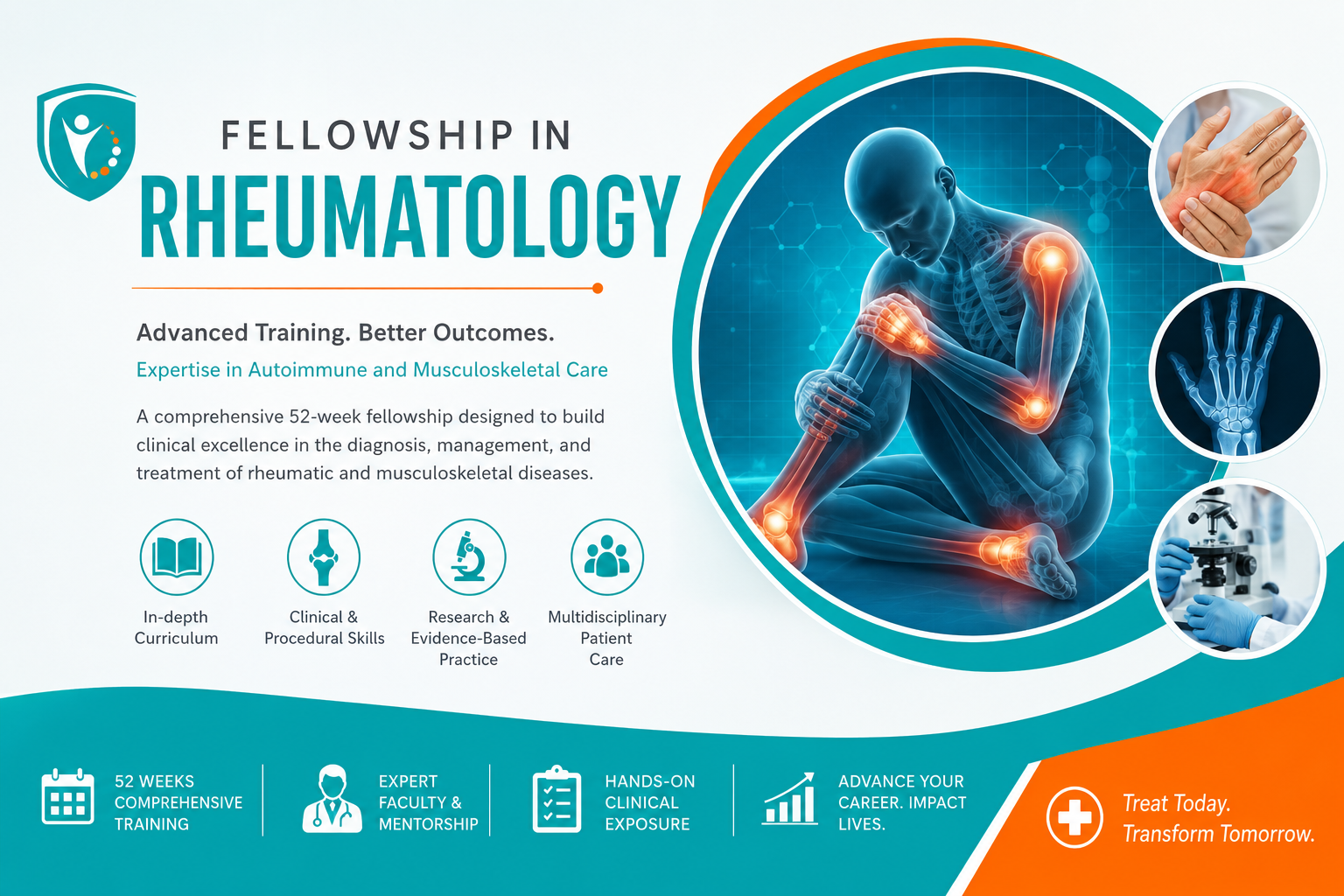

The Fellowship in Rheumatology is a comprehensive 52-week advanced training program designed for healthcare professionals seeking specialized expertise in the diagnosis, management, and treatment of rheumatic and musculoskeletal diseases. This fellowship provides an in-depth understanding of autoimmune disorders, inflammatory arthritis, …
The Fellowship in Rheumatology is a comprehensive 52-week advanced training program designed for healthcare professionals seeking specialized expertise in the diagnosis, management, and treatment of rheumatic and musculoskeletal diseases. This fellowship provides an in-depth understanding of autoimmune disorders, inflammatory arthritis, connective tissue diseases, vasculitis, metabolic bone disorders, and other complex rheumatologic conditions that require specialized clinical care.
The program combines theoretical knowledge with practical clinical training, enabling participants to develop proficiency in evaluating patients with acute and chronic rheumatic diseases. Fellows gain a strong foundation in immunology, musculoskeletal medicine, diagnostic imaging, laboratory investigations, and evidence-based therapeutic approaches. The curriculum is structured to help learners understand the pathophysiology of rheumatic diseases while developing the clinical skills necessary for accurate diagnosis and effective treatment planning.
Throughout the fellowship, participants explore a broad range of rheumatologic conditions, including rheumatoid arthritis, systemic lupus erythematosus, ankylosing spondylitis, psoriatic arthritis, systemic sclerosis, Sjögren’s syndrome, vasculitis syndromes, gout, osteoporosis, and fibromyalgia. Special emphasis is placed on the use of disease-modifying antirheumatic drugs (DMARDs), biologic therapies, targeted therapies, and individualized patient care strategies that improve long-term outcomes.
The fellowship also provides extensive training in musculoskeletal examination techniques, joint aspiration and injection procedures, synovial fluid analysis, and interpretation of radiological and ultrasound findings. Fellows learn to integrate clinical findings with laboratory and imaging data to establish accurate diagnoses and monitor disease progression. The program further highlights multidisciplinary collaboration, ensuring participants understand the roles of rehabilitation specialists, physiotherapists, orthopedic surgeons, nephrologists, dermatologists, and other healthcare professionals involved in comprehensive rheumatology care.
In addition to clinical training, the program emphasizes research methodology, biostatistics, medical ethics, clinical governance, and quality improvement initiatives. Fellows are encouraged to engage in scholarly activities, critically appraise scientific literature, and contribute to research projects that advance the field of rheumatology. These experiences help develop analytical thinking, academic leadership, and evidence-based decision-making skills.
The curriculum also addresses special populations, including pediatric and geriatric patients, as well as the management of rheumatic diseases during pregnancy and in patients with multiple comorbidities. Participants gain exposure to rheumatologic emergencies and complex clinical scenarios, preparing them to confidently manage challenging cases in diverse healthcare settings.
Upon successful completion of the Fellowship in Rheumatology, graduates will possess advanced competencies in clinical assessment, diagnostic evaluation, therapeutic management, procedural skills, patient counseling, and interdisciplinary collaboration. They will be well-equipped to practice as skilled rheumatology specialists, contribute to academic and clinical research, and improve patient outcomes through high-quality, evidence-based care.
This fellowship is ideal for physicians and healthcare professionals seeking to advance their careers in rheumatology, autoimmune disease management, musculoskeletal medicine, and related subspecialties while developing expertise that meets contemporary clinical and research standards.
- 6 Sections
- 65 Lessons
- 52 Weeks
- General Approach to Arthritis and Joint Pain11
- 1.1Rheuma Case: 68-year-old Woman with Knee Pain
- 1.2Rheuma Case:73-year-old Woman with Shoulder Pain
- 1.3Rheuma Case: 33-year-oldMan with Posterior Heel Pain
- 1.4Approach to Arthritis: Review
- 1.5Rheuma Case: 54-year-oldMan with Shoulder
- 1.6Review: Shoulder Pathology and Anatomy
- 1.7Rotator Cuff Anatomy and Disease
- 1.8Adhesive Capsulitis(Frozen Shoulder)
- 1.9Rheuma Case: 54-year-old Woman with Acute Right Shoulder Pain
- 1.10Rheuma Case: 63-year-old Woman with Increasing Right Shoulder Pain
- 1.11Quick Review: Rheumatoid Arthritis
- Connective Tissue Diseases15
- 2.1Rheuma Case: 59-year-oldMan with Bilateral Wrist Pain and Swelling
- 2.2Rheumatoid Arthritis: Diagnosis, Pathogenesis, and Treatment
- 2.3Rheuma Case: 24-year-old Woman with Pleuritic Chest Pain and Dyspnea
- 2.4Systemic Lupus Erythematosus(SLE) Diagnostic Criteria (4-Skin-RASHNIA)
- 2.5Differential Diagnosisfor Systemic Lupus Erythematosus(SLE)
- 2.6Systemic Lupus Erythematosus(SLE): Complications and Management
- 2.7Rheuma Case: 57-year-oldMan with Muscle Weakness
- 2.8Inflammatory Myopathies: Types, Diagnosis, Manifestations, Treatment
- 2.9Quick Review: Inflammatory Myopathies
- 2.10Rheuma Case: 37-year-old Woman with Reflux and Facial Rash
- 2.11Systemic Sclerosis(CREST Syndrome): Complications and Management
- 2.12Quick Review: Systemic Sclerosis
- 2.13Rheuma Case: 54-year-old Woman with Seasonal Allergies
- 2.14Sjögren’s Syndrome: KeyFeatures and Management
- 2.15Quick Review: Sjögren’s Syndrome
- Spondyloarthritides8
- 3.1Spondyloarthritides
- 3.2Rheuma Case: 26-year-old Woman with PersistentLow Back Pain
- 3.3Ankylosing Spondylitis: Complications and Treatment
- 3.4Rheuma Case: 37-year-old Woman with Joint Pain
- 3.5Reactive Arthritis: Diagnosis and Management
- 3.6Rheuma Case: 46-year-oldMan with Increasing Pain/Swelling in Fingers
- 3.7Psoriatic Arthritis: Diagnosis and Management
- 3.8Quick Review: Spondyloarthritides
- Non-Autoimmune Arthritis13
- 4.1Rheuma Case: 52-year-oldMan with Chronic Right Knee Pain
- 4.2Osteoarthritis: Risk Factors and Radiography
- 4.3Rheuma Case: 49-year-old Woman with R Proximal Thumb Pain
- 4.4Osteoarthritis: Treatment
- 4.5Quick Review: Osteoarthritis
- 4.6Rheuma Case: 51-year-oldMan with R Knee and L Ankle Pain
- 4.7Gout: History, Pathophysiology
- 4.8Gout: Diagnosis and Treatment
- 4.9Pseudogout(CPPD)
- 4.10Quick Review: Gout and Pseudogout
- 4.11Rheuma Case: 48-year-oldMan with Fevers, R Knee Pain and Swelling
- 4.12Non-gonococcal Septic Arthritis: Initial Treatment and Management
- 4.13Quick Review: Septic Arthritis
- Vasculitides11
- 5.1Rheuma Case: 37-year-old Woman with Dyspnea and Abdominal Pain
- 5.2Vasculitis: Overview Polyarteritis Nodosa
- 5.3Anti-GBM Disease (Goodpasture’s)
- 5.4ANCA-associated Vasculitis
- 5.5Eosinophilic Granulomatosis with Polyangiitis: Diagnosis and Management
- 5.6Rheuma Case:14-year-old Girl with Abdominal Pain and Rash
- 5.7Kawasaki Disease: Features and Manifestations
- 5.8Large Vessel Vasculitides: Takayasu’s and Giant Cell Arteritis
- 5.9Cryoglobulinemic Vasculitis
- 5.10IgA Vasculitis(Henoch–Schönlein)
- 5.11Quick Review: Vasculitis
- Miscellaneous Joint-related Disorders7
- 6.1Rheuma Case: 27-year-oldMan with Cough and Dyspnea
- 6.2and Dyspnea Rheuma Case: 62-year-old Woman with Sore Legs and Dyspnea
- 6.3Sarcoidosis: Complications and Management
- 6.4Quick Review: Sarcoidosis
- 6.5Rheuma Case: 31-year-old Woman with Body Aches
- 6.6Body Aches Fibromyalgia: Diagnosis and Management
- 6.7Quick Review: Fibromyalgia
You might be intersted in
-
0 Students
-
52 Weeks
-
133 Students
-
52 Weeks
-
129 Students
-
52 Weeks
-
139 Students
-
52 Weeks