
Fellowship in Ultrasonography

Overview The Fellowship in Ultrasonography is a comprehensive 52-week advanced training program designed for healthcare professionals seeking specialized expertise in diagnostic ultrasound imaging. Ultrasonography has become one of the most widely used diagnostic tools in modern medicine due to its …
Overview
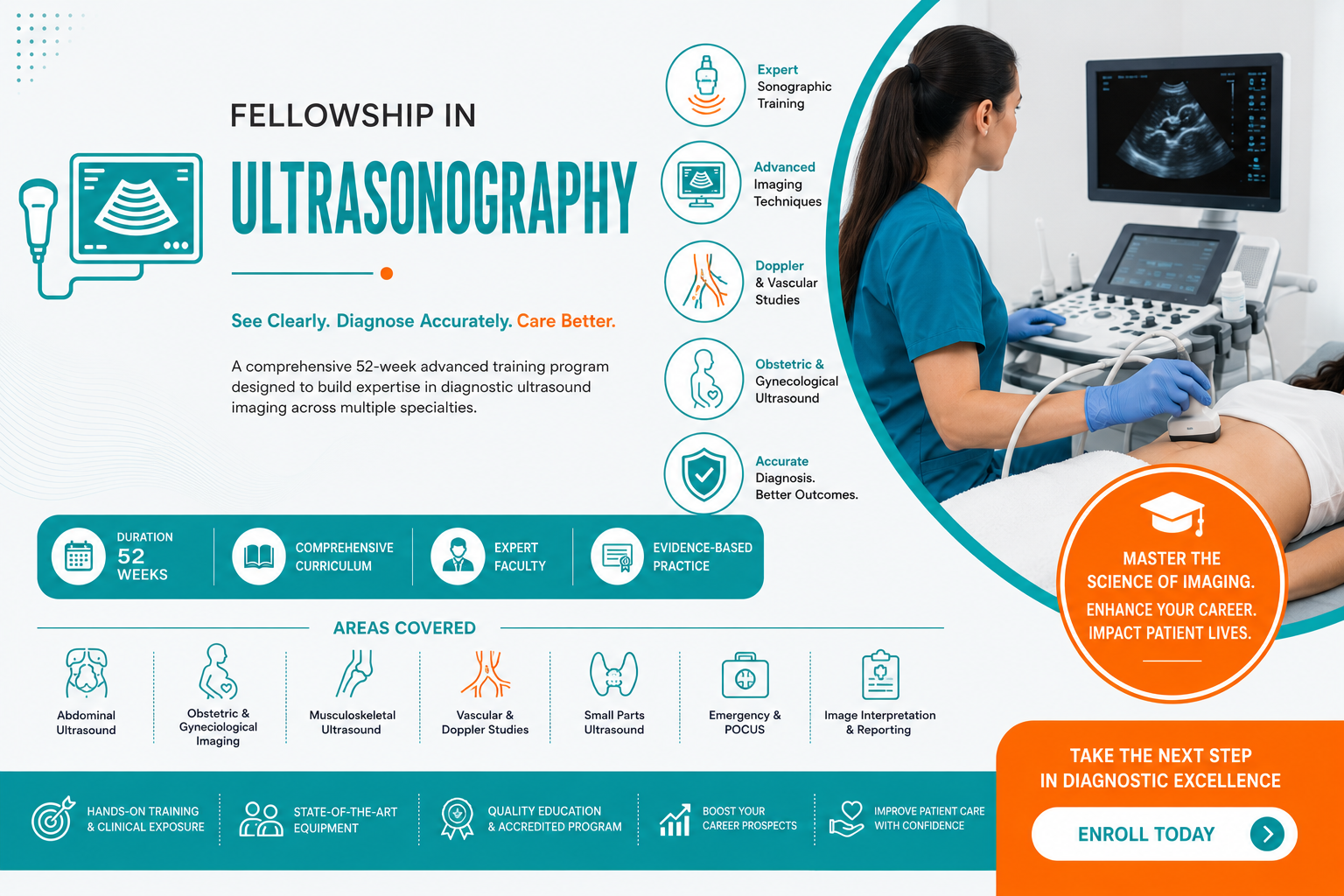
The Fellowship in Ultrasonography is a comprehensive 52-week advanced training program designed for healthcare professionals seeking specialized expertise in diagnostic ultrasound imaging. Ultrasonography has become one of the most widely used diagnostic tools in modern medicine due to its safety, real-time imaging capabilities, non-invasive nature, and broad clinical applications. This fellowship equips participants with the theoretical knowledge, practical skills, and clinical competence required to perform and interpret ultrasound examinations across multiple medical specialties.
The program combines academic instruction, hands-on scanning experience, clinical case discussions, image interpretation training, and evidence-based practice. Learners gain in-depth knowledge of ultrasound physics, instrumentation, scanning protocols, Doppler techniques, and diagnostic applications, enabling them to contribute effectively to patient diagnosis, treatment planning, and disease monitoring.
Program Objectives
The fellowship aims to develop highly skilled professionals who can confidently perform ultrasound examinations and interpret findings in a variety of clinical settings. Upon successful completion of the program, participants will be able to:
- Understand the principles and physics of ultrasonography.
- Operate ultrasound equipment efficiently and safely.
- Perform high-quality diagnostic ultrasound examinations.
- Identify normal anatomy and pathological findings.
- Apply Doppler ultrasound techniques for vascular assessment.
- Interpret ultrasound images accurately and systematically.
- Integrate ultrasound findings into clinical decision-making.
- Maintain quality assurance and patient safety standards.
- Communicate diagnostic findings effectively through structured reporting.
- Demonstrate professional competency in diverse ultrasound applications.
What You Will Learn
Throughout the fellowship, participants will receive extensive training in the following areas:
Ultrasound Physics and Instrumentation
Gain a thorough understanding of sound wave principles, image formation, transducer technology, machine settings, artifact recognition, and image optimization techniques essential for accurate diagnostic imaging.
Abdominal Ultrasonography
Learn comprehensive evaluation of abdominal organs including the liver, gallbladder, pancreas, spleen, kidneys, urinary bladder, and gastrointestinal structures. Develop skills in identifying common and complex abdominal pathologies.
Obstetric and Gynecological Ultrasound
Master fetal assessment, pregnancy monitoring, fetal growth evaluation, obstetric screening, pelvic imaging, and gynecological ultrasound examinations for women’s health diagnostics.
Doppler Ultrasonography
Understand blood flow dynamics, vascular imaging techniques, color Doppler applications, spectral Doppler interpretation, and assessment of arterial and venous disorders.
Small Parts Imaging
Study ultrasound applications involving the thyroid gland, breast tissue, scrotum, soft tissues, lymph nodes, and superficial structures.
Musculoskeletal Ultrasonography
Develop expertise in evaluating muscles, tendons, ligaments, joints, and soft tissue injuries, supporting diagnosis and treatment planning in orthopedic and sports medicine settings.
Emergency and Point-of-Care Ultrasound
Learn rapid bedside ultrasound applications used in emergency medicine, trauma assessment, critical care, and acute patient management.
Image Interpretation and Reporting
Acquire systematic approaches to image analysis, diagnostic interpretation, report writing, and clinical correlation to support accurate patient diagnosis.
Clinical Training
A major strength of this fellowship is its emphasis on practical learning and clinical exposure. Participants receive supervised hands-on training using modern ultrasound systems and gain real-world experience through clinical rotations.
Clinical training may include:
- Radiology Departments
- Diagnostic Imaging Centers
- Multispecialty Hospitals
- Obstetrics and Gynecology Clinics
- Emergency Departments
- Critical Care Units
- Vascular Laboratories
- Outpatient Diagnostic Facilities
Through direct patient interaction and guided scanning practice, learners build confidence and competence in performing a wide range of ultrasound examinations.
Key Features of the Program
- Comprehensive 52-Week Fellowship
- Advanced Ultrasound Imaging Training
- Extensive Hands-On Scanning Experience
- Expert Faculty and Clinical Mentorship
- Multi-Specialty Ultrasound Applications
- Doppler and Vascular Imaging Training
- Evidence-Based Learning Approach
- Structured Image Interpretation Sessions
- Real Clinical Case Discussions
- Industry-Relevant Curriculum
- Focus on Diagnostic Accuracy and Patient Safety
Career Opportunities
The growing demand for diagnostic imaging professionals has created significant career opportunities for individuals trained in ultrasonography. Upon completion of the fellowship, graduates may pursue positions such as:
- Ultrasonography Specialist
- Diagnostic Sonographer
- Clinical Ultrasonography Practitioner
- Ultrasound Imaging Consultant
- Radiology Department Professional
- Women’s Health Imaging Specialist
- Vascular Ultrasound Specialist
- Musculoskeletal Sonography Practitioner
- Emergency Ultrasound Professional
- Clinical Imaging Educator
- Diagnostic Imaging Coordinator
- Healthcare Diagnostic Consultant
Graduates may find employment opportunities in hospitals, diagnostic centers, imaging laboratories, specialty clinics, academic institutions, and private healthcare facilities.
Who Should Enroll?
This fellowship is ideal for:
- Medical Graduates
- Physicians and Clinicians
- Radiologists
- Diagnostic Imaging Professionals
- Sonographers
- Obstetric and Gynecological Practitioners
- Emergency Medicine Professionals
- Healthcare Professionals Seeking Imaging Specialization
- Medical Practitioners Interested in Point-of-Care Ultrasound
Skills You Will Develop
By the end of the fellowship, participants will possess:
- Advanced Ultrasound Scanning Skills
- Diagnostic Image Interpretation Expertise
- Doppler Assessment Competency
- Clinical Decision-Making Abilities
- Patient Communication Skills
- Technical Equipment Proficiency
- Structured Reporting Techniques
- Quality Assurance Knowledge
- Multidisciplinary Collaboration Skills
- Evidence-Based Diagnostic Practice
Learning Methodology
The fellowship employs a blended learning approach that combines:
- Interactive Lectures
- Practical Demonstrations
- Hands-On Ultrasound Workshops
- Clinical Rotations
- Case-Based Learning
- Image Review Sessions
- Faculty Mentorship
- Research and Academic Activities
- Competency Assessments
- Final Clinical Evaluation
This integrated methodology ensures participants acquire both theoretical understanding and practical expertise.
Program Outcomes
Upon successful completion of the Fellowship in Ultrasonography, graduates will be capable of independently performing and interpreting ultrasound examinations, contributing to accurate diagnosis and effective patient management. They will possess the clinical confidence, technical proficiency, and professional competence necessary to excel in diagnostic imaging environments and support high-quality healthcare delivery.
Conclusion
The Fellowship in Ultrasonography is a career-enhancing program designed to meet the increasing demand for skilled ultrasound professionals in modern healthcare. Through comprehensive academic instruction, practical scanning experience, expert mentorship, and extensive clinical exposure, the fellowship prepares participants to become proficient diagnostic imaging specialists. Graduates emerge with the knowledge and confidence to deliver accurate, safe, and patient-centered ultrasound services across a wide range of medical specialties and healthcare settings.
- 8 Sections
- 33 Lessons
- 67 Hours
- Introduction to UltrasonographyLearn the fundamentals of ultrasonography, including basic principles, image formation, and types of ultrasound used in medical diagnostics. Ideal for beginners stepping into medical imaging.4
- Abdominal SonographyExplore the techniques and protocols for performing abdominal ultrasound. Understand the anatomy, indications, and interpretation of sonographic images of abdominal organs.5
- Pelvic SonographyGain insights into pelvic ultrasound techniques for evaluating reproductive and urinary organs. Covers transabdominal and transvaginal approaches, indications, and common pathologies.5
- Obstetric SonographyLearn the essentials of ultrasound imaging in pregnancy, including fetal growth assessment, anomaly detection, and trimester-wise scanning protocols for maternal and fetal well-being.5
- Vascular SonographyMaster the principles and techniques of vascular ultrasound, including Doppler studies. Learn to assess blood flow, detect vascular abnormalities, and interpret arterial and venous imaging.4
- Ultrasound in Emergency & Critical CareDiscover the rapid application of ultrasound in emergency and ICU settings. Learn point-of-care techniques for trauma, shock, cardiac, and abdominal assessments to support critical decision-making.3
- Interventional ProceduresExplore ultrasound-guided interventional techniques such as biopsies, drainages, and needle aspirations. Learn procedural planning, safety protocols, and real-time guidance for accurate and minimally invasive interventions.3
- Clinical PracticalsApply your theoretical knowledge in real-world scenarios through supervised hands-on ultrasound scanning. Gain confidence in patient handling, machine settings, image acquisition, and preliminary reporting.4
You might be intersted in
-
0 Students
-
52 Weeks
-
133 Students
-
52 Weeks
-
129 Students
-
52 Weeks
-
139 Students
-
52 Weeks