
Fellowship in Internal Medicine
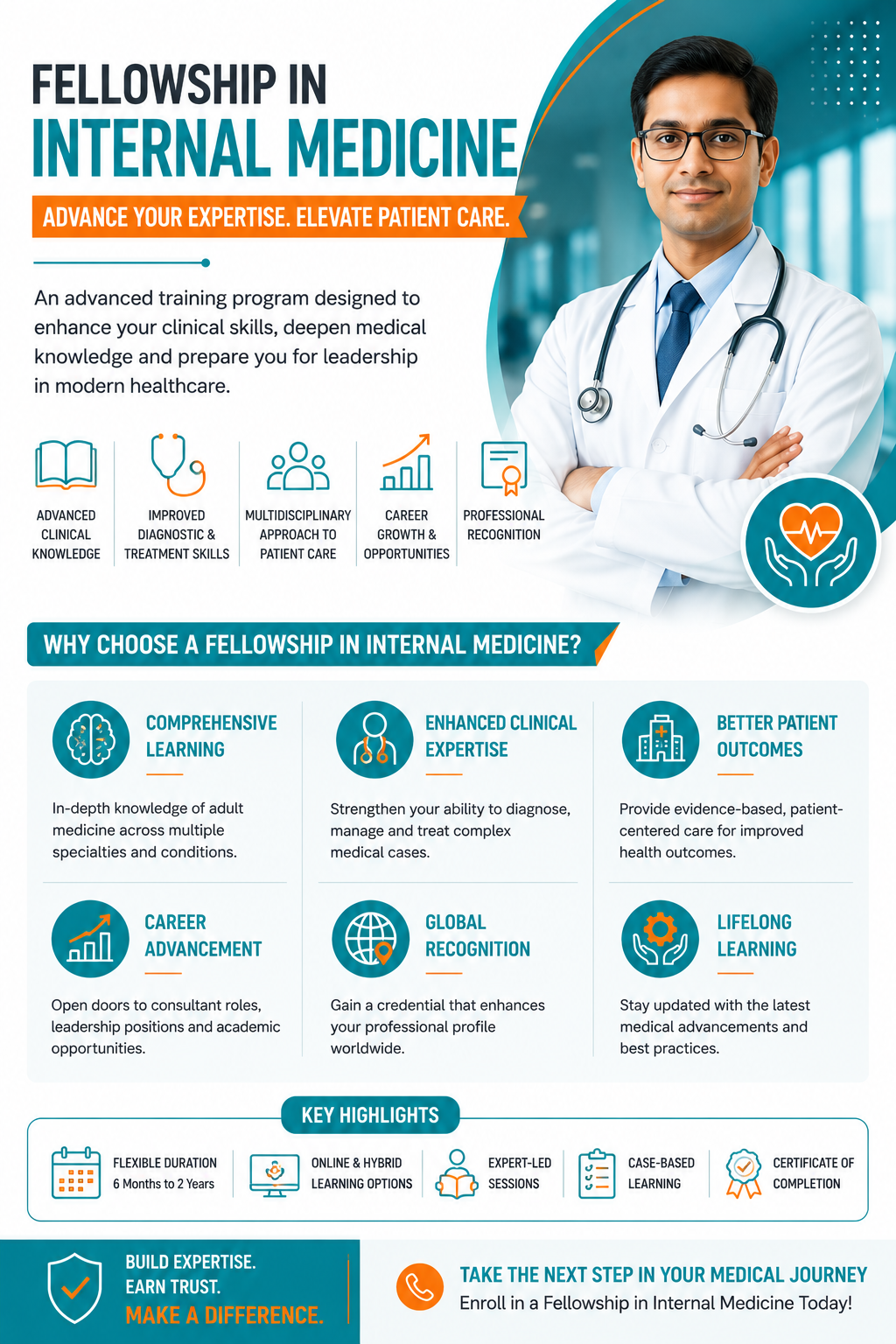

Internal medicine is a medical specialty focused on the comprehensive care of adults, addressing a wide spectrum of health conditions and diseases. Internists, or doctors specialized in internal medicine, are trained to diagnose, treat, and prevent a variety of complex …
Internal medicine is a medical specialty focused on the comprehensive care of adults, addressing a wide spectrum of health conditions and diseases. Internists, or doctors specialized in internal medicine, are trained to diagnose, treat, and prevent a variety of complex illnesses. They possess a deep understanding of the body’s systems and how they interact, which enables them to manage chronic illnesses such as diabetes, hypertension, and cardiovascular diseases.
Internists often work as primary care physicians, providing long-term, continuous care to patients. Their expertise extends to both outpatient and inpatient settings, offering a holistic approach to patient health. Internal medicine emphasizes evidence-based practice and patient-centered care, ensuring that treatment plans are tailored to individual needs.
Furthermore, internal medicine serves as a foundation for various subspecialties, including cardiology, gastroenterology, and endocrinology, among others. This specialty is crucial in the healthcare system, bridging the gap between general practice and specialized care, ensuring comprehensive and coordinated patient management.
- 9 Sections
- 200 Lessons
- 53 Weeks
- Cardiac Diseases39
- 1.1Definition – HeartFailure
- 1.2Pathophysiology – HeartFailure
- 1.3Types – HeartFailure
- 1.4Causes and Symptoms – HeartFailure
- 1.5Testing the Patient and Therapy – Heart Failure
- 1.6Classification – Congenital Heart Disease
- 1.7Obstructive Congenital HeartLesions – Congenital Heart Disease
- 1.8Cyanotic HeartLesions – Congenital Heart Disease
- 1.9Conclusio – Congenital Heart Disease
- 1.10Aortic Stenosis – Valvular Heart Disease
- 1.11Chronic Concepts – Valvular Heart Disease
- 1.12Aortic Stenosis – Valvular Heart Disease
- 1.13Aortic Regurgitation – Valvular Heart Disease
- 1.14Mitral Stenosis and Mitral Regurgitation – Valvular Heart Disease
- 1.15Tricuspid Regurgitation – Valvular Heart Disease
- 1.16Ptiqau – Coronary Artery Disease
- 1.17Acute Coronary Syndrome – Coronary Artery Disease
- 1.18Six Areas of Consensus – Coronary Artery Disease
- 1.19First Area of Consensus – Coronary Artery Disease
- 1.20Diseases of the Heart Muscle – Cardiomyopathy
- 1.21Diseases of the HeartMuscle – Cardiomyopathy
- 1.22Secondary Dilated Cardiomyopathy – Cardiomyopathy
- 1.23Hypertrophic Cardiomyopathy – Cardiomyopathy
- 1.24Restrictive Cardiomyopathy – Cardiomyopathy
- 1.25Therapy – Cardiomyopathy
- 1.26Reading ECGs and Identifying Arrhythmias – Cardiac Dysrhythmia
- 1.27Conduction System– Cardiac Dysrhythmia
- 1.28ECG Trac – Cardiac Dysrhythmia
- 1.29Sinus Atrial and Ventricular Rhythm– Cardiac Dysrhythmia
- 1.30Reading ECGs – Cardiac Dysrhythmia
- 1.31Pathophysiology of Hypertension – Hypertension
- 1.32Complications of Hypertension – Hypertension
- 1.33Therapy – Hypertension
- 1.34Diuretics – Hypertension
- 1.35Beta Receptors Adrenoceptor System– Hypertension
- 1.36Beta and Calcium Channel Blockers – Hypertension
- 1.37ARBs – Hypertension
- 1.38Other Forms of Therapy – Hypertension
- 1.39Cardiac Tumors
- Electrocardiogram (ECG) Interpretation44
- 2.1How to Read an Electrocardiogram (ECG): Introduction
- 2.2Cardiac Action Potential
- 2.3Standard 12 Lead ECG
- 2.4Systematic ECG Interpretation
- 2.5ECG Case: 22-year-oldMan with Anterior Chest Pain
- 2.6Review of Normal ECG
- 2.7ECG of Myocardial Infarction (MI): STEMIvs. NSTEMI
- 2.8ECG of Inferior Myocardial Infarction (MI)
- 2.9ECG of Anterior Myocardial Infarction (MI)
- 2.10Abnormal Waves: ECG of Healed Myocardial Infarction (MI)
- 2.11Abnormal T-Wave: Differentiating Pericarditisfrom Myocardial Infarction (MI)
- 2.12ECG Case: 83-year-old DiabeticMan with Low Blood Pressure
- 2.13ECG Case:79-year-oldMan with Pressure Feeling under Sternum
- 2.14ECG of Ventricular Hypertrophy
- 2.15ECG of Atrial Enlargement
- 2.16ECG Case: 32-year-old Man with Shortness of Breath
- 2.17ECG Case: 47-year-old Woman with Shortness of Breath and Fatigue
- 2.18Review of the Conduction System
- 2.19Bundle Branch and Fascicular Blocks
- 2.20ECG Case: 39-year-old Man with Acute Anterior MI
- 2.21Sick Sinus Syndrome and Sinus Exit Block
- 2.22First-degree AV Block
- 2.23Second-degree AV Block
- 2.24Third-degree AV Block
- 2.25ECG Case: 89-year-oldMan with Syncope
- 2.26Supraventricular Arrhythmias: Introduction
- 2.27ECG of Atrial Premature Beats
- 2.28ECG of Supraventricular Tachycardia
- 2.29ECG of AtrialFlutter and Fibrillation
- 2.30ECG of Nodeless Beats Systoles
- 2.31ECG Case: 50-year-old Woman with Palpitations and Shortness of Breath
- 2.32Types of Pacemaker
- 2.33How to Read a Pacemaker ECG
- 2.34Implanted Cardiac Defibrillator (ICD) Pacemaker
- 2.35ECG Case:73-year-oldMan with Pacemaker
- 2.36ECG of Premature Ventricular Contractions (PVC)
- 2.37ECG of Ventricular Tachycardia and Cardiac Arrest
- 2.38ECG of Torsades de Pointes
- 2.39ECG Case: 49-year-old Woman with “Extra Heart Beats”
- 2.40Effect of Electrolyte Abnormalities on the ECG
- 2.41Effects of Drugs on the ECG
- 2.42ECG Case: 69-year-oldMan with CHF(Opi Modern Display)
- 2.43How to Read an ECG: Conclusion
- 2.4412-Lead ECG Case Session
- Cardiovascular Cases29
- 3.1Cardiac Case: 57-year-oldMan with Substernal Chest Pain
- 3.2Cardiac Case: 62-year-old Woman with Fever and Epigastric Discomfort
- 3.3Cardiac Case: 49-year-oldMan with Indigestion during Exertion
- 3.4Cardiac Case: 46-year-old Woman with Shortness of Breath while Walking
- 3.5Cardiac Case:77-year-old Man with Shortness of Breath and Palpitations
- 3.6Cardiac Case: 90-year-old Man with COPD and Sudden Increase in Shortness of Breath
- 3.7Cardiac Case:70-year-old Man with Central Chest Pain Worsening when Breathing
- 3.8Cardiac Case: 51-year-old Man with Sudden Anterior Chest Pain Radiating to Back
- 3.9Cardiac Case: 33-year-old Man with Syncope
- 3.10Cardiac Case: 49-year-old Woman with Breast Cancer and Dyspnea
- 3.11Cardiac Case: 55-year-old Man with Alcohol Intake after Minor Traffic Accident
- 3.12Cardiac Case: 23-year-old Woman with Fatigue and Shortness of Breath after Exercising
- 3.13Cardiac Case: 64-year-oldMan with Dyspnea and Ankle Edema
- 3.14Cardiac Case: 60-year-old Woman with Shortness of Breath during Annual Checkup
- 3.15Cardiac Case:73-year-old Man with Dyspnea & Feel Inabilityto Lie Flat
- 3.16Cardiac Case: 69-year-old Woman with Murmur
- 3.17Cardiac Case: 61-year-old Woman with Murmur and Abnormal Heart Valve
- 3.18Cardiac Case: 20-year-old Man with Atypical Chest Pain
- 3.19Cardiac Case: 57-year-old Woman with First Heart Beat and Shortness of Breath
- 3.20Cardiac Case: 70-year-old Man with Dyspnea
- 3.21Cardiac Case: 22-year-old Woman with Fever and Ankle Edema afterLong-term Herbal Abuse
- 3.22Cardiac Case: 67-year-old Man with Substantial Chest Discomfort, Shortness of Breath and Profuse Sweating
- 3.23Cardiac Case:77-year-oldMan with High Blood Pressure
- 3.24Cardiac Case: 62-year-old Woman with Joint Discomfort,Low Grade Fever, and Dyspnea
- 3.25Cardiac Case: 30-year-old Man with Shortness of Breath and Peripheral Edema
- 3.26Cardiac Case: 32-year-old Woman with Leg Edema, Dyspnea and Fatigue
- 3.27Cardiac Case: 20-year-old Woman with Shortness of Breath and Inabilityto Lie Flat after Childbirth
- 3.28Cardiac Case:73-year-old Man with Pain on Finger and Light-headed
- 3.29Vascular Case: 27-year-old Man with Elevated Blood Pressure after Minor Vehicle Accident
- Acquired Neuromuscular Diseases26
- 4.1Introduction to Myopathy
- 4.2Case: 54-year-old Woman with Weakness
- 4.3Clinical Approach to Muscle Disorders
- 4.4Myopathy and Myositis: Diagnosis
- 4.5Evaluation of Muscle Diseases
- 4.6Introduction to Inflammatory Myopathies with Case
- 4.7Inflammatory Myopathies: Types
- 4.8Creatine Kinase Evaluation
- 4.9Polymyositis
- 4.10Dermatomyositis
- 4.11Inclusion Body Myositis
- 4.12Necrotizing Autoimmune Myositis
- 4.13Overlap Myopathies
- 4.14Antibody Assessments—Inflammatory Myopathies
- 4.15Management of Inflammatory Myopathies
- 4.16Polymyalgia Rheumatica (PMR)— Inflammatory Myalgia
- 4.17Introduction to Infectious Myopathies with Case
- 4.18HIV-associated Myositis—Infectious Myopathies
- 4.19Pathogen Myositis with Trichinella— Infectious Myopathies
- 4.20Toxic Myopathies with Case
- 4.21Hypothyroid and Hyperthyroid Myopathy
- 4.22Statin Myopathy
- 4.23Corticosteroid Myopathy
- 4.24Critical Illness Myopathy and Other Causes for Myopathy
- 4.25Rhabdomyolysis
- 4.26Other Metabolic Muscle Diseases
- Hereditary Neuromuscular Disorders12
- 5.1Inherited Muscle Disorders: Evaluation
- 5.2Inherited Myopathies: Types
- 5.3Muscular Dystrophies
- 5.4Introduction to Proximal Predominant Muscular Dystrophies
- 5.5Case: 6-year-old Boy with Weakness
- 5.6X-linked Dystrophinopathies and Duchenne Muscular Dystrophy
- 5.7Becker Muscular Dystrophy and Limb-girdle Muscular Dystrophy (LGMD)
- 5.8Distal Predominant Muscular Dystrophies
- 5.9Other Muscular Dystrophies
- 5.10Case: 5-month-old Girl with Weakness
- 5.11Evaluation ofthe Hypotonic Infant
- 5.12Congenital Muscular Dystrophy and Congenital Myopathy
- Disorders of the Neuromuscular Junctions21
- 6.1General Approach to Neuromuscular Junction Disorders
- 6.2Case: 32-year-old Woman with Weakness
- 6.3Physiology ofthe Neuromuscular Junction
- 6.4Neuromuscular Junction Disorders: Clinical Features and Pathophysiology
- 6.5Neuromuscular Junction Disorders: Summary
- 6.6Case: 32-year-old Woman with Weakness and Sustained Upgaze
- 6.7Myasthenia Gravis: Introduction and Clinical Features
- 6.8Myasthenia Gravis: Clinical and Serological Tests – Diagnosis
- 6.9Myasthenia Gravis: Repetitive Stimulation – Diagnosis
- 6.10Myasthenia Gravis: Antibody Testing – Diagnosis
- 6.11Myasthenia Gravis: Treatment
- 6.12Case:72-year-old Woman with Weakness
- 6.13BotulinumToxin Toxicity: Overview
- 6.14BotulinumToxin Toxicity: Pathophysiology and Treatment
- 6.15Case: 42-year-old Man with Weakness
- 6.16Lambert Eaton Myasthenic Syndrome (LEMS): Overview
- 6.17Lambert Eaton Myasthenic Syndrome (LEMS): Workup and Testing
- 6.18Lambert Eaton Myasthenic Syndrome (LEMS): Pathophysiology and Treatment
- 6.19Organophosphate Poisoning
- 6.20Transient Neonatal Myasthenia
- 6.21Congenital Myasthenic Syndrome (CMS)
- Peripheral Neuropathies5
- Diseases of the Spinal Cord20
- 8.1Case: 45-year-old Man with Bilateral Lower Extremity Weakness and Numbness
- 8.2Introduction to Spinal Cord
- 8.3Myelopathy
- 8.4Case: 53-year-old Woman with Progressive Weakness and Balance Difficulty
- 8.5How to Approach Spinal Cord Pathology (Macro)
- 8.6How to Approach Spinal Cord Pathology (Micro)
- 8.7Continuation of Case: 53-year-old Woman with Progressive Weakness and Balance Difficulty
- 8.8Case: 58-year-old Woman with Weakness and Neck Pain
- 8.9Intradural Extramedullary Myelopathy
- 8.10Case: 50-year-old Woman with Lower Extremity Weakness
- 8.11Intradural Intramedullary Myelopathy
- 8.12Case: 53-year-old Man with Numbnessin Lower Extremities
- 8.13Myelopathy – Vascular Disorders with Case
- 8.14Case: 22-year-old Woman with Back Pain and Autonomic Symptoms
- 8.15Myelopathy – Conus Medullarisvs. Cauda Equina
- 8.16Case: 45-year-old Man with Lower Extremity Weakness
- 8.17Toxic and Metabolic Causes of Myelopathy
- 8.18Vitamin B12 Deficiency Myelopathy
- 8.19Case: 57-year-old Woman with Leg and Back Pain
- 8.20Radiculopathy
- Diseases of the Motor Neurons4
You might be intersted in
-
0 Students
-
52 Weeks
-
133 Students
-
52 Weeks
-
129 Students
-
52 Weeks

-
139 Students
-
52 Weeks