
Fellowship in Nutrition and Daiet
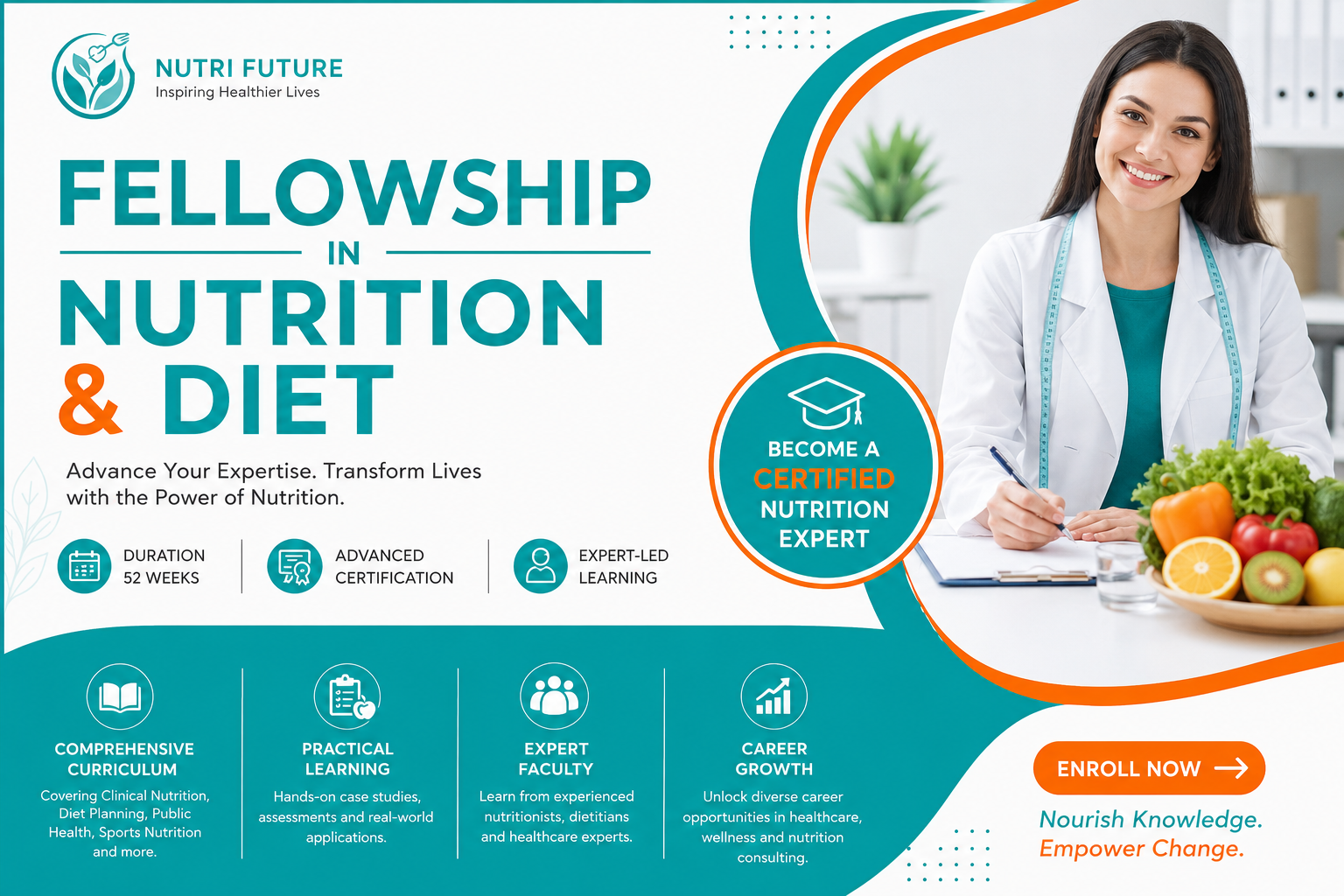

The Fellowship in Nutrition and Diet is a comprehensive 52-week advanced training program designed to provide in-depth knowledge of nutrition science, diet planning, clinical nutrition, public health nutrition, and medical nutrition therapy. The program equips healthcare professionals and aspiring nutrition specialists with the skills to assess nutritional status, develop evidence-based dietary interventions, manage nutrition-related disorders, and promote healthy lifestyles across diverse populations. Through a blend of theoretical learning, case-based discussions, practical applications, and research training, participants gain the expertise required for professional practice in clinical, community, sports, and wellness nutrition settings.
Program Overview
The Fellowship in Nutrition and Diet is a comprehensive 52-week advanced academic and professional training program designed to develop expertise in nutrition science, dietetics, clinical nutrition, and evidence-based dietary management. The program equips healthcare professionals, nutritionists, dietitians, wellness practitioners, and aspiring nutrition specialists with the knowledge and practical skills required to assess nutritional status, design individualized nutrition plans, manage nutrition-related disorders, and promote lifelong health and wellness.
As nutrition continues to play a central role in disease prevention, treatment, and health promotion, there is an increasing demand for qualified professionals who can translate scientific evidence into effective nutritional interventions. This fellowship provides an in-depth understanding of human nutrition, metabolism, food science, public health nutrition, therapeutic diets, and lifestyle management while emphasizing practical applications in clinical and community settings.
The curriculum integrates foundational nutrition sciences with advanced topics such as medical nutrition therapy, sports nutrition, functional foods, nutraceuticals, obesity management, chronic disease prevention, and nutrition counseling. Participants gain hands-on experience in nutritional assessment, dietary planning, case management, and research methodologies, enabling them to deliver high-quality nutrition care across diverse populations.
Program Objectives
Upon successful completion of the fellowship, learners will be able to:
- Understand the scientific principles of human nutrition and metabolism.
- Evaluate the role of macro and micronutrients in health and disease.
- Conduct comprehensive nutritional assessments using standardized methods.
- Develop personalized dietary plans for individuals across the lifespan.
- Apply medical nutrition therapy for various acute and chronic diseases.
- Design nutrition interventions for obesity, diabetes, cardiovascular disease, and other health conditions.
- Implement nutrition strategies for sports performance and active lifestyles.
- Promote community health through public health nutrition initiatives.
- Deliver effective nutrition education and counseling services.
- Critically evaluate nutrition research and apply evidence-based practices.
- Understand food safety, food quality, and regulatory considerations.
- Collaborate with multidisciplinary healthcare teams to improve patient outcomes.
Key Learning Areas
Nutrition Science and Human Physiology
Gain a strong foundation in nutrient metabolism, digestion, absorption, energy balance, and the physiological functions of nutrients within the human body.
Clinical Nutrition and Medical Nutrition Therapy
Learn evidence-based dietary management strategies for conditions such as diabetes, obesity, cardiovascular disease, kidney disorders, gastrointestinal diseases, cancer, and critical illness.
Nutritional Assessment
Develop practical skills in anthropometric measurements, dietary analysis, biochemical assessment, clinical evaluation, and nutrition screening techniques.
Life Cycle Nutrition
Explore nutritional requirements during pregnancy, infancy, childhood, adolescence, adulthood, and aging to support optimal growth, development, and healthy aging.
Sports and Performance Nutrition
Understand nutritional strategies that enhance athletic performance, recovery, hydration, body composition, and exercise adaptation.
Public Health and Community Nutrition
Study nutrition programs, food security, health promotion strategies, and policy initiatives aimed at improving population health outcomes.
Functional Foods and Nutraceuticals
Examine the role of functional foods, dietary supplements, probiotics, and nutraceuticals in disease prevention and health optimization.
Nutrition Counseling and Education
Build communication and counseling competencies necessary to facilitate behavior change, patient engagement, and long-term adherence to nutrition interventions.
Research and Evidence-Based Practice
Learn research methodologies, biostatistics, literature appraisal, and evidence synthesis to support informed decision-making in nutrition practice.
Who Should Enroll?
This fellowship is ideal for:
- Nutritionists and dietitians seeking advanced specialization
- Medical practitioners interested in nutrition-based healthcare
- Nurses and allied health professionals
- Public health professionals
- Sports nutrition consultants and fitness professionals
- Wellness and lifestyle coaches
- Healthcare educators and trainers
- Researchers in nutrition and health sciences
- Graduates pursuing careers in nutrition and dietetics
- Professionals working in food, wellness, and healthcare industries
Career Opportunities
Graduates of the Fellowship in Nutrition and Diet can pursue diverse career opportunities, including:
- Clinical Nutritionist
- Registered Dietitian (subject to local regulations)
- Medical Nutrition Therapist
- Public Health Nutrition Specialist
- Community Nutrition Consultant
- Sports Nutrition Consultant
- Wellness and Lifestyle Coach
- Nutrition Educator
- Corporate Wellness Advisor
- Food and Nutrition Program Manager
- Research Associate in Nutrition Sciences
- Nutritional Product Specialist
- Healthcare Nutrition Consultant
- Academic Faculty and Trainer
Practical Training and Capstone Experience
The fellowship emphasizes practical application through case studies, dietary planning exercises, nutrition assessments, counseling simulations, and evidence-based problem-solving activities. Learners will also complete a capstone project that demonstrates their ability to integrate scientific knowledge, clinical reasoning, and professional practice competencies in nutrition and dietetics.
Program Outcomes
By the end of the program, participants will possess the advanced knowledge and professional skills necessary to assess nutritional needs, develop individualized dietary interventions, manage nutrition-related disorders, promote preventive healthcare, and contribute to improved health outcomes at both individual and community levels. Graduates will be prepared to assume leadership roles in clinical nutrition, public health, wellness, education, research, and healthcare management.
The Fellowship in Nutrition and Diet provides a robust pathway for professionals seeking to advance their expertise in nutrition science and dietetics while making a meaningful impact on health, wellness, and disease prevention in diverse populations.
- 16 Sections
- 96 Lessons
- 52 Weeks
- Foundations of Nutrition ScienceThis module introduces learners to the fundamental principles of nutrition science, including the role of nutrients in human health, dietary guidelines, nutritional terminology, and the relationship between food and physiological functions. Students will gain a strong scientific foundation necessary for advanced study in nutrition and dietetics.6
- Human Anatomy and Physiology for NutritionThis module explores the structure and function of body systems relevant to nutrition. Learners will understand how digestion, absorption, metabolism, and nutrient utilization occur within the human body and how nutrition influences physiological health.6
- Macronutrients and Energy MetabolismThis module provides in-depth knowledge of carbohydrates, proteins, and fats, focusing on their digestion, metabolism, physiological functions, and dietary requirements. Learners will examine energy production pathways and nutrient interactions.6
- Micronutrients and Functional NutritionThis module focuses on vitamins, minerals, and trace elements essential for health. Students will learn deficiency disorders, toxicity risks, assessment methods, and the role of micronutrients in disease prevention and wellness.6
- Food Science and Food SafetyLearners will study food composition, preservation, processing, quality control, and food safety regulations. The module emphasizes safe food handling practices and their importance in public health.6
- Nutritional Assessment and ScreeningThis module trains students in assessing nutritional status using anthropometric, biochemical, clinical, and dietary assessment techniques. Learners will develop skills to identify nutritional risks and formulate interventions.6
- Nutrition Through the Life CycleThis module examines nutritional needs from conception to old age. Students will learn age-specific dietary requirements and strategies for promoting health throughout different stages of life.6
- Clinical Nutrition and Medical Nutrition TherapyThis module introduces medical nutrition therapy (MNT) and evidence-based dietary interventions for common health conditions. Learners will understand the integration of nutrition into clinical care.6
- Clinical Nutrition and Medical Nutrition Therapy IIBuilding on previous knowledge, this module focuses on advanced therapeutic nutrition for chronic diseases and complex medical conditions requiring specialized nutritional support.6
- Sports Nutrition and PerformanceThis module explores the relationship between nutrition, physical activity, and athletic performance. Students will learn dietary planning strategies for recreational and professional athletes.6
- Public Health NutritionLearners will study nutrition at the population level, including malnutrition, food security, nutrition policies, and community-based interventions aimed at improving public health outcomes.6
- Nutrition Education and CounselingThis module develops communication and counseling skills necessary for effective nutrition education. Learners will gain expertise in behavior change strategies and client-centered counseling approaches.6
- Weight Management and Lifestyle NutritionThis module focuses on healthy weight management strategies, lifestyle modification, and preventive nutrition. Students will learn evidence-based approaches to support long-term health outcomes.6
- Functional Foods and NutraceuticalsLearners will explore the science of functional foods, nutraceuticals, probiotics, and dietary supplements. The module emphasizes evidence-based evaluation and clinical applications.6
- Research Methods in NutritionThis module introduces research methodologies, biostatistics, scientific literature evaluation, and evidence-based practice. Students will develop critical appraisal skills for nutrition research.6
- Professional Practice, Internship, and Capstone ProjectThe final module integrates theoretical and practical learning through supervised training, case studies, professional ethics, and a capstone project. Learners will demonstrate competency in nutrition and dietetic practice.6
You might be intersted in
-
167 Students
-
52 Weeks
-
133 Students
-
52 Weeks
-
123 Students
-
52 Weeks
-
142 Students
-
52 Weeks