
Certificate in Neonatal Critical Care
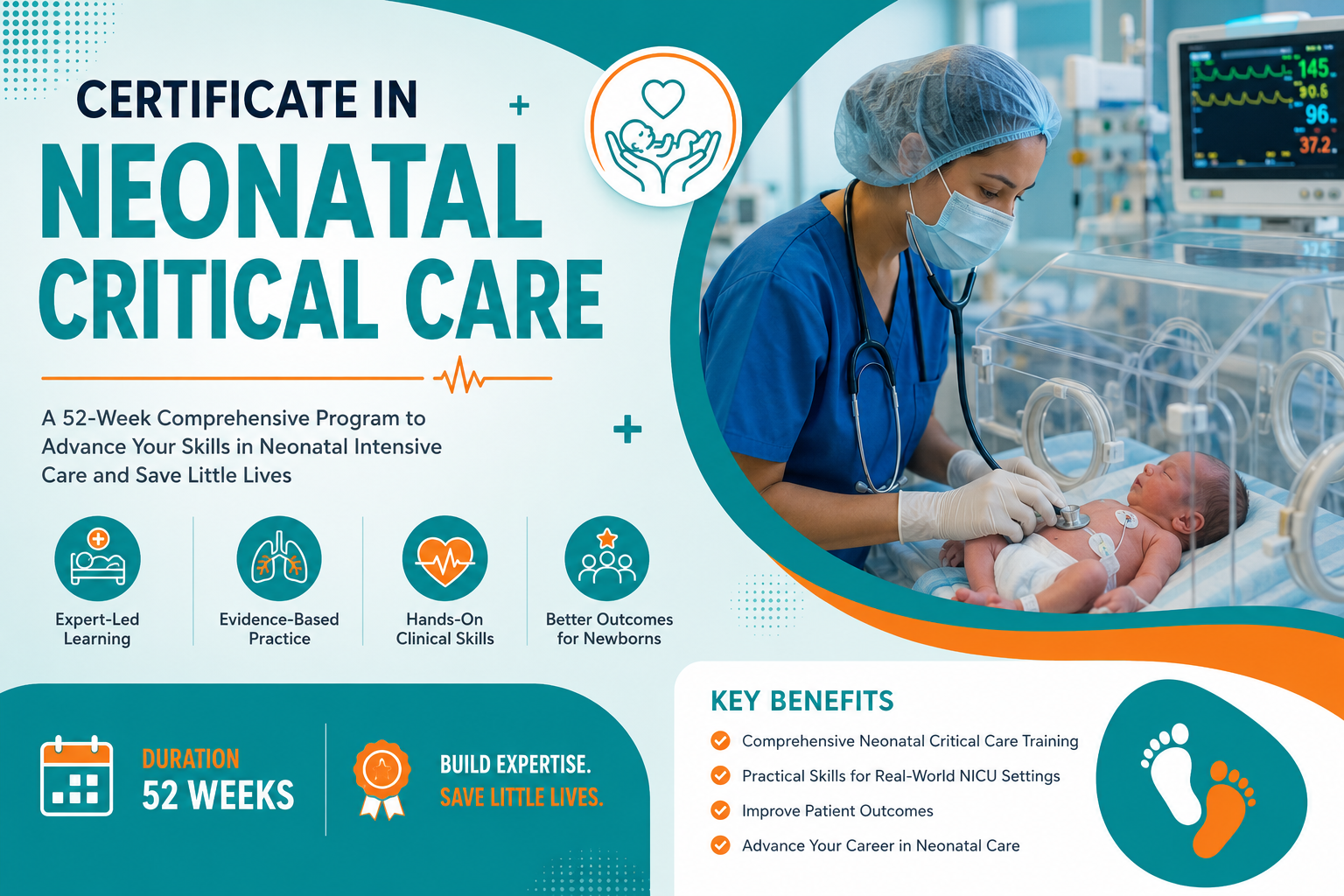

The Certificate in Neonatal Critical Care is a comprehensive 52-week programme designed to equip healthcare professionals with the knowledge and practical skills required to manage critically ill newborns in neonatal intensive care units (NICUs). Covering neonatal resuscitation, respiratory and cardiovascular support, neurological care, neonatal infections, nutrition, emergency procedures, and evidence-based clinical practice, this course prepares learners to deliver safe, effective, and compassionate critical care for neonates while enhancing their expertise in modern NICU management.
The Certificate in Neonatal Critical Care is a comprehensive 52-week professional programme designed to provide healthcare professionals with the advanced knowledge and practical competencies required to deliver high-quality care to critically ill newborns. The course focuses on the assessment, stabilization, treatment, and ongoing management of neonates requiring intensive care, while emphasizing evidence-based practice, patient safety, and multidisciplinary collaboration.
With advances in neonatal medicine and technology, the survival of premature and critically ill infants has improved significantly. This has created an increasing demand for healthcare professionals who possess specialised expertise in neonatal intensive care. This programme equips learners with the clinical skills needed to manage complex neonatal conditions, utilise modern NICU equipment, interpret diagnostic findings, and respond effectively to neonatal emergencies.
Throughout the programme, participants will explore neonatal physiology, fetal development, neonatal resuscitation, respiratory support, cardiovascular management, neurological disorders, neonatal infections, nutrition, fluid and electrolyte management, and neonatal surgical emergencies. Learners will also gain an understanding of ethical decision-making, communication with families, infection prevention, quality improvement, and research methodologies relevant to neonatal critical care.
The curriculum combines theoretical learning with clinical case discussions, evidence-based guidelines, practical demonstrations, and simulation-based training to ensure learners develop confidence in managing critically ill newborns in diverse healthcare settings. By the end of the programme, participants will be prepared to contribute effectively to neonatal intensive care units (NICUs), special newborn care units (SNCUs), and paediatric critical care environments.
Course Objectives
Upon successful completion of this programme, learners will be able to:
- Understand neonatal anatomy, physiology, and adaptation after birth.
- Perform comprehensive assessment of critically ill neonates.
- Apply neonatal resuscitation principles according to current international guidelines.
- Recognise and manage neonatal respiratory emergencies and provide appropriate respiratory support.
- Assess and manage cardiovascular instability, congenital heart conditions, and neonatal shock.
- Diagnose and manage neonatal neurological disorders, including seizures and hypoxic-ischaemic encephalopathy.
- Identify and treat neonatal infections, sepsis, and meningitis using evidence-based protocols.
- Develop nutritional management plans including enteral and parenteral nutrition.
- Manage neonatal fluid balance, electrolyte disturbances, and metabolic disorders.
- Interpret laboratory investigations and bedside monitoring findings.
- Perform essential neonatal intensive care procedures safely.
- Apply infection prevention and patient safety measures within the NICU.
- Communicate effectively with families and multidisciplinary healthcare teams.
- Integrate ethical principles into neonatal critical care decision-making.
- Participate in quality improvement initiatives and evidence-based clinical practice.
Who Should Enrol?
This programme is suitable for:
- Medical graduates (MBBS or equivalent)
- Paediatricians
- Neonatologists seeking structured academic training
- Resident doctors
- NICU medical officers
- Nursing professionals working in neonatal or paediatric intensive care
- Advanced neonatal nurse practitioners
- Healthcare professionals involved in newborn care
- Clinicians interested in neonatal critical care
What You Will Learn
During this 52-week programme, learners will gain expertise in:
- Foundations of neonatal critical care
- Fetal development and neonatal transition
- Neonatal resuscitation and stabilisation
- Respiratory distress syndrome and ventilation strategies
- Continuous Positive Airway Pressure (CPAP)
- Mechanical ventilation and respiratory monitoring
- Congenital heart diseases
- Neonatal shock and haemodynamic management
- Neurological assessment and seizure management
- Therapeutic hypothermia
- Neonatal infections and antimicrobial stewardship
- Nutrition and breastfeeding support
- Total parenteral nutrition
- Fluid and electrolyte management
- Neonatal jaundice and haematological disorders
- Renal disorders in newborns
- Necrotising enterocolitis and gastrointestinal emergencies
- Neonatal surgical care
- Vascular access and bedside procedures
- Blood gas interpretation
- Quality improvement and clinical governance
- Research methodology in neonatal medicine
Learning Methodology
The programme adopts a structured learning approach that includes:
- Comprehensive online lectures
- Interactive case-based discussions
- Clinical scenario analysis
- Simulation-based neonatal emergency training
- Practical demonstrations
- Evidence-based guideline reviews
- Self-directed learning modules
- Assignments and assessments
- Capstone project
Career Opportunities
Graduates of this programme can pursue opportunities in:
- Neonatal Intensive Care Units (NICUs)
- Special Newborn Care Units (SNCUs)
- Paediatric Intensive Care Units (PICUs)
- Tertiary care hospitals
- Children’s hospitals
- Academic medical institutions
- Teaching hospitals
- Neonatal transport services
- Clinical research organisations
- Public health newborn programmes
Skills You Will Gain
By completing this course, learners will develop the ability to:
- Perform advanced neonatal assessment
- Manage critically ill newborns confidently
- Conduct neonatal resuscitation effectively
- Interpret neonatal investigations accurately
- Deliver respiratory and cardiovascular support
- Manage neonatal emergencies promptly
- Implement infection control measures
- Optimise neonatal nutrition and growth
- Perform essential NICU procedures safely
- Communicate effectively with families and healthcare teams
- Apply evidence-based neonatal care practices
- Lead quality improvement initiatives within neonatal services
Why Choose This Course?
The Certificate in Neonatal Critical Care has been designed to meet the growing demand for specialised neonatal healthcare professionals. Its comprehensive curriculum integrates current international best practices with practical clinical learning, enabling participants to strengthen both their theoretical understanding and clinical decision-making skills. The programme prepares healthcare professionals to provide safe, compassionate, and evidence-based care for critically ill newborns while supporting improved neonatal outcomes and professional career advancement.
- 12 Sections
- 73 Lessons
- 52 Weeks
- Foundations of Neonatal Critical CareThis module introduces learners to the principles of neonatal critical care, including neonatal physiology, adaptation to extrauterine life, and the organization of neonatal intensive care units (NICUs). Participants will develop an understanding of neonatal terminology, ethical considerations, infection prevention, patient safety, and multidisciplinary teamwork required for managing critically ill newborns.6
- Fetal Development and Neonatal AdaptationThis module focuses on fetal growth, embryology, neonatal adaptation after birth, and factors influencing neonatal health. Learners will understand the physiological changes occurring immediately after delivery and recognize abnormalities requiring critical intervention.6
- Neonatal ResuscitationThis module provides comprehensive training in neonatal resuscitation based on current international guidelines. Learners will gain confidence in airway management, chest compressions, emergency medication administration, and post-resuscitation stabilization.6
- Respiratory Critical CareThis module covers respiratory disorders commonly encountered in critically ill neonates. Learners will understand respiratory support techniques, oxygen therapy, mechanical ventilation, surfactant therapy, and management of respiratory emergencies.6
- Cardiovascular Critical CareThis module explores neonatal cardiovascular disorders, congenital heart diseases, shock, and hemodynamic monitoring. Learners will develop skills in recognizing and managing cardiovascular instability in newborns.6
- Neurological Critical CareThis module focuses on neonatal neurological assessment, seizure management, hypoxic-ischemic encephalopathy, intracranial hemorrhage, and neuroprotective strategies used in critical care settings.6
- Neonatal Infections and SepsisThis module provides an in-depth understanding of neonatal infections, antimicrobial therapy, infection control practices, and management of neonatal sepsis in intensive care settings.6
- Nutrition and Metabolic CareThis module emphasizes nutritional assessment, enteral and parenteral nutrition, breastfeeding support, electrolyte management, and metabolic disorders in critically ill neonates.6
- Neonatal Hematology and Renal CareThis module covers hematological and renal disorders commonly encountered in neonatal intensive care, including jaundice, anemia, coagulation disorders, acute kidney injury, and fluid management.6
- Gastrointestinal and Surgical EmergenciesThis module introduces gastrointestinal disorders and neonatal surgical emergencies requiring intensive care management. Learners will understand preoperative stabilization and postoperative critical care.6
- Neonatal Procedures and MonitoringThis module develops competency in bedside procedures, invasive monitoring, vascular access, blood gas analysis, imaging interpretation, and emergency interventions in critically ill neonates.6
- Quality Improvement, Ethics, and ResearchThis final module prepares learners to deliver evidence-based neonatal critical care through quality improvement initiatives, ethical decision-making, research methodology, leadership, communication, and professional development.7
You might be intersted in
-
146 Students
-
52 Weeks
-
121 Students
-
52 Weeks
-
32 Students
-
10 Weeks