
Certificate in Cancer Nutrition
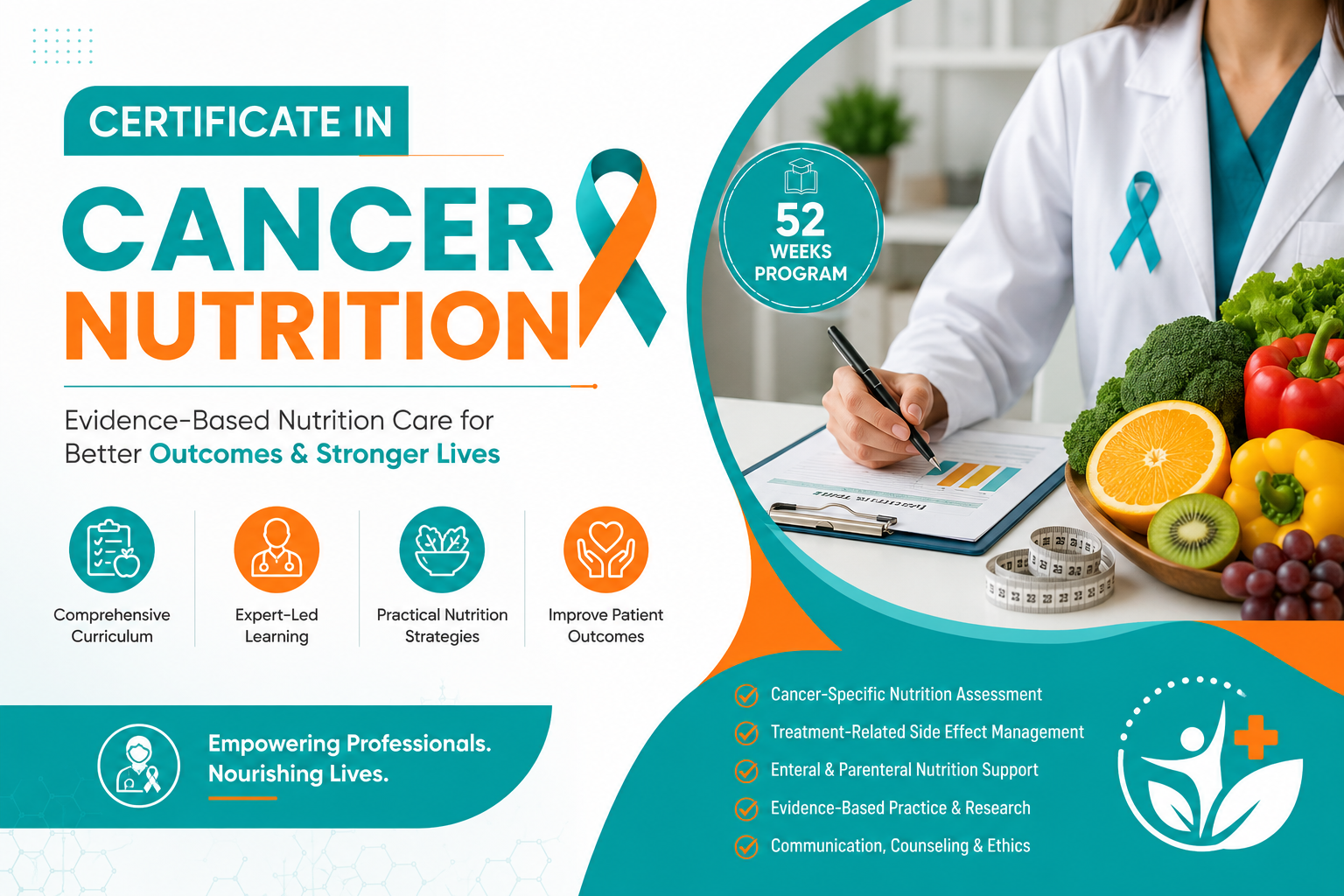

The Certificate in Cancer Nutrition is a comprehensive 52-week program designed to equip healthcare professionals with specialized knowledge in oncology nutrition. The course covers nutritional assessment, cancer metabolism, nutrition during treatment, symptom management, enteral and parenteral nutrition, survivorship care, and evidence-based dietary interventions. Learners develop practical skills to create personalized nutrition plans that improve treatment outcomes, enhance quality of life, and support recovery for patients across the cancer care continuum. This program prepares participants to confidently deliver patient-centered nutritional care in oncology settings.
The Certificate in Cancer Nutrition is a comprehensive 52-week professional program designed to provide healthcare professionals with advanced knowledge and practical skills in the nutritional management of individuals affected by cancer. As nutrition plays a vital role throughout the cancer care continuum—from prevention and diagnosis to treatment, recovery, and survivorship—this course equips learners with evidence-based strategies to improve patient outcomes, enhance quality of life, and support multidisciplinary oncology care.
Cancer and its treatments can significantly affect nutritional status, leading to complications such as malnutrition, cachexia, weight loss, muscle wasting, fatigue, gastrointestinal disturbances, and reduced treatment tolerance. This program enables learners to understand the complex relationship between cancer, metabolism, and nutrition while developing the expertise needed to perform comprehensive nutritional assessments and deliver individualized nutrition care plans.
Throughout the course, participants explore the fundamentals of cancer biology, tumor metabolism, and the physiological changes associated with different malignancies. They learn to identify nutritional risk factors, interpret clinical and biochemical data, and apply standardized nutrition screening and assessment tools used in oncology practice. The curriculum also emphasizes nutritional interventions before, during, and after chemotherapy, radiotherapy, immunotherapy, targeted therapy, and surgical treatment.
Special attention is given to the management of treatment-related side effects such as nausea, vomiting, mucositis, dysphagia, xerostomia, taste alterations, diarrhea, constipation, and cancer-related fatigue. Learners develop practical skills in designing dietary strategies that help patients maintain adequate nutritional intake, minimize complications, and improve adherence to treatment.
The program also covers disease-specific nutrition management for a variety of cancers, including breast, gastrointestinal, head and neck, lung, hematological, and pediatric cancers. Students gain expertise in enteral and parenteral nutrition, feeding tube management, nutrition support monitoring, and the prevention of nutrition-related complications in critically ill oncology patients.
Beyond clinical nutrition support, the course examines survivorship nutrition, weight management, physical activity, recurrence prevention, and long-term wellness planning. Learners also critically evaluate dietary supplements, herbal products, functional foods, probiotics, and complementary nutrition therapies using current scientific evidence to ensure safe and ethical patient recommendations.
Communication and counseling are integral components of the curriculum. Participants strengthen their patient education, motivational interviewing, cultural competency, and interdisciplinary collaboration skills, enabling them to provide compassionate, patient-centered nutritional care within oncology teams.
The final phase of the program integrates theory with clinical application through case-based learning, research appraisal, documentation practices, and a capstone project. Learners apply evidence-based nutrition principles to real-world oncology scenarios, preparing them to make informed clinical decisions and contribute effectively to cancer care services.
Key Learning Outcomes
Upon successful completion of the program, learners will be able to:
- Understand the role of nutrition across the cancer care continuum.
- Perform comprehensive nutritional screening and assessment for oncology patients.
- Develop individualized nutrition care plans based on evidence-based guidelines.
- Manage nutrition-related complications associated with cancer treatments.
- Provide enteral and parenteral nutrition support when clinically indicated.
- Deliver nutrition interventions for different cancer types and patient populations.
- Support cancer survivors through long-term nutrition and lifestyle counseling.
- Evaluate complementary nutrition therapies using scientific evidence.
- Communicate effectively with patients, caregivers, and multidisciplinary healthcare teams.
- Apply ethical principles and current research in oncology nutrition practice.
Who Should Enroll?
This program is ideal for:
- Registered Dietitians and Clinical Nutritionists
- Medical Practitioners
- Oncology Nurses
- Pharmacists
- Allied Healthcare Professionals
- Public Health Professionals
- Medical Graduates
- Healthcare Researchers
- Nutrition and Dietetics Graduates
- Professionals seeking specialization in oncology nutrition
Career Opportunities
Graduates of the Certificate in Cancer Nutrition can pursue opportunities in:
- Oncology Hospitals
- Cancer Care Centers
- Clinical Nutrition Departments
- Multispecialty Hospitals
- Palliative Care Services
- Rehabilitation Centers
- Community Cancer Programs
- Research Institutions
- Academic and Teaching Organizations
- Private Nutrition and Dietetic Practice
The Certificate in Cancer Nutrition empowers healthcare professionals with the knowledge, clinical competence, and confidence to deliver evidence-based nutritional care for patients with cancer. By combining scientific principles with practical application, this 52-week program prepares learners to become valuable members of multidisciplinary oncology teams, helping improve treatment tolerance, recovery, survivorship, and overall patient well-being.
- 12 Sections
- 72 Lessons
- 52 Weeks
- Foundations of Cancer NutritionThis module introduces learners to the essential principles of cancer nutrition, emphasizing the relationship between nutrition, metabolism, and cancer development. Students will gain an understanding of the nutritional needs of cancer patients throughout the continuum of care, the role of evidence-based nutrition interventions, and the responsibilities of nutrition professionals within multidisciplinary oncology teams.6
- Cancer Pathophysiology and MetabolismThis module explores the biological mechanisms of cancer and how malignancies alter normal metabolism. Learners will examine metabolic changes, inflammation, cachexia, sarcopenia, and the body's nutritional response to cancer progression and treatment.6
- Nutritional Assessment in OncologyThis module focuses on comprehensive nutritional screening and assessment techniques used in oncology. Students will learn to identify malnutrition, evaluate dietary intake, assess body composition, interpret laboratory findings, and formulate individualized nutrition care plans.6
- Nutrition During Cancer TreatmentLearners will study nutritional management strategies during chemotherapy, radiotherapy, immunotherapy, surgery, and targeted therapies. Emphasis is placed on maintaining nutritional status, minimizing treatment-related side effects, and supporting recovery.6
- Managing Nutrition-Related Side EffectsThis module teaches practical nutritional interventions for common treatment-related complications including nausea, vomiting, mucositis, xerostomia, dysphagia, diarrhea, constipation, taste changes, and fatigue.6
- Nutrition for Different Types of CancerStudents will explore disease-specific nutritional approaches for various cancers, recognizing how tumor location, treatment, and prognosis influence dietary management and nutritional requirements.6
- Enteral and Parenteral NutritionThis module provides knowledge of advanced nutrition support techniques for patients unable to meet nutritional needs orally. Learners will understand indications, administration, monitoring, and complications associated with enteral and parenteral nutrition.6
- Special Nutrition ConsiderationsThis module covers nutrition management in special populations including pediatric, geriatric, obese, diabetic, renal-impaired, and critically ill oncology patients. Students will learn to adapt nutrition plans to meet diverse clinical needs.6
- Survivorship and Long-Term NutritionThis module focuses on nutrition after treatment completion. Learners will develop strategies to promote recovery, prevent recurrence, reduce chronic disease risk, and improve long-term quality of life through personalized nutrition counseling.6
- Integrative and Complementary NutritionStudents will critically evaluate complementary nutrition therapies, dietary supplements, functional foods, herbal products, and emerging evidence. Emphasis is placed on patient safety, scientific evidence, and ethical practice.6
- Counseling, Communication and EthicsThis module develops effective communication, counseling, cultural competence, motivational interviewing, and ethical decision-making skills required for delivering patient-centered nutrition care in oncology settings.6
- Clinical Practice, Research and CapstoneThe final module integrates theoretical knowledge with supervised clinical practice and research principles. Learners will analyze clinical cases, interpret current research, complete a capstone project, and demonstrate competency in comprehensive oncology nutrition care.6
You might be intersted in
-
79 Students
-
52 Weeks
-
121 Students
-
52 Weeks
-
32 Students
-
10 Weeks