
Advance Certificate In Acute Medicine
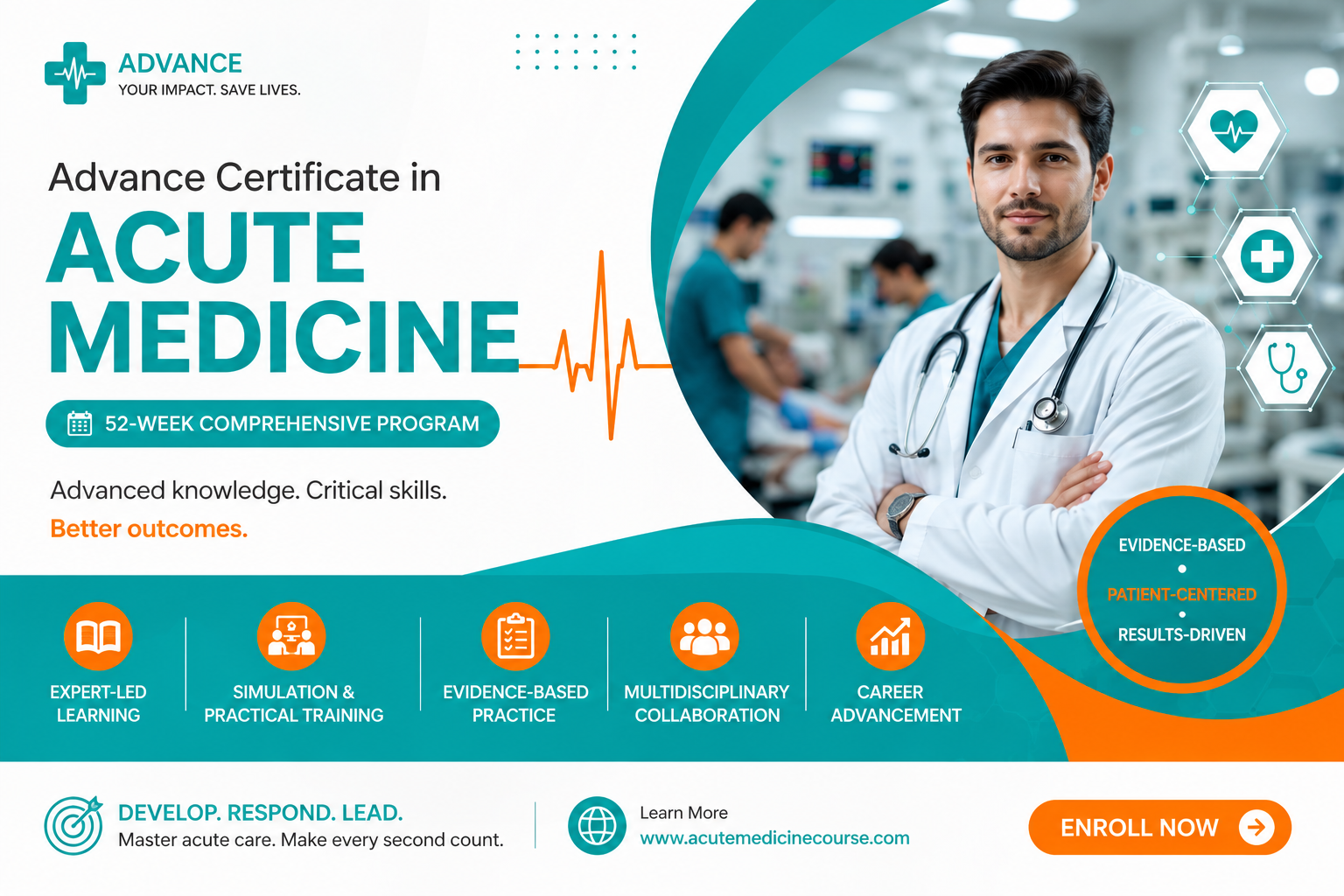

The Advance Certificate in Acute Medicine is a rigorous 52-week professional training program designed to provide healthcare professionals with comprehensive knowledge and advanced clinical skills for the effective management of acutely ill adult patients. Acute medicine is a dynamic and …
The Advance Certificate in Acute Medicine is a rigorous 52-week professional training program designed to provide healthcare professionals with comprehensive knowledge and advanced clinical skills for the effective management of acutely ill adult patients. Acute medicine is a dynamic and demanding specialty that focuses on the rapid assessment, diagnosis, stabilization, treatment, and ongoing management of patients presenting with urgent medical conditions. As healthcare systems continue to experience increasing numbers of emergency admissions and critically ill patients, the demand for clinicians trained in acute medicine has never been greater. This program prepares participants to confidently manage medical emergencies, improve patient outcomes, and deliver safe, evidence-based care across emergency departments, acute medical units, intensive care units, and hospital wards.
The curriculum has been carefully developed to bridge the gap between theoretical medical knowledge and real-world clinical practice. It emphasizes the principles of early recognition of critical illness, rapid clinical decision-making, multidisciplinary teamwork, and patient-centered care. Throughout the course, learners gain a strong understanding of the pathophysiology of acute diseases, advanced diagnostic techniques, emergency treatment protocols, and the latest international clinical guidelines. By integrating academic instruction with case-based discussions, simulation exercises, practical workshops, and supervised clinical learning, the program ensures participants develop the competence required to handle complex and time-sensitive medical situations.
The course begins by introducing the foundations of acute medicine, including the organization of acute healthcare services, emergency patient pathways, clinical governance, ethical and legal responsibilities, patient safety, and quality improvement. Learners explore the role of the acute physician in coordinating multidisciplinary care while developing professional communication skills essential for working effectively with patients, families, nurses, specialists, and allied healthcare professionals. These core principles establish the framework for delivering high-quality emergency medical care in diverse clinical settings.
A major focus of the program is the systematic assessment of acutely ill patients. Participants learn structured approaches to history taking, comprehensive physical examination, rapid clinical assessment, and the use of validated early warning scoring systems. The course emphasizes recognizing subtle signs of clinical deterioration, prioritizing urgent interventions, and making informed decisions under pressure. Learners become proficient in interpreting laboratory investigations, arterial blood gases, electrocardiograms (ECGs), chest radiographs, computed tomography (CT), magnetic resonance imaging (MRI), ultrasound findings, and other diagnostic investigations commonly used in acute medicine.
The respiratory medicine component provides in-depth training in the diagnosis and management of acute respiratory disorders, including severe asthma, chronic obstructive pulmonary disease exacerbations, community-acquired pneumonia, pulmonary embolism, pleural emergencies, acute respiratory distress syndrome (ARDS), and respiratory failure. Participants develop practical skills in airway assessment, oxygen delivery systems, nebulization therapy, non-invasive ventilation, airway adjuncts, and emergency airway management. Evidence-based treatment protocols and respiratory monitoring techniques are integrated throughout the module to prepare clinicians for managing critically ill respiratory patients.
The cardiovascular section focuses on the assessment and treatment of life-threatening cardiac conditions. Learners study acute coronary syndromes, myocardial infarction, unstable angina, cardiac arrhythmias, acute heart failure, cardiogenic shock, hypertensive emergencies, pericardial disease, and cardiac arrest. The curriculum covers advanced ECG interpretation, cardiac biomarkers, emergency pharmacology, thrombolytic therapy, anticoagulation, resuscitation guidelines, and post-resuscitation care. Participants also gain knowledge of advanced life support algorithms and emergency cardiovascular interventions that improve survival and reduce complications.
Neurological emergencies are another key area of study. Participants learn to rapidly assess patients with stroke, transient ischemic attack, seizures, status epilepticus, meningitis, encephalitis, traumatic brain injury, spinal cord disorders, raised intracranial pressure, and altered levels of consciousness. The course emphasizes early neurological assessment, neuroimaging interpretation, stroke pathways, seizure management, neuroprotective strategies, and multidisciplinary rehabilitation planning. Learners also develop the ability to differentiate neurological emergencies from common medical mimics, ensuring accurate diagnosis and timely treatment.
The program offers comprehensive coverage of gastrointestinal, hepatobiliary, renal, endocrine, and metabolic emergencies. Learners gain expertise in the management of gastrointestinal bleeding, acute pancreatitis, intestinal obstruction, liver failure, acute kidney injury, electrolyte disturbances, acid-base disorders, diabetic ketoacidosis (DKA), hyperosmolar hyperglycaemic state (HHS), adrenal insufficiency, thyroid storm, myxedema coma, severe hypoglycaemia, and other endocrine crises. Through problem-based learning and clinical case scenarios, participants develop strong analytical skills for managing complex medical presentations.
Infectious diseases remain one of the leading causes of emergency hospital admissions, making their management an essential component of acute medicine. This program provides detailed instruction on sepsis recognition, septic shock management, antimicrobial stewardship, bloodstream infections, respiratory infections, tropical diseases, viral illnesses, fungal infections, and infection prevention practices. Participants learn current evidence-based sepsis bundles, fluid resuscitation strategies, antimicrobial selection, source control, organ support, and monitoring techniques that contribute to improved patient survival.
The toxicology and environmental medicine module equips learners with the skills required to assess and manage poisoning, medication overdose, alcohol toxicity, chemical exposure, envenomation, heat-related illness, hypothermia, and occupational hazards. Participants study toxicokinetics, toxicodynamics, decontamination procedures, antidote administration, supportive therapy, and consultation with poison information services. Practical scenarios enhance decision-making and emergency preparedness in managing uncommon but potentially fatal presentations.
Critical care principles are integrated throughout the curriculum to strengthen learners’ ability to stabilize and monitor severely ill patients. Participants receive training in fluid resuscitation, electrolyte replacement, hemodynamic monitoring, arterial blood gas interpretation, mechanical ventilation principles, vasopressor therapy, nutrition in critically ill patients, and sedation strategies. Hands-on workshops provide experience in vascular access, arterial line placement, central venous catheter care, point-of-care ultrasound (POCUS), urinary catheterization, lumbar puncture, and other bedside procedures commonly performed in acute medical units.
The course also highlights the importance of caring for special patient populations, including older adults with frailty, pregnant women with acute medical disorders, oncology patients, immunocompromised individuals, and patients requiring palliative or end-of-life care. Participants learn how physiological differences, comorbidities, and complex social factors influence diagnosis, treatment, and clinical outcomes. Emphasis is placed on compassionate communication, shared decision-making, symptom control, and ethical considerations when managing vulnerable patients.
In addition to clinical expertise, the program develops essential professional competencies in leadership, teamwork, healthcare management, clinical governance, quality improvement, patient safety, research methodology, audit, and evidence-based practice. Learners participate in multidisciplinary case reviews, morbidity and mortality meetings, journal clubs, and quality improvement projects designed to strengthen analytical thinking and promote lifelong professional development. They also gain experience in effective documentation, clinical handovers, and healthcare communication, ensuring seamless continuity of patient care.
Simulation-based education forms an integral part of the learning experience. High-fidelity simulation exercises expose participants to realistic emergency scenarios involving cardiac arrest, septic shock, respiratory failure, trauma, neurological emergencies, and multi-system critical illness. These immersive experiences enhance procedural skills, crisis resource management, situational awareness, and teamwork while allowing learners to practice clinical interventions in a safe and controlled environment before applying them in clinical practice.
During the final phase of the program, learners undertake supervised clinical assessments, advanced case presentations, research activities, clinical audits, and a capstone project that integrates knowledge from every module. Continuous formative and summative assessments evaluate clinical competence, diagnostic reasoning, communication skills, professionalism, and procedural proficiency. Successful completion of these assessments demonstrates readiness to manage acute medical patients independently while maintaining the highest standards of clinical care.
Upon graduating from the Advance Certificate in Acute Medicine, participants will possess advanced competencies in emergency assessment, differential diagnosis, clinical stabilization, evidence-based treatment planning, emergency procedures, critical care management, and multidisciplinary collaboration. Graduates will be capable of recognizing deteriorating patients, initiating life-saving interventions, interpreting complex investigations, coordinating specialist referrals, and delivering compassionate, patient-focused care across a wide range of acute healthcare settings.
This program is ideally suited for MBBS graduates, junior doctors, medical officers, emergency medicine physicians, internal medicine practitioners, hospitalists, critical care clinicians, family physicians, physician associates, and other healthcare professionals who wish to enhance their expertise in acute medical care. It also provides an excellent foundation for clinicians preparing for advanced specialist training in emergency medicine, acute internal medicine, critical care, hospital medicine, or related disciplines.
By combining world-class academic content, evidence-based clinical practice, practical skills training, and multidisciplinary learning, the Advance Certificate in Acute Medicine empowers healthcare professionals to become highly competent clinicians capable of delivering rapid, effective, and compassionate care to patients experiencing acute medical emergencies. Graduates will leave the program with the confidence, clinical judgment, and leadership skills necessary to improve patient outcomes and contribute meaningfully to modern healthcare systems.
- 12 Sections
- 71 Lessons
- 52 Weeks
- Foundations of Acute MedicineThis module introduces the principles of acute medicine, focusing on the assessment and management of acutely ill adult patients. Learners develop a strong understanding of emergency care pathways, patient safety, communication, ethical considerations, and evidence-based clinical practice. The module establishes the essential clinical knowledge and professional skills required for effective decision-making in acute medical settings.4
- Clinical Assessment and Diagnostic SkillsThis module develops systematic approaches to patient assessment using history taking, physical examination, and rapid clinical evaluation. Learners gain competence in interpreting laboratory investigations, imaging, ECGs, and bedside diagnostic tools to identify life-threatening conditions promptly.6
- Airway, Breathing and Respiratory EmergenciesThis module focuses on recognizing and managing respiratory emergencies. Participants learn airway management techniques, oxygen therapy, non-invasive ventilation, and emergency interventions for common respiratory disorders encountered in acute medicine.6
- Cardiovascular EmergenciesThis module covers the diagnosis and treatment of life-threatening cardiovascular emergencies. Learners understand evidence-based protocols for managing acute coronary syndromes, arrhythmias, hypertensive crises, shock, and cardiac arrest.6
- Neurological EmergenciesThis module prepares learners to recognize and manage neurological emergencies using rapid neurological assessment and evidence-based treatment protocols. Special emphasis is placed on stroke pathways, seizures, and altered consciousness.6
- Infectious Diseases and SepsisThis module emphasizes early recognition and management of severe infections. Learners develop expertise in antimicrobial stewardship, sepsis bundles, infection prevention, and managing patients with infectious diseases requiring urgent intervention.6
- Gastrointestinal and Renal EmergenciesThis module focuses on acute gastrointestinal and renal disorders commonly encountered in emergency departments and acute medical units. Learners gain confidence in diagnosing and managing life-threatening abdominal and renal conditions.6
- Endocrine and Metabolic EmergenciesThis module develops competency in identifying endocrine crises and metabolic emergencies. Learners understand rapid diagnosis, stabilization, and ongoing management using current clinical guidelines.6
- Toxicology and Environmental EmergenciesThis module provides practical knowledge for managing poisoning, overdose, envenomation, and environmental emergencies. Learners become familiar with toxicology principles, antidotes, and supportive emergency care.6
- Critical Care Principles and Acute ProceduresThis module introduces the principles of critical care management, monitoring, and common bedside procedures performed in acute medical settings. Emphasis is placed on patient stabilization and multidisciplinary collaboration.6
- Special Populations and Multidisciplinary CareThis module addresses the unique needs of elderly patients, immunocompromised individuals, pregnant women, and patients with multiple comorbidities. Learners develop collaborative care strategies involving multidisciplinary healthcare teams.6
- Advanced Clinical Practice and CapstoneThe final module integrates all aspects of acute medicine through simulation, case-based learning, clinical audits, and supervised practice. Learners refine clinical decision-making, leadership, communication, and quality improvement skills while completing a capstone project demonstrating competency in acute medical care.7
You might be intersted in
-
79 Students
-
52 Weeks
-
146 Students
-
52 Weeks
-
32 Students
-
10 Weeks