
Fellowship in Parkinson’s disease and Movement disorder
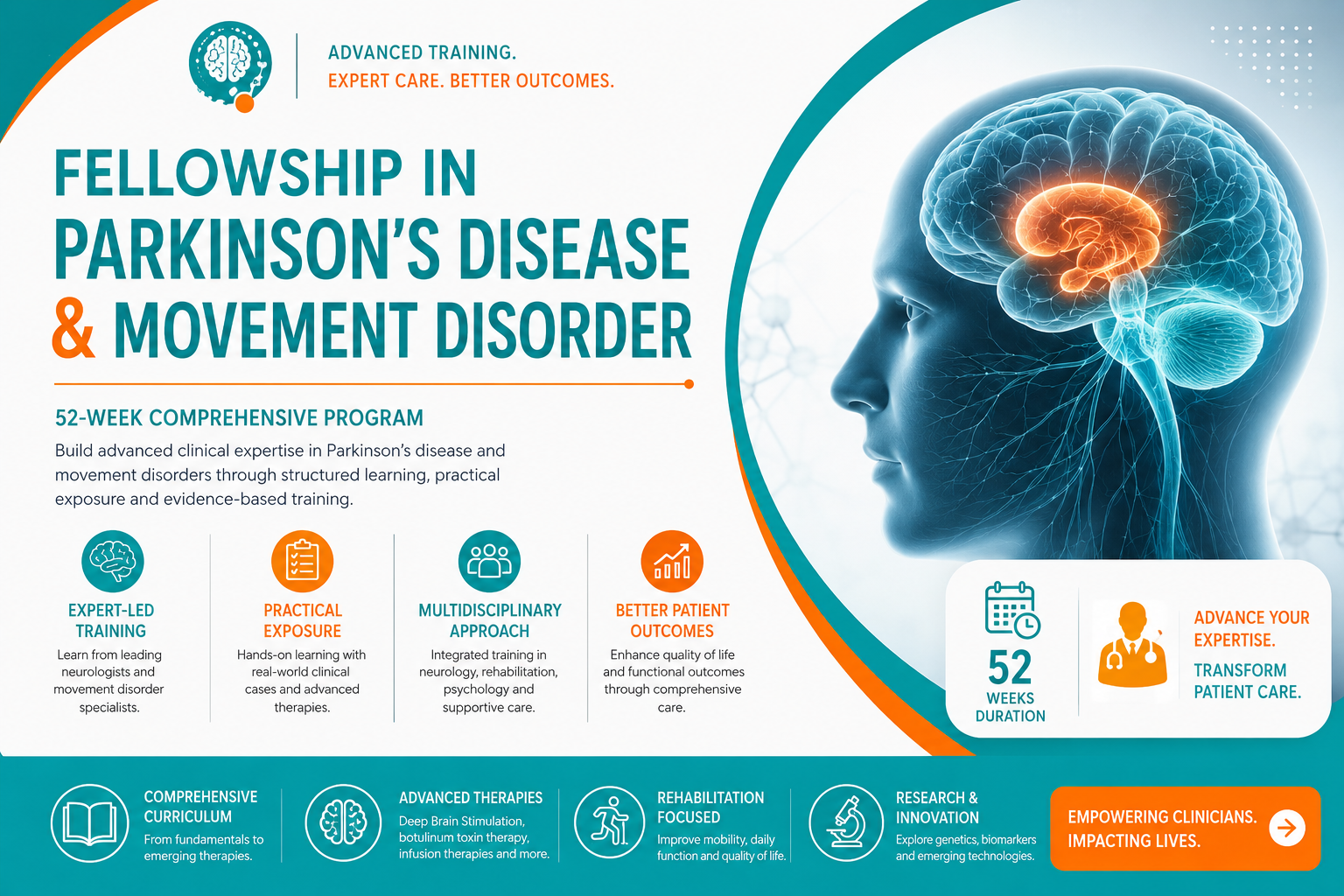

The Fellowship in Parkinson’s Disease and Movement Disorder is a comprehensive 52-week advanced training program designed for physicians and healthcare professionals seeking specialized expertise in the diagnosis, evaluation, and management of Parkinson’s disease and other movement disorders. The curriculum covers clinical assessment, neurophysiology, pharmacological therapy, deep brain stimulation, rehabilitation, atypical parkinsonian syndromes, tremor disorders, dystonia, botulinum toxin therapy, genetics, and evidence-based neurological practice, preparing learners to deliver high-quality, patient-centered movement disorder care.
The Fellowship in Parkinson’s Disease and Movement Disorder is a comprehensive 52-week advanced training program designed for physicians, medical graduates, neurologists, and healthcare professionals seeking specialized expertise in the diagnosis, evaluation, treatment, and long-term management of Parkinson’s disease and other movement disorders. With the global burden of neurodegenerative diseases steadily increasing, there is a growing demand for clinicians who possess advanced knowledge of movement disorder pathophysiology, modern diagnostic techniques, pharmacological therapies, surgical interventions, rehabilitation, and multidisciplinary patient care. This fellowship equips learners with the clinical competence and evidence-based knowledge required to deliver high-quality care for patients affected by complex neurological movement disorders.
The curriculum begins with a strong foundation in the anatomy and physiology of the central nervous system, emphasizing the basal ganglia, cerebellum, brainstem, and neural pathways involved in motor control. Participants develop a comprehensive understanding of normal movement physiology and the pathological mechanisms responsible for hypokinetic and hyperkinetic disorders. The program explores neurodegeneration, alpha-synuclein pathology, mitochondrial dysfunction, oxidative stress, neuroinflammation, genetic mutations, and environmental risk factors contributing to Parkinson’s disease and related disorders.
Learners receive extensive training in clinical assessment and neurological examination techniques essential for diagnosing movement disorders. The program covers detailed history taking, motor examination, gait and balance assessment, tremor evaluation, rigidity, bradykinesia, postural instability, cognitive screening, and the application of standardized clinical rating scales such as the Unified Parkinson’s Disease Rating Scale (UPDRS) and Hoehn and Yahr staging. Emphasis is placed on recognizing early symptoms, identifying disease progression, and differentiating Parkinson’s disease from atypical and secondary causes of parkinsonism.
A significant component of the fellowship focuses on diagnostic investigations used in movement disorder practice. Participants learn the appropriate use and interpretation of neuroimaging techniques including magnetic resonance imaging (MRI), dopamine transporter (DaT) imaging, positron emission tomography (PET), and other functional imaging modalities. The curriculum also introduces laboratory investigations, cerebrospinal fluid biomarkers, genetic testing, and emerging diagnostic technologies that support early diagnosis and personalized treatment planning.
The fellowship provides comprehensive education in the pharmacological management of Parkinson’s disease across all stages of illness. Learners study the pharmacology, indications, contraindications, dosing strategies, and adverse effects of levodopa, dopamine agonists, monoamine oxidase-B inhibitors, catechol-O-methyltransferase inhibitors, amantadine, anticholinergic medications, and other therapies used to optimize symptom control. Participants also develop expertise in managing motor fluctuations, wearing-off phenomena, dyskinesias, medication-induced complications, impulse control disorders, and individualized treatment adjustments based on patient characteristics and disease severity.
Advanced therapeutic interventions form an important part of the curriculum. Participants gain in-depth knowledge of device-assisted therapies including Deep Brain Stimulation (DBS), levodopa-carbidopa intestinal gel infusion, continuous dopaminergic infusion therapies, and MRI-guided focused ultrasound. The program covers patient selection criteria, surgical targets, perioperative management, postoperative programming, complication management, and long-term follow-up to optimize patient outcomes through advanced neurological interventions.
The fellowship emphasizes the recognition and treatment of the diverse non-motor symptoms associated with Parkinson’s disease, which often contribute significantly to disability and reduced quality of life. Learners study cognitive impairment, Parkinson’s disease dementia, depression, anxiety, psychosis, sleep disorders, autonomic dysfunction, gastrointestinal disturbances, urinary symptoms, sexual dysfunction, fatigue, chronic pain, and other non-motor manifestations. Participants learn multidisciplinary approaches that integrate pharmacological and non-pharmacological strategies for comprehensive patient care.
Rehabilitation is another essential component of the program. Participants explore evidence-based physiotherapy, occupational therapy, speech and language therapy, swallowing rehabilitation, exercise prescription, fall prevention strategies, gait training, assistive technologies, and home-based rehabilitation programs. The fellowship highlights the importance of coordinated multidisciplinary care involving neurologists, physiotherapists, speech therapists, occupational therapists, psychologists, nurses, and caregivers to maximize patient independence and quality of life.
The curriculum extends beyond Parkinson’s disease to provide detailed coverage of the full spectrum of movement disorders. Learners develop expertise in the diagnosis and management of essential tremor, dystonia, chorea, Huntington’s disease, myoclonus, tics, Tourette syndrome, hemiballismus, ataxia, functional movement disorders, and pediatric movement disorders. Clinical differentiation, disease-specific management strategies, and long-term follow-up are emphasized throughout the course.
Participants also receive specialized training in atypical parkinsonian syndromes, including Multiple System Atrophy (MSA), Progressive Supranuclear Palsy (PSP), Corticobasal Syndrome (CBS), Dementia with Lewy Bodies (DLB), vascular parkinsonism, drug-induced parkinsonism, and other uncommon neurodegenerative disorders. The fellowship focuses on distinguishing clinical characteristics, neuroimaging findings, prognostic indicators, and individualized management approaches for these complex conditions.
The program includes practical instruction in botulinum toxin therapy for focal movement disorders such as cervical dystonia, blepharospasm, hemifacial spasm, limb dystonia, and selected spasticity disorders. Participants learn patient selection, muscle localization, injection techniques, dosage optimization, adverse event management, and long-term treatment planning.
Emerging developments in movement disorder medicine are incorporated throughout the fellowship. Learners explore advances in molecular genetics, precision medicine, pharmacogenomics, disease-modifying therapies, stem cell research, gene therapy, biomarker discovery, wearable technologies, digital health applications, artificial intelligence, and remote patient monitoring. These topics prepare graduates to integrate future innovations into clinical practice and remain current with rapidly evolving neurological care.
The fellowship also emphasizes research methodology, critical appraisal of scientific literature, clinical trial design, biostatistics, evidence-based medicine, medical ethics, patient communication, shared decision-making, and quality improvement. Participants strengthen their ability to interpret research findings, contribute to clinical research initiatives, and apply scientific evidence to everyday neurological practice.
Upon successful completion of the Fellowship in Parkinson’s Disease and Movement Disorder, graduates will possess advanced clinical knowledge and practical skills required to diagnose and manage Parkinson’s disease and a wide range of movement disorders across diverse healthcare settings. They will be equipped to provide patient-centered, multidisciplinary, and evidence-based neurological care while contributing to improved functional outcomes, enhanced quality of life, and the continued advancement of movement disorder medicine. This fellowship serves as an excellent professional development opportunity for clinicians seeking to expand their expertise in one of the most specialized and rapidly evolving fields of neurology.
- 10 Sections
- 81 Lessons
- 52 Weeks
- Foundations of Parkinson's Disease and Movement DisordersThis module introduces learners to the fundamental principles of Parkinson's disease and movement disorders. Participants will explore the epidemiology, neuroanatomy, neurophysiology, classification, and clinical significance of hypokinetic and hyperkinetic movement disorders. The module provides a strong scientific foundation for understanding disease mechanisms, diagnostic approaches, and multidisciplinary management strategies used in modern neurological practice.7
- Clinical Evaluation and Neurological ExaminationThis module focuses on developing comprehensive clinical assessment skills for patients with movement disorders. Learners will master neurological examination techniques, detailed history taking, motor assessment scales, gait evaluation, cognitive screening, and differential diagnosis to accurately identify various movement disorders.8
- Parkinson's Disease PathogenesisThis module explores the molecular and cellular mechanisms underlying Parkinson's disease. Learners will study alpha-synuclein pathology, neurodegeneration, genetic mutations, mitochondrial dysfunction, oxidative stress, neuroinflammation, and disease progression to understand the biological basis of Parkinson's disease.8
- Diagnosis of Parkinson's DiseaseThis module covers diagnostic strategies for Parkinson's disease using clinical criteria, imaging modalities, laboratory investigations, and biomarkers. Learners will understand early diagnosis, atypical presentations, and differentiation from secondary causes of parkinsonism.8
- Pharmacological ManagementThis module provides detailed knowledge of medications used in Parkinson's disease management. Learners will understand drug mechanisms, dosing strategies, adverse effects, treatment algorithms, and individualized pharmacotherapy across different disease stages.9
- Advanced Therapeutic InterventionsThis module focuses on advanced treatment options for patients with complex Parkinson's disease, including infusion therapies, surgical interventions, and device-assisted management. Participants learn patient selection, perioperative care, and long-term follow-up.8
- Non-Motor Symptoms of Parkinson's DiseaseThis module emphasizes recognition and management of non-motor manifestations that significantly impact quality of life. Learners will address psychiatric, autonomic, gastrointestinal, sleep-related, sensory, and cognitive complications.9
- Rehabilitation in Parkinson's DiseaseThis module introduces multidisciplinary rehabilitation approaches aimed at improving mobility, independence, communication, swallowing, and overall quality of life through coordinated therapeutic interventions.8
- Tremor DisordersThis module provides in-depth knowledge of tremor syndromes, their pathophysiology, diagnostic evaluation, and therapeutic approaches. Learners distinguish essential tremor from Parkinsonian and other tremor disorders.8
- Hyperkinetic Movement DisordersThis module covers the diagnosis and management of hyperkinetic disorders, including dystonia, chorea, myoclonus, tics, and other involuntary movement disorders encountered in neurological practice.8
You might be intersted in
-
167 Students
-
52 Weeks
-
132 Students
-
52 Weeks
-
123 Students
-
52 Weeks
-
122 Students
-
52 Weeks