
Fellowship in Clinical Ethics
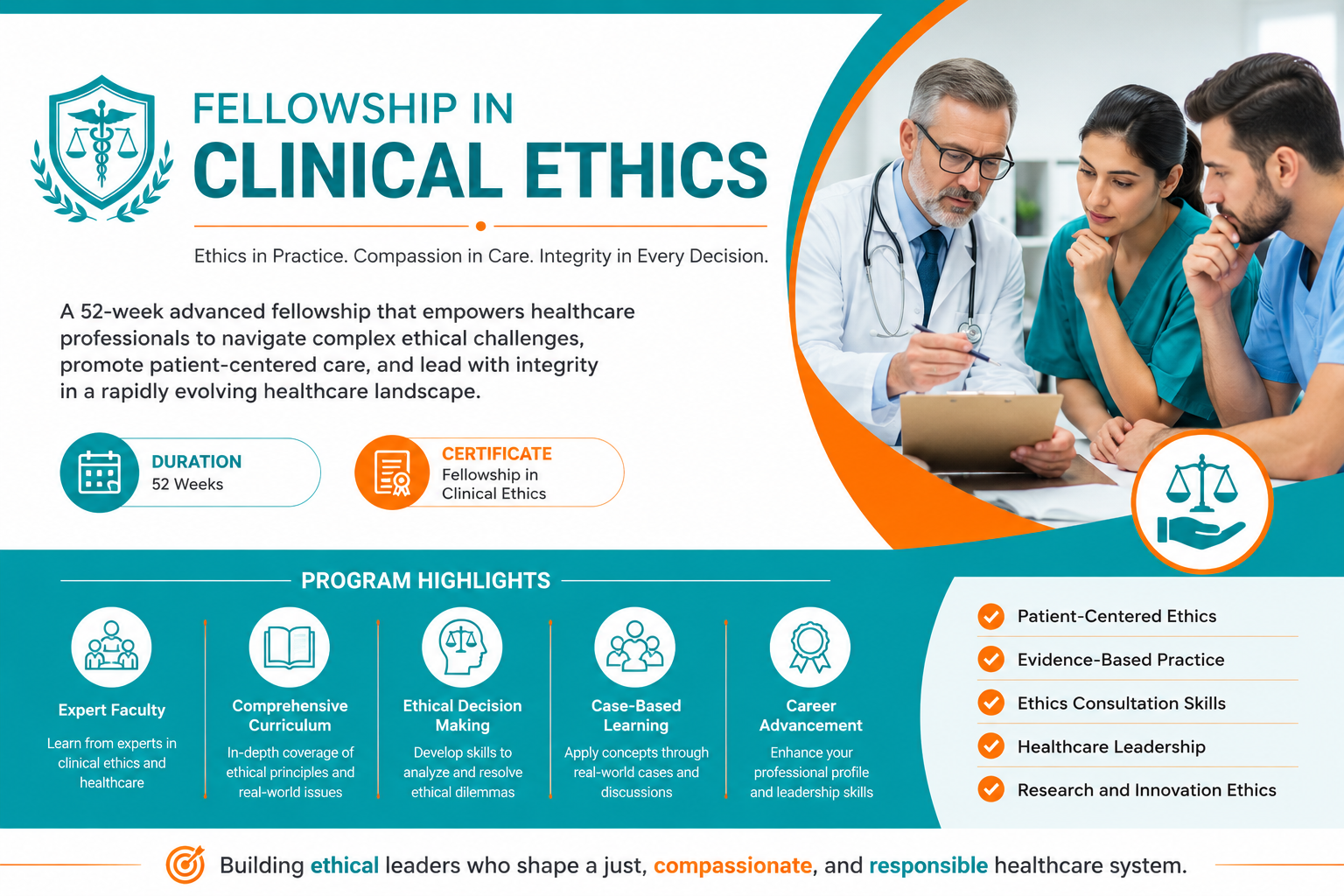

The Fellowship in Clinical Ethics is a comprehensive 52-week advanced training program designed for healthcare professionals seeking expertise in ethical decision-making, patient-centered care, and clinical ethics consultation. The program explores fundamental ethical principles, informed consent, confidentiality, end-of-life care, research ethics, public health ethics, and emerging challenges in modern healthcare. Through case-based learning and practical application, participants develop the knowledge and skills required to address complex ethical dilemmas, support healthcare teams, and promote ethical excellence in clinical practice.
The Fellowship in Clinical Ethics is a comprehensive 52-week advanced training program designed for healthcare professionals, physicians, nurses, allied health practitioners, healthcare administrators, researchers, and educators seeking specialized expertise in ethical decision-making within clinical and healthcare settings. As modern healthcare becomes increasingly complex due to advances in medical technology, evolving legal frameworks, diverse patient populations, and challenging treatment decisions, the need for professionals skilled in clinical ethics has never been greater. This fellowship provides learners with the knowledge, analytical tools, and practical competencies required to address ethical dilemmas while promoting patient-centered, compassionate, and evidence-based care.
Clinical ethics plays a critical role in supporting healthcare providers, patients, and families when difficult decisions arise. From informed consent and patient autonomy to end-of-life care, resource allocation, confidentiality, and emerging technologies, ethical considerations influence nearly every aspect of healthcare delivery. This fellowship equips participants with a deep understanding of ethical principles, moral reasoning, and professional responsibilities that guide healthcare practice. Learners gain the ability to evaluate complex situations systematically and develop ethically sound recommendations that balance patient welfare, legal requirements, professional obligations, and societal values.
The curriculum begins with a strong foundation in biomedical ethics, exploring the historical evolution of medical ethics, major ethical theories, and the core principles of autonomy, beneficence, nonmaleficence, and justice. Participants learn structured approaches to ethical analysis and decision-making, enabling them to navigate challenging clinical situations with confidence and clarity. Through case studies and real-world scenarios, learners develop critical thinking skills necessary for identifying ethical issues and evaluating competing perspectives.
A major focus of the fellowship is patient rights and shared decision-making. Participants explore informed consent processes, capacity assessments, surrogate decision-making, and communication strategies that support respect for patient autonomy. The program examines the ethical responsibilities of healthcare professionals when balancing patient preferences with clinical recommendations, ensuring that care decisions remain respectful, transparent, and patient-centered.
The fellowship also provides extensive training in confidentiality, privacy protection, and professional boundaries. As healthcare systems increasingly rely on electronic health records, telemedicine, and digital health technologies, maintaining patient trust through ethical management of sensitive information has become essential. Learners study ethical and legal obligations related to privacy, data protection, and professional conduct while developing strategies to manage ethical conflicts in clinical practice.
End-of-life ethics is another critical area of study within the program. Participants examine ethical challenges related to palliative care, advance directives, life-sustaining treatment decisions, do-not-resuscitate orders, and compassionate care for terminally ill patients. Through interdisciplinary discussions and case-based learning, learners gain the ability to support patients and families during some of the most difficult healthcare decisions while respecting dignity, values, and quality of life.
The fellowship explores specialized ethical issues in reproductive health, genetics, pediatrics, mental health, and public health. Participants analyze ethical questions surrounding assisted reproductive technologies, genetic testing, prenatal diagnosis, pediatric consent, adolescent confidentiality, psychiatric treatment, and involuntary care. The program also addresses public health ethics, including vaccination policies, health equity, disease prevention, pandemic response, and the ethical responsibilities of healthcare systems toward communities and vulnerable populations.
Research ethics forms an essential component of the curriculum, preparing participants to understand ethical standards governing clinical trials, biomedical research, innovation, and scientific integrity. Learners examine participant protection, informed consent in research, ethics committee processes, and the responsible conduct of research. These competencies are particularly valuable for professionals involved in academic medicine, healthcare research, and clinical investigations.
In addition to individual patient care, the fellowship emphasizes organizational ethics and healthcare leadership. Participants learn how ethical principles guide healthcare policies, institutional governance, resource allocation, quality improvement initiatives, and professional accountability. The program prepares learners to contribute effectively to ethics committees, hospital leadership teams, and policy development processes that promote ethical excellence throughout healthcare organizations.
Contemporary healthcare challenges receive special attention throughout the fellowship. Learners critically examine ethical issues associated with artificial intelligence, precision medicine, telemedicine, digital health technologies, big data, and emerging biomedical innovations. By exploring these rapidly evolving areas, participants develop the ability to address new ethical questions and contribute to responsible healthcare innovation in a changing clinical landscape.
A distinguishing feature of the Fellowship in Clinical Ethics is its emphasis on practical application. Through ethics consultations, case analyses, interdisciplinary discussions, reflective exercises, and capstone projects, participants translate theoretical knowledge into real-world practice. This experiential learning approach enables learners to develop confidence in conducting ethical assessments, facilitating difficult conversations, and providing ethical guidance within healthcare teams.
Upon successful completion of the program, graduates will possess advanced competencies in ethical reasoning, clinical decision-making, ethics consultation, healthcare leadership, and policy analysis. They will be prepared to serve as clinical ethics consultants, ethics committee members, healthcare leaders, educators, researchers, and advocates for ethical healthcare practice. The fellowship also provides a strong foundation for professionals seeking to enhance patient care quality, support organizational ethics initiatives, and contribute to ethical discourse within healthcare systems.
Whether working in hospitals, clinics, academic institutions, research organizations, public health agencies, or healthcare administration, graduates of the Fellowship in Clinical Ethics will be equipped to address complex ethical challenges with professionalism, integrity, compassion, and evidence-based judgment. The program empowers healthcare professionals to become leaders in ethical healthcare delivery and champions of patient-centered care in an increasingly complex and interconnected healthcare environment.
- 12 Sections
- 74 Lessons
- 52 Weeks
- Foundations of Clinical EthicsThis module introduces learners to the fundamental concepts, principles, and historical development of clinical ethics. Participants explore ethical theories, moral reasoning, professional responsibilities, and the role of ethics in healthcare decision-making. The module establishes a strong foundation for analyzing ethical dilemmas encountered in modern clinical practice.6
- Patient Autonomy and Informed ConsentThis module focuses on respecting patient autonomy and ensuring ethical healthcare decisions through informed consent. Learners examine legal and ethical requirements for consent, capacity assessment, surrogate decision-making, and shared decision-making models. Emphasis is placed on balancing autonomy with professional responsibilities.6
- Confidentiality, Privacy, and Professional BoundariesThis module examines ethical obligations related to patient confidentiality, privacy, and trust. Students learn how to manage sensitive health information, navigate digital healthcare records, and maintain professional boundaries while ensuring ethical and legal compliance.6
- Ethical Issues in Clinical Decision-MakingThis module develops advanced skills in analyzing complex clinical situations involving ethical dilemmas. Learners evaluate competing ethical principles, stakeholder interests, and practical considerations in everyday healthcare settings.6
- End-of-Life Ethics and Palliative CareThis module explores ethical considerations surrounding end-of-life care, palliative medicine, and decision-making for terminally ill patients. Learners study advance directives, withholding and withdrawing treatment, palliative sedation, and ethical approaches to compassionate care.6
- Reproductive and Genetic EthicsThis module addresses ethical issues related to reproductive medicine, fertility treatment, prenatal diagnosis, genetic testing, and emerging reproductive technologies. Students evaluate ethical concerns involving family planning, genetic information, and reproductive rights.6
- Pediatric and Adolescent EthicsThis module focuses on ethical considerations in caring for children and adolescents. Learners examine parental authority, assent, consent, child welfare, confidentiality, and decision-making for vulnerable pediatric populations.6
- Mental Health and Capacity EthicsThis module explores ethical challenges associated with mental healthcare, psychiatric treatment, involuntary hospitalization, and decision-making capacity. Students develop skills for balancing autonomy, safety, and therapeutic responsibilities.6
- Ethics in Public Health and Global HealthThis module examines ethical considerations in population health, disease prevention, public health emergencies, and global healthcare systems. Learners analyze ethical tensions between individual rights and collective welfare.6
- Research Ethics and Innovation in HealthcareThis module provides comprehensive knowledge of ethical standards governing biomedical research, clinical trials, innovation, and scientific integrity. Students explore participant protection, research governance, and responsible innovation.6
- Organizational Ethics and Healthcare LeadershipThis module focuses on ethical leadership, healthcare governance, organizational culture, and institutional accountability. Learners understand how ethical principles guide policy development and healthcare administration.6
- Contemporary Issues and Clinical Ethics PracticumThis capstone module integrates knowledge gained throughout the fellowship through case-based learning, ethics consultations, policy analysis, and applied clinical ethics projects. Learners critically evaluate contemporary ethical issues and demonstrate professional competence in ethical decision-making.8
- 12.1Artificial Intelligence and Healthcare Ethics
- 12.2Digital Health and Telemedicine Ethics
- 12.3Ethics of Precision Medicine
- 12.4Cultural and Religious Perspectives in Healthcare
- 12.5Clinical Ethics Case Conferences
- 12.6Ethics Consultation Practicum
- 12.7Capstone Project Development
- 12.8Final Clinical Ethics Portfolio and Assessment
You might be intersted in
-
167 Students
-
52 Weeks
-
132 Students
-
52 Weeks
-
124 Students
-
52 Weeks
-
133 Students
-
52 Weeks