
Fellowship in Preventive Medicine
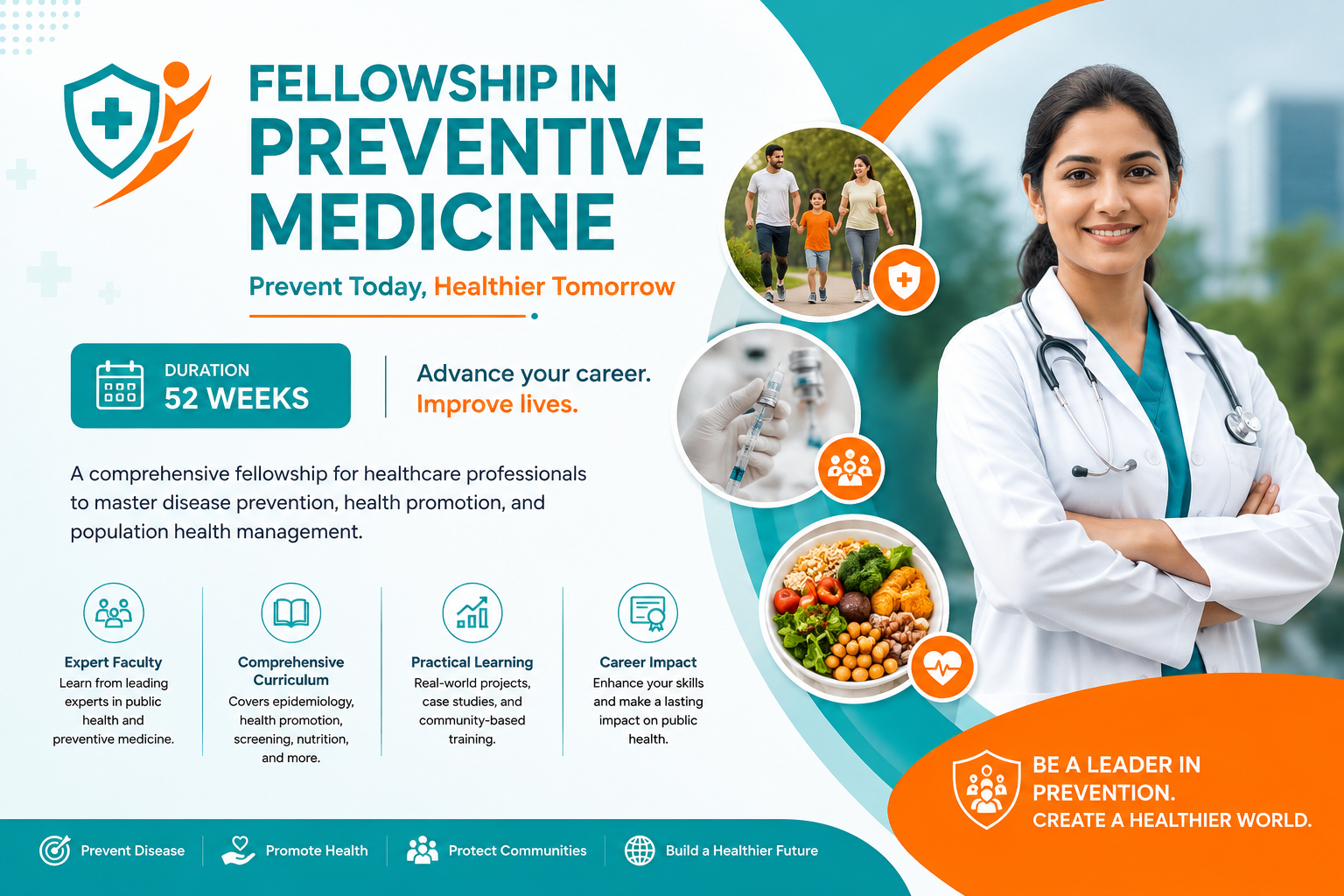

The Fellowship in Preventive Medicine is a comprehensive 52-week advanced training program designed for physicians, healthcare professionals, public health practitioners, and medical graduates seeking specialized expertise in disease prevention, health promotion, and population health management. The program equips learners with …
The Fellowship in Preventive Medicine is a comprehensive 52-week advanced training program designed for physicians, healthcare professionals, public health practitioners, and medical graduates seeking specialized expertise in disease prevention, health promotion, and population health management. The program equips learners with the knowledge and practical skills required to identify health risks, implement preventive interventions, and improve health outcomes at individual, community, and population levels.
As healthcare systems worldwide shift from treatment-focused models to prevention-oriented approaches, preventive medicine has become an essential discipline in reducing disease burden, healthcare costs, and health disparities. This fellowship provides a strong foundation in epidemiology, biostatistics, public health policy, environmental health, occupational health, and evidence-based preventive practices. Participants will learn how to design, implement, and evaluate preventive healthcare programs that address both communicable and non-communicable diseases.
The curriculum explores key areas such as disease surveillance, screening programs, immunization strategies, outbreak investigation, lifestyle medicine, nutrition, maternal and child health, and chronic disease prevention. Learners will gain an in-depth understanding of major public health challenges including cardiovascular diseases, diabetes, cancer, respiratory disorders, infectious diseases, and emerging global health threats. Special emphasis is placed on risk assessment, early detection, behavioral modification, and community-based interventions that contribute to long-term health improvement.
Throughout the program, participants will develop competencies in research methodology, healthcare leadership, program management, quality improvement, and health communication. They will learn to analyze health data, interpret epidemiological evidence, formulate preventive strategies, and contribute to policy development. The fellowship also addresses contemporary issues such as health equity, social determinants of health, climate change and health, pandemic preparedness, and global health initiatives.
A distinctive feature of this fellowship is its practical and application-oriented approach. Learners engage in case studies, public health projects, preventive health assessments, and community-based learning activities that bridge the gap between theory and real-world practice. The capstone project enables participants to apply their knowledge to a meaningful preventive medicine challenge, fostering innovation and evidence-based problem-solving skills.
Upon successful completion of the Fellowship in Preventive Medicine, graduates will be prepared to lead preventive healthcare initiatives in hospitals, public health organizations, government agencies, academic institutions, corporate wellness programs, research centers, and community healthcare settings. They will possess the expertise necessary to design effective prevention programs, promote healthier populations, and contribute to sustainable healthcare systems.
This fellowship serves as an ideal pathway for healthcare professionals who aspire to become leaders in preventive medicine, public health practice, community health management, and population-based healthcare. By emphasizing prevention, early intervention, and health promotion, the program empowers participants to make a lasting impact on individual and community well-being while advancing their professional careers in a rapidly evolving healthcare landscape.
- 12 Sections
- 72 Lessons
- 52 Weeks
- Foundations of Preventive MedicineThis module introduces the principles, scope, and significance of preventive medicine in modern healthcare systems. Learners will explore the levels of prevention, determinants of health, disease prevention strategies, and the role of preventive medicine in improving population health outcomes. The module establishes the foundation for understanding how preventive interventions reduce morbidity, mortality, and healthcare costs.6
- Epidemiology and BiostatisticsThis module focuses on the epidemiological methods used to study disease patterns and population health. Participants will learn biostatistical techniques for data analysis, interpretation of research findings, and evidence-based decision-making. Emphasis is placed on understanding disease occurrence, risk factors, and public health surveillance.6
- Public Health Systems and PoliciesThis module examines healthcare systems, public health infrastructure, and policies that support preventive healthcare initiatives. Learners will gain insights into health governance, healthcare financing, and policy formulation for disease prevention and health promotion.6
- Environmental and Occupational HealthThis module explores environmental and occupational factors influencing health and disease. Participants will learn risk assessment methods, workplace safety standards, environmental hazards, and strategies to prevent occupational and environmental illnesses.6
- Communicable Disease PreventionThis module provides comprehensive knowledge of infectious disease prevention and control. Learners will study disease transmission, outbreak investigation, immunization programs, and infection prevention strategies in community and healthcare settings.6
- Non-Communicable Disease PreventionThis module focuses on preventing chronic diseases through risk factor modification, lifestyle interventions, and community-based preventive strategies. Participants will explore evidence-based approaches for reducing the burden of cardiovascular diseases, diabetes, cancer, and respiratory illnesses.6
- Nutrition and Preventive HealthcareThis module addresses the role of nutrition in disease prevention and health promotion. Learners will understand nutritional assessment, dietary guidelines, food safety, and nutrition interventions across different population groups.6
- Maternal, Child, and Adolescent HealthThis module focuses on preventive strategies that improve maternal, neonatal, child, and adolescent health outcomes. Topics include reproductive health, growth monitoring, immunization, and preventive interventions throughout early life stages.6
- Lifestyle Medicine and Health PromotionThis module emphasizes lifestyle interventions for disease prevention and wellness promotion. Participants will learn how physical activity, healthy nutrition, sleep, stress management, and behavioral counseling contribute to long-term health.6
- Screening and Early Detection ProgramsThis module covers the design, implementation, and evaluation of screening programs for early disease detection. Learners will understand screening principles, ethical considerations, and evidence-based recommendations for population screening.6
- Global Health and Emerging ChallengesThis module explores global health priorities, health inequalities, emerging diseases, and international efforts to improve population health. Participants will understand how globalization and environmental changes influence preventive medicine.6
- Research, Leadership, and Capstone ProjectThe final module develops research, leadership, and program management competencies. Participants will learn project planning, healthcare leadership, quality improvement, and scientific communication while completing a preventive medicine capstone project addressing a real-world public health challenge.6
You might be intersted in
-
167 Students
-
52 Weeks
-
123 Students
-
52 Weeks
-
142 Students
-
52 Weeks
-
122 Students
-
52 Weeks