The MRCP(UK) Federation Part 1 exam is the first major step toward becoming a member of the Royal Colleges of Physicians. It evaluates a doctor’s understanding of core medical sciences, clinical reasoning, and common medical disorders relevant to internal medicine practice. According to the official exam structure, the exam consists of two papers with 100 best-of-five MCQs each, making a total of 200 questions.
Understanding the MRCP Part 1 syllabus and subject-wise weightage is extremely important because not all specialties contribute equally to the exam. Some subjects repeatedly carry a higher number of questions and therefore deserve greater attention during revision.
MRCP Part 1 Exam Pattern
- Two papers conducted on the same day
- 100 MCQs in each paper
- Best-of-five answer format
- 3 hours per paper
- Total questions: 200
- No negative marking
The exam focuses on both clinical medicine and basic sciences, testing not only factual knowledge but also clinical application and interpretation skills.
Understanding the MRCP Part 1 Syllabus
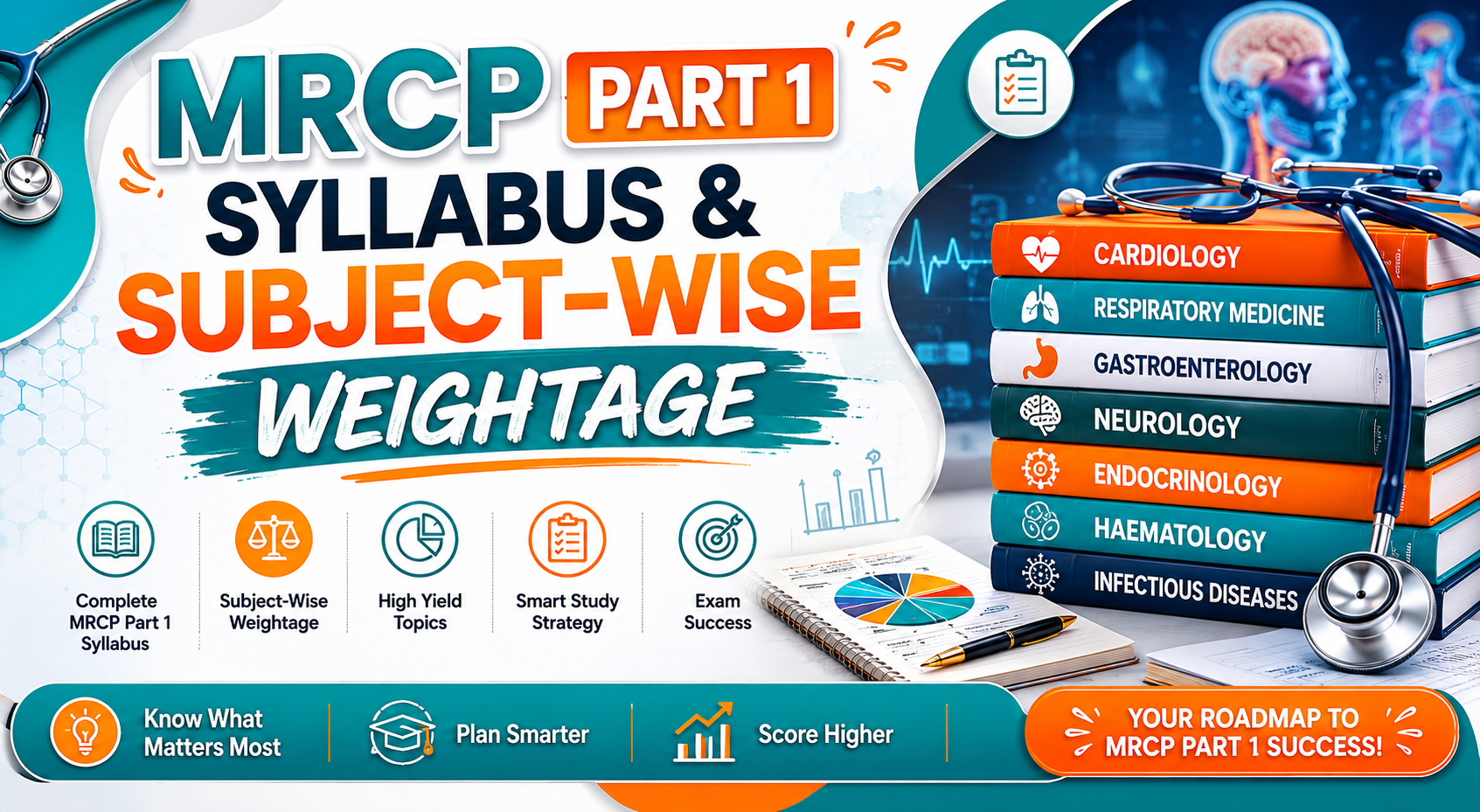
MRCP part 1 asseses the candidate’s knowledge in different subjects of internal medicine and their ability to apply their knowledge. Being a fundamental paper, MRCP Part 1 encompasses a vast syllabus, covering various subjects including cardiology, respiratory medicine, neurology, gastroenterology, endocrinology, nephrology, haematology, infectious diseases, rheumatology, ophthalmology, geriatric medicine, oncology, and psychiatry. Questions are also asked from topics that fall under clinical sciences including clinical anatomy, clinical physiology, genetics, immunology, evidence-based medicine, etc.
MRCP Part 1 Subject-Wise Weightage
Below is the approximate distribution of questions across specialties based on the official MRCP blueprint and revision guides.
| Specialty | Approximate Questions |
|---|---|
| Cardiology | 14 |
| Clinical Pharmacology & Therapeutics | 15 |
| Clinical Sciences | 25 |
| Dermatology | 8 |
| Endocrinology & Diabetes | 14 |
| Gastroenterology & Hepatology | 14 |
| Geriatric Medicine | 8 |
| Haematology | 10 |
| Infectious Diseases | 14 |
| Neurology | 14 |
| Oncology | 5 |
| Medical Ophthalmology | 4 |
| Palliative Medicine | 4 |
| Psychiatry | 9 |
| Renal Medicine | 14 |
| Respiratory Medicine | 14 |
| Rheumatology | 14 |
| Total | 200 |
Clinical Sciences Breakdown
Clinical sciences form one of the most heavily tested areas in MRCP Part 1. Candidates often underestimate this section, but it contributes approximately 25 questions.
| Clinical Science Topic | Approximate Questions |
|---|---|
| Cell & Molecular Biology | 2 |
| Clinical Anatomy | 3 |
| Clinical Biochemistry | 4 |
| Clinical Physiology | 4 |
| Genetics | 3 |
| Immunology | 4 |
| Statistics, Epidemiology & Evidence-Based Medicine | 5 |
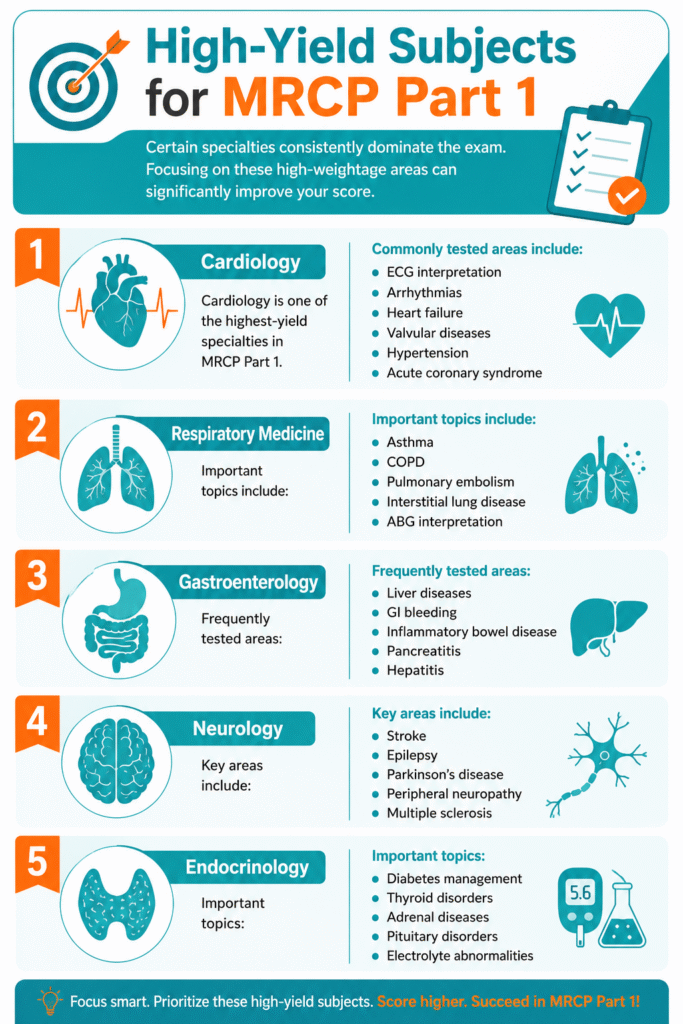
High-Yield Subjects for MRCP Part 1
How to Study According to Weightage
Studying according to weightage is one of the most effective strategies for exam preparation, especially for competitive exams like MRCS. It involves analyzing the syllabus and identifying topics that carry higher marks or are frequently tested, then allocating more time and effort to those areas. High-weightage topics should be studied in depth with strong conceptual understanding, regular revision, and practice questions, while low-weightage topics can be covered more briefly for basic familiarity. This approach helps maximize scores by ensuring that the most important areas are fully prepared without wasting time on less relevant content. Additionally, combining weightage-based study with mock tests and previous years’ questions allows candidates to recognize patterns and prioritize revision more efficiently, ultimately improving accuracy and exam performance.
Prioritize High-Weightage Subjects
Prioritizing high-weightage subjects first is one of the most effective strategies for efficient exam preparation. It ensures that you focus your time and energy on topics that contribute the most marks in the exam, helping you maximize your score potential early in your study plan. By starting with high-yield subjects, you build a strong conceptual foundation in core areas, which also makes it easier to understand and retain related topics later. This approach reduces last-minute stress and improves revision efficiency, as the most important content is already well-covered. Once these key subjects are mastered, you can move on to medium and low-weightage topics with greater confidence and a more balanced preparation strategy.
Don’t Ignore Clinical Sciences
Clinical sciences should never be ignored during exam preparation, as they often form the foundation for understanding complex clinical scenarios and frequently appear in application-based questions. Subjects like genetics, immunology, pharmacology, and statistics may seem less prominent compared to major clinical specialties, but they play a crucial role in testing analytical thinking and basic scientific understanding. These topics are often revisited in different forms throughout the exam, making consistent revision essential for retaining key concepts. A strong grasp of clinical sciences also improves decision-making skills and helps in interpreting patient cases more accurately. Therefore, integrating these subjects into your regular study schedule ensures a more balanced preparation and prevents unexpected loss of marks in seemingly minor but high-yield areas.
Use Question Banks Daily
Most successful candidates rely heavily on:
- Passmedicine
- Pastest
- Official MRCP sample papers
Recent discussions among MRCP candidates highlight that question banks are the most effective preparation tool for pattern recognition and exam practice.
Practice Mock Exams
Timed mock exams help improve:
- Speed
- Clinical reasoning
- Time management
- Exam stamina
Best Resources for MRCP Part 1 Preparation
Popular resources used by successful candidates include:
- Passmedicine
- Pastest
- MRCP official mock papers
- Oxford Handbook of Clinical Medicine
- Kalra Notes
- Essential Revision Notes for MRCP
Many recent candidates recommend combining Passmedicine for concept learning with Pastest for realistic mock papers.
Final Thoughts
The MRCP Part 1 syllabus is vast, but understanding the subject-wise weightage can make your preparation far more focused and efficient. High-yield specialties like cardiology, respiratory medicine, neurology, and gastroenterology should form the core of your revision plan, while clinical sciences and pharmacology should never be neglected.
Consistent question practice, structured revision, and strategic time allocation are the keys to success in MRCP Part 1. With the right preparation approach, passing the exam becomes much more achievable.