Introduction
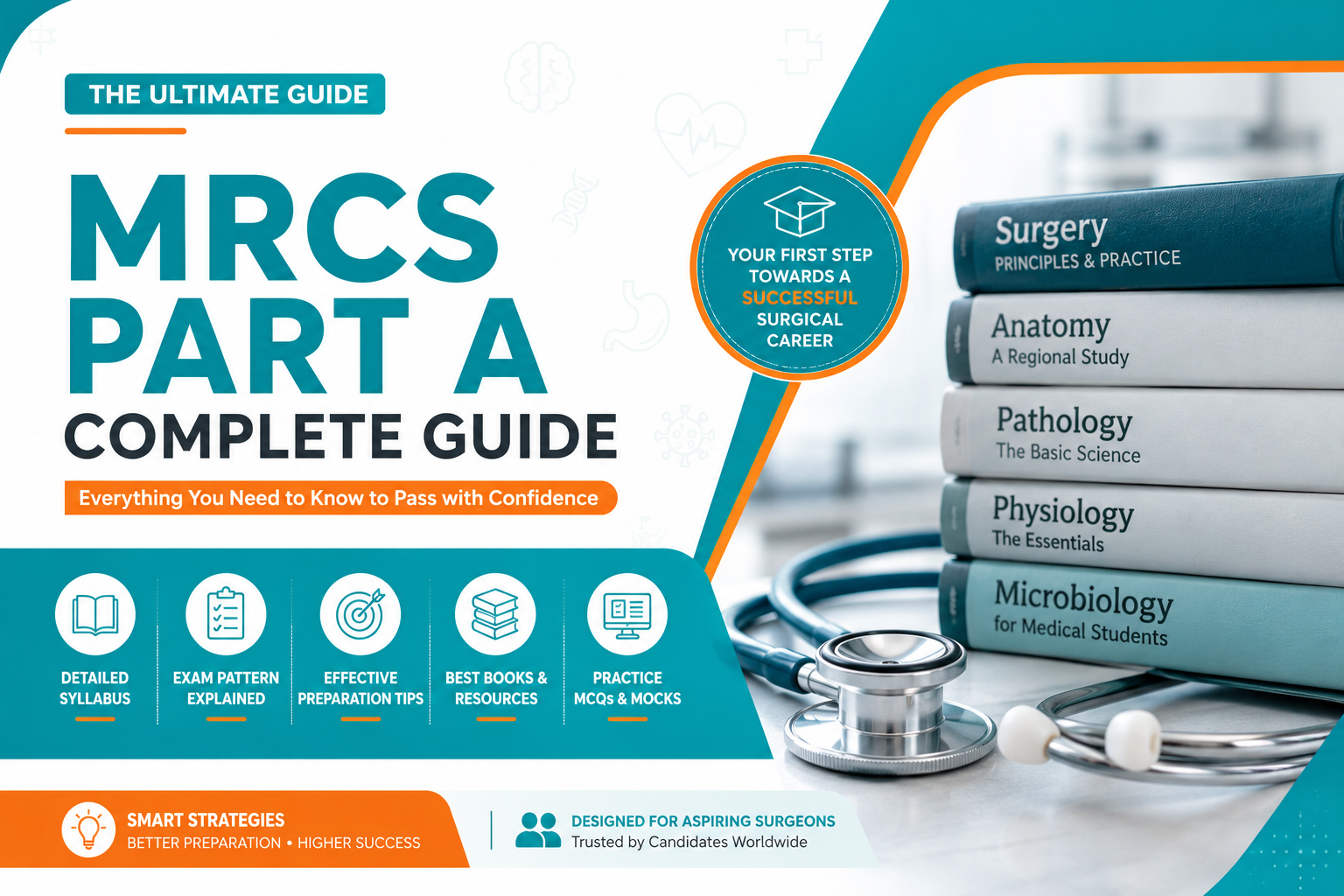
The Membership of the Royal Colleges of Surgeons (MRCS) is one of the most respected postgraduate surgical qualifications for doctors who want to build a successful career in surgery. For many international medical graduates, MRCS opens the door to advanced surgical training and global career opportunities. Among the two stages of the examination, MRCS Part A is the first and most important step.
MRCS Part A is a written examination that tests the candidate’s knowledge of applied basic sciences and principles of surgery. Passing this exam requires strong conceptual understanding, smart preparation, and proper time management. In this complete guide, you will learn everything about MRCS Part A including eligibility, exam pattern, syllabus, preparation tips, recommended books, and strategies to improve your chances of success.
What is MRCS Part A?
MRCS Part A is the first stage of the Membership Examination conducted by the Royal Colleges of Surgeons in the United Kingdom. It is designed to assess the knowledge and understanding expected from surgical trainees during the early years of surgical training.
The exam mainly focuses on:
- Applied Basic Sciences
- Principles of Surgery in General
Candidates who pass MRCS Part A become eligible to appear for MRCS Part B, which is the practical and clinical examination.
Eligibility Criteria for MRCS Part A
To apply for MRCS Part A, candidates generally need:
- A primary medical qualification recognized by the General Medical Council (GMC)
- Completion of internship or equivalent clinical experience
- Registration with the medical council in their country
International medical graduates from India and other countries can also apply for the examination.
| Cardiothoracic Surgery ST3 | Plastic Surgery ST3 |
| Emergency Medicine ST3 | Trauma & Orthopaedic Surgery ST3 |
| General Surgery ST3 | Thoracic Surgery ST4 |
| Oral & Maxillofacial ST3 | Urology ST3 |
| Otolaryngology ST3* | Vascular Surgery ST3 |
| Paediatric Surgery ST3 |
MRCS Part A Exam Pattern
The examination is computer-based and usually conducted at international test centers.
The exam contains:
- Two papers in one day
- Multiple Choice Questions (MCQs)
- Single Best Answer format
Paper 1
Focus Areas:
- Applied Basic Sciences
- Anatomy
- Physiology
- Pathology
- Microbiology
Paper 2
Focus Areas:
- Principles of Surgery
- Clinical Management
- Surgical Skills
- Critical Care
- Ethics and Communication
MRCS Part A Syllabus
The MRCS Part A syllabus is extensive and requires detailed preparation. Major subjects include:
Applied Anatomy
This is one of the most important sections of the exam. Candidates should focus on:
- Gross anatomy
- Neuroanatomy
- Embryology
- Surface anatomy
- Surgical anatomy
Physiology
Topics include:
- Cardiovascular system
- Respiratory system
- Renal physiology
- Endocrinology
- Gastrointestinal physiology
Pathology
Important concepts:
- Inflammation
- Healing
- Neoplasia
- Immunology
- Hemodynamic disorders
Microbiology
Candidates should study:
- Bacteriology
- Virology
- Infection control
- Antibiotics
- Sterilization techniques
Principles of Surgery
This section covers:
- Trauma management
- Preoperative care
- Postoperative complications
- Surgical infections
- Critical care
Best Books for MRCS Part A Preparation
Choosing the right study material is very important for success. Popular books include:
- “Get Through MRCS Part A”
- “Pastest MRCS”
- “EMRCS Question Bank”
- “Bailey & Love’s Short Practice of Surgery”
- “Last’s Anatomy”
- “Basic Science for the MRCS”
Online question banks and mock tests also play a major role in preparation.
MRCS Part A results
The standard for the MRCS Part A exam is set using the ‘Angoff procedure’; you can find more information about what this entails on the Intercollegiate MRCS Exam website. This same process is used to set the standard for all MRCS Part A exams and ensures that the standard required to pass the exam is consistent for all. However, as each MRCS Part A exam is different, the pass mark for individual exams will vary each time.
When you complete the MRCS Part A exam, your marks for both papers (Paper 1: applied basic science and Paper 2: principles of surgery in general) will be combined to give you a total mark for Part A of the assessment. Following the exam, you’ll receive a breakdown of your marks, but no further feedback is provided.
The date you can access your MRCS Part A results will be specified on your MRCS exam documentation or provided when you complete the exam. Results will then be published on the individual Royal College of Surgeons’ website, through which you sat the exam, on the date given. Following this, you’ll also receive written confirmation of your results.
MRCS Part A questions
To gain an understanding of the knowledge and skills assessed as part of the MRCS exam, you should familiarise yourself with the MRCS syllabus. The ‘competence based’ curriculum identifies the applied and theoretical knowledge and practical skills, and professional behaviours, you’ll be required to demonstrate within the MRCS exam.
The syllabus is divided into the following ten modules, which you’ll be assessed on during the MRCS exam:
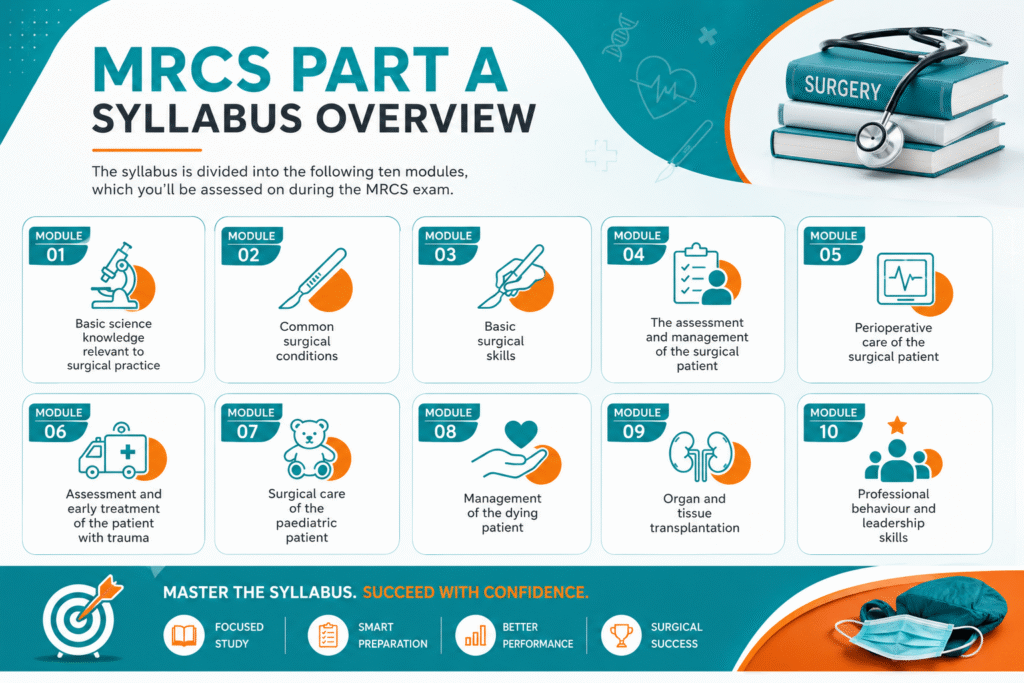
- Module 1: basic science knowledge relevant to surgical practice
- Module 2: common surgical conditions
- Module 3: basic surgical skills
- Module 4: the assessment and management of the surgical patient
- Module 5: perioperative care of the surgical patient
- Module 6: assessment and early treatment of the patient with trauma
- Module 7: surgical care of the paediatric patient
- Module 8: management of the dying patient
- Module 9: organ and tissue transplantation
- Module 10: professional behaviour and leadership skills
You can find a full breakdown of the topics covered and the number of questions for each in our MRCS Part A Preparation blog.
MRCS Resources
Aside from the MRCS syllabus and the recommended reading list (see below), practice questions and mock exams will be one of the most valuable resources for preparing for the MRCS exam. Using a mixture of practice questions and mock exams will ensure that you’re familiar with the types of questions you’ll be asked, have the opportunity to develop your responses and grow accustomed to dealing with the time pressure and demands of a full MRCS exam.
When it comes to choosing the most suitable resources for your revision, it’s important to consider the cost involved, the number of questions included and the quality of these questions, as well as the platform being used. We’ve included a comparison table below to show how different MRCS Part A resources compare.
How to Prepare for MRCS Part A
A proper study strategy can significantly improve your performance.
Create a Study Plan
Prepare a realistic timetable covering all subjects. Divide your preparation into:
- Concept learning
- Revision
- Practice questions
- Mock exams
Focus on High-Yield Topics
Anatomy and principles of surgery carry significant weight in the examination. Spend extra time mastering these subjects.
Practice MCQs Daily
Daily question practice improves:
- Clinical reasoning
- Speed
- Accuracy
- Time management
Revise Regularly
Frequent revision helps retain important concepts and improves confidence before the exam.
Attempt Mock Exams
Mock tests simulate the real examination environment and help identify weak areas.
Common Challenges Faced by Candidates
Many candidates struggle with:
- Large syllabus
- Time management
- Anatomy memorization
- Balancing work and study
Consistency and disciplined preparation are essential to overcome these challenges.
Tips to Pass MRCS Part A Successfully
- Start preparation early
- Study consistently every day
- Practice high-quality MCQs
- Focus on understanding concepts instead of memorizing facts
- Revise anatomy repeatedly
- Join study groups if helpful
- Solve previous exam questions
Importance of MRCS Qualification
Achieving MRCS qualification offers several career benefits:
- International recognition
- Better surgical training opportunities
- Stronger CV for residency applications
- Career growth in surgery
- Opportunities in the UK and other countries
For many doctors, MRCS is an important milestone toward becoming a successful surgeon.
MRCS books
The MRCS candidate guidance provides the following list of recommended textbooks for preparing for the MRCS exam:
Basic science textbooks
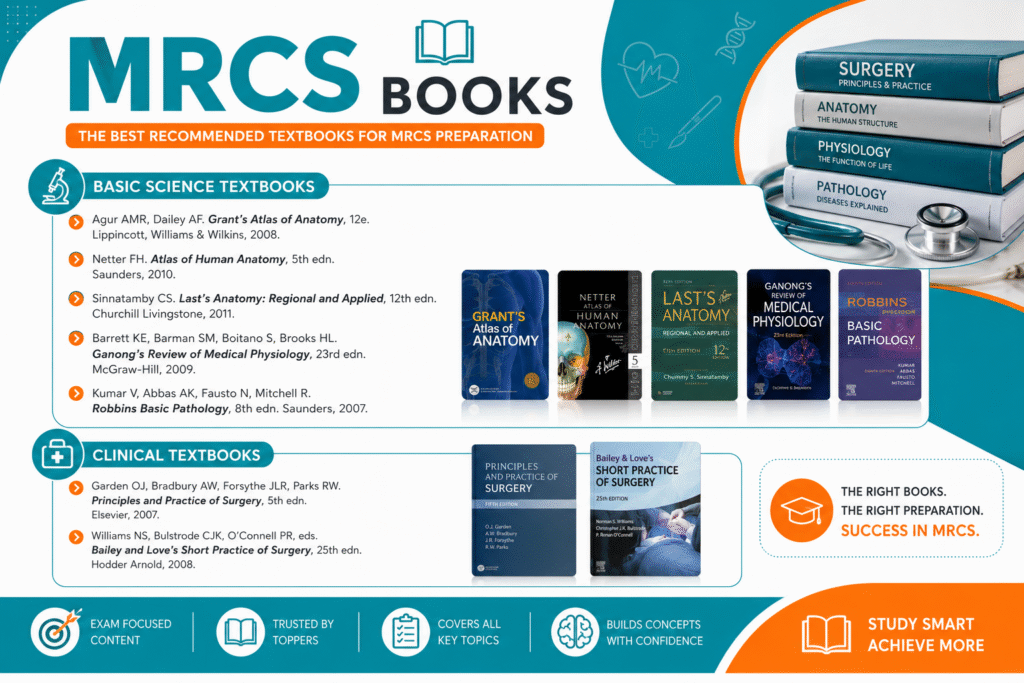
- Agur AMR, Dailey AF. Grant’s Atlas of Anatomy, 12e. Lippincott, Williams & Wilkins, 2008.
- Netter FH. Atlas of Human Anatomy, 5th edn. Saunders, 2010.
- Sinnatamby CS. Last’s Anatomy: Regional and Applied, 12th edn. Churchill Livingstone, 2011.
- Barrett KE, Barman SM, Boitano S, Brooks HL. Ganong’s Review of Medical Physiology, 23rd edn. McGraw-Hill, 2009.
- Kumar V, Abbas AK, Fausto N, Mitchell R. Robbins Basic Pathology, 8th edn. Saunders, 2007.
Clinical textbooks
- Garden OJ, Bradbury AW, Forsythe JLR, Parks RW. Principles and Practice of Surgery, 5th edn. Elsevier, 2007.
- Williams NS, Bulstrode CJK, O’Connell PR, eds. Bailey and Love’s Short Practice of Surgery, 25th edn. Hodder Arnold, 2008.
5 Tips to help you revise
As with all exams, effective revision will ensure that you are prepared for the MRCS and provide you with the best possible chance of performing well on the day. The following tips will help you to get the most out of your revision time:
- Consider when may be the best time to undertake the exam
Before you even book your test and begin revising, consider your current knowledge, skills and experience, and how prepared you are for the MRCS. Although you can take the MRCS earlier, provided you meet the eligibility criteria, the candidate guidance recommends that you undertake Part A in Specialty/Core Training Year 1 (ST/CT1) and Part B in Specialty/Core Training Year 2 (ST/CT2). Many people do pass Part A in their foundation years; however, it’s important to ensure that you have time to fully prepare, as you may risk wasting your limited attempts at passing the exams. - Familiarise yourself with the syllabus
As mentioned above, the MRCS syllabus outlines the knowledge, skills and behaviours assessed within the exam. Therefore, you can gain an understanding of what to expect within the exam, providing a useful starting point for identifying key areas for revision. - Dedicate time to the recommended reading
The MRCS candidate guidance advises that the recommended texts provide the level of knowledge required to successfully pass the exam. Mastery of the syllabus subjects, to the depth covered in the texts, and the ability to apply this knowledge in the context of surgical practice, is essential. In addition to this, you are expected to read beyond the recommended reading list in your preparations for the MRCS. However, many candidates find it difficult to revise from textbooks while working full-time. This is where using a high-quality question bank can help. Our adaptive MRCS Part A question bank contains all the resources you need to pass the exam, and using AI technology, it creates a personalised learning journey based on your individual strengths and weaknesses. - Utilise practice questions
While being familiar with the syllabus and recommended texts is valuable, dedicating time to completing practice questions will allow you to apply your knowledge and gain exam experience. Quality practice questions will also provide feedback, which will support you to develop your knowledge and skills, and help your revision progress. - Don’t skip practising full mock exams
In addition to helping you become familiar with the exam format, completing full practice tests will support you to prepare for the demands of a five-hour exam, which offers additional challenges. It’ll also provide you with a more realistic exam experience and expectation of what you can achieve in the given time frame and over the space of a five-hour exam.
For thousands of professionally written practice questions and tests, try out MRCS Part A question bank now.
Conclusion
MRCS Part A is a challenging but achievable examination for dedicated medical graduates who wish to pursue a career in surgery. With proper planning, quality study resources, and consistent practice, candidates can successfully clear the exam and move forward in their surgical journey.
Understanding the syllabus, mastering basic sciences, practicing MCQs regularly, and staying disciplined throughout preparation are the keys to success. Whether you are an international medical graduate or a surgical trainee, early preparation and smart study techniques can make your MRCS journey smoother and more successful in 2026.