
Fellowship in orthopedics
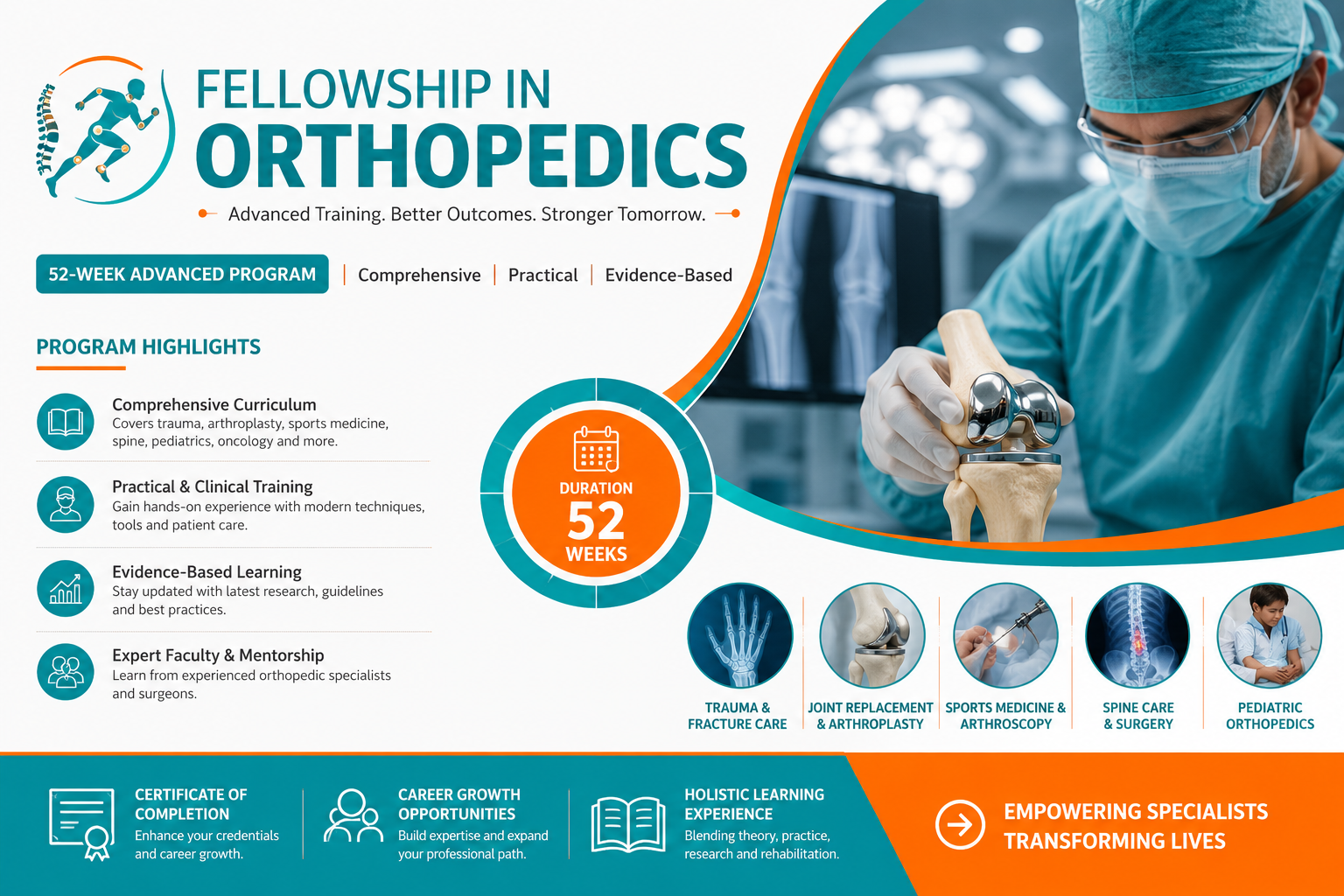

The Fellowship in Orthopedics is a comprehensive 52-week advanced training program designed for healthcare professionals seeking expertise in the diagnosis, treatment, and management of musculoskeletal disorders. The curriculum covers orthopedic trauma, fracture management, joint replacement, sports medicine, spine surgery, pediatric orthopedics, orthopedic oncology, rehabilitation, and research methodologies. Through evidence-based learning and case-oriented training, participants develop the clinical knowledge, surgical understanding, and decision-making skills required for modern orthopedic practice. This fellowship prepares learners to deliver high-quality patient care while staying aligned with the latest advancements in orthopedic medicine and surgery.
The Fellowship in Orthopedics is a comprehensive 52-week advanced training program designed for medical professionals who wish to develop specialized expertise in the diagnosis, treatment, and management of musculoskeletal disorders. This fellowship provides an in-depth understanding of orthopedic principles, trauma care, surgical techniques, rehabilitation strategies, and evidence-based clinical practice. The program is ideal for physicians, surgeons, and healthcare professionals seeking to enhance their knowledge and skills in modern orthopedic care.
Orthopedic disorders are among the leading causes of disability worldwide, affecting bones, joints, muscles, ligaments, tendons, and the spine. With advancements in diagnostic imaging, minimally invasive procedures, joint replacement technologies, and rehabilitation protocols, orthopedic specialists must remain updated with the latest developments in the field. This fellowship is structured to bridge the gap between theoretical knowledge and practical clinical application, enabling participants to provide high-quality patient-centered care.
Throughout the program, learners explore the fundamentals of musculoskeletal anatomy, biomechanics, bone physiology, and orthopedic diagnostics. The curriculum provides detailed training in radiographic interpretation, MRI and CT evaluation, laboratory investigations, and clinical examination techniques essential for accurate diagnosis and treatment planning. Participants develop a strong foundation in orthopedic assessment and decision-making that supports effective patient management across diverse clinical settings.
A major component of the fellowship focuses on orthopedic trauma and fracture management. Participants learn the principles of trauma assessment, fracture classification, emergency orthopedic care, and both operative and non-operative treatment strategies. The curriculum covers upper and lower limb fractures, pelvic injuries, polytrauma management, and complications associated with traumatic musculoskeletal injuries. Learners gain valuable insights into contemporary approaches to fracture fixation and post-trauma rehabilitation.
The fellowship also provides extensive training in orthopedic surgical principles and techniques. Participants become familiar with orthopedic instrumentation, internal and external fixation methods, surgical planning, perioperative management, and infection prevention strategies. The program emphasizes patient safety, ethical surgical practice, and the management of intraoperative and postoperative complications. This knowledge helps learners understand the surgical aspects of orthopedic care and collaborate effectively within multidisciplinary healthcare teams.
Specialized modules cover joint disorders and arthroplasty, including osteoarthritis, inflammatory arthritis, hip replacement, knee replacement, and shoulder arthroplasty. Learners explore implant selection, surgical indications, postoperative care, and long-term outcome assessment. The curriculum also addresses revision procedures and advances in prosthetic technologies that have transformed modern joint replacement surgery.
Sports medicine and arthroscopy form another important component of the program. Participants learn about sports-related injuries, ligament reconstruction, meniscal pathology, shoulder instability, and minimally invasive arthroscopic procedures. The fellowship examines injury prevention, rehabilitation protocols, and return-to-sport strategies, enabling learners to support athletes and active individuals through all stages of recovery.
The curriculum includes comprehensive training in spine disorders and surgery, covering degenerative conditions, spinal trauma, deformities, disc diseases, and surgical interventions. Participants gain knowledge of contemporary diagnostic techniques and evidence-based treatment approaches for cervical, thoracic, and lumbar spine conditions. Rehabilitation and long-term management strategies are also emphasized.
Pediatric orthopedics is addressed through dedicated modules focusing on congenital musculoskeletal abnormalities, developmental disorders, growth-related conditions, pediatric fractures, scoliosis, and neuromuscular disorders. Learners understand the unique challenges associated with orthopedic care in children and adolescents and develop strategies for age-appropriate diagnosis and treatment.
The fellowship further explores orthopedic oncology and metabolic bone diseases. Participants study benign and malignant bone tumors, metastatic bone disease, osteoporosis, and metabolic skeletal disorders. The curriculum highlights multidisciplinary approaches to diagnosis, treatment planning, limb salvage procedures, and long-term patient follow-up.
Additional training covers disorders of the hand, wrist, foot, and ankle, including tendon injuries, nerve compression syndromes, deformities, reconstructive procedures, and rehabilitation techniques. Learners develop a comprehensive understanding of functional anatomy and management strategies for complex extremity conditions.
A strong emphasis is placed on rehabilitation medicine, pain management, and functional recovery. Participants learn how physiotherapy, occupational therapy, and multidisciplinary rehabilitation programs contribute to optimal patient outcomes. The program also introduces evidence-based medicine, orthopedic research methodologies, biostatistics, scientific writing, and quality improvement initiatives that support professional growth and lifelong learning.
The final phase of the fellowship integrates advanced orthopedic concepts through case discussions, multidisciplinary care planning, clinical audits, and a capstone project. Participants are encouraged to critically evaluate clinical evidence, apply best practices, and demonstrate competence in managing complex orthopedic cases.
Upon successful completion, graduates will possess advanced knowledge of orthopedic medicine and surgery, enhanced clinical decision-making abilities, and a comprehensive understanding of modern musculoskeletal healthcare. The fellowship prepares healthcare professionals to deliver safe, effective, and evidence-based orthopedic care while contributing to improved patient outcomes and advancements in the field of orthopedics.
- 12 Sections
- 100 Lessons
- 52 Weeks
- Foundations of OrthopedicsThis module introduces learners to the fundamental principles of orthopedic surgery, including musculoskeletal anatomy, biomechanics, bone physiology, fracture healing, and orthopedic terminology. Participants develop a strong theoretical foundation necessary for understanding orthopedic disorders, diagnostic approaches, and treatment planning.8
- Orthopedic Diagnostics and ImagingThis module focuses on diagnostic techniques used in orthopedic practice. Learners gain expertise in interpreting radiographs, CT scans, MRI studies, ultrasound imaging, and laboratory investigations relevant to musculoskeletal disorders.8
- Trauma and Fracture ManagementThis module covers the principles of trauma care and fracture management. Participants learn assessment of injured patients, classification of fractures, emergency orthopedic care, and surgical and non-surgical treatment strategies.8
- Principles of Orthopedic SurgeryThis module introduces operative orthopedic techniques, surgical planning, instrumentation, operating room protocols, and patient safety. Learners understand indications, contraindications, and perioperative management.8
- Joint Disorders and ArthroplastyThis module focuses on degenerative and inflammatory joint diseases and modern joint replacement procedures. Learners study patient selection, implant types, surgical techniques, and postoperative rehabilitation.8
- Sports Medicine and ArthroscopyThis module provides comprehensive training in sports-related injuries and minimally invasive orthopedic procedures. Learners gain knowledge of arthroscopic techniques, ligament reconstruction, and rehabilitation strategies.8
- Spine Disorders and SurgeryThis module covers spinal anatomy, degenerative disorders, trauma, deformities, and surgical interventions. Participants learn evidence-based approaches to diagnosis and management of spinal conditions.8
- Pediatric OrthopedicsThis module focuses on musculoskeletal disorders affecting children. Learners study congenital anomalies, growth disturbances, pediatric trauma, and developmental orthopedic conditions.8
- Orthopedic Oncology and Metabolic Bone DiseasesThis module explores benign and malignant bone tumors, metastatic disease, osteoporosis, and metabolic bone disorders. Participants learn diagnostic pathways and multidisciplinary management approaches.8
- Hand, Wrist, Foot, and Ankle SurgeryThis module addresses disorders and injuries affecting the upper and lower extremities. Learners develop skills in diagnosis, surgical planning, and rehabilitation for hand and foot conditions.8
- Rehabilitation and Orthopedic ResearchThis module emphasizes postoperative rehabilitation, physiotherapy integration, pain management, evidence-based practice, and orthopedic research methodologies. Learners develop skills for lifelong learning and clinical improvement.12
- 11.1Principles of Orthopedic Rehabilitation
- 11.2Physiotherapy in Orthopedics
- 11.3Pain Management Strategies
- 11.4Functional Outcome Assessment
- 11.5Research Methodology
- 11.6Biostatistics for Orthopedics
- 11.7Evidence-Based Orthopedic Practice
- 11.8Scientific Writing and Publication
- 11.9Clinical Audit and Quality Improvement
- 11.10Emerging Technologies in Orthopedics
- 11.11Artificial Intelligence in Orthopedic Practice
- 11.12Patient Education and Counseling
- Advanced Orthopedic Practice and Capstone ProjectThe final module integrates all concepts through advanced case discussions, multidisciplinary management, leadership training, and a comprehensive capstone project. Participants demonstrate competency in independent orthopedic decision-making and patient care.8
- 12.1Complex Orthopedic Case Management
- 12.2Revision Arthroplasty
- 12.3Advanced Trauma Reconstruction
- 12.4Multidisciplinary Orthopedic Care
- 12.5Leadership and Professional Ethics
- 12.6Capstone Project and Final Assessment
- 12.7Grand Rounds Presentation
- 12.8Fellowship Completion Review and Certification Preparation
You might be intersted in
-
167 Students
-
52 Weeks
-
132 Students
-
52 Weeks
-
133 Students
-
52 Weeks
-
123 Students
-
52 Weeks