
Fellowship in Ortho surgery
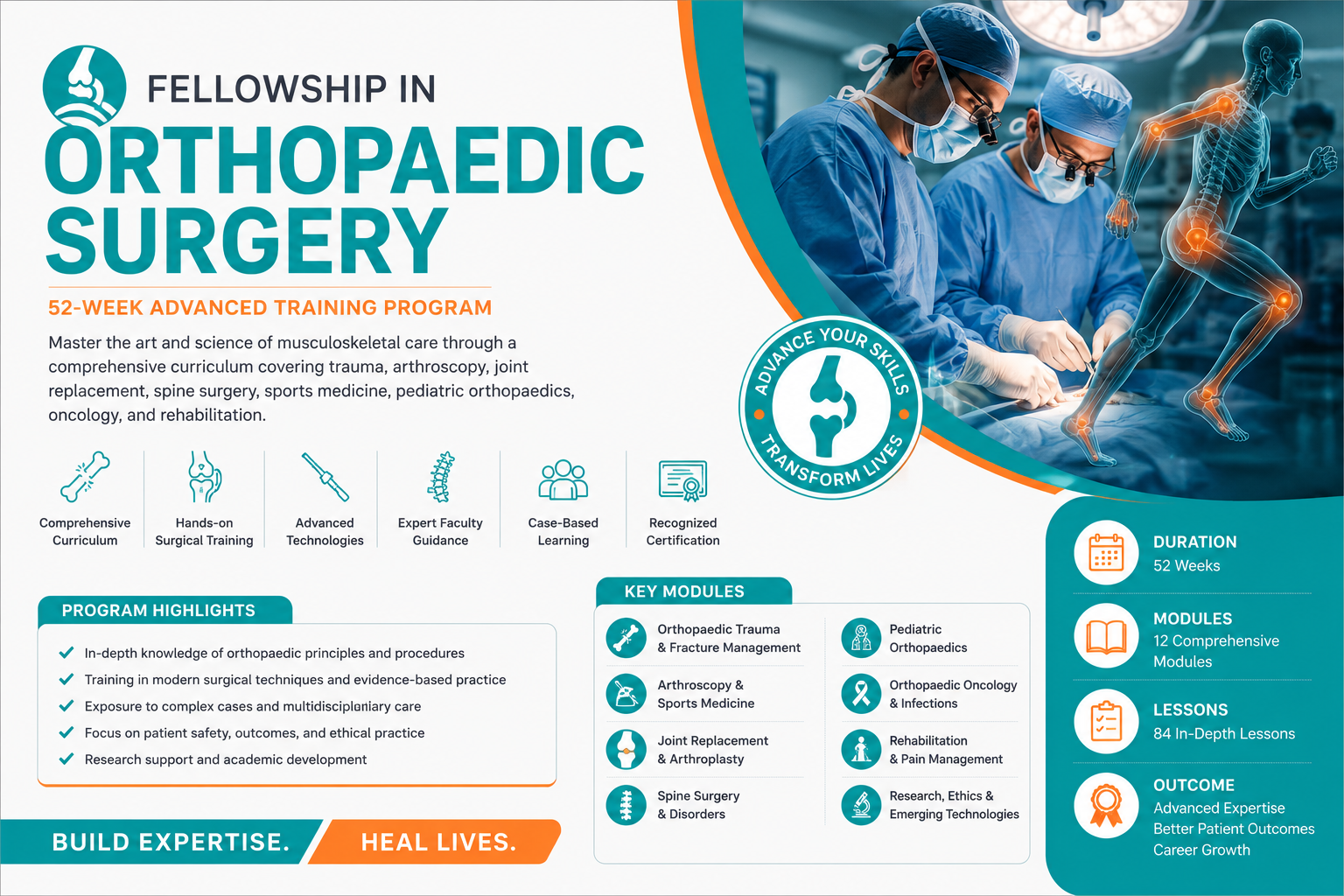

The Fellowship in Orthopaedic Surgery is a comprehensive 52-week advanced training program designed for medical professionals seeking specialized expertise in the diagnosis, treatment, and surgical management of musculoskeletal disorders. The curriculum covers orthopaedic trauma, fracture management, joint replacement, arthroscopy, sports medicine, spine surgery, pediatric orthopaedics, orthopaedic oncology, and rehabilitation. Through evidence-based learning, case discussions, and surgical skill development, participants gain the knowledge and clinical competence required to excel in modern orthopaedic practice and improve patient outcomes.
The Fellowship in Orthopaedic Surgery is a comprehensive 52-week advanced training program designed for medical professionals who aspire to develop specialized expertise in the diagnosis, treatment, and surgical management of musculoskeletal disorders. This fellowship provides in-depth knowledge of orthopaedic principles, trauma care, reconstructive procedures, and modern surgical techniques, enabling participants to deliver high-quality patient care across diverse clinical settings.
Orthopaedic surgery is a rapidly evolving specialty that encompasses the management of conditions affecting bones, joints, ligaments, tendons, muscles, and the spine. This fellowship offers a structured curriculum that combines theoretical learning, evidence-based practice, case-based discussions, and clinical skill development. Participants will gain a thorough understanding of musculoskeletal anatomy, biomechanics, fracture healing, diagnostic imaging, and patient assessment techniques that form the foundation of orthopaedic practice.
The program extensively covers orthopaedic trauma and fracture management, including the principles of reduction, fixation methods, casting techniques, management of open fractures, and treatment of complex trauma cases. Learners will explore both conservative and operative approaches to treating musculoskeletal injuries while understanding the latest advancements in trauma surgery and emergency orthopaedic care.
Specialized modules focus on upper and lower limb orthopaedics, allowing participants to develop expertise in managing shoulder, elbow, wrist, hand, hip, knee, ankle, and foot disorders. The curriculum also includes comprehensive training in sports medicine and arthroscopy, equipping learners with knowledge of minimally invasive procedures, ligament reconstruction, sports injury prevention, and rehabilitation strategies for athletes and active individuals.
The fellowship further emphasizes joint replacement surgery and arthroplasty, covering patient selection, implant technologies, perioperative planning, surgical techniques, postoperative care, and management of complications. Participants will gain valuable insights into hip and knee replacement procedures, revision surgeries, and long-term patient outcomes.
Spine surgery is another key component of the program, with dedicated training in spinal anatomy, degenerative disorders, disc diseases, trauma, infections, and deformity correction. Learners will understand the principles of spinal evaluation and surgical interventions commonly performed in contemporary orthopaedic practice.
In addition, the curriculum explores pediatric orthopaedics, orthopaedic oncology, and musculoskeletal infections. Participants will learn to diagnose and manage congenital deformities, growth-related conditions, bone tumors, osteomyelitis, and complex reconstructive challenges through a multidisciplinary approach.
The fellowship also integrates rehabilitation medicine, pain management, research methodology, evidence-based practice, ethics, and emerging technologies such as robotic-assisted surgery and computer navigation systems. These components ensure that graduates remain prepared for future developments in orthopaedic care and surgical innovation.
Throughout the 52-week program, participants will engage in case studies, clinical discussions, procedural demonstrations, and research activities designed to strengthen critical thinking and clinical decision-making skills. The curriculum encourages the application of current scientific evidence to real-world clinical scenarios, promoting excellence in patient-centered care.
Upon successful completion of the Fellowship in Orthopaedic Surgery, graduates will possess advanced knowledge and practical competencies in orthopaedic assessment, trauma management, arthroscopy, joint replacement, spine care, pediatric orthopaedics, and rehabilitation. This qualification supports career advancement in hospitals, trauma centers, specialty orthopaedic clinics, academic institutions, and surgical practice, while enhancing the ability to deliver safe, effective, and evidence-based musculoskeletal care.
- 12 Sections
- 85 Lessons
- 52 Weeks
- Foundations of Orthopaedic SurgeryThis module introduces learners to the fundamental principles of orthopaedic surgery, including musculoskeletal anatomy, biomechanics, bone physiology, fracture healing, and surgical principles. Participants will develop a strong foundation necessary for understanding orthopaedic disorders and surgical interventions.7
- Orthopaedic Assessment and DiagnosticsThis module focuses on clinical evaluation techniques, history taking, physical examination, radiological interpretation, and diagnostic modalities used in orthopaedic practice. Learners will gain skills in identifying common musculoskeletal conditions through systematic assessment.7
- Fracture Management PrinciplesThis module covers the classification, diagnosis, and management of fractures. Participants will learn both non-operative and operative techniques, including fracture fixation methods and complication management.7
- Trauma and Emergency OrthopaedicsThis module emphasizes the management of musculoskeletal trauma and orthopaedic emergencies. Learners will develop competencies in handling acute injuries, polytrauma patients, and limb-threatening conditions.7
- Upper Limb OrthopaedicsThis module focuses on disorders and surgical management of the shoulder, elbow, wrist, and hand. Learners will explore trauma, degenerative conditions, and reconstructive procedures of the upper extremity.7
- Lower Limb OrthopaedicsThis module covers common and complex conditions affecting the hip, knee, ankle, and foot. Participants will learn diagnostic approaches and surgical interventions for lower limb disorders.7
- Spine Surgery and DisordersThis module introduces spinal anatomy, degenerative diseases, trauma, infections, and surgical procedures. Learners will gain insight into evaluation and management of spinal conditions.7
- Arthroscopy and Sports MedicineThis module focuses on minimally invasive arthroscopic procedures and sports-related injuries. Participants will learn modern diagnostic and therapeutic approaches in sports orthopaedics.7
- Joint Replacement SurgeryThis module provides comprehensive training in arthroplasty procedures, patient selection, implant choices, perioperative management, and long-term follow-up of joint replacement patients.7
- Pediatric OrthopaedicsThis module covers congenital, developmental, and traumatic musculoskeletal disorders in children. Learners will understand age-specific diagnostic and treatment approaches.7
- Orthopaedic Oncology and InfectionsThis module addresses musculoskeletal tumors, bone infections, and related surgical management. Participants will learn diagnostic strategies and multidisciplinary treatment approaches.7
- Rehabilitation, Research, and Advanced Orthopaedic PracticeThis final module integrates rehabilitation principles, research methodology, evidence-based practice, ethics, and emerging technologies in orthopaedic surgery. Learners will complete a capstone project demonstrating clinical competency.8
You might be intersted in
-
167 Students
-
52 Weeks
-
132 Students
-
52 Weeks
-
133 Students
-
52 Weeks
-
123 Students
-
52 Weeks