
Fellowship in Nephrology
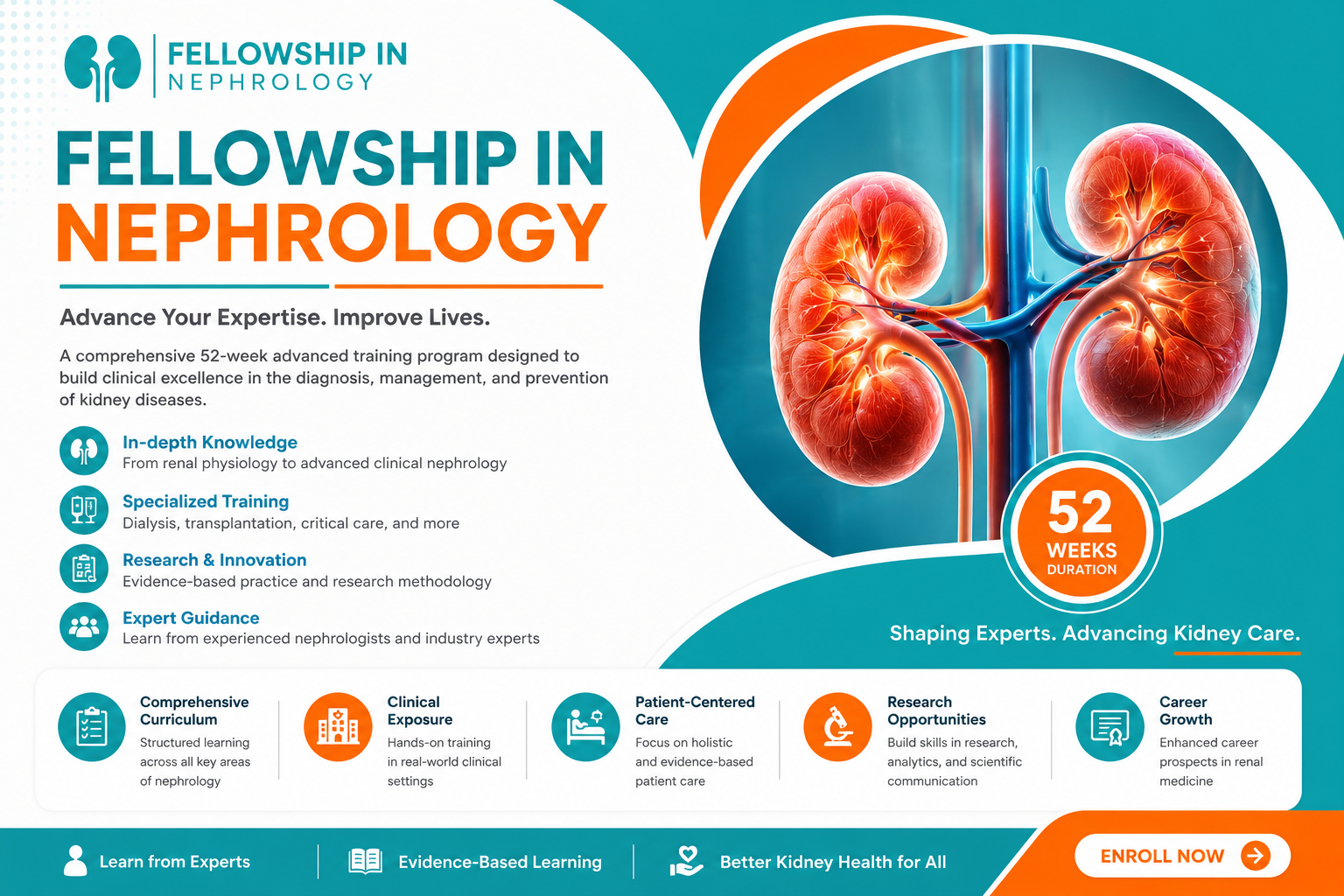

The Fellowship in Nephrology is a comprehensive 52-week advanced training program designed to develop expertise in the diagnosis, management, and prevention of kidney diseases. The curriculum covers renal physiology, acute and chronic kidney disease, glomerular disorders, dialysis, kidney transplantation, electrolyte and acid-base disturbances, hypertension, and emerging nephrology practices. Through evidence-based learning, clinical case discussions, and research training, participants gain the knowledge and skills required to deliver high-quality nephrology care and advance their professional careers in renal medicine.
Program Overview
The Fellowship in Nephrology is a comprehensive 52-week advanced training program designed for healthcare professionals seeking specialized expertise in the prevention, diagnosis, treatment, and long-term management of kidney diseases. This intensive fellowship provides a strong foundation in renal physiology and pathophysiology while offering in-depth exposure to contemporary nephrology practices, dialysis therapies, kidney transplantation, and emerging advancements in renal medicine.
Kidney diseases represent a significant global health challenge, requiring clinicians to possess specialized knowledge and skills to manage complex renal conditions effectively. This fellowship equips participants with the competencies needed to address acute and chronic kidney disorders, optimize patient outcomes, and contribute to the advancement of nephrology care through evidence-based practice and clinical research.
Throughout the program, learners will explore the full spectrum of nephrology, from fundamental renal science to advanced clinical management strategies. The curriculum integrates theoretical learning, case-based discussions, diagnostic interpretation, treatment planning, and research methodology to create a well-rounded educational experience.
Program Objectives
The fellowship aims to:
- Develop a comprehensive understanding of renal anatomy, physiology, and pathophysiology.
- Enhance proficiency in diagnosing and managing acute and chronic kidney diseases.
- Build expertise in interpreting renal laboratory investigations, imaging studies, and kidney biopsies.
- Strengthen knowledge of glomerular, tubular, interstitial, vascular, and hereditary kidney disorders.
- Provide advanced training in dialysis modalities and renal replacement therapies.
- Develop competency in kidney transplantation evaluation and post-transplant management.
- Improve clinical decision-making in electrolyte, acid-base, and mineral metabolism disorders.
- Foster research skills and evidence-based clinical practice in nephrology.
- Prepare participants for leadership roles in renal healthcare and academic medicine.
What You Will Learn
During this 52-week fellowship, participants will gain advanced knowledge and practical understanding of:
Renal Physiology and Diagnostics
Study the structure and function of the kidneys, mechanisms of filtration and tubular transport, fluid and electrolyte regulation, acid-base balance, and advanced diagnostic techniques used in nephrology practice.
Acute Kidney Injury
Learn to identify, classify, diagnose, and manage acute kidney injury across various clinical settings, including critical care environments and emergency nephrology.
Chronic Kidney Disease
Explore the epidemiology, progression, complications, and multidisciplinary management of chronic kidney disease, including diabetic kidney disease and hypertensive nephropathy.
Glomerular and Tubulointerstitial Disorders
Gain expertise in nephrotic and nephritic syndromes, immune-mediated kidney diseases, interstitial nephritis, inherited renal disorders, and cystic kidney diseases.
Hypertension and Renovascular Disease
Understand the relationship between kidney function and blood pressure regulation while developing skills in diagnosing and managing primary and secondary hypertension.
Dialysis and Renal Replacement Therapy
Master the principles and clinical applications of hemodialysis, peritoneal dialysis, continuous renal replacement therapy, vascular access management, and dialysis adequacy monitoring.
Kidney Transplantation
Develop knowledge of transplant immunology, donor and recipient evaluation, immunosuppressive therapies, rejection management, and long-term post-transplant care.
Electrolyte and Acid-Base Disorders
Learn advanced approaches to diagnosing and treating sodium, potassium, calcium, phosphate, magnesium, and acid-base abnormalities commonly encountered in nephrology practice.
Special Populations in Nephrology
Explore renal care considerations for pediatric, geriatric, pregnant, and critically ill patients, along with emerging precision medicine approaches.
Research and Evidence-Based Practice
Acquire skills in research methodology, biostatistics, clinical audit, scientific writing, and quality improvement initiatives relevant to nephrology.
Who Should Enroll?
This fellowship is suitable for:
- Medical graduates interested in nephrology specialization
- Physicians seeking advanced training in renal medicine
- Internal medicine practitioners
- Healthcare professionals involved in kidney disease management
- Academic clinicians and medical educators
- Researchers interested in renal sciences
- Dialysis and transplant care professionals
Career Opportunities
Upon successful completion of the Fellowship in Nephrology, graduates may pursue roles such as:
- Nephrology Specialist
- Renal Medicine Consultant
- Dialysis Unit Director
- Kidney Transplant Coordinator
- Clinical Research Associate in Nephrology
- Academic Faculty in Renal Medicine
- Hospital-Based Nephrology Practitioner
- Renal Healthcare Program Manager
- Clinical Educator and Trainer
Key Features
- Comprehensive 52-week curriculum
- Advanced nephrology-focused training
- Evidence-based clinical learning
- Case-based discussions and practical applications
- Coverage of dialysis and transplantation
- Focus on emerging nephrology technologies
- Research and publication training
- Professional and academic skill development
- Multidisciplinary approach to renal healthcare
- Capstone project and final assessment
Learning Outcomes
By the end of the program, participants will be able to:
- Perform comprehensive evaluation of patients with kidney diseases.
- Diagnose and manage acute and chronic renal disorders using current clinical guidelines.
- Interpret renal laboratory investigations, imaging studies, and pathology findings.
- Develop individualized treatment plans for complex nephrology patients.
- Manage dialysis therapies and renal replacement procedures effectively.
- Evaluate transplant candidates and provide post-transplant care.
- Address electrolyte, acid-base, and mineral metabolism disorders confidently.
- Apply evidence-based medicine principles to nephrology practice.
- Conduct clinical research and contribute to advancements in kidney healthcare.
- Demonstrate leadership and professional excellence in renal medicine.
Conclusion
The Fellowship in Nephrology provides an in-depth and clinically relevant educational pathway for healthcare professionals seeking advanced expertise in kidney disease management. Combining foundational science, modern clinical practice, dialysis care, transplantation, and research training, this program prepares graduates to meet the growing global demand for highly skilled nephrology professionals and deliver exceptional patient-centered renal care.
- 12 Sections
- 100 Lessons
- 52 Weeks
- Foundations of NephrologyThis module introduces learners to the fundamental principles of nephrology, including kidney anatomy, physiology, and the essential mechanisms involved in fluid, electrolyte, and acid-base homeostasis. Participants will develop a strong understanding of normal renal function, which serves as the foundation for diagnosing and managing kidney diseases. Emphasis is placed on nephron structure, glomerular filtration, tubular function, and renal blood flow.8
- Renal Diagnostics and Clinical EvaluationThis module focuses on the systematic assessment of patients with kidney diseases. Learners will gain expertise in clinical history taking, physical examination, laboratory interpretation, urinalysis, imaging studies, and renal biopsy techniques. The module emphasizes evidence-based diagnostic approaches and differential diagnosis formulation.8
- Acute Kidney InjuryThis module explores the pathophysiology, diagnosis, and management of acute kidney injury (AKI). Participants will learn to identify pre-renal, intrinsic, and post-renal causes, assess severity, and implement timely interventions. Current guidelines and critical care nephrology principles are integrated throughout the module.8
- Chronic Kidney DiseaseThis module provides comprehensive knowledge of chronic kidney disease (CKD), including risk factors, progression mechanisms, complications, and treatment strategies. Learners will understand CKD staging, monitoring, and multidisciplinary approaches to improve patient outcomes.8
- Glomerular DiseasesThis module examines primary and secondary glomerular disorders, focusing on their clinical presentations, pathological features, and treatment options. Learners will gain expertise in nephrotic syndrome, nephritic syndrome, and immune-mediated kidney diseases.8
- Tubulointerstitial and Cystic Kidney DiseasesThis module covers diseases affecting the renal tubules and interstitium, including inherited and acquired disorders. Participants will learn about cystic kidney diseases, electrolyte disturbances, and interstitial nephritis.8
- Hypertension and Renovascular DiseaseThis module explores the relationship between hypertension and kidney disease. Learners will study the pathophysiology of blood pressure regulation, secondary hypertension, renovascular disorders, and evidence-based therapeutic interventions.8
- Dialysis and Extracorporeal TherapiesThis module provides extensive training in renal replacement therapies. Participants will understand indications, modalities, complications, and management of hemodialysis, peritoneal dialysis, and continuous renal replacement therapy.10
- 8.1Principles of Dialysis
- 8.2Hemodialysis Fundamentals
- 8.3Vascular Access Management
- 8.4Peritoneal Dialysis Techniques
- 8.5Continuous Renal Replacement Therapy
- 8.6Dialysis Adequacy Assessment
- 8.7Complications of Dialysis
- 8.8Patient Education and Counseling
- 8.9Home Dialysis Programs
- 8.10Emerging Technologies in Dialysis
- Kidney TransplantationThis module focuses on renal transplantation, including donor evaluation, recipient selection, immunology, immunosuppressive therapy, and post-transplant care. Ethical and legal considerations are also discussed.10
- Electrolyte, Acid-Base, and Mineral Bone DisordersThis module develops advanced competency in diagnosing and managing electrolyte imbalances, acid-base disturbances, and CKD-related mineral bone disorders. Clinical problem-solving and case-based learning are emphasized.8
- Electrolyte, Acid-Base, and Mineral Bone DisordersThis module develops advanced competency in diagnosing and managing electrolyte imbalances, acid-base disturbances, and CKD-related mineral bone disorders. Clinical problem-solving and case-based learning are emphasized.8
- Special Populations and Emerging NephrologyThis module addresses nephrological care in special populations, including pediatric, geriatric, pregnant, and critically ill patients. Learners will also explore emerging therapies, precision medicine, and innovations in nephrology.8
You might be intersted in
-
167 Students
-
52 Weeks
-
124 Students
-
52 Weeks
-
123 Students
-
52 Weeks
-
142 Students
-
52 Weeks