
Fellowship in Nephrology
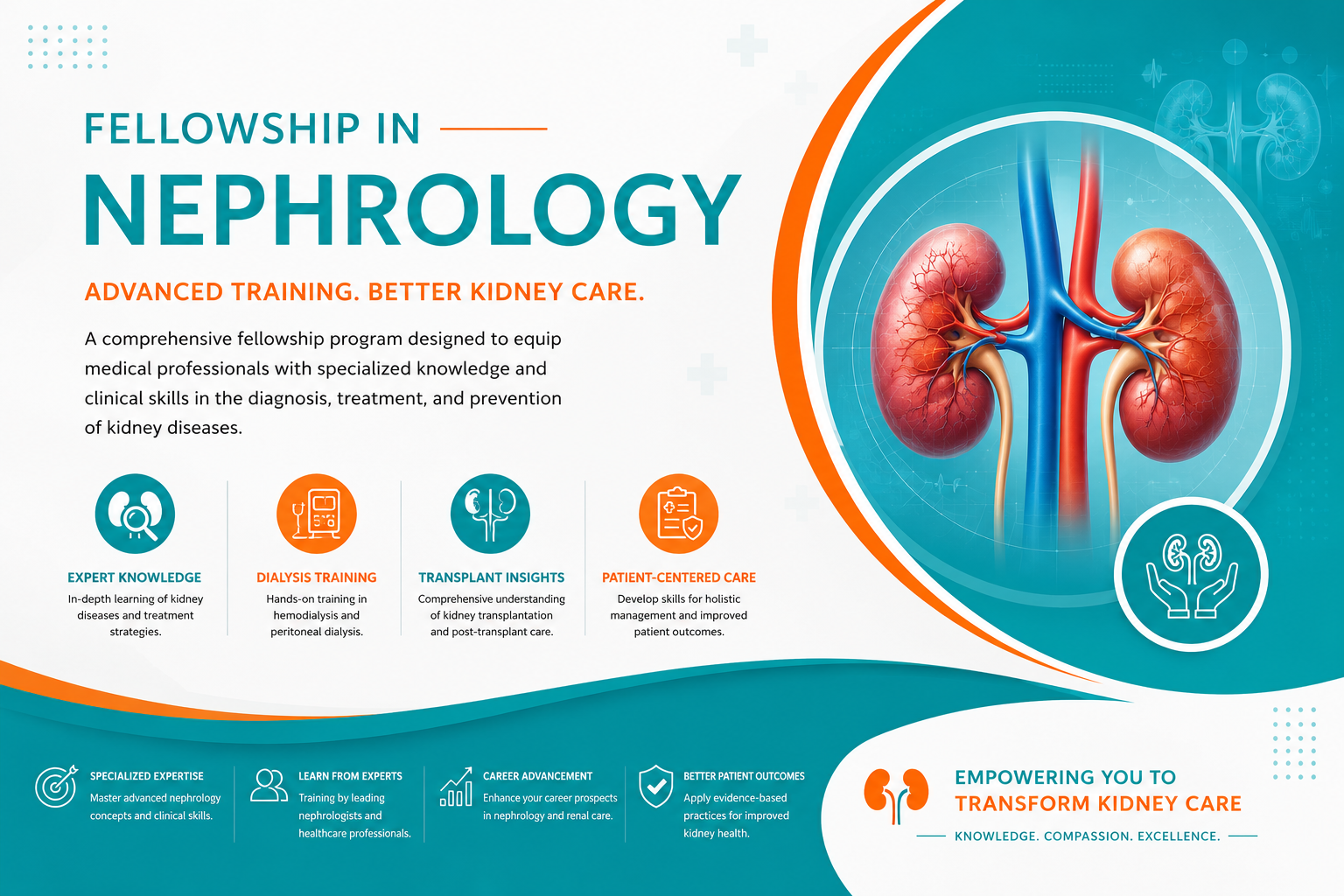

The Fellowship in Nephrology is a comprehensive advanced training program designed for medical graduates and practicing physicians who wish to specialize in the diagnosis, treatment, and management of kidney-related diseases. This fellowship provides in-depth knowledge of renal physiology, chronic kidney …
The Fellowship in Nephrology is a comprehensive advanced training program designed for medical graduates and practicing physicians who wish to specialize in the diagnosis, treatment, and management of kidney-related diseases. This fellowship provides in-depth knowledge of renal physiology, chronic kidney disease (CKD), acute kidney injury (AKI), glomerular disorders, electrolyte imbalances, hypertension, dialysis, and kidney transplantation. With the increasing global burden of kidney diseases, nephrology has become one of the most critical subspecialties in modern healthcare, requiring highly skilled professionals capable of delivering specialized patient care.
The program combines evidence-based theoretical learning with practical clinical exposure, enabling participants to develop expertise in evaluating and managing patients with complex renal conditions. Learners gain a thorough understanding of renal diagnostics, interpretation of laboratory investigations, imaging studies, renal biopsy findings, and advanced treatment protocols. Special emphasis is placed on preventive nephrology, early detection of kidney disorders, and strategies to slow disease progression through personalized patient management.
Throughout the fellowship, candidates explore essential topics such as diabetic kidney disease, hypertensive nephropathy, hereditary kidney disorders, nephrotic syndrome, nephritic syndrome, and systemic diseases affecting renal function. The curriculum also covers critical care nephrology, including the management of critically ill patients with acute kidney injury and the use of continuous renal replacement therapies (CRRT). Participants develop proficiency in fluid and electrolyte management, a cornerstone of nephrology practice.
A key component of the fellowship is training in dialysis modalities, including hemodialysis and peritoneal dialysis. Participants learn patient selection criteria, vascular access management, dialysis prescription, complication prevention, and long-term monitoring. The program also provides valuable insights into kidney transplantation, covering donor and recipient evaluation, immunosuppressive therapies, transplant complications, and post-transplant care.
The fellowship emphasizes a multidisciplinary approach to patient care, encouraging collaboration with endocrinologists, cardiologists, intensivists, transplant surgeons, and primary care physicians. This integrated approach helps improve patient outcomes and ensures comprehensive management of individuals with renal diseases. Participants also gain exposure to the latest advancements in nephrology, including precision medicine, regenerative therapies, artificial intelligence applications in renal care, and emerging treatment strategies.
Upon successful completion, graduates possess the knowledge and clinical skills necessary to manage a wide range of kidney disorders confidently. The fellowship enhances career opportunities in hospitals, dialysis centers, transplant programs, academic institutions, and specialized renal care clinics. It is particularly beneficial for physicians seeking to advance their expertise, improve patient outcomes, and establish themselves as leaders in the rapidly evolving field of nephrology.
This Fellowship in Nephrology serves as a valuable stepping stone for healthcare professionals committed to delivering high-quality kidney care and addressing the growing challenges associated with renal diseases worldwide.
- 10 Sections
- 123 Lessons
- 52 Weeks
- Acute Kidney Injury (AKI)19
- 1.1Acute KidneyInjury(AKI): Staging and Etiology
- 1.2Renal Case:72-year-old Woman with Altered Mental Status
- 1.3Pre-renal AKI: Pathophysiology
- 1.4Pre-renal AKI: Diagnosis and Treatment
- 1.5Renal Case: 56-year-oldMan with Coronary Angiography
- 1.6Acute Tubular Necrosis: Pathophysiology and Causes – AKI
- 1.7Acute Tubular Necrosis: Diagnosis and Treatment – AKI
- 1.8Renal Case: 35-year-old Woman with Increased Serum Creatinine
- 1.9Acute Interstitial Nephritis – AKI Renal Case: 47-year-old Woman with Non- Hodgkin’s Lymphoma
- 1.10Acute Tubular Obstruction – AKI
- 1.11Renal Case: 63-year-oldMan with Nausea, Fatigue, and Lethargy
- 1.12Vascular Disease: Causes – AKI
- 1.13Vascular Disease: Diagnosis and Treatment – AKI
- 1.14Renal Case: 62-year-old Woman with Nausea,Fatigue, and Lethargy
- 1.15Glomerular Disease – AKI
- 1.16Renal Case: 66-year-oldMan with Voiding Symptoms
- 1.17Obstructive Uropathy(Post-renal AKI) with Case
- 1.18Acute Kidney Injury(AKI): Complications
- 1.19Acute Kidney Injury(AKI): General Approach
- Chronic Kidney Disease (CKD)15
- 2.1Chronic Kidney Disease (CKD): Definition with Case
- 2.2Assessing Kidney Function: Glomerular Filtration Rate (GFR) with Case
- 2.3Assessing Kidney Function: Proteinuria
- 2.4Chronic Kidney Disease (CKD): Stages
- 2.5Chronic Kidney Disease (CKD): Stages Chronic Kidney Disease (CKD): Causes
- 2.6Renal Case: 63-year-old Woman with Elevated Serum Creatinine
- 2.7Chronic Kidney Disease (CKD): Pathophysiology
- 2.8Renal Case: 49-year-oldMan with Increased Serum Creatinine
- 2.9Diabetes Mellitus: Common Diseases that Predispose to CKD
- 2.10Renal Case: 57-year-oldMan with Increased Serum Creatinine
- 2.11Hypertension: Common Diseases that Predispose to CKD
- 2.12Chronic Kidney Disease (CKD): Complications with Case
- 2.13Chronic Kidney Disease (CKD): Risk Factors for Progression
- 2.14Chronic Kidney Disease (CKD): Interventions to Slow Down Progression with Case
- 2.15Chronic Kidney Disease (CKD): Patient Care
- Nephrolithiasis (Kidney Stones)9
- 3.1Nephrolithiasis(Kidney Stones): Etiology, Epidemiology, and Pathogenesis with Case
- 3.2Nephrolithiasis: Clinical Manifestations and Differential Diagnosis with Case
- 3.3Renal Case: 49-year-oldMan with Recently Diagnosed Kidney Stone
- 3.4Nephrolithiasis: Clinical Evaluation
- 3.5Calcium Stones: Treatment – Nephrolithiasis
- 3.6Uric Acid Stones: Treatment – Nephrolithiasis
- 3.7Struvite Stones: Treatment – Nephrolithiasis
- 3.8Cystine Stones: Treatment – Nephrolithiasis
- 3.9Renal Case: 42-year-old Woman with 2nd Diagnosis of a Kidney Stone
- Water Balance: Hypo- and Hypernatremia14
- 4.1Body Water Balance: Terms and Definitions
- 4.2Body Water Balance: Normal Kidney Function
- 4.3Review of ADH Regulation
- 4.4Hyponatremia and Its Neurologic Effects
- 4.5Hypovolemic Hypotonic Hyponatremia
- 4.6Hyponatremia: Clinical Approach
- 4.7Euvolemic Hypotonic Hyponatremia
- 4.8Hypervolemic Hypotonic Hyponatremia
- 4.9Hyponatremia :Management
- 4.10Renal Case: 39-year-old Woman with Type 2 DM
- 4.11Renal Case: 52-year-oldMan with Depression
- 4.12Hypernatremia: Etiology
- 4.13Hypernatremia: Management
- 4.14Renal Case: 81-year-oldMan with Depression
- Potassium Disorders: Hypo- and Hyperkalemia14
- 5.1Review of Potassium Metabolism
- 5.2Transcellular Shift – Hypokalemia
- 5.3GILosses – Hypokalemia
- 5.4Renal Losses : Metabolic Alkalosis – Hypokalemia
- 5.5Renal Losses: Metabolic Acidosis – Hypokalemia
- 5.6Renal Losses: Magnesium Deficit – Hypokalemia
- 5.7Hypokalemia: Clinical Manifestations
- 5.8Hypokalemia: Diagnosis and Treatment
- 5.9Renal Case: 32-year-oldMan with New- onset Hypertension
- 5.10Renal Case: 22-year-old Woman Complaining of Weakness
- 5.11Hyperkalemia: Etiology
- 5.12Hyperkalemia : Clinical Manifestations and Diagnosis
- 5.13Hyperkalemia : Treatment
- 5.14Renal Case: 52-year-oldMan with End- stage Renal Disease (ESRD)
- Secondary Hypertension13
- 6.1Primary vs Secondary Hypertension
- 6.2Renal Case: 34-year-old Woman with New Onset of Hypertension
- 6.3Renovascular Disease: Etiology and Pathophysiology – Secondary Hypertension
- 6.4Renovascular Disease: Clinical Features and Treatment – Secondary Hypertension
- 6.5Renal Parenchymal Hypertension – Secondary Hypertension
- 6.6Renal Case: 52-year-oldMan with New- onset Hypertension
- 6.7Primary Hyperaldosteronism– Secondary Hypertension
- 6.8Renal Case: 38-year-oldMan with Purple Stretch Marks
- 6.9Stretch Marks Cushing’s Disease and Syndrome – Secondary Hypertension
- 6.10Renal Case: 47-year-old Woman with Palpitations
- 6.11Pheochromocytoma – Secondary Hypertension
- 6.12Renal Case: 59-year-oldMan who Snores
- 6.13Obstructive Sleep Apnea – Secondary Hypertension
- Nephrotic Syndrome11
- 7.1Nephrotic Syndrome: Pathophysiology with Case
- 7.2Nephrotic Syndrome: Complications and Treatment
- 7.3Nephrotic Syndrome: Etiology
- 7.4Renal Case: 64-year-oldMan with Lower Extremity Edema
- 7.5Membranous Nephropathy – Nephrotic Syndrome
- 7.6Renal Case: 32-year-old Woman with Abrupt Onset of Edema
- 7.7Minimal Change Disease – Nephrotic Syndrome
- 7.8Renal Case: 38-year-oldMan with Sickle Cell Disease
- 7.9Focal Segmental Glomerulosclerosis(FSGS) – Nephrotic Syndrome
- 7.10Amyloidosis – Secondary Nephrotic Syndrome
- 7.11Diabetic Nephropathy – Secondary Nephrotic Syndrome
- Nephritic Syndrome11
- 8.1Acute Nephritic Syndrome: Fundamentals
- 8.2Renal Case: 63-year-oldMan with Microscopic Hematuria
- 8.3Membranoproliferative Glomerulonephritis (MPGN) – Nephritic Syndrome
- 8.4Complement-mediated MPGN – Nephritic Syndrome
- 8.5Renal Case: 22-year-old Woman with Tea- colored Urine
- 8.6IgA Nephropathy – Nephritic Syndrome
- 8.7Renal Case: 28-year-oldMan with Cola- colored Urine
- 8.8Infection-associated Glomerulonephritis – Nephritic Syndrome
- 8.9Renal Case: 35-year-old Woman with Edema and Weight Gain
- 8.10Lupus Nephritis – Nephritic Syndrome
- 8.11Rapidly Progressive Glomerulonephritis (RPGN) – Nephritic Syndrome
- Renal Replacement Therapy5
- Urinary Tract Infection (UTI)12
- 10.1UTI: Pathogenesis and Etiology (with Case)
- 10.2UTI: Diagnosis and Treatment
- 10.3UTIs in Children
- 10.4UTIs in Young Women
- 10.5Renal Case: 45-year-old Woman in the ER with Acute Onset of Fever
- 10.6Acute Pyelonephritis – Complicated UTIs
- 10.7Prostatitis – Complicated UTIs
- 10.8Catheter-associated Infections – Complicated UTIs
- 10.9Emphysematous Pyelonephritis – Complicated UTIs
- 10.10Xanthogranulomato us Pyelonephritis – Complicated UTIs
- 10.11Renal Case: 52-year-old Woman Noted to Have Bacteriuria
- 10.12Asymptomatic Bacteriuria – UTI