
Fellowship in Laproscopy surgery
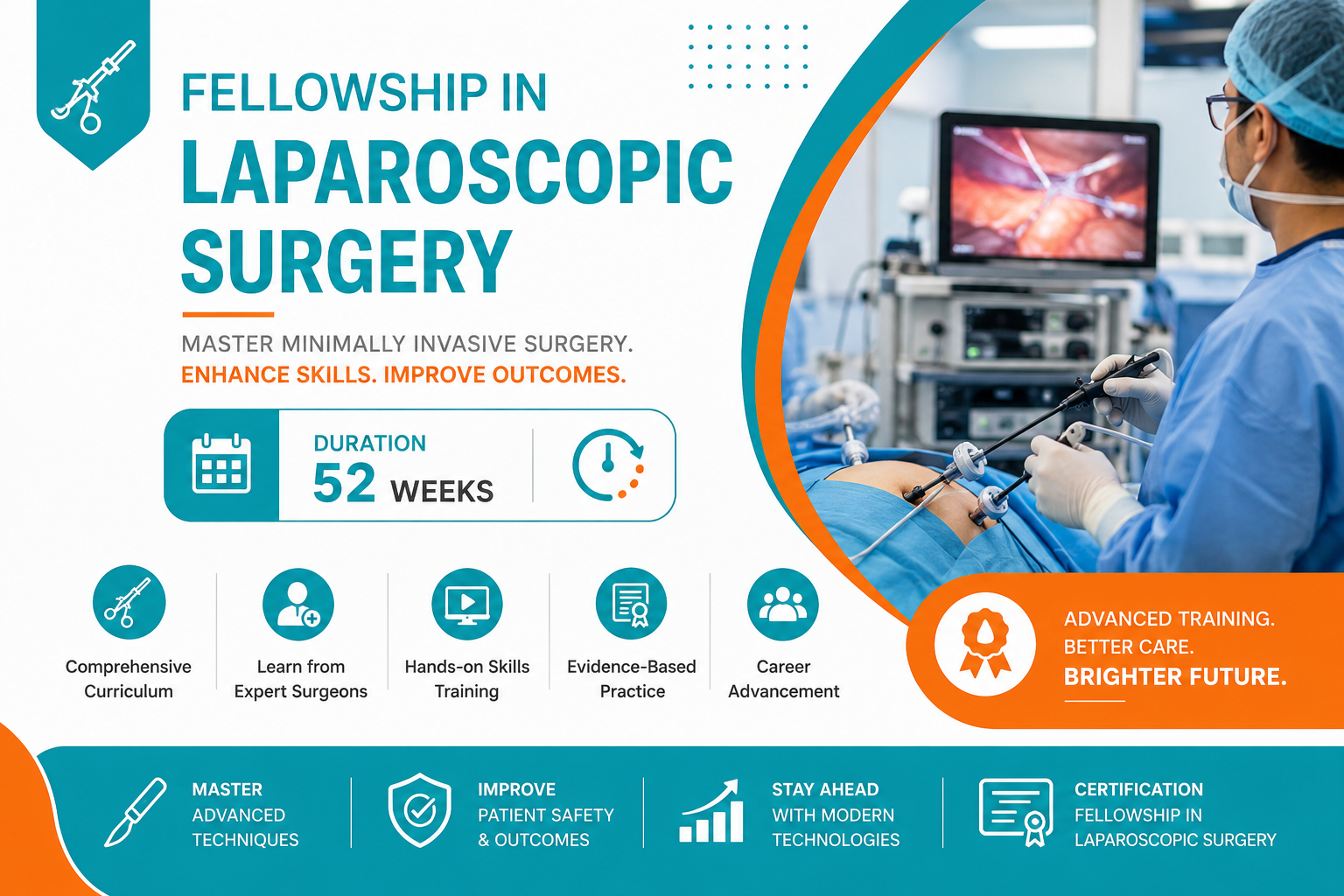

The Fellowship in Laparoscopic Surgery is a comprehensive 52-week advanced training program designed for surgeons and healthcare professionals seeking expertise in minimally invasive surgical techniques. The curriculum covers laparoscopic fundamentals, surgical anatomy, instrumentation, access techniques, suturing, hernia repair, gastrointestinal and hepatobiliary procedures, bariatric surgery, complication management, and advanced laparoscopic interventions. Through evidence-based learning and practical case discussions, participants develop the knowledge and skills required to perform safe, effective, and patient-centered laparoscopic procedures in modern surgical practice.
The Fellowship in Laparoscopic Surgery is a comprehensive 52-week advanced training program designed to equip surgeons and healthcare professionals with the knowledge, technical skills, and clinical expertise required to excel in minimally invasive surgical practice. As laparoscopic surgery continues to transform modern healthcare through reduced postoperative pain, shorter hospital stays, faster recovery, and improved patient outcomes, there is an increasing demand for surgeons trained in advanced laparoscopic techniques.
This fellowship provides an in-depth understanding of the principles and practice of laparoscopic surgery, beginning with foundational concepts such as surgical ergonomics, operating room setup, instrumentation, imaging systems, pneumoperitoneum creation, and patient selection. Participants gain a strong grounding in the anatomy and physiology relevant to minimally invasive procedures, enabling safe and effective surgical decision-making.
The curriculum emphasizes the development of essential laparoscopic skills, including camera navigation, hand-eye coordination, tissue handling, laparoscopic suturing, intracorporeal and extracorporeal knot tying, dissection techniques, and complication prevention. Learners are introduced to the latest energy devices and surgical technologies used in modern minimally invasive surgery.
A significant portion of the program focuses on common and advanced laparoscopic procedures. Participants will study laparoscopic cholecystectomy, appendectomy, inguinal and ventral hernia repair, gastrointestinal surgery, colorectal surgery, hepatobiliary interventions, and bariatric procedures. The fellowship also explores complex surgical cases, advanced laparoscopic approaches, and emerging innovations in robotic-assisted surgery.
Clinical decision-making and patient safety remain central themes throughout the program. Participants will learn to identify and manage intraoperative and postoperative complications, including bleeding, bowel injuries, bile duct injuries, infections, and conversion to open surgery when necessary. Evidence-based guidelines and best practices are integrated into every stage of learning to promote high standards of surgical care.
The fellowship also covers perioperative management, preoperative assessment, postoperative recovery protocols, enhanced recovery pathways, and multidisciplinary patient care. Through case-based discussions and practical learning activities, participants develop confidence in handling a wide range of surgical scenarios encountered in daily clinical practice.
In addition to technical training, the program incorporates research methodology, surgical ethics, quality improvement strategies, and evidence-based medicine. Learners will critically evaluate current literature, understand clinical research principles, and apply scientific evidence to improve surgical outcomes and patient care.
Upon successful completion of the fellowship, participants will possess a comprehensive understanding of laparoscopic surgery and the ability to apply advanced minimally invasive surgical techniques safely and effectively. Graduates will be well-prepared to enhance their surgical practice, improve patient outcomes, and contribute to the ongoing advancement of minimally invasive surgery within their healthcare institutions.
Who Should Enroll?
- General Surgeons
- Surgical Residents and Trainees
- Gastrointestinal Surgeons
- Bariatric Surgeons
- Hepatobiliary Surgeons
- Colorectal Surgeons
- Surgical Specialists seeking laparoscopic expertise
- Healthcare professionals involved in surgical care and perioperative management
Key Learning Outcomes
- Understand the principles and applications of minimally invasive surgery.
- Master laparoscopic instrumentation and operating room setup.
- Develop proficiency in laparoscopic suturing and knot-tying techniques.
- Perform safe laparoscopic access and trocar placement.
- Gain expertise in laparoscopic cholecystectomy and appendectomy.
- Understand laparoscopic hernia repair techniques including TEP and TAPP.
- Apply advanced techniques in gastrointestinal, colorectal, hepatobiliary, and bariatric surgery.
- Recognize and manage laparoscopic surgical complications.
- Integrate evidence-based practices into surgical decision-making.
- Enhance patient safety, surgical outcomes, and professional competence.
Duration: 52 Weeks
Level: Advanced
Mode: Fellowship Program
Certification: Fellowship in Laparoscopic Surgery Certificate upon successful completion.
- 16 Sections
- 96 Lessons
- 52 Weeks
- Fundamentals of Laparoscopic SurgeryThis module introduces learners to the principles, history, evolution, and scope of laparoscopic surgery. Participants will understand the advantages and limitations of minimally invasive surgery, operating room setup, ergonomics, instrumentation, and patient selection. The module establishes the foundation required for safe and effective laparoscopic practice across surgical specialties.6
- Applied Anatomy for Laparoscopic ProceduresThis module provides a detailed understanding of surgical anatomy relevant to laparoscopic procedures. Participants will review abdominal wall anatomy, vascular structures, gastrointestinal anatomy, hepatobiliary anatomy, pelvic anatomy, and anatomical landmarks critical for safe surgical dissection and trocar placement.6
- Laparoscopic Equipment and Energy SourcesLearners will develop expertise in the use and maintenance of laparoscopic equipment. The module covers camera systems, insufflators, light sources, energy devices, troubleshooting techniques, and safety measures to optimize surgical outcomes and reduce equipment-related complications.6
- Access Techniques and Port PlacementThis module focuses on safe abdominal access techniques and trocar placement strategies. Participants will learn methods of establishing pneumoperitoneum, port positioning principles, complication prevention, and management of entry-related injuries.6
- Laparoscopic Suturing and Knotting SkillsThis hands-on skills module develops proficiency in intracorporeal and extracorporeal suturing techniques. Learners will gain competence in needle handling, knot tying, tissue approximation, and advanced laparoscopic dexterity.6
- Diagnostic LaparoscopyParticipants will learn the indications, techniques, and interpretation of diagnostic laparoscopy. The module explores its role in abdominal pain evaluation, staging of malignancies, trauma assessment, and unexplained abdominal pathology.6
- Laparoscopic CholecystectomyThis module provides comprehensive training in one of the most common laparoscopic procedures. Learners will master patient preparation, operative steps, critical view of safety, complication avoidance, and postoperative care.6
- Laparoscopic AppendectomyParticipants will gain detailed knowledge of laparoscopic appendectomy techniques, including management of uncomplicated and complicated appendicitis, intraoperative decision-making, and postoperative care.6
- Laparoscopic Hernia SurgeryThis module focuses on minimally invasive approaches to hernia repair. Learners will understand anatomy, mesh selection, TEP and TAPP techniques, recurrence prevention, and complication management.6
- Laparoscopic Gastrointestinal SurgeryParticipants will explore laparoscopic procedures involving the gastrointestinal tract. The module covers fundoplication, bowel resection, adhesiolysis, and management of gastrointestinal emergencies.6
- Bariatric and Metabolic SurgeryThis module introduces laparoscopic bariatric surgery and metabolic procedures. Learners will understand patient selection, operative techniques, nutritional considerations, and long-term follow-up strategies.6
- Hepatobiliary and Pancreatic LaparoscopyThis advanced module covers minimally invasive approaches to hepatobiliary and pancreatic diseases. Participants will learn operative planning, technical considerations, and complication management.6
- Laparoscopic Colorectal SurgeryLearners will gain knowledge of minimally invasive colorectal surgery, including cancer surgery principles, resections, anastomotic techniques, and enhanced recovery protocols.6
- Complications and Emergency ManagementThis module focuses on recognizing, preventing, and managing intraoperative and postoperative complications. Participants will develop skills in crisis management and surgical decision-making.6
- Advanced Laparoscopic ProceduresParticipants will be introduced to advanced laparoscopic techniques and emerging technologies. The module includes complex surgical procedures, robotic integration, and innovations in minimally invasive surgery.6
- Research, Ethics, and Fellowship CapstoneThe final module develops research competencies, ethical decision-making, quality improvement skills, and professional development. Participants will complete a capstone project demonstrating mastery of laparoscopic surgery principles and practices.6
You might be intersted in
-
167 Students
-
52 Weeks
-
132 Students
-
52 Weeks
-
124 Students
-
52 Weeks
-
133 Students
-
52 Weeks