
Fellowship in Infertility
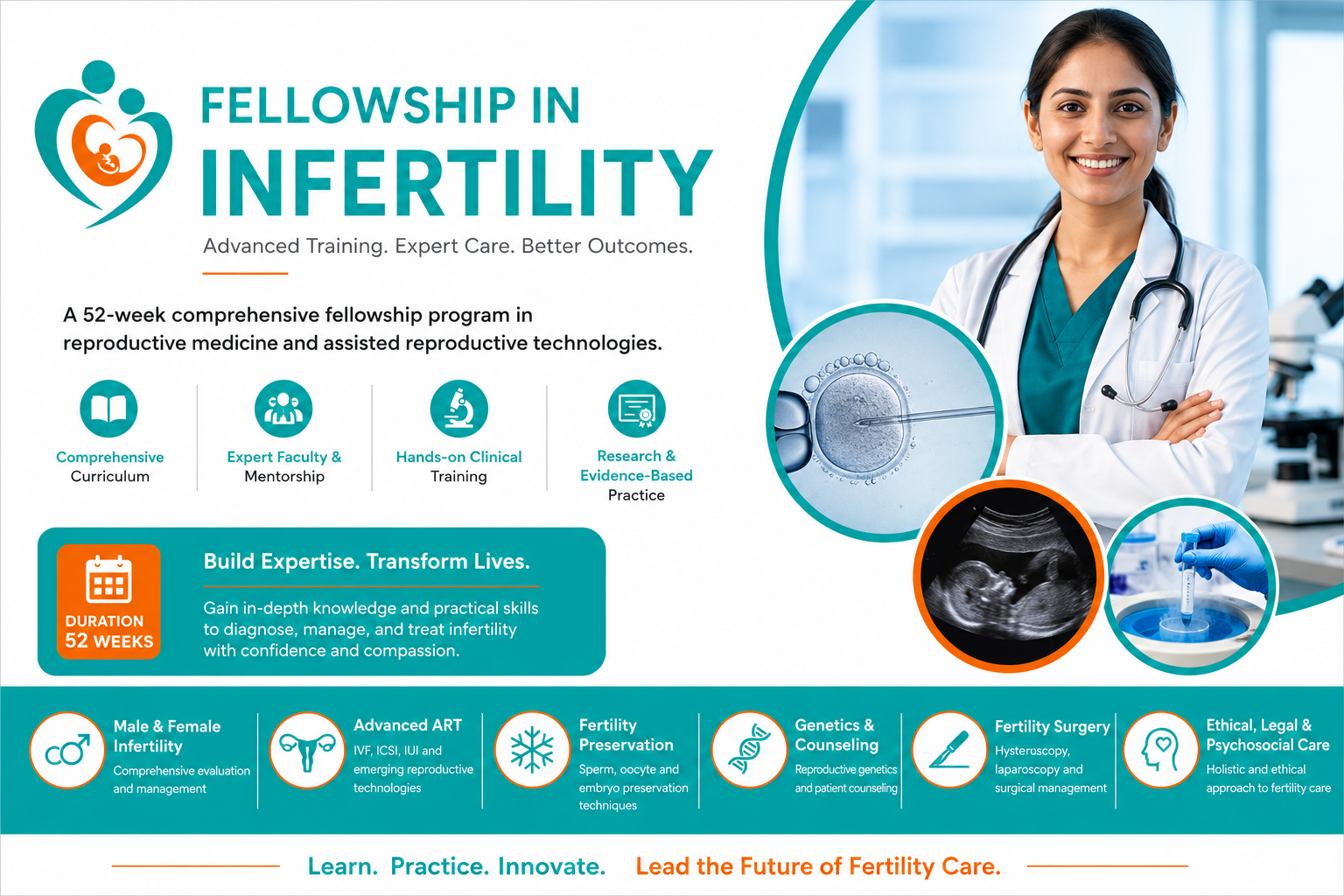

The Fellowship in Infertility is a comprehensive 52-week advanced training program designed for healthcare professionals seeking expertise in reproductive medicine and assisted reproductive technologies (ART). The program provides in-depth knowledge of infertility evaluation, reproductive endocrinology, male and female infertility, ovulation induction, IVF, ICSI, fertility preservation, reproductive genetics, and fertility surgery. Through evidence-based learning and clinical application, participants develop the skills required to diagnose, manage, and counsel infertile couples effectively. The curriculum also covers ethical, legal, psychosocial, and research aspects of fertility care, preparing fellows to deliver high-quality, patient-centered reproductive healthcare in modern fertility practice.
The Fellowship in Infertility is a comprehensive 52-week advanced training program designed for medical professionals who aspire to specialize in reproductive medicine and infertility management. This fellowship provides an in-depth understanding of the scientific, clinical, and technological aspects of fertility care, enabling participants to develop expertise in diagnosing and treating infertility in both men and women.
Infertility affects millions of couples worldwide and requires a multidisciplinary approach involving reproductive endocrinology, gynecology, andrology, genetics, embryology, and assisted reproductive technologies (ART). This fellowship equips learners with the knowledge and practical skills necessary to evaluate infertile couples, identify underlying causes, and formulate evidence-based treatment plans tailored to individual patient needs.
The curriculum begins with the fundamentals of reproductive anatomy, physiology, endocrinology, and embryology, providing a strong foundation in human reproduction. Participants then progress to advanced topics such as ovulatory disorders, polycystic ovary syndrome (PCOS), endometriosis, tubal factor infertility, diminished ovarian reserve, male infertility, and unexplained infertility. Comprehensive training in diagnostic procedures, hormonal assessment, fertility imaging, and semen analysis ensures a systematic approach to infertility evaluation.
A major focus of the fellowship is Assisted Reproductive Technology (ART), including ovulation induction, intrauterine insemination (IUI), in vitro fertilization (IVF), intracytoplasmic sperm injection (ICSI), embryo culture, embryo transfer, and cryopreservation techniques. Participants gain detailed knowledge of ART protocols, patient selection, ovarian stimulation strategies, laboratory procedures, and clinical outcome assessment. The program also explores advanced reproductive technologies such as fertility preservation, donor programs, preimplantation genetic testing (PGT), and emerging innovations in reproductive medicine.
The fellowship emphasizes reproductive genetics and counseling, enabling participants to understand hereditary conditions, chromosomal abnormalities, genetic screening, and ethical considerations in fertility treatment. Fellows also develop expertise in counseling couples facing infertility challenges, addressing emotional, psychological, and social concerns while promoting patient-centered care.
In addition, the program covers fertility-enhancing surgical procedures, including hysteroscopy, laparoscopy, management of endometriosis, tubal reconstruction, and uterine cavity correction. Learners gain insight into the role of minimally invasive surgery in improving reproductive outcomes and enhancing fertility treatment success rates.
Ethical, legal, and regulatory aspects of infertility treatment form an integral part of the curriculum. Participants explore issues related to assisted reproduction, donor gametes, surrogacy, fertility preservation, informed consent, and professional responsibilities within reproductive medicine practice. These topics ensure that graduates can provide ethical and legally compliant fertility care in diverse healthcare settings.
The fellowship also promotes evidence-based practice through training in research methodology, biostatistics, clinical audits, quality improvement initiatives, and critical appraisal of scientific literature. By completing a capstone project, participants strengthen their ability to contribute to advancements in reproductive medicine and fertility research.
Upon successful completion of the Fellowship in Infertility, graduates will be equipped to confidently assess and manage infertility cases, utilize modern reproductive technologies, provide comprehensive fertility counseling, and deliver high-quality reproductive healthcare. This program is ideal for physicians, gynecologists, reproductive medicine practitioners, and healthcare professionals seeking advanced specialization in infertility and assisted reproductive medicine.
- 12 Sections
- 99 Lessons
- 52 Weeks
- Foundations of Reproductive MedicineThis module introduces fellows to the fundamental principles of human reproduction, reproductive endocrinology, and infertility medicine. Learners will develop a strong understanding of reproductive anatomy, physiology, hormonal regulation, gametogenesis, fertilization, implantation, and early embryonic development. The module establishes the scientific foundation necessary for advanced infertility evaluation and treatment.8
- 1.1Introduction to Reproductive Medicine
- 1.2Male Reproductive Anatomy and Physiology
- 1.3Female Reproductive Anatomy and Physiology
- 1.4Reproductive Endocrinology Basics
- 1.5Gametogenesis and Fertilization
- 1.6Embryology and Implantation
- 1.7Hormonal Regulation of Reproduction
- 1.8Ethical Principles in Reproductive Medicine
- Evaluation of the Infertile CoupleThis module focuses on comprehensive infertility assessment. Fellows learn evidence-based approaches to history taking, physical examination, laboratory testing, imaging, and fertility investigations. Emphasis is placed on identifying female, male, combined, and unexplained infertility factors.8
- 2.1Initial Infertility Consultation
- 2.2Medical and Reproductive History Assessment
- 2.3Physical Examination Techniques
- 2.4Semen Analysis Interpretation
- 2.5Ovarian Reserve Testing
- 2.6Hormonal Evaluation in Infertility
- 2.7Pelvic Ultrasound in Fertility Assessment
- 2.8Diagnostic Approach to Unexplained Infertility
- Female Infertility DisordersThis module provides in-depth knowledge of female infertility causes, including ovulatory disorders, tubal disease, endometriosis, uterine abnormalities, and age-related infertility. Fellows learn diagnostic pathways and evidence-based treatment options for various gynecological conditions affecting fertility.9
- Male InfertilityThis module explores the epidemiology, pathophysiology, diagnosis, and management of male infertility. Fellows gain expertise in semen analysis, hormonal evaluation, genetic testing, and treatment strategies, including medical and surgical interventions.8
- Reproductive Endocrinology and Ovulation InductionThis module focuses on endocrine disorders affecting fertility and the principles of ovulation induction. Fellows learn pharmacologic management, monitoring protocols, and individualized treatment planning for infertile patients.9
- 5.1Hypothalamic-Pituitary-Ovarian Axis
- 5.2Thyroid Disorders and Fertility
- 5.3Hyperprolactinemia
- 5.4Ovulation Induction Principles
- 5.5Clomiphene Citrate Therapy
- 5.6Letrozole in Infertility Treatment
- 5.7Gonadotropin Therapy
- 5.8Monitoring Ovulation Induction Cycles
- 5.9Prevention of Ovarian Hyperstimulation Syndrome
- Assisted Reproductive TechnologyThis module provides comprehensive training in assisted reproductive technologies. Fellows learn patient selection, ovarian stimulation protocols, laboratory procedures, embryo culture, transfer techniques, and outcome assessment.11
- 6.1Introduction to ART
- 6.2Controlled Ovarian Stimulation
- 6.3Follicular Monitoring
- 6.4Oocyte Retrieval Techniques
- 6.5IVF Laboratory Principles
- 6.6In Vitro Fertilization Procedures
- 6.7Intracytoplasmic Sperm Injection (ICSI)
- 6.8Embryo Culture and Grading
- 6.9Embryo Transfer Techniques
- 6.10Cryopreservation of Gametes and Embryos
- 6.11ART Success Rates and Outcome Measures
- Advanced Reproductive TechnologiesThis module covers emerging and advanced ART procedures. Fellows gain knowledge of fertility preservation, donor programs, genetic testing, and innovative reproductive technologies used in contemporary fertility practice.9
- Reproductive Genetics and CounselingThis module focuses on genetic factors influencing fertility and reproductive outcomes. Fellows learn genetic counseling principles, risk assessment, prenatal genetics, and communication skills for patient-centered fertility care.8
- Fertility Surgery and Minimally Invasive ProceduresThis module introduces surgical approaches used in infertility management. Fellows learn indications, techniques, and outcomes of hysteroscopic and laparoscopic procedures that improve reproductive outcomes.8
- Pregnancy After Infertility TreatmentThis module examines conception outcomes following fertility treatments. Fellows learn early pregnancy assessment, management of ART pregnancies, multiple gestations, and obstetric complications associated with infertility treatments.7
- Psychosocial, Ethical, and Legal Aspects of InfertilityThis module addresses the emotional, ethical, social, and legal dimensions of infertility care. Fellows develop skills in counseling, informed consent, patient advocacy, and regulatory compliance in reproductive medicine.7
- Research, Quality Improvement, and Fellowship CapstoneThe final module integrates clinical knowledge through research methodology, evidence-based practice, quality improvement initiatives, and a capstone project. Fellows demonstrate competency in infertility management and contribute to advancements in reproductive medicine.7
You might be intersted in
-
167 Students
-
52 Weeks
-
132 Students
-
52 Weeks
-
133 Students
-
52 Weeks
-
123 Students
-
52 Weeks