Fellowship in Community Medicine

The Fellowship in Community Medicine is a comprehensive 52-week advanced training program designed for healthcare professionals seeking expertise in public health, preventive medicine, epidemiology, and community healthcare management. This fellowship equips learners with the knowledge and practical skills required to …
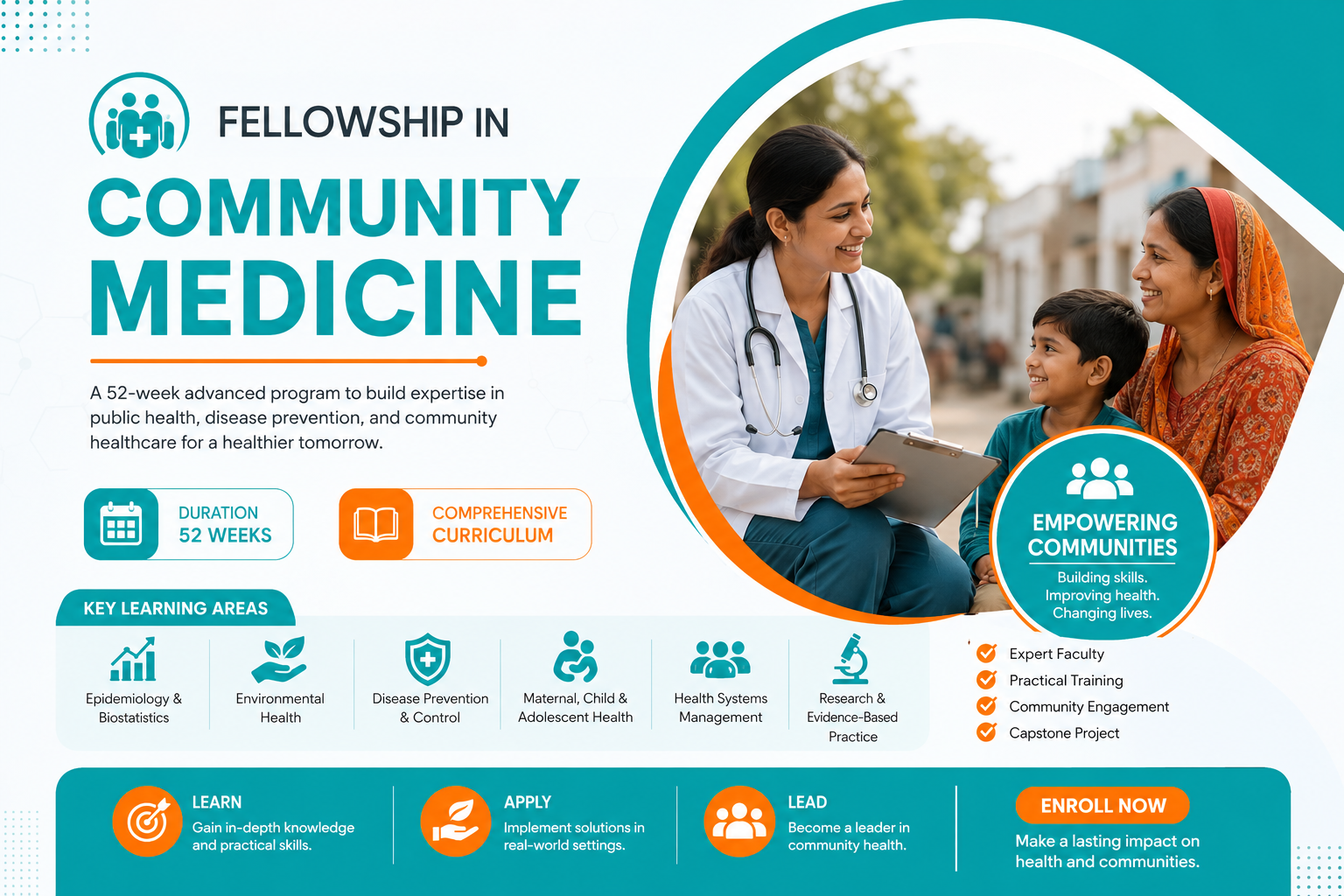
The Fellowship in Community Medicine is a comprehensive 52-week advanced training program designed for healthcare professionals seeking expertise in public health, preventive medicine, epidemiology, and community healthcare management. This fellowship equips learners with the knowledge and practical skills required to address population health challenges, develop evidence-based interventions, and contribute to healthcare policy and program implementation at local, national, and global levels.
The program begins with the foundational concepts of community medicine, including the determinants of health, disease prevention strategies, health promotion, and public health ethics. Participants gain a thorough understanding of the social, environmental, and behavioral factors that influence health outcomes and learn how to apply community-oriented approaches to healthcare delivery.
A significant portion of the fellowship focuses on epidemiology and biostatistics, enabling learners to understand disease patterns, conduct health research, analyze public health data, and make informed decisions based on scientific evidence. Participants develop competencies in disease surveillance, outbreak investigation, screening programs, and research methodology, which are essential for modern public health practice.
The curriculum also explores environmental health and sanitation, emphasizing safe water supply, waste management, air quality, climate change, and environmental risk assessment. Learners gain insights into the impact of environmental factors on community health and the strategies required to prevent environmentally related diseases.
The fellowship provides in-depth training in the prevention and control of communicable and non-communicable diseases. Participants study national and international disease control programs, immunization strategies, infectious disease surveillance, and community-based interventions for chronic diseases such as diabetes, cardiovascular disorders, cancer, and respiratory illnesses. The program emphasizes preventive approaches and population-based healthcare planning.
Special attention is given to maternal, child, adolescent, and reproductive health, preparing participants to address the unique healthcare needs of vulnerable populations. Learners examine family welfare services, nutrition programs, school health initiatives, and maternal and child health indicators that guide healthcare planning and policy development.
Nutrition and public health form another essential component of the fellowship. Participants learn methods for nutritional assessment, prevention of malnutrition, food safety management, and the design of community nutrition programs aimed at improving health outcomes across different population groups.
The program also develops leadership and management capabilities through modules on health systems management, healthcare administration, health economics, quality assurance, and health policy. Learners gain practical knowledge in healthcare planning, resource allocation, program monitoring, and evaluation, enabling them to effectively manage public health initiatives and healthcare organizations.
Occupational health, disaster preparedness, and emergency response are covered extensively, helping participants understand workplace hazards, public health emergencies, disaster risk reduction, and rehabilitation strategies. These competencies are increasingly important in addressing modern health crises and ensuring community resilience.
Behavioral sciences and health education modules enhance participants’ ability to communicate effectively, promote healthy behaviors, design awareness campaigns, and engage communities in health improvement initiatives. Learners explore health communication strategies, behavior change models, counseling techniques, and advocacy methods that support sustainable public health outcomes.
A strong emphasis is placed on research and evidence-based practice, enabling participants to conduct public health studies, critically evaluate scientific literature, and contribute to healthcare innovation. The fellowship develops skills in quantitative and qualitative research, scientific writing, data management, and program evaluation.
The final phase of the program includes a comprehensive community medicine practicum and capstone project, where learners apply their knowledge in real-world settings. Participants conduct community health assessments, design and implement interventions, analyze public health data, and present evidence-based solutions to contemporary healthcare challenges.
Upon successful completion of the Fellowship in Community Medicine, graduates will be prepared to serve as public health specialists, community medicine consultants, epidemiologists, healthcare administrators, program managers, health policy advisors, research professionals, and leaders in population health initiatives. The program provides a balanced blend of theoretical knowledge, practical experience, and research skills necessary to improve health outcomes and strengthen healthcare systems in diverse community settings.
This fellowship is ideal for medical graduates, healthcare practitioners, public health professionals, and individuals seeking advanced expertise in community-oriented healthcare, disease prevention, health promotion, and public health leadership. By combining academic rigor with practical application, the program empowers participants to make meaningful contributions to the health and well-being of populations worldwide.
- 13 Sections
- 104 Lessons
- 52 Weeks
- Foundations of Community MedicineThis module introduces learners to the principles, scope, and evolution of community medicine. Participants will explore the relationship between health and society, determinants of health, concepts of disease prevention, health promotion, and the role of community medicine in healthcare systems. The module provides a strong foundation for understanding public health challenges and developing population-based healthcare strategies.8
- Epidemiology and BiostatisticsThis module focuses on epidemiological principles and statistical methods used in public health research and practice. Learners will understand disease distribution, study designs, measures of disease frequency, data analysis, and interpretation of health information for evidence-based decision-making.8
- Environmental Health and SanitationThis module examines environmental factors affecting health and explores strategies for maintaining healthy environments. Topics include water quality, waste management, air pollution, housing, sanitation, and climate-related health risks.8
- Communicable Disease ControlThis module provides comprehensive knowledge of communicable diseases and their prevention, surveillance, and control. Learners will study outbreak investigation, vaccination programs, and national disease control strategies.8
- Non-Communicable Diseases and Lifestyle MedicineThis module addresses the growing burden of non-communicable diseases (NCDs) and emphasizes preventive approaches. Learners will explore risk factors, screening methods, and community-based interventions for chronic diseases.8
- Maternal, Child, and Adolescent HealthThis module focuses on reproductive, maternal, neonatal, child, and adolescent health. Learners will gain knowledge of healthcare programs, nutrition, immunization, and strategies to improve health outcomes among vulnerable populations.8
- Nutrition and Public HealthThis module explores the role of nutrition in health and disease prevention. Learners will assess nutritional status, understand common nutritional disorders, and develop community nutrition interventions.8
- Health Systems and Health ManagementThis module introduces healthcare delivery systems, health administration, leadership, and management principles. Learners will study healthcare planning, resource management, and quality improvement initiatives.8
- Occupational Health and Disaster ManagementThis module covers occupational health hazards, workplace safety, and disaster preparedness. Learners will develop skills for risk assessment, emergency response planning, and public health interventions during disasters.8
- Health Education and Behavioral SciencesThis module examines behavioral and social factors influencing health. Learners will develop communication skills and design health education programs aimed at promoting healthy behaviors within communities.8
- Public Health Research and Evidence-Based PracticeThis module develops research competencies essential for community medicine specialists. Learners will study research methodologies, ethics, data management, and scientific writing to support evidence-based healthcare.8
- National Health Programs and Global HealthThis module provides an overview of national and international public health initiatives. Learners will evaluate health policies, disease control programs, and global health challenges affecting populations worldwide.8
- Community Medicine Practicum and Capstone ProjectThe final module provides hands-on field experience and project-based learning. Participants will conduct community assessments, design interventions, analyze public health data, and present a capstone project demonstrating competency in community medicine practice.8
You might be intersted in
-
167 Students
-
52 Weeks
-
124 Students
-
52 Weeks
-
142 Students
-
52 Weeks
-
89 Students
-
52 Weeks