
Fellowship in cardiac Care nursing
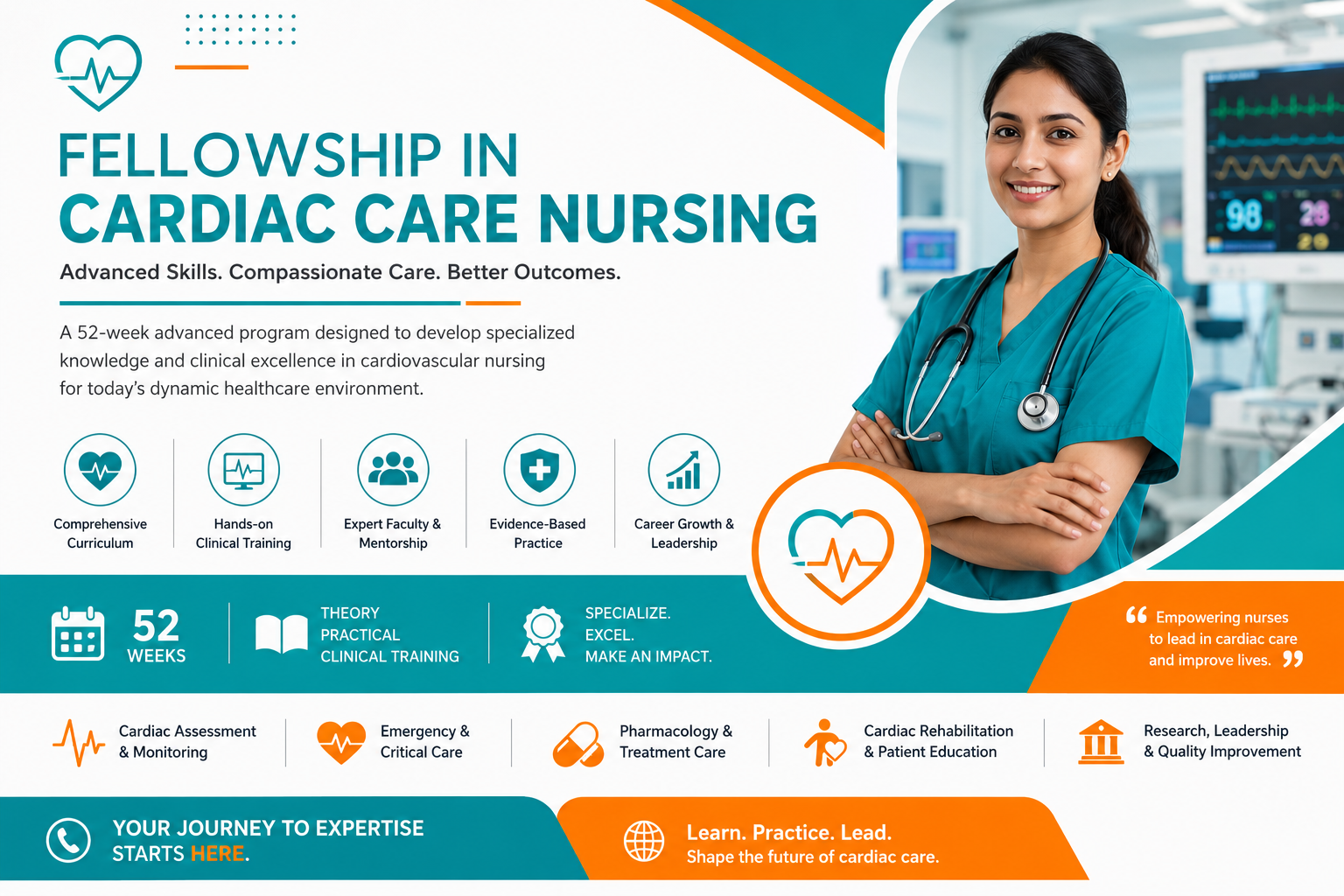

The Fellowship in Cardiac Care Nursing is a comprehensive 52-week advanced training program designed to equip nursing professionals with specialized knowledge and clinical skills in cardiovascular care. The program covers cardiac assessment, ECG interpretation, coronary artery disease management, heart failure care, cardiac emergencies, critical care cardiology, interventional procedures, cardiac rehabilitation, and evidence-based nursing practice. Through a combination of theoretical learning, hands-on clinical training, and case-based discussions, participants develop the competencies required to deliver high-quality care to patients with acute and chronic cardiac conditions across diverse healthcare settings.
The Fellowship in Cardiac Care Nursing is a comprehensive 52-week advanced training program designed for registered nurses and healthcare professionals seeking specialized expertise in cardiovascular and cardiac critical care. As cardiovascular diseases continue to be a leading cause of morbidity and mortality worldwide, the demand for highly skilled cardiac care nurses has increased significantly across hospitals, cardiac centers, intensive care units, and emergency departments.
This fellowship provides an in-depth understanding of cardiovascular anatomy and physiology, cardiac assessment techniques, diagnostic procedures, pharmacological management, and evidence-based nursing interventions. Participants will develop the clinical competencies required to care for patients with a wide range of cardiac conditions, including coronary artery disease, acute coronary syndrome, myocardial infarction, heart failure, arrhythmias, cardiomyopathies, valvular heart diseases, and congenital cardiac disorders.
The program emphasizes both theoretical knowledge and hands-on clinical practice. Learners gain practical experience in cardiac monitoring, ECG interpretation, hemodynamic assessment, emergency response, advanced life support, and critical care management. Through structured clinical rotations in coronary care units (CCUs), intensive cardiac care units (ICCUs), cardiac catheterization laboratories, emergency departments, and cardiac rehabilitation centers, participants develop confidence in managing complex cardiovascular cases.
Special focus is given to cardiac emergencies and advanced cardiac life support. Nurses are trained to recognize early signs of cardiac deterioration, respond effectively to life-threatening situations, and provide high-quality care during cardiac arrest, cardiogenic shock, and other acute cardiovascular emergencies. The curriculum also covers advanced technologies used in cardiac care, including pacemakers, defibrillators, hemodynamic monitoring systems, and mechanical circulatory support devices.
In addition to acute care management, the fellowship highlights preventive cardiology and cardiac rehabilitation. Participants learn strategies for patient education, lifestyle modification, risk-factor management, medication adherence, and long-term follow-up care. These skills enable nurses to support patients throughout the continuum of cardiac care, from prevention and diagnosis to treatment and recovery.
The program also develops leadership, communication, research, and quality improvement competencies essential for advanced nursing practice. Learners are encouraged to apply evidence-based approaches, participate in multidisciplinary healthcare teams, and contribute to improved patient outcomes through continuous quality enhancement initiatives.
Upon successful completion of the fellowship, graduates will be equipped to work in specialized cardiac care environments, including coronary care units, intensive care units, cardiac catheterization laboratories, emergency departments, cardiac surgery units, rehabilitation centers, and tertiary healthcare institutions. The fellowship serves as an excellent pathway for nurses seeking career advancement, specialization in cardiovascular nursing, and leadership roles within modern healthcare systems.
This 52-week program combines academic excellence, clinical expertise, and professional development to prepare nurses for the evolving challenges of cardiovascular healthcare while ensuring the highest standards of patient-centered cardiac care.
- 12 Sections
- 82 Lessons
- 52 Weeks
- Foundations of Cardiac Care NursingThis module introduces learners to the fundamental principles of cardiac care nursing. Students will gain an understanding of cardiovascular anatomy, physiology, common cardiac disorders, patient assessment techniques, and the role of cardiac nurses in multidisciplinary healthcare teams. The module establishes a strong theoretical foundation for advanced cardiac nursing practice.6
- Cardiovascular Assessment and Diagnostic ProceduresThis module focuses on comprehensive cardiovascular assessment techniques and diagnostic investigations used in cardiac care settings. Learners will develop skills in patient history taking, physical examination, ECG interpretation, and understanding diagnostic reports essential for clinical decision-making.7
- Cardiac PharmacologyThis module provides in-depth knowledge of medications used in cardiovascular disease management. Students will learn pharmacological principles, drug administration, monitoring, adverse effects, and patient education regarding cardiac medications.7
- Coronary Artery Disease ManagementLearners will explore the pathophysiology, diagnosis, treatment, and nursing management of coronary artery disease. The module emphasizes evidence-based care strategies for patients experiencing acute and chronic coronary conditions.7
- Cardiac Arrhythmias and MonitoringThis module develops competencies in recognizing and managing cardiac arrhythmias. Students will learn rhythm interpretation, monitoring techniques, and nursing interventions for various cardiac conduction abnormalities.7
- Heart Failure and CardiomyopathiesThis module focuses on heart failure syndromes and cardiomyopathies. Learners will understand disease progression, treatment modalities, symptom management, and patient education strategies to improve quality of life.7
- Critical Care Cardiology NursingStudents will gain expertise in caring for critically ill cardiac patients in intensive and coronary care units. The module covers advanced monitoring, life-support systems, and management of complex cardiac emergencies.7
- Cardiac Emergencies and ResuscitationThis module prepares learners to respond effectively to cardiac emergencies. Students will develop advanced skills in emergency assessment, resuscitation protocols, and post-resuscitation care.7
- Interventional Cardiology and Cardiac Surgery NursingThis module covers nursing care related to interventional cardiology procedures and cardiac surgeries. Learners will understand perioperative management, complication prevention, and postoperative recovery.7
- Pediatric and Congenital Cardiac CareStudents will learn specialized nursing approaches for pediatric cardiac patients and individuals with congenital heart diseases. The module emphasizes developmental considerations and family-centered care.6
- Cardiac Rehabilitation and Preventive CardiologyThis module focuses on preventive strategies and rehabilitation programs that improve cardiovascular outcomes. Learners will promote healthy lifestyles and support long-term recovery for cardiac patients.7
- Advanced Cardiac Nursing Practice and ResearchThe final module integrates advanced clinical practice, leadership, quality improvement, and research in cardiac care nursing. Students will apply evidence-based practices and complete a capstone project demonstrating comprehensive cardiac nursing competence.7
You might be intersted in
-
133 Students
-
52 Weeks
-
123 Students
-
52 Weeks
-
142 Students
-
52 Weeks
-
126 Students
-
52 Weeks