
Fellowship in Infertility
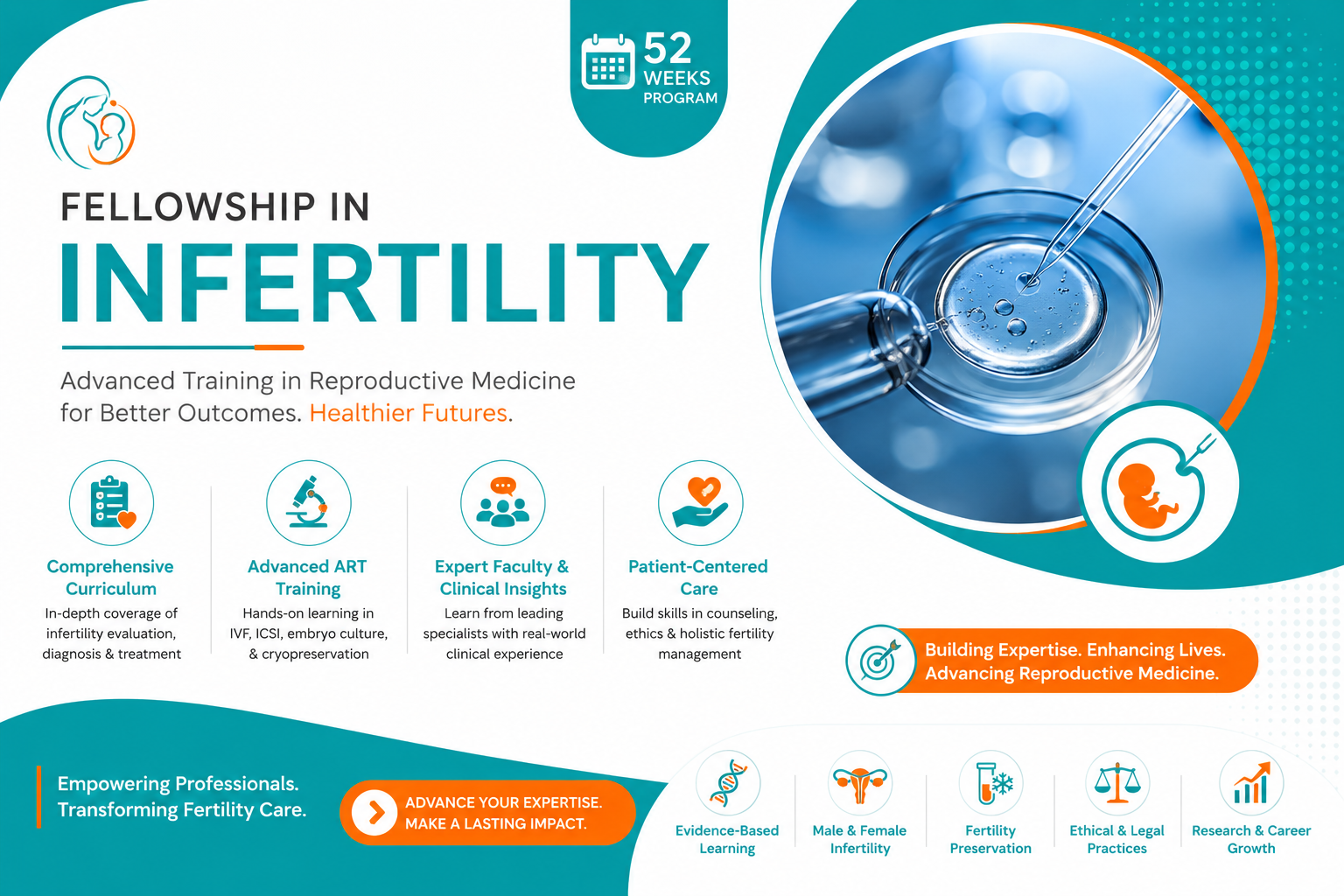

The Fellowship in Infertility is a comprehensive 52-week advanced training program designed to equip healthcare professionals with specialized knowledge and practical skills in reproductive medicine and infertility management. The program covers male and female infertility evaluation, reproductive endocrinology, assisted reproductive technologies (ART), IVF, ICSI, embryology, fertility preservation, genetic testing, patient counseling, and ethical aspects of reproductive healthcare. Through evidence-based learning, clinical case discussions, and research-oriented training, participants develop the expertise required to diagnose, manage, and treat complex infertility conditions in modern fertility practice.
The Fellowship in Infertility is a comprehensive 52-week advanced training program designed to provide healthcare professionals with specialized knowledge and practical expertise in the diagnosis, evaluation, treatment, and management of infertility and reproductive disorders. With infertility affecting millions of couples worldwide and the demand for fertility services steadily increasing, this fellowship equips learners with the clinical competencies and evidence-based approaches required to deliver high-quality reproductive healthcare.
This program offers an in-depth understanding of human reproductive anatomy, physiology, reproductive endocrinology, and the complex mechanisms involved in fertility and conception. Participants gain a strong foundation in both male and female reproductive health, enabling them to identify and manage a wide range of infertility-related conditions. The curriculum integrates scientific principles with clinical practice, ensuring that learners develop a comprehensive understanding of fertility assessment and treatment planning.
Throughout the fellowship, learners explore the evaluation of female infertility, including ovulatory disorders, polycystic ovary syndrome (PCOS), endometriosis, tubal factor infertility, uterine abnormalities, diminished ovarian reserve, and age-related fertility decline. Equal emphasis is placed on male infertility, covering semen analysis, hormonal evaluation, genetic factors, varicocele, testicular dysfunction, and reproductive disorders that affect male fertility. Participants learn to conduct systematic infertility assessments and interpret diagnostic findings using evidence-based clinical guidelines.
A significant component of the program focuses on reproductive endocrinology and hormonal disorders. Learners gain expertise in understanding hormonal regulation of reproduction, endocrine dysfunctions, thyroid disorders, hyperprolactinemia, adrenal disorders, and metabolic conditions that impact fertility. Training includes the appropriate use of hormonal therapies and individualized treatment protocols to optimize reproductive outcomes.
The fellowship provides extensive training in infertility diagnostics and advanced reproductive technologies. Participants become proficient in interpreting laboratory investigations, ovarian reserve testing, reproductive imaging, hysterosalpingography (HSG), sonohysterography, hysteroscopy, laparoscopy, and genetic testing. This diagnostic expertise enables healthcare professionals to develop accurate fertility treatment plans tailored to each patient’s needs.
A core strength of the program is its detailed coverage of Assisted Reproductive Technologies (ART). Learners acquire advanced knowledge of ovulation induction, controlled ovarian stimulation, in vitro fertilization (IVF), intracytoplasmic sperm injection (ICSI), embryo transfer, cryopreservation, and fertility preservation techniques. The fellowship also explores donor programs, surrogacy, preimplantation genetic testing (PGT), and emerging innovations that continue to transform reproductive medicine.
Participants receive specialized training in embryology and laboratory sciences, gaining insights into gamete biology, fertilization, embryo development, embryo grading, laboratory quality control, and ART laboratory management. Understanding these laboratory processes enhances collaboration between clinicians and embryologists, ultimately improving patient outcomes in fertility treatment programs.
The program also addresses complex and challenging infertility cases, including unexplained infertility, recurrent pregnancy loss, fertility preservation in cancer patients, autoimmune reproductive disorders, obesity-related infertility, and fertility concerns associated with chronic medical conditions. Through case-based learning and multidisciplinary approaches, learners develop advanced clinical decision-making skills necessary for managing difficult fertility cases.
Recognizing the emotional and psychological impact of infertility, the fellowship includes comprehensive training in patient counseling, communication, and psychosocial support. Participants learn effective counseling techniques, patient-centered care approaches, ethical decision-making, and strategies for supporting individuals and couples throughout their fertility journey. The curriculum also examines legal and ethical issues related to assisted reproduction, donor programs, surrogacy, confidentiality, and informed consent.
Research and evidence-based practice are integral components of the fellowship. Learners develop skills in clinical research methodology, critical appraisal of scientific literature, data interpretation, and clinical audit processes. A fellowship project allows participants to apply research principles to real-world reproductive health challenges while contributing to professional development and lifelong learning.
Upon successful completion of the Fellowship in Infertility, graduates will be equipped to evaluate infertility comprehensively, develop individualized treatment strategies, collaborate effectively within multidisciplinary fertility teams, and apply advanced reproductive technologies in clinical practice. The program prepares healthcare professionals to provide compassionate, ethical, and evidence-based fertility care while meeting the growing demand for specialized infertility services.
This fellowship is ideal for medical graduates, obstetricians and gynecologists, reproductive medicine practitioners, fertility specialists, family physicians, nurses, embryologists, and allied healthcare professionals seeking to advance their expertise in reproductive medicine and infertility management. By combining academic rigor, clinical relevance, and practical application, the Fellowship in Infertility provides a strong pathway toward excellence in modern fertility and reproductive healthcare.
- 12 Sections
- 96 Lessons
- 52 Weeks
- Fundamentals of Reproductive Medicine and InfertilityThis module introduces learners to the foundations of reproductive medicine and infertility. Participants will gain a comprehensive understanding of human reproductive anatomy, physiology, reproductive endocrinology, and the epidemiology of infertility. The module establishes the scientific basis required to understand fertility disorders, reproductive health challenges, and contemporary approaches to infertility management.8
- 1.1Introduction to Reproductive Medicine
- 1.2Epidemiology of Infertility
- 1.3Male Reproductive Anatomy and Physiology
- 1.4Female Reproductive Anatomy and Physiology
- 1.5Reproductive Endocrinology Basics
- 1.6Hormonal Regulation of Reproduction
- 1.7Gametogenesis and Fertilization
- 1.8Overview of Fertility Assessment
- Female Infertility EvaluationThis module focuses on the systematic evaluation of female infertility. Learners will study ovulatory disorders, tubal factors, uterine abnormalities, endometriosis, and age-related fertility decline. Emphasis is placed on evidence-based diagnostic approaches and interpretation of clinical findings.8
- Male Infertility EvaluationThis module explores the causes, diagnosis, and management of male infertility. Participants will learn about semen analysis, hormonal evaluation, genetic factors, testicular dysfunction, and male reproductive disorders that contribute to infertility.8
- Diagnostic Techniques in InfertilityThis module provides comprehensive training in infertility diagnostic tools and procedures. Learners will understand laboratory investigations, imaging techniques, ovarian reserve assessment, and advanced reproductive diagnostics used in fertility clinics.8
- Reproductive Endocrinology and Hormonal DisordersThis module examines endocrine disorders affecting fertility. Participants will explore hormonal pathways, endocrine dysfunctions, and management strategies that optimize reproductive outcomes in both men and women.8
- Ovulation Induction and Controlled Ovarian StimulationThis module focuses on ovulation induction strategies and ovarian stimulation protocols used in fertility treatment. Learners will understand patient selection, medication regimens, monitoring techniques, and management of treatment-related complications.8
- Assisted Reproductive Technologies (ART)This module provides in-depth knowledge of assisted reproductive technologies. Participants will learn the principles, indications, techniques, and outcomes of IVF, ICSI, embryo transfer, and other ART procedures.8
- Embryology and Laboratory SciencesThis module covers embryology and laboratory procedures integral to fertility treatment. Learners will understand embryo development, laboratory quality control, gamete handling, and advances in reproductive laboratory sciences.8
- Advanced Reproductive TechnologiesThis module explores advanced fertility technologies and innovations. Participants will learn about genetic testing, fertility preservation, donor programs, and emerging reproductive techniques used in modern infertility practice.8
- Special Situations in InfertilityThis module addresses complex infertility cases and special populations. Learners will develop expertise in managing recurrent pregnancy loss, unexplained infertility, cancer-related fertility issues, and reproductive challenges in advanced maternal age.8
- Ethics, Legal Issues, and Counseling in InfertilityThis module focuses on ethical, legal, and psychosocial aspects of infertility care. Participants will develop counseling skills and understand patient rights, informed consent, confidentiality, and ethical considerations surrounding reproductive technologies.8
- Clinical Practice, Research, and Fellowship ProjectThe final module integrates clinical knowledge through case-based learning, research methodology, and capstone project development. Learners will strengthen decision-making skills and apply evidence-based approaches to infertility management.8
You might be intersted in
-
167 Students
-
52 Weeks
-
132 Students
-
52 Weeks
-
123 Students
-
52 Weeks
-
142 Students
-
52 Weeks