
Fellowship in Physiology
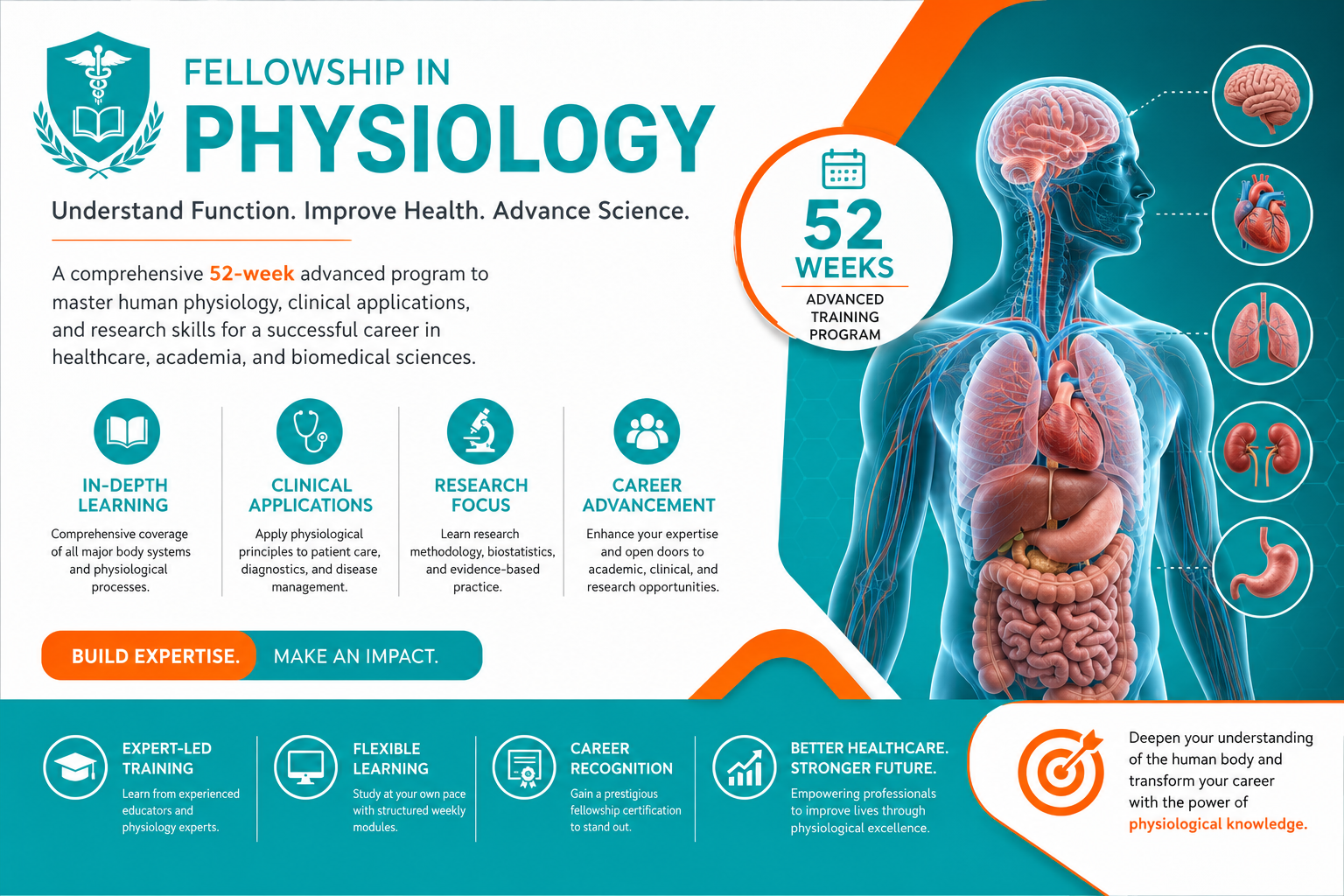

The Fellowship in Physiology is a comprehensive 52-week advanced training program designed to provide in-depth knowledge of human physiological systems and their clinical applications. The course covers cellular, neurophysiological, cardiovascular, respiratory, renal, endocrine, gastrointestinal, reproductive, and immunological functions, enabling learners to understand the mechanisms that maintain health and contribute to disease. Through a blend of theoretical learning, clinical correlations, and research-oriented training, participants develop the expertise needed for academic, clinical, and biomedical research careers in physiology.
The Fellowship in Physiology is a comprehensive 52-week advanced academic and professional training program designed to provide healthcare professionals, medical graduates, educators, researchers, and allied health practitioners with an in-depth understanding of the physiological mechanisms that govern human health and disease. Physiology forms the foundation of modern medical science, explaining how cells, tissues, organs, and body systems function individually and collectively to maintain homeostasis and support life. This fellowship equips learners with the knowledge and analytical skills required to understand normal body functions, interpret physiological changes in disease states, and apply physiological principles in clinical practice, research, and education.
The program begins with the fundamental concepts of human physiology, including cellular physiology, membrane transport, body fluid regulation, and the principles of homeostasis. Learners develop a strong scientific foundation by studying molecular and cellular mechanisms that regulate physiological processes. Topics such as cell signaling, metabolism, gene expression, intracellular communication, and physiological adaptation provide a deeper understanding of how physiological functions are coordinated at the cellular level.
A significant portion of the fellowship focuses on system-based physiology, enabling participants to gain expertise in the functioning of major organ systems. The neurophysiology component explores the structure and function of the nervous system, including neuronal communication, sensory processing, motor control, autonomic regulation, and higher brain functions. Learners gain insights into the physiological basis of cognition, behavior, and neurological responses that influence health and disease.
The cardiovascular physiology module provides detailed knowledge of cardiac function, blood circulation, vascular regulation, and hemodynamics. Participants learn how the heart and blood vessels work together to maintain adequate tissue perfusion and oxygen delivery. Topics such as cardiac electrophysiology, blood pressure regulation, microcirculation, and cardiovascular adaptations to exercise and stress help learners understand both normal physiology and cardiovascular disorders.
Respiratory physiology is explored through the study of pulmonary ventilation, gas exchange, respiratory mechanics, oxygen transport, carbon dioxide elimination, and acid-base balance. Learners gain a comprehensive understanding of how the respiratory system supports metabolic demands and maintains physiological equilibrium. Clinical correlations help bridge the gap between theoretical knowledge and real-world patient care.
The fellowship also covers renal physiology, emphasizing kidney function, fluid and electrolyte balance, acid-base regulation, and hormonal control of renal processes. Participants learn how the kidneys contribute to maintaining homeostasis and how physiological disruptions can lead to systemic disease. Understanding renal physiology is essential for interpreting laboratory findings and managing complex clinical conditions.
Gastrointestinal physiology is another key area of study, focusing on digestive processes, nutrient absorption, gastrointestinal motility, secretion, and neurohormonal regulation. Learners gain insight into the physiological mechanisms that enable efficient digestion and nutrient utilization, while also understanding common physiological abnormalities affecting the digestive system.
The endocrine physiology component examines the body’s hormonal control systems and their role in regulating metabolism, growth, development, reproduction, and stress responses. Topics include pituitary, thyroid, adrenal, pancreatic, and reproductive hormones, along with endocrine feedback mechanisms and physiological regulation. This knowledge helps learners understand the complex interactions between hormones and body systems.
The reproductive physiology module provides a detailed understanding of male and female reproductive systems, reproductive endocrinology, gametogenesis, fertilization, pregnancy, fetal development, parturition, and lactation. Participants explore the physiological processes that support human reproduction and reproductive health throughout the lifespan.
In addition to organ system physiology, the fellowship includes comprehensive training in hematology and immunophysiology. Learners study blood cell formation, oxygen transport, coagulation mechanisms, immune responses, and physiological defense systems. These topics are essential for understanding host protection, disease resistance, and the physiological basis of various hematological and immunological disorders.
The program places strong emphasis on applied and clinical physiology, enabling learners to connect physiological concepts with patient care and healthcare practice. Participants are introduced to physiological assessment techniques, laboratory investigations, physiological monitoring, diagnostic testing, and interpretation of physiological data. Case studies and clinical scenarios help learners apply theoretical knowledge to practical situations commonly encountered in healthcare settings.
Research and evidence-based practice are integral components of the fellowship. Learners receive training in research methodology, biostatistics, scientific writing, critical appraisal of literature, and data interpretation. These skills prepare graduates to contribute to academic research, clinical investigations, and advancements in physiological sciences. The fellowship encourages analytical thinking, problem-solving, and the application of scientific evidence in decision-making.
The Fellowship in Physiology is suitable for medical graduates, physicians, physiotherapists, nurses, biomedical scientists, healthcare educators, researchers, and allied health professionals seeking advanced specialization in physiological sciences. The curriculum is designed to support career advancement in clinical practice, medical education, academic research, healthcare administration, biomedical industries, and public health sectors.
Upon successful completion of the program, graduates will possess a comprehensive understanding of human physiology across all major body systems, the ability to interpret physiological data and laboratory findings, and the skills necessary to apply physiological principles in clinical, educational, and research environments. They will be equipped to contribute to improved patient care, scientific innovation, healthcare education, and interdisciplinary collaboration within the rapidly evolving field of medical and physiological sciences.
This 52-week Fellowship in Physiology serves as a robust platform for developing advanced expertise in human physiology, fostering scientific inquiry, and preparing healthcare professionals to meet the growing demands of modern medicine, research, and healthcare education.
- 12 Sections
- 104 Lessons
- 52 Weeks
- Foundations of Human PhysiologyThis module introduces the fundamental principles of physiology and the mechanisms that regulate normal body function. Learners will explore cellular physiology, homeostasis, body fluid compartments, membrane transport systems, and physiological adaptations that maintain internal balance. The module establishes a strong scientific foundation necessary for understanding advanced physiological systems and their clinical relevance.8
- Molecular and Cellular PhysiologyThis module focuses on the cellular and molecular mechanisms that govern physiological processes. Students will study cellular metabolism, signal transduction pathways, gene expression, protein synthesis, and intracellular communication. The module emphasizes how cellular events influence organ function and overall health.8
- NeurophysiologyThis module examines the structure and function of the nervous system. Learners will study neuronal communication, synaptic transmission, sensory physiology, motor control, autonomic regulation, and higher brain functions. The module highlights the physiological basis of behavior, cognition, and neurological disorders.9
- Muscle PhysiologyThis module explores the physiology of skeletal, cardiac, and smooth muscles. Students will learn about muscle contraction mechanisms, excitation-contraction coupling, energy metabolism, and physiological adaptations to exercise and disease.8
- Cardiovascular PhysiologyThis module provides comprehensive knowledge of heart and vascular function. Learners will understand cardiac electrophysiology, cardiac cycle dynamics, blood pressure regulation, circulation, and cardiovascular adaptations in health and disease.9
- Respiratory PhysiologyThis module covers the physiological principles governing respiration. Students will explore ventilation, gas exchange, oxygen transport, respiratory regulation, acid-base balance, and respiratory adaptations to environmental and pathological conditions.9
- Renal PhysiologyThis module focuses on kidney function and fluid-electrolyte balance. Learners will study nephron physiology, glomerular filtration, tubular transport, urine formation, and hormonal regulation of body fluids.9
- Gastrointestinal PhysiologyThis module explores digestive system physiology, including gastrointestinal motility, secretion, digestion, absorption, and neurohormonal regulation. Students will understand how nutrients are processed and utilized by the body.9
- Endocrine PhysiologyThis module examines hormone synthesis, secretion, action, and regulation. Learners will study endocrine glands and understand how hormones coordinate physiological functions across organ systems.9
- Reproductive PhysiologyThis module provides detailed knowledge of male and female reproductive physiology. Students will learn about reproductive endocrinology, gametogenesis, fertilization, pregnancy, and lactation.8
- Hematology and ImmunophysiologyThis module covers blood physiology and immune system function. Learners will explore hematopoiesis, blood components, coagulation, immune responses, and physiological defense mechanisms.9
- Applied, Clinical and Research PhysiologyThis final module integrates physiological concepts with clinical practice and research methodologies. Students will develop skills in physiological assessment, interpretation of laboratory data, evidence-based practice, and scientific research relevant to physiology.9
- 12.1Principles of Clinical Physiology
- 12.2Physiological Monitoring Techniques
- 12.3Interpretation of Physiological Data
- 12.4Exercise and Environmental Physiology
- 12.5Aging and Physiological Changes
- 12.6Pathophysiological Correlations
- 12.7Research Methodology in Physiology
- 12.8Biostatistics for Physiological Research
- 12.9Scientific Writing and Publication
You might be intersted in
-
167 Students
-
52 Weeks
-
132 Students
-
52 Weeks
-
124 Students
-
52 Weeks
-
133 Students
-
52 Weeks