
Fellowship in Anatomy
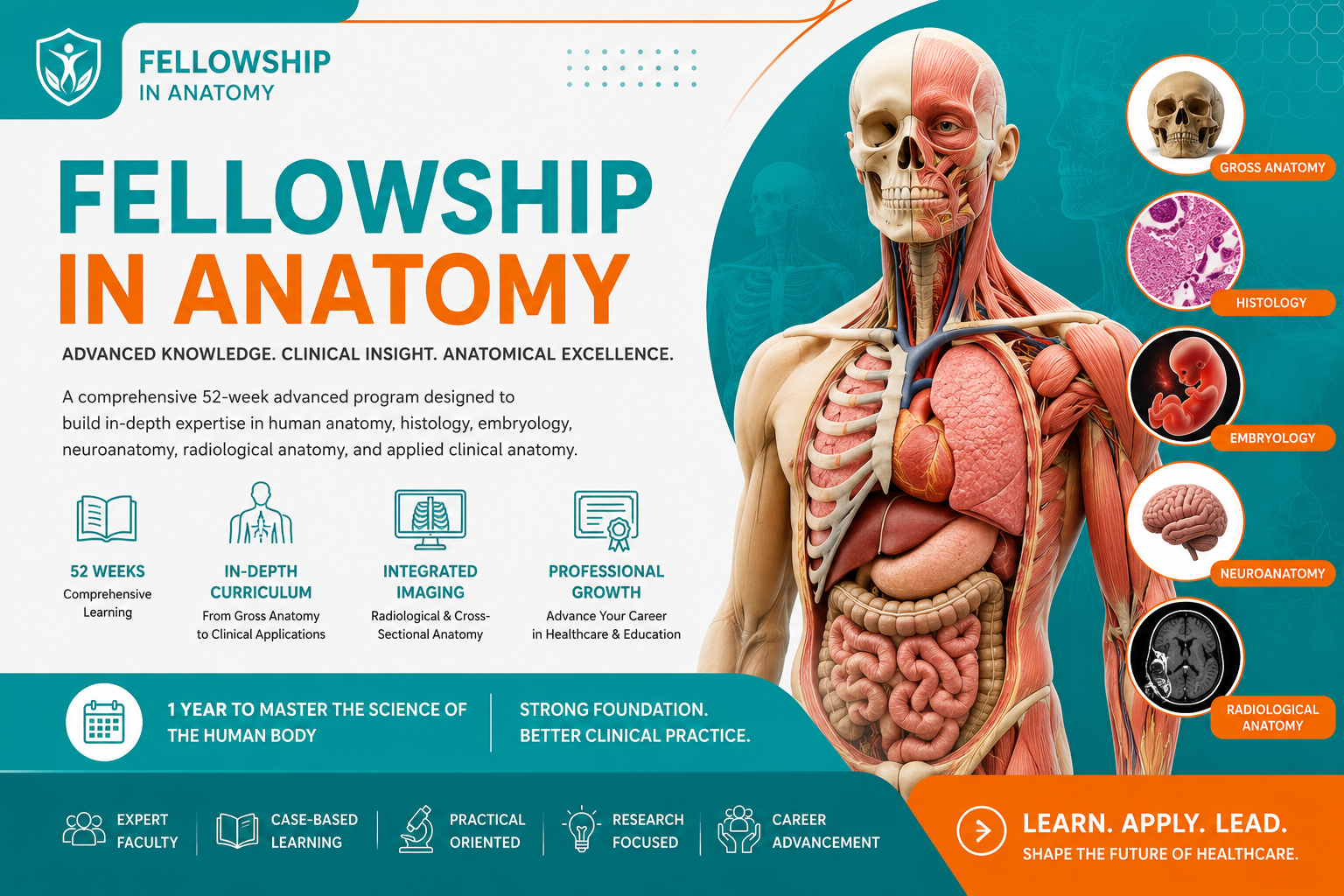

The Fellowship in Anatomy is a comprehensive 52-week advanced training program designed to provide healthcare professionals, medical graduates, educators, and researchers with in-depth knowledge of human anatomical sciences. The program covers gross anatomy, histology, embryology, neuroanatomy, radiological anatomy, and applied clinical anatomy, enabling learners to develop a strong understanding of human body structure and its clinical significance. Through a combination of theoretical learning, case-based discussions, anatomical correlations, and imaging interpretation, participants gain the expertise required for medical education, clinical practice, surgical specialties, and biomedical research. This fellowship bridges foundational anatomical knowledge with modern diagnostic and therapeutic applications, preparing graduates for advanced roles in healthcare and academic settings.
The Fellowship in Anatomy is a comprehensive 52-week advanced academic and professional training program designed to provide an in-depth understanding of human anatomical sciences and their application in modern healthcare, medical education, research, and clinical practice. This fellowship is ideal for medical graduates, healthcare professionals, anatomy educators, researchers, physiotherapists, nurses, allied health practitioners, and individuals seeking specialized expertise in the structure and organization of the human body. As anatomy forms the foundation of all medical sciences, a thorough understanding of anatomical principles is essential for accurate diagnosis, effective treatment planning, surgical interventions, and healthcare education.
The program offers a systematic and detailed exploration of human anatomy, beginning with fundamental anatomical concepts and progressing to advanced topics in gross anatomy, microscopic anatomy, developmental anatomy, neuroanatomy, radiological anatomy, and clinical anatomy. Participants gain a comprehensive understanding of the structure, relationships, and functions of organs, tissues, and body systems while developing the ability to correlate anatomical knowledge with clinical and diagnostic applications.
Throughout the fellowship, learners study the musculoskeletal system in detail, including the anatomy of bones, joints, muscles, ligaments, and connective tissues. The curriculum emphasizes the anatomical basis of movement, posture, biomechanics, and musculoskeletal disorders, helping learners understand how structural abnormalities contribute to disease and injury. Detailed modules on the upper limb, lower limb, thorax, abdomen, pelvis, perineum, head, and neck provide a region-based approach to mastering human anatomy.
A significant component of the program focuses on histology and cell biology, enabling participants to understand the microscopic organization of tissues and organs. Learners explore cellular structures, tissue classification, tissue function, and histopathological changes associated with disease. This knowledge serves as a critical bridge between basic anatomical sciences and clinical medicine.
The fellowship also provides extensive training in embryology and developmental anatomy, covering human development from fertilization through fetal growth and organ formation. Participants examine developmental processes, congenital anomalies, and birth defects, gaining valuable insights into how developmental changes influence adult anatomy and clinical outcomes. Understanding embryological development helps healthcare professionals recognize and manage developmental abnormalities more effectively.
Advanced instruction in neuroanatomy allows learners to study the structure and organization of the central and peripheral nervous systems. Topics include the spinal cord, brainstem, cerebellum, cerebral cortex, cranial nerves, neural pathways, and autonomic nervous system. Students develop the ability to correlate neuroanatomical structures with neurological disorders, clinical symptoms, and diagnostic findings, enhancing their understanding of neurological diseases and patient care.
The program places strong emphasis on radiological and cross-sectional anatomy, which has become increasingly important in contemporary medical practice. Learners gain experience interpreting anatomical structures through imaging modalities such as X-rays, computed tomography (CT), magnetic resonance imaging (MRI), and ultrasound. By integrating anatomy with diagnostic imaging, participants improve their ability to recognize normal anatomical structures, identify abnormalities, and support clinical decision-making.
A unique feature of the fellowship is its focus on applied and clinical anatomy. Students explore the anatomical basis of common medical conditions, surgical procedures, trauma management, minimally invasive interventions, and diagnostic techniques. Through case-based learning and clinical correlations, participants learn how anatomical knowledge directly influences patient assessment, treatment planning, and surgical outcomes. This practical approach ensures that learners can translate theoretical knowledge into real-world healthcare applications.
The fellowship also introduces learners to surface anatomy, anatomical landmarks, anatomical variations, and surgical anatomy, enabling them to understand important structures encountered during physical examinations and surgical procedures. Knowledge of anatomical variations is particularly valuable for healthcare professionals involved in diagnostic imaging, surgery, emergency medicine, and clinical practice.
In addition to scientific knowledge, the program develops critical skills in research methodology, academic writing, evidence-based practice, and anatomical education. Participants learn how anatomy contributes to medical innovation, biomedical research, healthcare technology, and interdisciplinary clinical care. The curriculum encourages analytical thinking, lifelong learning, and professional development, preparing graduates to contribute effectively to healthcare institutions, universities, research centers, and clinical environments.
Upon successful completion of the Fellowship in Anatomy, graduates possess advanced expertise in human anatomical sciences and their clinical applications. They are well-equipped to pursue careers in medical education, anatomy instruction, clinical research, healthcare training, diagnostic sciences, surgical support specialties, and allied healthcare professions. The fellowship also serves as a valuable academic credential for professionals seeking to enhance their qualifications and deepen their understanding of one of the most fundamental disciplines in medicine.
By combining foundational anatomical principles with modern clinical relevance, imaging interpretation, developmental sciences, and applied medical knowledge, the Fellowship in Anatomy provides a rigorous and comprehensive learning experience that prepares participants to excel in both academic and healthcare settings. This program represents an ideal pathway for professionals committed to advancing their expertise in anatomy and contributing to excellence in medical science and patient care.
- 12 Sections
- 96 Lessons
- 52 Weeks
- Foundations of Human AnatomyThis module introduces learners to the fundamental concepts of human anatomy, including anatomical terminology, body organization, anatomical planes, body systems, and the relationship between structure and function. Students develop a strong foundation for understanding human body architecture and gain familiarity with anatomical methods, imaging techniques, and ethical considerations in anatomical sciences.8
- Cell Biology and HistologyThis module explores the microscopic organization of the human body. Learners study cellular structures, tissue types, histological techniques, and the relationship between microscopic anatomy and physiological functions. The module builds a foundation for understanding tissue pathology and organ structure.8
- Embryology and Developmental AnatomyThis module examines human development from fertilization through fetal growth. Students learn the stages of embryonic development, organogenesis, congenital anomalies, and developmental processes that influence adult anatomy.8
- Musculoskeletal Anatomy – Upper LimbThis module provides an in-depth study of the bones, joints, muscles, nerves, and vascular structures of the upper limb. Clinical correlations help learners understand injuries, movement disorders, and surgical anatomy.8
- Musculoskeletal Anatomy – Lower LimbThis module focuses on the anatomical structures of the lower limb and their role in locomotion and posture. Students gain detailed knowledge of musculoskeletal relationships and common clinical conditions affecting the lower extremities.8
- Anatomy of the ThoraxThis module examines the anatomy of the thoracic cavity, including the heart, lungs, mediastinum, thoracic wall, and major vessels. Learners understand structural relationships essential for cardiopulmonary medicine and surgery.8
- Anatomy of the AbdomenThis module provides a detailed study of abdominal structures, digestive organs, vascular supply, lymphatics, and peritoneal relationships. Clinical applications include abdominal examinations and surgical approaches.8
- Anatomy of the Pelvis and PerineumThis module focuses on the complex anatomy of the pelvic cavity and perineum. Learners study reproductive organs, urinary structures, pelvic floor anatomy, and clinically significant anatomical relationships.8
- Head and Neck AnatomyThis module covers the intricate anatomy of the head and neck, including cranial structures, sensory organs, facial muscles, glands, blood vessels, and nerves. Special emphasis is placed on clinically relevant anatomy.8
- NeuroanatomyThis module provides comprehensive knowledge of the central and peripheral nervous systems. Students study brain structures, spinal cord anatomy, neural pathways, and neuroanatomical correlations in neurological disorders.8
- Cross-Sectional and Radiological AnatomyThis module integrates anatomy with modern diagnostic imaging. Learners develop skills in interpreting anatomical structures through radiographs, CT scans, MRI, ultrasound, and cross-sectional imaging.8
- Applied and Surgical AnatomyThis advanced module bridges anatomical knowledge with clinical practice. Students learn surgical landmarks, anatomical variations, procedural anatomy, cadaveric correlations, and applications in modern medicine, surgery, and research.8
You might be intersted in
-
167 Students
-
52 Weeks
-
124 Students
-
52 Weeks
-
133 Students
-
52 Weeks
-
123 Students
-
52 Weeks