
Fellowship In ENT
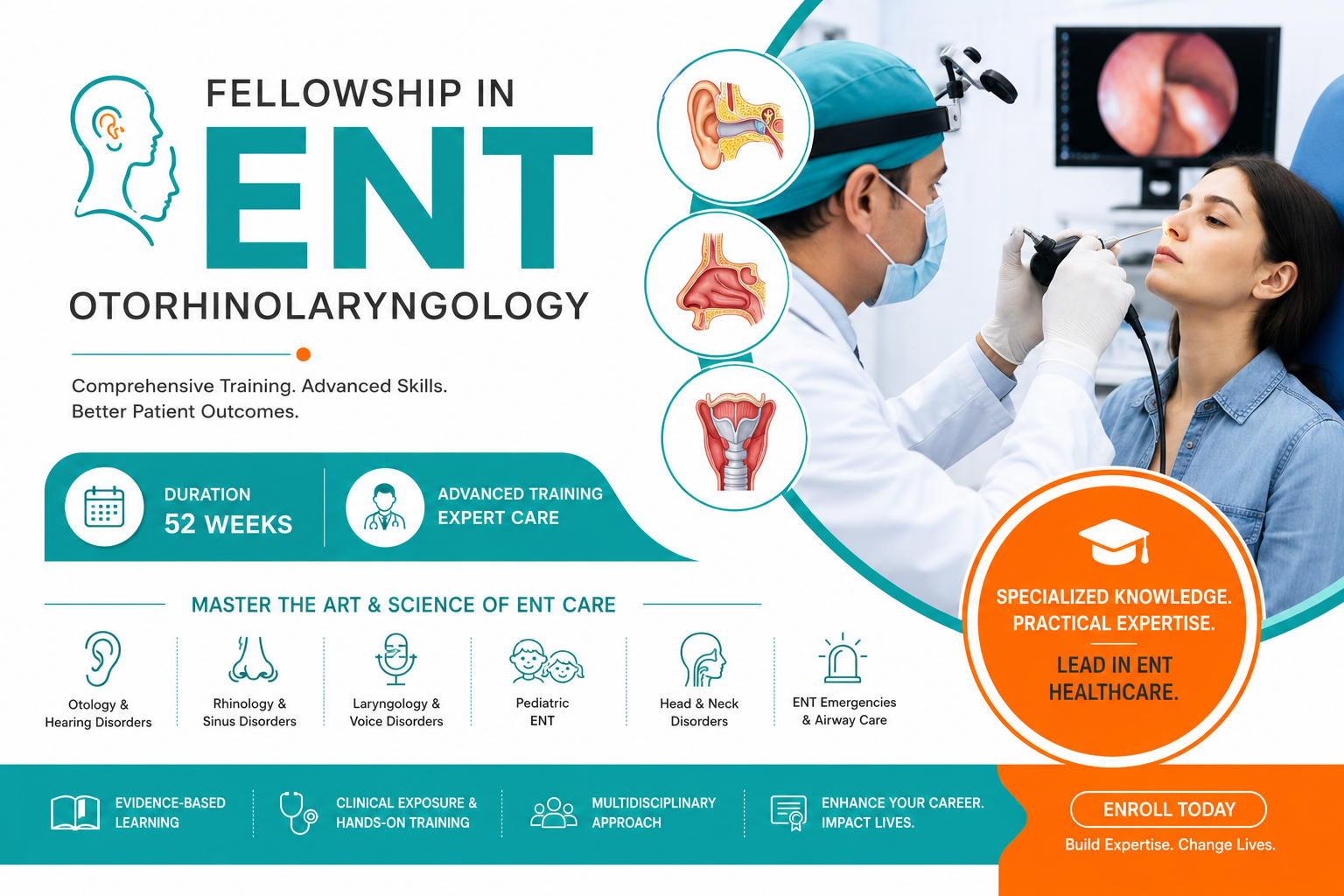

The Fellowship in ENT (Otorhinolaryngology) is a comprehensive 52-week advanced training program designed for healthcare professionals seeking specialized expertise in the diagnosis, treatment, and management of disorders affecting the ear, nose, throat, head, and neck. The program covers otology, rhinology, laryngology, pediatric ENT, head and neck diseases, sleep medicine, ENT emergencies, surgical principles, and evidence-based clinical practice. Through a combination of theoretical learning, clinical case discussions, diagnostic training, and hands-on exposure, participants develop the knowledge and skills required to deliver high-quality ENT care in diverse healthcare settings.
The Fellowship in ENT (Otorhinolaryngology) is a comprehensive 52-week advanced training program designed for physicians, medical graduates, and healthcare professionals who wish to develop specialized knowledge and clinical expertise in the diagnosis, treatment, and management of disorders affecting the ear, nose, throat, head, and neck. As ENT disorders continue to contribute significantly to global healthcare needs, there is an increasing demand for professionals trained in modern otorhinolaryngological practice, advanced diagnostics, and patient-centered care.
This fellowship provides an in-depth understanding of the anatomy, physiology, pathology, and clinical management of conditions affecting the auditory, respiratory, vestibular, and upper digestive systems. Participants will gain extensive knowledge of common and complex ENT disorders, including hearing loss, chronic ear infections, sinus diseases, allergic rhinitis, voice disorders, airway abnormalities, sleep-related breathing disorders, and head and neck pathologies. The curriculum is designed to bridge the gap between theoretical learning and practical clinical application, ensuring graduates are prepared to deliver high-quality ENT care in diverse healthcare environments.
Throughout the program, learners will explore the major subspecialties of ENT, including Otology, Rhinology, Laryngology, Pediatric ENT, Head and Neck Disorders, Sleep Medicine, and ENT Emergencies. The course emphasizes evidence-based clinical practice and integrates the latest advances in diagnostic technologies, endoscopic procedures, audiological assessment, imaging interpretation, and surgical principles. Participants will develop the skills required to accurately evaluate patients, formulate differential diagnoses, and implement effective treatment plans.
A key component of the fellowship is the study of otology and hearing sciences, where participants gain expertise in diagnosing and managing hearing loss, tinnitus, vertigo, vestibular disorders, otitis media, cholesteatoma, and other ear-related conditions. Learners will understand the role of audiometry, tympanometry, hearing aids, cochlear implants, and vestibular testing in comprehensive patient assessment and management.
The fellowship also provides extensive training in rhinology and sinus disorders, focusing on conditions such as allergic rhinitis, chronic rhinosinusitis, nasal polyps, epistaxis, and structural nasal abnormalities. Participants will learn the principles of nasal endoscopy, sinus imaging, and contemporary medical and surgical treatment approaches, including the fundamentals of Functional Endoscopic Sinus Surgery (FESS).
In the area of laryngology and voice disorders, learners will study diseases affecting the larynx, vocal cords, and airway. The program covers voice assessment, hoarseness evaluation, vocal cord lesions, airway obstruction, laryngopharyngeal reflux, and rehabilitation strategies aimed at restoring optimal vocal function and quality of life.
Recognizing the unique challenges of pediatric care, the fellowship includes dedicated training in Pediatric ENT, enabling participants to diagnose and manage common childhood ENT conditions such as recurrent ear infections, tonsillar and adenoidal disease, congenital anomalies, airway disorders, and pediatric hearing impairment. Special attention is given to age-specific assessment techniques and family-centered care approaches.
The curriculum further explores head and neck disorders, including salivary gland diseases, thyroid-related conditions, oral lesions, neck masses, and head and neck cancers. Participants will learn diagnostic pathways, staging systems, multidisciplinary treatment planning, and long-term patient management strategies. Understanding the role of collaborative care among surgeons, oncologists, radiologists, and rehabilitation specialists is emphasized throughout the program.
Given the growing prevalence of sleep-related breathing disorders, the fellowship provides comprehensive instruction in sleep medicine and airway management. Participants will learn to evaluate and manage conditions such as obstructive sleep apnea, snoring, and upper airway obstruction using both medical and surgical treatment options. Training includes the interpretation of sleep studies and the integration of multidisciplinary treatment approaches.
The program also addresses the management of ENT emergencies and trauma, preparing participants to respond effectively to urgent clinical situations. Learners will develop competencies in airway stabilization, epistaxis control, foreign body removal, facial trauma assessment, acute hearing loss management, and the treatment of deep neck infections. These skills are essential for ensuring timely intervention and reducing patient morbidity.
In addition to clinical knowledge, participants will gain exposure to the principles of ENT surgery and perioperative care. The fellowship introduces common surgical procedures, operating room protocols, patient safety standards, infection prevention measures, and postoperative management. This foundation enables learners to understand surgical indications, assist in procedures, and contribute effectively to multidisciplinary surgical teams.
Research and evidence-based practice are integral components of the fellowship. Participants will learn how to critically appraise scientific literature, conduct clinical audits, apply research findings to patient care, and engage in quality improvement initiatives. These skills foster lifelong learning and support the delivery of safe, effective, and up-to-date healthcare services.
Upon successful completion of the Fellowship in ENT, graduates will possess advanced competencies in ENT assessment, diagnosis, treatment planning, patient counseling, emergency management, and interdisciplinary collaboration. They will be equipped to work in hospitals, specialty clinics, academic institutions, community healthcare settings, and surgical centers, contributing to improved patient outcomes and the advancement of ENT healthcare services.
This fellowship serves as an excellent opportunity for healthcare professionals seeking to expand their clinical expertise, enhance career prospects, and become leaders in the field of Otorhinolaryngology through comprehensive, evidence-based, and patient-focused training.
- 12 Sections
- 86 Lessons
- 52 Weeks
- Foundations of ENT and Head & Neck AnatomyThis module introduces learners to the fundamental principles of Otorhinolaryngology (ENT), including the anatomy, physiology, and functions of the ear, nose, throat, and head and neck structures. Participants will gain a strong foundation in ENT terminology, clinical examination techniques, and diagnostic approaches essential for specialized practice.7
- Diagnostic Methods in ENTThis module focuses on the diagnostic tools and technologies used in ENT practice. Learners will develop skills in interpreting audiological tests, imaging studies, endoscopic findings, and laboratory investigations to accurately diagnose ENT disorders.7
- Otology and Hearing DisordersThis module covers diseases and disorders affecting the ear and auditory system. Participants will learn to diagnose and manage hearing loss, infections, balance disorders, and other common otological conditions using evidence-based approaches.9
- 3.1External Ear Disorders
- 3.2Acute and Chronic Otitis Media
- 3.3Acute and Chronic Otitis Media
- 3.4External Ear Disorders
- 3.5Vertigo and Vestibular Disorders
- 3.6Tinnitus Evaluation and Management
- 3.7Hearing Loss: Conductive and Sensorineural
- 3.8Otosclerosis and Cholesteatoma
- 3.9Cochlear Implants and Hearing Aids
- Rhinology and Sinus DisordersThis module explores diseases of the nose and paranasal sinuses. Learners will gain expertise in diagnosing and managing allergic, inflammatory, infectious, and structural nasal conditions that affect breathing and quality of life.7
- Laryngology and Voice DisordersThis module focuses on disorders affecting the larynx, vocal cords, and voice production. Participants will understand the causes, evaluation, and management of voice abnormalities and airway-related conditions.7
- Pediatric ENTThis module addresses ENT conditions commonly encountered in infants, children, and adolescents. Learners will develop competencies in pediatric assessment and management strategies while understanding developmental considerations.7
- Head and Neck DisordersThis module provides comprehensive knowledge of benign and malignant diseases affecting the head and neck region. Learners will study diagnostic pathways, staging, and multidisciplinary management approaches.7
- Sleep Medicine and Airway DisordersThis module examines sleep-related breathing disorders and upper airway conditions. Participants will learn diagnostic methods and treatment strategies for obstructive and functional airway diseases.7
- ENT Emergencies and TraumaThis module prepares learners to manage urgent ENT conditions and traumatic injuries. Emphasis is placed on rapid assessment, stabilization, and emergency interventions to prevent complications.7
- ENT Surgical Principles and ProceduresThis module introduces the principles of ENT surgery, operating room protocols, surgical instrumentation, and perioperative patient care. Learners will understand common ENT procedures and postoperative management.7
- Research, Evidence-Based Practice, and Clinical GovernanceThis module develops research literacy and evidence-based decision-making skills. Participants will learn to critically evaluate scientific literature, conduct clinical audits, and contribute to quality improvement initiatives.7
- Advanced Clinical Training and Fellowship ProjectThe final module integrates theoretical knowledge and clinical skills through supervised practice, case discussions, and a capstone project. Learners will demonstrate competency in comprehensive ENT patient management and professional practice.7
You might be intersted in
-
167 Students
-
52 Weeks
-
132 Students
-
52 Weeks
-
133 Students
-
52 Weeks
-
123 Students
-
52 Weeks