
Fellowship In Paediatric care Nursing
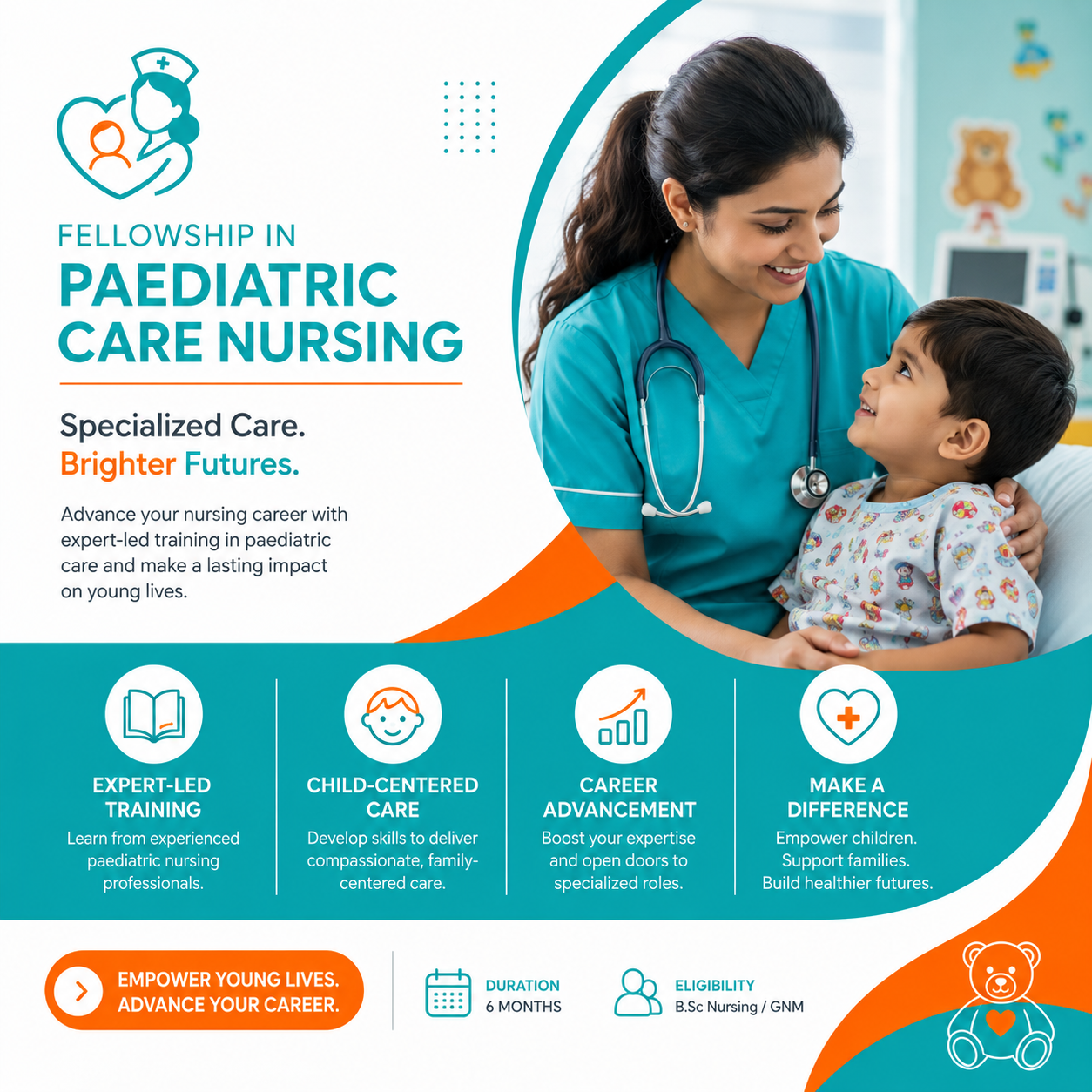

The Fellowship in Paediatric Care Nursing is a comprehensive 52-week advanced nursing program designed to equip healthcare professionals with specialized knowledge and clinical skills in child healthcare. The course covers paediatric assessment, neonatal care, emergency and critical care nursing, infectious diseases, chronic illness management, mental health, family-centered care, and community paediatrics. Through a blend of theoretical learning, hands-on clinical training, and a capstone project, participants develop the expertise required to provide safe, evidence-based, and compassionate nursing care for infants, children, and adolescents across diverse healthcare settings.
Course Overview
The Fellowship in Paediatric Care Nursing is a comprehensive 52-week advanced training program designed for registered nurses and healthcare professionals seeking specialized expertise in the care of infants, children, and adolescents. The program combines evidence-based theoretical knowledge with hands-on clinical training to prepare nurses for the unique challenges of paediatric healthcare across hospitals, clinics, neonatal units, emergency departments, intensive care units, and community settings.
Children require specialized nursing care due to their distinct physiological, developmental, emotional, and psychological needs. This fellowship equips participants with the skills required to assess, manage, and support paediatric patients throughout various stages of growth and development. Learners gain proficiency in child health assessment, neonatal care, emergency interventions, critical care management, medication administration, family-centered care, and health promotion strategies.
The curriculum emphasizes holistic patient care, ensuring that nurses can provide compassionate, safe, and culturally sensitive care while collaborating effectively with multidisciplinary healthcare teams. Through supervised clinical rotations and practical exposure, participants develop confidence in handling both routine and complex paediatric cases.
Course Objectives
Upon successful completion of the fellowship, participants will be able to:
- Apply advanced principles of paediatric nursing in diverse healthcare settings.
- Conduct comprehensive physical, developmental, and psychosocial assessments of children.
- Deliver evidence-based nursing care for neonates, infants, children, and adolescents.
- Manage common and complex paediatric medical and surgical conditions.
- Provide safe medication administration using paediatric dosage calculations.
- Recognize and respond effectively to paediatric emergencies and critical illnesses.
- Support children and families through education, counseling, and advocacy.
- Implement infection prevention and immunization practices.
- Collaborate with multidisciplinary healthcare teams to optimize patient outcomes.
- Utilize research and evidence-based practice to improve quality of care.
Key Learning Areas
Foundations of Paediatric Nursing
Participants develop a strong understanding of paediatric nursing principles, ethical and legal responsibilities, family-centered care, communication strategies, and professional nursing standards required for child healthcare.
Child Growth and Development
The fellowship explores physical, cognitive, emotional, and psychosocial development from infancy through adolescence. Learners gain expertise in developmental assessment and age-appropriate nursing interventions.
Neonatal and Infant Care
Students learn essential newborn care, neonatal assessment, breastfeeding support, care of premature infants, neonatal nutrition, and management of common neonatal disorders.
Paediatric Health Assessment
Comprehensive assessment skills are developed through training in history taking, physical examination, developmental screening, growth monitoring, pain assessment, and identification of abnormal findings.
Paediatric Medical-Surgical Nursing
The program covers the nursing management of respiratory, cardiovascular, gastrointestinal, neurological, endocrine, renal, and dermatological conditions affecting children.
Paediatric Pharmacology
Participants learn safe medication administration practices, dosage calculations, vaccine management, adverse drug reaction monitoring, and medication safety protocols specific to paediatric patients.
Infectious Diseases and Immunization
Learners gain knowledge of childhood infections, immunization schedules, vaccine administration techniques, infection prevention strategies, and public health initiatives.
Emergency and Critical Care Nursing
Specialized training is provided in paediatric emergency assessment, airway management, shock management, trauma care, resuscitation, poisoning management, and life-saving interventions.
Paediatric Intensive Care Nursing
Students are introduced to advanced critical care concepts including mechanical ventilation, hemodynamic monitoring, fluid management, sedation, pain control, and multidisciplinary critical care approaches.
Chronic Disease Management
The fellowship addresses long-term care of children with asthma, diabetes, congenital disorders, developmental disabilities, and other chronic health conditions requiring ongoing support.
Paediatric Mental Health Nursing
Participants learn to recognize and manage mental health challenges including anxiety, depression, ADHD, autism spectrum disorders, and behavioral concerns in children and adolescents.
Community and Family Health
The course emphasizes health promotion, disease prevention, school health programs, parent education, child advocacy, and community-based paediatric care services.
Research and Leadership
Learners develop competencies in evidence-based practice, quality improvement initiatives, nursing leadership, clinical audits, and professional development.
Clinical Training and Practicum
A major strength of the fellowship is its extensive clinical training component. Participants gain supervised practical experience in:
- Paediatric Wards
- Neonatal Care Units
- Paediatric Intensive Care Units (PICU)
- Emergency and Trauma Departments
- Outpatient Paediatric Clinics
- Community Health Centers
- Immunization Clinics
- Specialized Child Health Services
Clinical rotations allow learners to apply theoretical concepts to real-world patient care while developing critical thinking, communication, and clinical decision-making skills.
Capstone Project
During the final phase of the fellowship, participants complete a capstone project focused on improving paediatric healthcare outcomes. This project encourages the application of evidence-based practice, research methodology, and quality improvement principles to address current challenges in child healthcare.
Career Opportunities
Graduates of the Fellowship in Paediatric Care Nursing can pursue rewarding career opportunities in:
- Paediatric Hospitals
- Children’s Specialty Hospitals
- Neonatal Intensive Care Units (NICU)
- Paediatric Intensive Care Units (PICU)
- Emergency and Trauma Centers
- General Hospitals
- Community Health Organizations
- School Health Services
- Child Development Centers
- Home Healthcare Services
- Rehabilitation Facilities
- Academic and Training Institutions
Potential job roles include:
- Paediatric Staff Nurse
- Paediatric Critical Care Nurse
- Neonatal Nurse
- Child Health Nurse Specialist
- Paediatric Emergency Nurse
- Community Child Health Nurse
- School Health Nurse
- Clinical Nurse Educator
- Nursing Supervisor
- Paediatric Care Coordinator
Who Should Enroll?
This fellowship is ideal for:
- Registered Nurses (RN)
- B.Sc. Nursing Graduates
- GNM Graduates
- Nursing Professionals Seeking Specialization
- Critical Care Nurses
- Neonatal Nurses
- Healthcare Professionals Involved in Child Health Services
- Nurses Seeking Career Advancement in Paediatric Healthcare
Why Choose This Fellowship?
- Comprehensive 52-week curriculum
- Advanced paediatric nursing specialization
- Strong emphasis on clinical competency
- Hands-on practical training and case-based learning
- Exposure to neonatal, emergency, and critical care settings
- Focus on family-centered and child-friendly care
- Evidence-based and industry-relevant content
- Research and leadership development opportunities
- Enhanced employability in specialized paediatric healthcare roles
- Preparation for advanced nursing practice and career progression
The Fellowship in Paediatric Care Nursing prepares nurses to deliver high-quality, compassionate, and evidence-based care to children across the healthcare continuum. By integrating advanced clinical knowledge, practical experience, and professional development, this program develops skilled paediatric nursing professionals capable of making a meaningful impact on child health outcomes and family well-being.
- 16 Sections
- 112 Lessons
- 52 Weeks
- Foundations of Paediatric Care NursingThis module introduces learners to the principles of paediatric nursing, child growth and development, family-centered care, ethical considerations, legal responsibilities, and communication strategies. Students will gain a strong foundation in understanding the unique healthcare needs of infants, children, and adolescents while developing professional nursing competencies required in paediatric settings.7
- Paediatric Anatomy, Physiology and DevelopmentThis module focuses on the anatomical and physiological differences between children and adults. Learners will understand developmental milestones, age-specific health assessments, and physiological changes from infancy through adolescence to support safe and effective nursing care.7
- Comprehensive Paediatric AssessmentStudents will learn systematic approaches to paediatric health assessment, including history taking, physical examination, developmental evaluation, and recognition of abnormal findings. Emphasis is placed on age-appropriate assessment techniques.7
- Neonatal and Infant CareThis module provides comprehensive knowledge of neonatal nursing, newborn assessment, infant care, breastfeeding support, and management of common neonatal conditions. Learners will develop skills required to care for healthy and high-risk newborns.7
- Paediatric Nutrition and Growth ManagementThis module explores nutritional requirements in children, nutritional assessment, feeding practices, growth monitoring, and management of malnutrition. Learners will understand the role of nutrition in child health and disease prevention.7
- Common Paediatric Medical ConditionsStudents will gain knowledge of common childhood illnesses affecting various body systems. The module emphasizes assessment, nursing management, patient education, and evidence-based interventions.7
- Paediatric Pharmacology and Medication SafetyThis module covers principles of paediatric pharmacology, safe medication administration, dosage calculations, adverse drug reactions, and medication error prevention in children.7
- Paediatric Infectious Diseases and ImmunizationLearners will study common infectious diseases in children, infection prevention measures, immunization schedules, outbreak management, and public health approaches to disease prevention.7
- Emergency and Critical Paediatric NursingThis module equips nurses with the skills required to identify and manage paediatric emergencies. Learners will develop competence in rapid assessment, stabilization, and emergency interventions.7
- Paediatric Intensive Care NursingThis module focuses on caring for critically ill children requiring intensive monitoring and advanced nursing interventions. Students will learn critical care principles and multidisciplinary collaboration.7
- Paediatric Surgical NursingStudents will learn perioperative nursing care for paediatric surgical patients, including preoperative preparation, postoperative monitoring, pain management, and family education.7
- Chronic Illness and Special Needs CareThis module addresses long-term management of children with chronic illnesses and special healthcare needs. Learners will understand rehabilitation, home care support, and multidisciplinary coordination.7
- Paediatric Mental Health NursingThis module focuses on emotional, behavioral, and psychological health in children and adolescents. Students will learn assessment techniques and therapeutic nursing interventions.7
- Family Education and Community Paediatric NursingLearners will develop skills in health education, community outreach, disease prevention, and family support. The module emphasizes holistic child healthcare across community settings.7
- Research, Leadership and Quality Improvement in Paediatric NursingThis module prepares nurses to participate in research, clinical audits, leadership activities, and quality improvement initiatives. Learners will strengthen evidence-based practice and professional development skills.7
- Clinical Practicum and Capstone ProjectThe final module integrates theoretical knowledge with supervised clinical practice. Students will complete rotations in paediatric units, demonstrate competency in patient care, and undertake a capstone project addressing a paediatric healthcare challenge.7
You might be intersted in
-
133 Students
-
52 Weeks
-
123 Students
-
52 Weeks
-
142 Students
-
52 Weeks
-
126 Students
-
52 Weeks