
Diploma in Digital health
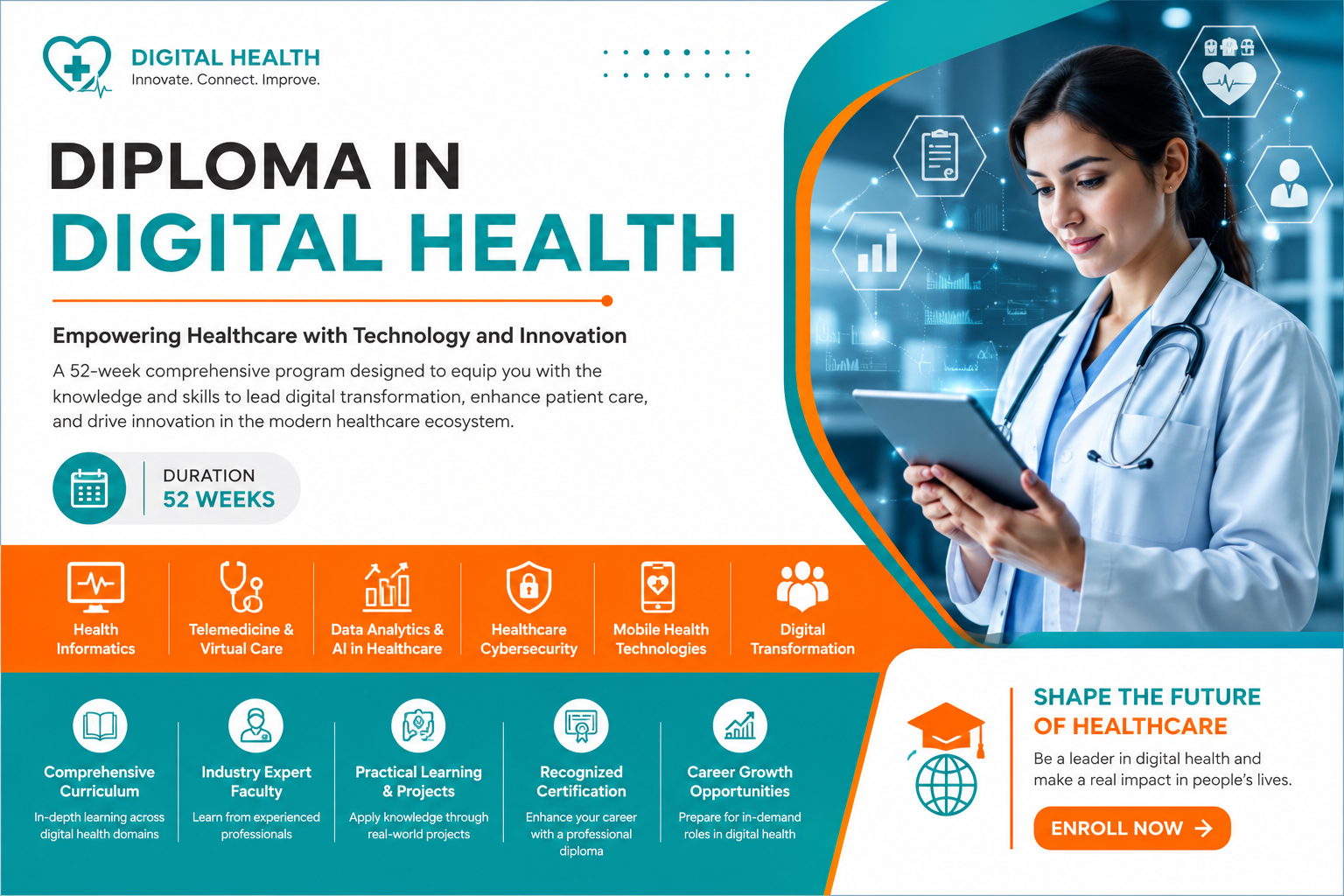
The Diploma in Digital Health is a comprehensive 52-week program designed to equip healthcare professionals with the knowledge and skills needed to navigate the digital transformation of healthcare. The curriculum covers health information systems, electronic health records, telemedicine, healthcare analytics, artificial intelligence, cybersecurity, interoperability, public health informatics, and emerging healthcare technologies. Through practical learning and a capstone project, participants gain expertise in implementing, managing, and evaluating digital health solutions that improve patient care, operational efficiency, and healthcare outcomes in modern healthcare settings.
The Diploma in Digital Health is a comprehensive 52-week professional program designed to prepare healthcare professionals, administrators, IT specialists, and public health practitioners for the rapidly evolving digital healthcare landscape. As healthcare systems worldwide increasingly adopt advanced technologies to improve patient care, operational efficiency, and health outcomes, professionals with expertise in digital health have become essential to modern healthcare organizations.
This program provides an in-depth understanding of how digital technologies are transforming healthcare delivery, clinical decision-making, patient engagement, and population health management. Participants will explore the foundations of digital health, health information systems, electronic health records, telemedicine, healthcare analytics, artificial intelligence, mobile health technologies, cybersecurity, interoperability, and digital health governance. The curriculum is structured to combine theoretical knowledge with practical applications, ensuring learners develop the competencies required to implement and manage technology-driven healthcare solutions.
Throughout the course, participants will gain expertise in electronic health record systems, digital documentation practices, telehealth services, and healthcare data management. They will learn how healthcare organizations use digital platforms to streamline workflows, improve communication, enhance patient safety, and support evidence-based clinical decisions. The program also introduces learners to emerging technologies such as artificial intelligence, machine learning, blockchain, wearable devices, Internet of Medical Things (IoMT), and precision medicine, providing valuable insights into the future of healthcare innovation.
A significant focus of the diploma is healthcare data analytics. Participants will learn to collect, analyze, interpret, and visualize healthcare data to support quality improvement initiatives and strategic decision-making. They will develop an understanding of predictive analytics, population health management, and clinical decision support systems, enabling them to contribute to data-driven healthcare environments. The program also emphasizes the importance of cybersecurity and privacy protection, equipping learners with the knowledge necessary to safeguard sensitive health information and ensure regulatory compliance.
The curriculum explores digital health governance, ethical considerations, and legal frameworks that guide the implementation and use of healthcare technologies. Participants will examine topics such as patient consent, responsible data usage, digital equity, and ethical challenges associated with artificial intelligence and health data management. These discussions prepare graduates to make informed decisions that balance innovation with patient rights and professional responsibilities.
Public health informatics is another important component of the program. Learners will study how digital tools support disease surveillance, health promotion, outbreak response, and population health initiatives. They will gain an appreciation for the role of digital technologies in addressing global health challenges and improving access to healthcare services across diverse communities.
The diploma also focuses on organizational digital transformation and leadership. Participants will learn strategies for implementing new technologies, managing change within healthcare organizations, and evaluating digital health initiatives. Through case studies and practical exercises, they will develop skills in project planning, stakeholder engagement, technology adoption, and performance measurement. These competencies are increasingly valuable as healthcare institutions continue their digital transformation journeys.
One of the highlights of the program is the capstone project, where participants apply their knowledge to address a real-world healthcare challenge. Under expert guidance, learners will design, develop, and evaluate a digital health solution, demonstrating their ability to integrate technology, clinical knowledge, and management principles. This project provides practical experience and strengthens professional portfolios for career advancement.
The Diploma in Digital Health is suitable for physicians, nurses, allied health professionals, healthcare managers, public health professionals, health informatics specialists, IT professionals working in healthcare, and graduates seeking careers in digital health and healthcare technology. No matter their professional background, participants will benefit from acquiring the interdisciplinary skills required in today’s technology-enabled healthcare environment.
Upon successful completion of the program, graduates will possess a strong foundation in digital health technologies and their application across clinical, administrative, and public health settings. They will be prepared to lead digital transformation initiatives, support healthcare innovation, improve patient outcomes, and contribute to the development of more efficient, accessible, and data-driven healthcare systems.
As digital technologies continue to reshape the future of medicine and healthcare delivery, the Diploma in Digital Health offers a valuable opportunity to gain industry-relevant expertise and become a leader in one of healthcare’s fastest-growing and most impactful fields. This program empowers professionals to bridge the gap between healthcare and technology while driving innovation that enhances the quality, safety, and accessibility of healthcare services worldwide.
- 16 Sections
- 96 Lessons
- 52 Weeks
- Foundations of Digital HealthThis module introduces learners to the rapidly evolving field of digital health, covering its history, scope, key concepts, and global impact on healthcare delivery. Participants will gain an understanding of how technology is transforming patient care, healthcare administration, public health, and medical education. The module also explores digital health ecosystems, stakeholders, and emerging trends shaping the future of healthcare.6
- Health Information SystemsThis module focuses on the design, implementation, and management of health information systems used in healthcare organizations. Learners will understand data collection, storage, processing, and reporting mechanisms that support clinical and administrative decision-making. The module highlights interoperability and the role of information systems in improving healthcare quality and efficiency.6
- Electronic Health Records and DocumentationThis module provides comprehensive training on electronic health records, digital documentation standards, and clinical workflows. Learners will explore the benefits, challenges, and regulatory requirements associated with electronic documentation while developing practical skills in maintaining accurate and secure patient records.6
- Telemedicine and Virtual CareThis module examines telemedicine technologies and virtual healthcare delivery models. Participants will learn how remote consultations, telemonitoring, and virtual care platforms improve healthcare access and patient outcomes. Legal, ethical, and operational aspects of telehealth services are also discussed.6
- Healthcare Data AnalyticsThis module introduces healthcare data analytics concepts, enabling learners to interpret clinical and operational data for evidence-based decision-making. Participants will explore analytical tools, performance metrics, and visualization techniques that support healthcare quality improvement initiatives.6
- Artificial Intelligence in HealthcareThis module explores the applications of artificial intelligence, machine learning, and predictive technologies in healthcare. Learners will understand how AI supports diagnostics, treatment planning, workflow optimization, and population health management while examining ethical and practical considerations.6
- Mobile Health (mHealth) TechnologiesThis module focuses on mobile health applications, wearable devices, and digital tools that support patient engagement and self-management. Learners will examine the design, implementation, and evaluation of mHealth solutions across diverse healthcare settings.6
- Digital Health Security and PrivacyThis module provides an in-depth understanding of cybersecurity, privacy regulations, and risk management in digital health environments. Participants will learn strategies to protect sensitive healthcare information and ensure compliance with data protection standards.6
- Digital Health Governance and EthicsThis module examines governance structures, ethical principles, and regulatory frameworks that guide digital health initiatives. Learners will explore responsible technology adoption, patient rights, informed consent, and ethical decision-making in healthcare innovation.6
- Interoperability and Health Data ExchangeThis module focuses on interoperability standards and mechanisms that enable seamless exchange of healthcare information across systems. Participants will understand the importance of data sharing in improving continuity of care and healthcare coordination.6
- Public Health InformaticsThis module explores the use of digital technologies to support public health programs, disease surveillance, and population health management. Learners will examine how informatics contributes to healthcare planning, outbreak response, and health promotion initiatives.6
- Digital Transformation in Healthcare OrganizationsThis module examines organizational strategies for digital transformation in healthcare settings. Participants will learn change management principles, leadership approaches, and implementation frameworks that support successful adoption of digital health solutions.6
- Emerging Technologies in Digital HealthThis module introduces innovative technologies shaping the future of healthcare, including blockchain, Internet of Things (IoT), robotics, augmented reality, and precision medicine. Learners will evaluate their potential impact on healthcare delivery and patient outcomes.6
- Quality Improvement and Patient SafetyThis module focuses on leveraging digital technologies to enhance patient safety, healthcare quality, and clinical outcomes. Learners will explore quality improvement methodologies and digital tools used to monitor and improve healthcare performance.6
- Digital Health Research and InnovationThis module develops learners' abilities to evaluate, design, and conduct digital health research projects. Participants will explore innovation methodologies, research ethics, implementation science, and evidence generation for digital health interventions.6
- Capstone Project and Professional PracticeThe final module integrates knowledge and skills acquired throughout the diploma. Learners will develop a comprehensive digital health project addressing a real-world healthcare challenge. The module also focuses on professional development, leadership, and career pathways in digital health.6
You might be intersted in
-
167 Students
-
52 Weeks
-
133 Students
-
52 Weeks
-
123 Students
-
52 Weeks
-
142 Students
-
52 Weeks