
Fellowship in Pathology
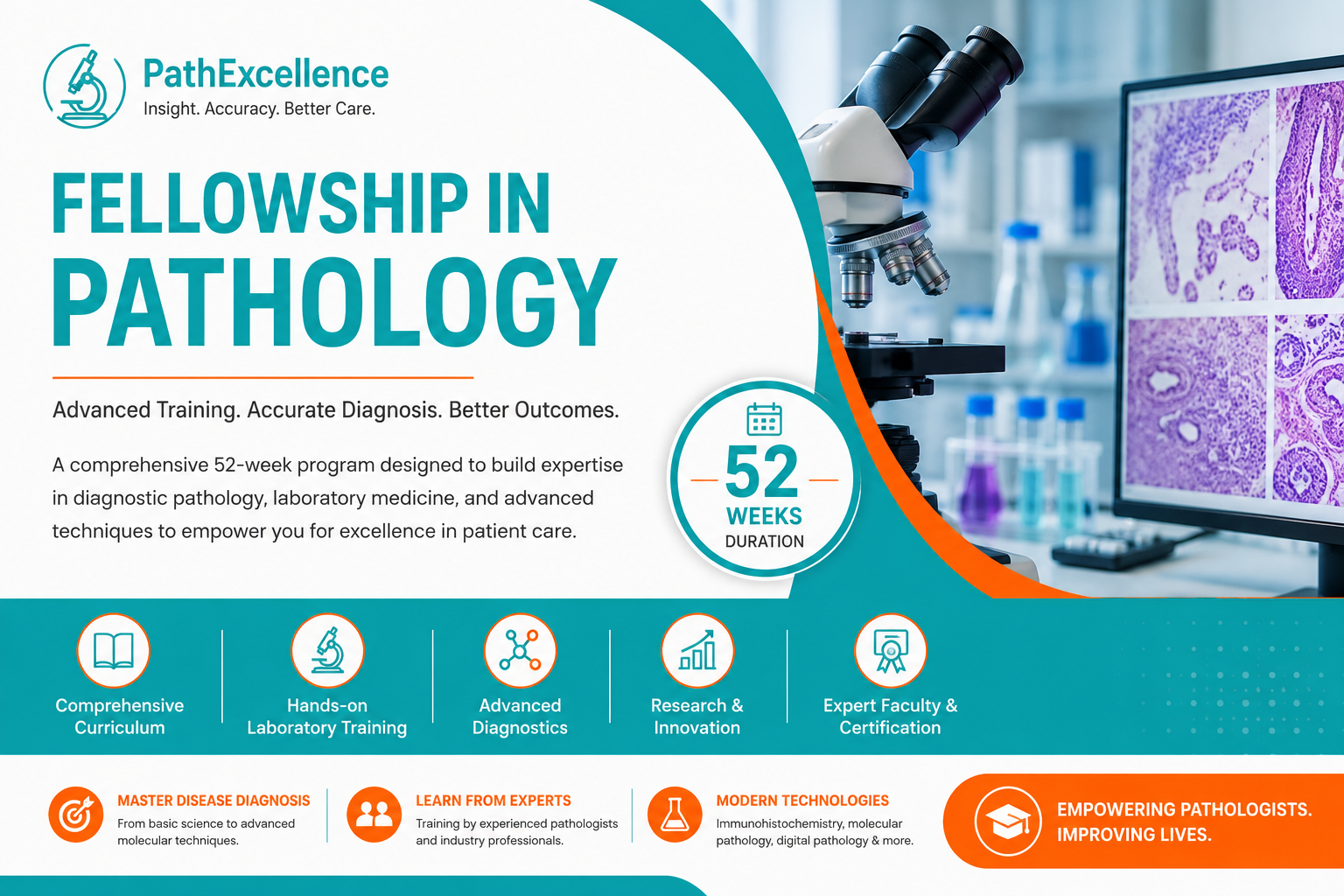

The Fellowship in Pathology is a comprehensive 52-week advanced training program designed for healthcare professionals seeking expertise in diagnostic pathology and laboratory medicine. The curriculum covers general pathology, histopathology, cytopathology, hematopathology, systemic pathology, molecular diagnostics, oncologic pathology, and laboratory management. Through case-based learning, microscopic interpretation, quality assurance practices, and research training, participants develop the knowledge and skills required for accurate disease diagnosis, clinical correlation, and modern pathology practice. This fellowship prepares learners for leadership roles in diagnostic laboratories, academic institutions, hospitals, and specialized pathology services.
The Fellowship in Pathology is a comprehensive 52-week advanced training program designed to equip healthcare professionals with in-depth knowledge and practical expertise in the diagnosis, investigation, and understanding of human diseases. Pathology serves as the foundation of modern medicine by providing critical diagnostic information that guides clinical decision-making, disease management, and patient care. This fellowship offers a structured and evidence-based curriculum that bridges theoretical concepts with real-world diagnostic applications.
The program begins with a strong foundation in general pathology, covering cellular injury, inflammation, tissue repair, genetic disorders, immunopathology, infectious diseases, and molecular mechanisms of disease. Participants gain a thorough understanding of disease pathogenesis and the biological processes that contribute to health and illness. These foundational principles enable learners to accurately interpret pathological changes across various organ systems.
A significant component of the fellowship focuses on histopathology, where learners develop expertise in specimen handling, tissue processing, staining techniques, microscopic examination, and diagnostic reporting. Participants become familiar with routine and special staining methods, frozen section analysis, quality assurance practices, and laboratory safety standards. Training emphasizes the accurate interpretation of tissue morphology and the application of standardized diagnostic criteria.
The curriculum also provides extensive training in cytopathology, including exfoliative cytology, fine-needle aspiration cytology (FNAC), gynecological and non-gynecological cytology, and cancer screening techniques. Learners acquire the skills needed to identify cellular abnormalities, distinguish benign from malignant lesions, and generate clinically relevant cytological reports.
In the area of hematopathology, participants explore disorders of blood, bone marrow, and lymphoid tissues. The program covers anemia, leukemias, lymphomas, coagulation disorders, bone marrow examination, and advanced hematological diagnostics. Emphasis is placed on integrating laboratory findings with clinical information to support accurate diagnosis and treatment planning.
The fellowship offers comprehensive coverage of systemic pathology, including diseases affecting the cardiovascular, respiratory, gastrointestinal, hepatobiliary, renal, endocrine, reproductive, nervous, musculoskeletal, and integumentary systems. Through detailed case studies and microscopic evaluations, learners gain proficiency in recognizing pathological patterns, understanding disease progression, and correlating histological findings with clinical presentations.
Modern pathology increasingly relies on advanced diagnostic technologies, and this program incorporates training in immunohistochemistry, molecular pathology, biomarker analysis, digital pathology, and precision medicine. Participants learn how molecular techniques contribute to disease classification, prognostication, therapeutic decision-making, and personalized patient care. These competencies prepare learners for the evolving landscape of diagnostic medicine.
The fellowship also emphasizes oncologic pathology, providing detailed instruction in tumor biology, cancer grading and staging, tumor classification systems, and contemporary approaches to cancer diagnosis. Learners develop the ability to evaluate neoplastic lesions accurately and contribute effectively to multidisciplinary cancer care teams.
To ensure professional competence beyond diagnostic practice, the curriculum includes modules on research methodology, biostatistics, quality management systems, laboratory accreditation, ethics, legal considerations, and healthcare leadership. Participants gain the skills necessary to conduct scientific research, critically evaluate medical literature, implement quality improvement initiatives, and maintain compliance with international laboratory standards.
Throughout the 52-week program, learners engage in case-based discussions, diagnostic exercises, laboratory training, research activities, and capstone projects that reinforce practical application of knowledge. This integrated learning approach promotes analytical thinking, diagnostic accuracy, and evidence-based decision-making.
Upon successful completion, graduates will be equipped to work in hospitals, diagnostic laboratories, academic institutions, research centers, public health organizations, and specialized pathology services. They will possess advanced competencies in disease diagnosis, laboratory operations, clinical consultation, and modern diagnostic technologies, making them valuable contributors to healthcare systems worldwide.
The Fellowship in Pathology is ideal for medical graduates, pathologists, laboratory physicians, healthcare professionals, and researchers seeking advanced specialization in pathology and laboratory medicine. By combining foundational science, clinical relevance, and cutting-edge diagnostic methodologies, this program prepares participants for excellence in contemporary pathology practice and lifelong professional growth.
- 12 Sections
- 96 Lessons
- 52 Weeks
- Foundations of PathologyThis module introduces the fundamental principles of pathology, including the mechanisms of disease, cellular adaptations, injury, inflammation, healing, and tissue repair. Learners develop a strong understanding of pathological processes that form the basis for diagnostic pathology and laboratory medicine. The module establishes core concepts required for interpreting disease manifestations across organ systems.8
- General Pathology and Disease MechanismsThis module focuses on the molecular and genetic basis of disease, immunopathology, infectious pathology, and environmental influences on health. Participants gain insight into disease pathogenesis and the interaction between host and environmental factors in the development of pathological conditions.8
- Histopathology Techniques and Laboratory PracticeThis module provides comprehensive training in tissue processing, specimen handling, staining techniques, and microscopic evaluation. Learners acquire practical knowledge of laboratory workflows, quality control measures, and safety practices essential for accurate histopathological diagnosis.8
- CytopathologyThis module covers the principles and applications of cytological examination in disease diagnosis. Participants learn specimen preparation, staining methods, interpretation of cytological findings, and screening approaches for benign and malignant conditions.8
- HematopathologyThis module explores disorders of blood, bone marrow, and lymphoid tissues. Learners gain expertise in peripheral smear examination, bone marrow interpretation, hematological malignancies, and laboratory investigations used in hematopathology.8
- Systemic Pathology – Cardiovascular and Respiratory SystemsThis module examines pathological conditions affecting the cardiovascular and respiratory systems. Emphasis is placed on disease mechanisms, microscopic features, diagnostic interpretation, and clinicopathological correlation.8
- Systemic Pathology – Gastrointestinal and Hepatobiliary SystemsThis module covers diseases affecting the gastrointestinal tract, liver, pancreas, and biliary system. Learners study inflammatory, infectious, metabolic, and neoplastic conditions with emphasis on histopathological diagnosis.8
- Systemic Pathology – Renal and Genitourinary SystemsThis module focuses on kidney and urinary tract diseases, including glomerular, tubular, interstitial, and neoplastic conditions. Participants learn diagnostic criteria and pathological evaluation of genitourinary specimens.8
- Systemic Pathology – Endocrine, Breast, and Reproductive SystemsThis module explores diseases of endocrine organs, breast tissue, and male and female reproductive systems. Learners gain skills in identifying common benign and malignant lesions and understanding hormone-related pathologies.8
- Neuropathology, Musculoskeletal, and Skin PathologyThis module covers disorders affecting the nervous system, bones, joints, soft tissues, and skin. Participants learn characteristic histological features and diagnostic approaches for inflammatory, degenerative, and neoplastic conditions.8
- Oncologic Pathology and Advanced Diagnostic TechniquesThis module provides in-depth training in tumor pathology, grading and staging systems, immunohistochemistry, molecular pathology, and emerging diagnostic technologies. Learners develop expertise in modern cancer diagnostics and precision medicine.8
- Research, Quality Management, Ethics, and Capstone ProjectThis final module integrates research methodology, laboratory accreditation standards, ethical considerations, and professional practice. Learners complete a capstone project demonstrating their ability to apply pathology knowledge in clinical and laboratory settings.8
You might be intersted in
-
167 Students
-
52 Weeks
-
132 Students
-
52 Weeks
-
133 Students
-
52 Weeks
-
123 Students
-
52 Weeks