
Fellowship in Microbiology
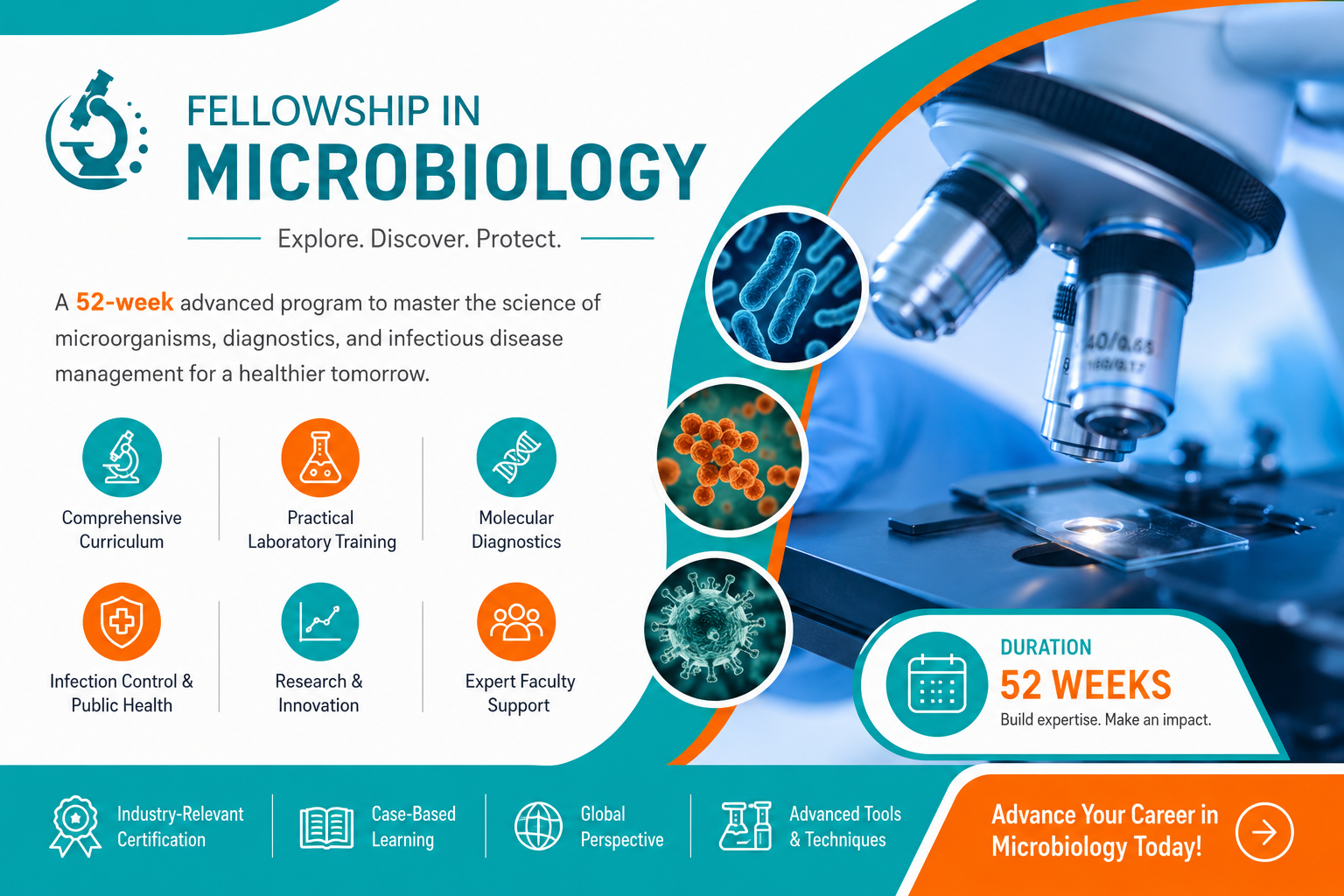

The Fellowship in Microbiology is a comprehensive 52-week advanced training program designed to provide in-depth knowledge of bacteriology, virology, mycology, parasitology, immunology, molecular microbiology, and clinical diagnostics. The course equips healthcare professionals and laboratory scientists with the expertise to identify infectious agents, perform advanced diagnostic procedures, interpret microbiological findings, implement infection control measures, and contribute to research and public health initiatives. Through a combination of theoretical learning, laboratory applications, and a fellowship project, participants develop the competencies required for leadership roles in clinical, academic, and diagnostic microbiology.
The Fellowship in Microbiology is a comprehensive 52-week advanced training program designed for healthcare professionals, laboratory scientists, microbiologists, pathologists, medical graduates, and researchers seeking specialized expertise in the field of microbiology. The program provides an in-depth understanding of microorganisms and their role in human health and disease, while emphasizing modern diagnostic techniques, laboratory practices, infection control strategies, and research methodologies.
Microbiology plays a critical role in diagnosing infectious diseases, monitoring outbreaks, guiding antimicrobial therapy, and supporting public health initiatives. With the increasing emergence of antimicrobial resistance, novel pathogens, and global infectious disease threats, there is a growing demand for highly trained microbiology professionals capable of delivering accurate laboratory diagnoses and contributing to evidence-based healthcare decisions.
This fellowship offers a structured curriculum covering bacteriology, virology, mycology, parasitology, immunology, molecular microbiology, antimicrobial stewardship, epidemiology, and advanced laboratory diagnostics. Participants gain both theoretical knowledge and practical insights into microbiological investigations, specimen processing, microbial identification, molecular testing, and interpretation of laboratory findings.
The program also explores cutting-edge technologies such as polymerase chain reaction (PCR), genomic sequencing, bioinformatics, automation in microbiology laboratories, and molecular diagnostics. Learners develop competencies in laboratory management, quality assurance, biosafety, infection prevention, and outbreak investigation, preparing them for leadership roles in clinical and research settings.
Throughout the fellowship, participants engage in case-based learning, scientific discussions, laboratory applications, and a supervised research project that strengthens their analytical and research skills. By integrating foundational sciences with advanced diagnostic approaches, the course prepares professionals to address contemporary challenges in infectious disease diagnosis and microbiological research.
Key Learning Outcomes
Upon successful completion of the fellowship, participants will be able to:
- Understand the biology, classification, and pathogenic mechanisms of microorganisms.
- Perform and interpret bacteriological, virological, mycological, and parasitological investigations.
- Apply molecular diagnostic techniques for the detection and characterization of infectious agents.
- Evaluate antimicrobial susceptibility and resistance patterns.
- Implement infection prevention and control measures in healthcare settings.
- Conduct laboratory quality assurance and biosafety programs.
- Utilize epidemiological principles in disease surveillance and outbreak investigations.
- Analyze microbiological data using modern research and statistical methods.
- Contribute to antimicrobial stewardship initiatives.
- Design, conduct, and present microbiology research projects.
- Manage and supervise clinical microbiology laboratory operations.
- Support clinicians with evidence-based microbiological consultation and diagnostic interpretation.
Curriculum Highlights
The fellowship covers a broad range of advanced microbiology topics, including:
- Foundations of Medical Microbiology
- General and Clinical Bacteriology
- Medical Virology
- Medical Mycology
- Medical Parasitology
- Immunology and Serology
- Molecular Microbiology and Genomics
- Antimicrobial Agents and Resistance
- Clinical and Diagnostic Microbiology
- Public Health Microbiology
- Epidemiology and Disease Surveillance
- Laboratory Quality Management
- Biosafety and Biosecurity
- Research Methodology and Scientific Writing
- Advanced Diagnostic Technologies
- Fellowship Research Project
Practical Training Components
The program emphasizes real-world laboratory and clinical applications through:
- Microbial culture and identification techniques
- Microscopy and staining procedures
- Antimicrobial susceptibility testing
- Molecular diagnostic workflows
- Serological and immunological testing
- Laboratory quality control exercises
- Infection control audits
- Clinical case discussions
- Outbreak investigation simulations
- Research project development and presentation
Career Opportunities
Graduates of the Fellowship in Microbiology can pursue advanced roles in:
- Clinical Microbiology Laboratories
- Hospital Diagnostic Centers
- Academic and Research Institutions
- Public Health Organizations
- Pharmaceutical and Biotechnology Industries
- Infectious Disease Research Centers
- Government Health Agencies
- Quality Assurance and Laboratory Accreditation Bodies
- Molecular Diagnostic Laboratories
- Infection Prevention and Control Programs
Potential job roles include:
- Clinical Microbiologist
- Medical Microbiology Specialist
- Research Scientist
- Infection Control Officer
- Laboratory Director
- Public Health Microbiologist
- Molecular Diagnostics Specialist
- Biomedical Research Associate
- Antimicrobial Stewardship Coordinator
- Academic Faculty and Trainer
Who Should Enroll?
This fellowship is ideal for:
- MBBS Graduates
- Medical Practitioners
- Pathologists
- Microbiologists
- Laboratory Medicine Professionals
- Biomedical Scientists
- Researchers in Life Sciences
- Healthcare Administrators Involved in Laboratory Services
- Infection Control Professionals
- Public Health Professionals
Certification
Upon successful completion of all modules, assessments, practical assignments, and the fellowship research project, participants will receive a Fellowship in Microbiology certification demonstrating advanced competency in microbiological diagnostics, infectious disease investigation, laboratory management, and microbiological research.
Conclusion
The Fellowship in Microbiology is designed to develop highly skilled professionals capable of addressing modern challenges in infectious disease diagnosis, antimicrobial resistance, laboratory quality management, and public health surveillance. By combining scientific rigor, practical laboratory training, and research-based learning, the program equips participants with the knowledge and expertise required to excel in clinical, academic, research, and public health microbiology settings worldwide.
- 12 Sections
- 96 Lessons
- 52 Weeks
- Foundations of Medical MicrobiologyThis module introduces the fundamental principles of microbiology, including microbial classification, structure, physiology, genetics, and host-pathogen interactions. Learners develop a strong foundation in microbiological concepts essential for understanding infectious diseases, laboratory diagnostics, and microbial pathogenesis. The module also covers biosafety, infection control, and laboratory quality management practices.8
- 1.1Introduction to Medical Microbiology
- 1.2History and Evolution of Microbiology
- 1.3Microbial Classification and Taxonomy
- 1.4Structure and Function of Microorganisms
- 1.5Microbial Growth and Metabolism
- 1.6Microbial Genetics and Gene Transfer
- 1.7Host-Microbe Interactions
- 1.8Biosafety and Laboratory Practices
- Bacteriology I – General BacteriologyThis module focuses on the morphology, physiology, and identification of clinically important bacteria. Students learn bacterial culture techniques, staining methods, antimicrobial susceptibility testing, and diagnostic approaches used in modern microbiology laboratories.8
- Bacteriology II – Clinical BacteriologyThis module explores pathogenic bacteria responsible for human diseases. Learners gain expertise in laboratory diagnosis, epidemiology, pathogenesis, and treatment considerations for major bacterial infections affecting various organ systems.8
- VirologyThis module provides comprehensive knowledge of medically important viruses, viral pathogenesis, host immune responses, diagnostic methods, and antiviral therapies. Emerging viral diseases and outbreak management are also discussed.8
- MycologyThis module examines medically significant fungi, fungal infections, laboratory diagnosis, antifungal susceptibility testing, and clinical management. Students develop skills in identifying pathogenic fungi through microscopy and culture techniques.8
- ParasitologyThis module covers protozoan and helminthic parasites of medical importance. Learners study parasite life cycles, transmission, diagnosis, prevention, and treatment strategies for parasitic diseases.8
- Immunology for MicrobiologyThis module explores the immune system and its relationship with infectious diseases. Students learn immunological mechanisms, laboratory immunodiagnostics, vaccine science, and immune-mediated infectious disorders.8
- Molecular Microbiology and GenomicsThis module introduces advanced molecular techniques used in microbial detection, characterization, and surveillance. Emphasis is placed on genomics, bioinformatics, and precision diagnostics in microbiology.8
- Antimicrobial Agents and ResistanceThis module provides in-depth knowledge of antimicrobial drugs, mechanisms of action, resistance development, stewardship programs, and emerging challenges in combating antimicrobial resistance globally.8
- Clinical and Diagnostic MicrobiologyThis module focuses on specimen collection, processing, diagnostic methodologies, interpretation of laboratory findings, and quality assurance in clinical microbiology laboratories.8
- Public Health and Epidemiological MicrobiologyThis module addresses infectious disease epidemiology, outbreak investigations, surveillance systems, infection prevention, and the role of microbiologists in public health interventions.8
- Research, Advanced Applications, and Fellowship ProjectThe final module develops research competencies, scientific communication skills, and advanced microbiological applications. Learners complete a supervised fellowship project integrating laboratory and clinical microbiology principles.8
You might be intersted in
-
124 Students
-
52 Weeks
-
133 Students
-
52 Weeks
-
123 Students
-
52 Weeks
-
142 Students
-
52 Weeks