
Fellowship in Family Medicine
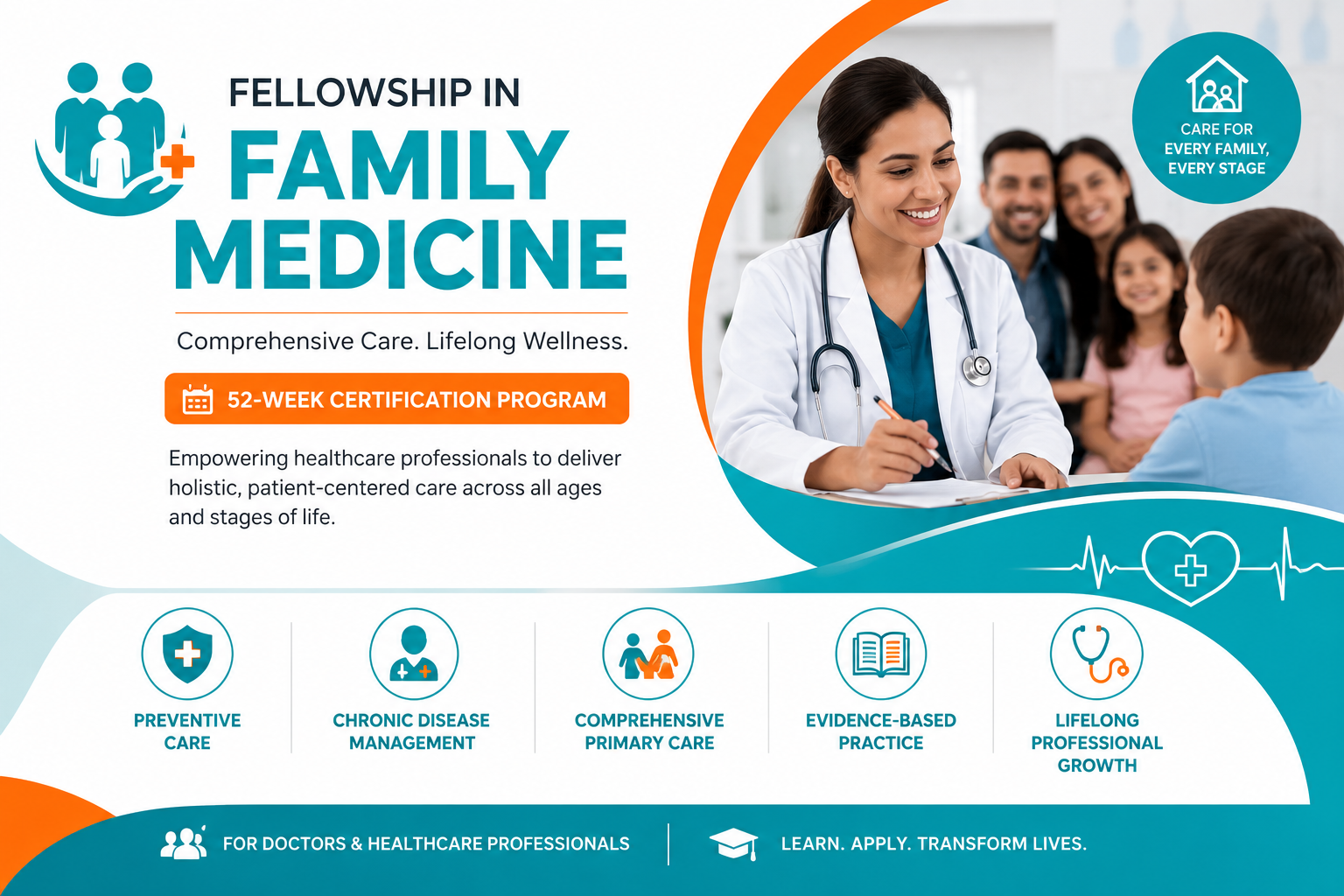

The Fellowship in Family Medicine is a comprehensive 52-week advanced training program designed to enhance the knowledge and clinical skills of medical professionals in delivering high-quality, patient-centered primary healthcare. The curriculum covers preventive medicine, chronic disease management, women’s health, pediatrics, geriatrics, mental health, emergency care, community medicine, and evidence-based clinical practice, preparing participants to provide comprehensive care for individuals and families across all stages of life.
The Fellowship in Family Medicine is a comprehensive 52-week advanced training program designed to equip medical graduates and healthcare professionals with the knowledge, clinical skills, and professional competencies required to deliver high-quality, patient-centered primary healthcare across all stages of life. The program emphasizes the core principles of family medicine, including continuity of care, comprehensive healthcare, preventive medicine, evidence-based clinical practice, and holistic management of individuals and families within their community.
Family physicians serve as the first point of contact within the healthcare system, managing a wide range of acute and chronic medical conditions while coordinating multidisciplinary care and promoting long-term health and wellness. This fellowship prepares participants to confidently diagnose, treat, and manage common medical problems affecting children, adolescents, adults, women, older adults, and individuals with multiple chronic illnesses. Learners will develop expertise in health promotion, disease prevention, lifestyle modification, early diagnosis, chronic disease management, mental health care, emergency stabilization, and patient education.
The curriculum provides extensive coverage of essential clinical disciplines encountered in primary care, including internal medicine, pediatrics, obstetrics and gynecology, geriatrics, psychiatry, dermatology, orthopedics, ophthalmology, otorhinolaryngology (ENT), emergency medicine, community medicine, and preventive healthcare. Participants will strengthen their clinical reasoning through case-based discussions, evidence-based learning, and practical approaches to managing patients in outpatient, community, and primary care settings.
A major focus of the fellowship is preventive and community-oriented healthcare. Participants will gain practical knowledge of immunization programs, health screening, nutrition, lifestyle medicine, occupational and environmental health, non-communicable disease prevention, and public health initiatives. The program also emphasizes patient counseling, communication skills, shared decision-making, and culturally competent care to improve health outcomes across diverse populations.
The fellowship also addresses the growing burden of chronic diseases such as hypertension, diabetes mellitus, cardiovascular disease, chronic respiratory disorders, obesity, and metabolic syndrome. Learners will acquire the skills necessary for long-term disease monitoring, medication management, risk factor modification, rehabilitation planning, and coordination with specialist services when appropriate.
Mental health is integrated throughout the curriculum, enabling participants to identify and manage common psychiatric conditions encountered in primary care, including depression, anxiety disorders, stress-related illnesses, substance use disorders, sleep disturbances, and behavioral problems. Emphasis is placed on early intervention, counseling techniques, crisis assessment, and collaborative care with mental health professionals.
Women’s health and child healthcare form another important component of the program. Participants will learn preventive gynecology, reproductive health, antenatal and postnatal care, contraception, menopause management, growth and developmental assessment, pediatric nutrition, immunization schedules, and management of common childhood illnesses. The curriculum also prepares physicians to provide comprehensive healthcare for older adults through training in geriatric assessment, frailty management, polypharmacy, dementia care, falls prevention, and palliative care.
In addition to clinical excellence, the fellowship develops competencies in healthcare leadership, clinical governance, quality improvement, medical ethics, legal responsibilities, health informatics, digital health, telemedicine, research methodology, and evidence-based decision-making. Participants will understand the effective management of family medicine practices, multidisciplinary teamwork, healthcare documentation, and continuous professional development.
Throughout the 52-week program, learners engage in structured academic modules, clinical case discussions, self-directed learning, assessments, and a capstone project that integrates theoretical knowledge with practical application. The curriculum is designed to prepare participants for the evolving demands of modern primary healthcare while fostering lifelong learning and professional growth.
Upon successful completion of the Fellowship in Family Medicine, graduates will possess the clinical competence, confidence, and leadership skills to provide comprehensive, continuous, coordinated, and compassionate care for individuals and families across all age groups. They will be well prepared to practice in primary care clinics, community health centers, multispecialty hospitals, rural healthcare facilities, telemedicine services, occupational health settings, academic institutions, and public health organizations, contributing significantly to improved healthcare delivery and healthier communities.
- 7 Sections
- 90 Lessons
- 52 Weeks
- Introduction to Family Medicine8
- Acute Care0
- Case: 49-year-old with Fever Presentsto Family Medicine Clinic37
- 3.1Case:Left-sided Chest Pain
- 3.2Case: Jaw/Another Migraine?
- 3.3Upper Respiratory Symptoms
- 3.4Upper Respiratory Infection: Diagnosis and Management
- 3.5Acute Neck Injury
- 3.6Acute Neck Injury: Management
- 3.7Acute Back Pain
- 3.8Acute Back Pain: Management
- 3.9Acute Shoulder Pain
- 3.10Acute Shoulder Pain: Diagnosis
- 3.11Acute Shoulder Pain: Management
- 3.12Acute Knee Pain
- 3.13Acute Knee Pain: Differential Diagnosis
- 3.14Patellofemoral Syndrome and Osteoarthritis
- 3.15Ankle and Foot Pain
- 3.16Ankle and Foot Pain :Management
- 3.17Hand and Wrist Pain
- 3.18Abdominal Pain
- 3.19Abdominal Pain: Cases
- 3.20Localized Rashes: Dermatitis and Fungal Infections
- 3.21Localized Rashes: Impetigo, Cellulitis and Herpes Zoster
- 3.22Generalized Rashes: Atopic Dermatitis and Viral Exanthems
- 3.23Generalized Rashes: Nummular Eczema, Pityriasis Rosea and Psoriasis
- 3.24Urgent Gynecologic Disease
- 3.25Urgent Urologic Disease
- 3.26Dizziness
- 3.27Chest Pain
- 3.28Chest Pain: Pulmonary Embolism and Thoracic Aorta Aneurysm
- 3.29Cluster Headache
- 3.30Tension-type Headache and Acute Migraine Headache: Management
- 3.31Dyspnea
- 3.32Dyspnea: Diagnosis
- 3.33Feverin Adults
- 3.34Insomnia
- 3.35Insomnia:Management
- 3.36Anxiety Disorders
- 3.37Ocular Emergencies
- Chronic Care28
- 4.1Hypertension: Diagnosis
- 4.2Hypertension: General Treatment
- 4.3Hypertension: Specific Treatment
- 4.4Hypertension: Specific Treatment Diabetes Mellitus: Screening Guidelines with Case
- 4.5Type 2 Diabetes: Diagnosis and Management
- 4.6Type 2 Diabetes: Insulin Treatment
- 4.7Asthma: Adherence and Control
- 4.8Asthma: Hazard Reduction and Inhaler
- 4.9Asthma:Medication and Follow-up
- 4.10Chronic Obstructive Pulmonary Disease (COPD)
- 4.11COPD: Treatment
- 4.12LABA/LAMA Combination vs Monotherapy
- 4.13Hyperlipidemia: Diagnosis and Management
- 4.14Arthritis: Diagnosis with Case
- 4.15Arthritis: Treatment
- 4.16Depression: Case Study and Screening
- 4.17Depression: Therapy
- 4.18Osteoporosis in Pregnancy
- 4.19Obesity: Diagnosis and Management
- 4.20Obesity: Medications and Bariatric Surgery
- 4.21Atherosclerotic Cardiovascular Disease
- 4.22Atherosclerotic Cardiovascular Disease: Diagnosis
- 4.23Atherosclerotic Cardiovascular Disease:Management
- 4.24HeartFailure: Diagnosis
- 4.25HeartFailure: Treatment
- 4.26Osteoporosis: Diagnosis and Management
- 4.27Alcohol and Substance Use Disorders
- 4.28Pain Management :Lower Back Pain with Case
- Chronic Care2
- Preventive Medicine8
- Geriatric Care7
You might be intersted in
-
132 Students
-
52 Weeks
-
124 Students
-
52 Weeks
-
133 Students
-
52 Weeks
-
123 Students
-
52 Weeks