
Fellowship in Neurology
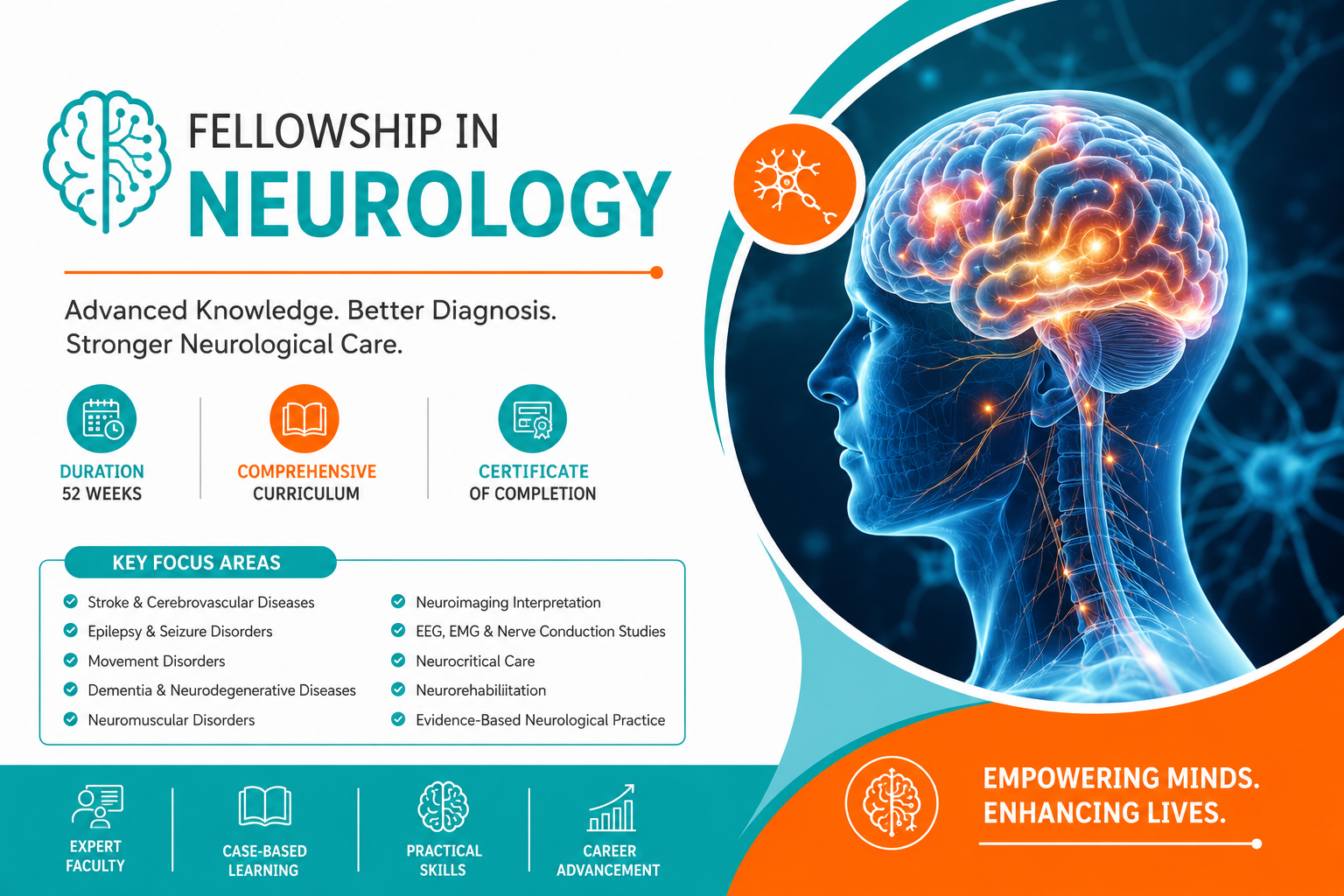

The Fellowship in Neurology is a comprehensive 52-week advanced training program designed for physicians, medical graduates, and healthcare professionals seeking specialized expertise in the diagnosis, evaluation, treatment, and long-term management of disorders affecting the brain, spinal cord, peripheral nerves, neuromuscular …
The Fellowship in Neurology is a comprehensive 52-week advanced training program designed for physicians, medical graduates, and healthcare professionals seeking specialized expertise in the diagnosis, evaluation, treatment, and long-term management of disorders affecting the brain, spinal cord, peripheral nerves, neuromuscular junction, and muscles. As neurological disorders continue to be among the leading causes of disability and mortality worldwide, there is an increasing demand for clinicians who possess advanced knowledge, strong clinical reasoning skills, and evidence-based approaches to neurological care. This fellowship equips participants with the competencies required to deliver high-quality neurological services across outpatient clinics, inpatient wards, emergency settings, and multidisciplinary care environments.
The curriculum provides an in-depth understanding of neuroanatomy, neurophysiology, neuropathology, neuropharmacology, and clinical neuroscience, establishing a strong foundation for accurate diagnosis and effective patient management. Participants develop expertise in performing comprehensive neurological examinations, recognizing neurological signs and symptoms, formulating differential diagnoses, and utilizing diagnostic investigations such as neuroimaging, electroencephalography (EEG), electromyography (EMG), nerve conduction studies (NCS), cerebrospinal fluid analysis, and genetic testing where appropriate.
Throughout the program, learners gain practical knowledge in the diagnosis and management of a broad spectrum of neurological disorders. These include stroke and cerebrovascular diseases, epilepsy and seizure disorders, headaches and migraine syndromes, movement disorders such as Parkinson’s disease and dystonia, multiple sclerosis and other demyelinating disorders, peripheral neuropathies, neuromuscular diseases, myasthenia gravis, motor neuron diseases, dementia, Alzheimer’s disease, cognitive disorders, neurodegenerative diseases, sleep disorders, spinal cord disorders, neuroinfections, brain tumors, traumatic brain injury, autonomic nervous system disorders, and neurological emergencies. Emphasis is placed on early recognition, prompt intervention, and individualized patient-centered treatment strategies.
The fellowship also focuses extensively on acute neurological care, enabling participants to confidently manage emergencies such as acute ischemic stroke, intracerebral hemorrhage, status epilepticus, meningitis, encephalitis, raised intracranial pressure, Guillain-Barré syndrome, myasthenic crisis, spinal cord compression, and altered consciousness. Learners become familiar with emergency neurological assessment protocols, thrombolysis principles, neurocritical care concepts, and multidisciplinary approaches that improve patient outcomes.
A significant component of the program is dedicated to advanced diagnostic techniques and interpretation. Participants develop proficiency in understanding CT and MRI imaging of the brain and spine, vascular imaging, EEG interpretation, EMG and nerve conduction studies, evoked potentials, lumbar puncture procedures, and laboratory investigations relevant to neurological disorders. The curriculum emphasizes integrating clinical findings with diagnostic data to formulate accurate diagnoses and evidence-based management plans.
The fellowship explores modern therapeutic approaches in neurology, including pharmacological management, immunotherapy, biological therapies, neurorehabilitation, pain management, movement disorder interventions, epilepsy management, and advances in neurogenetics and precision medicine. Learners gain insight into emerging technologies such as artificial intelligence in neurology, digital health monitoring, neuroimaging innovations, brain-computer interfaces, tele-neurology, and novel disease-modifying therapies for neurodegenerative diseases.
Recognizing the importance of multidisciplinary care, the program highlights collaboration with neurosurgeons, neuroradiologists, rehabilitation specialists, physiotherapists, occupational therapists, speech and language therapists, psychologists, psychiatrists, critical care specialists, and primary care physicians. Participants learn to coordinate comprehensive treatment plans that address not only neurological disease but also functional recovery, cognitive rehabilitation, psychosocial support, and quality of life.
Research methodology, evidence-based clinical practice, medical ethics, patient safety, healthcare communication, and quality improvement are integrated throughout the fellowship. Participants learn to critically evaluate neurological literature, interpret clinical guidelines, apply research findings to patient care, and contribute to continuous improvements in neurological practice. Ethical considerations, informed consent, end-of-life care, and shared decision-making are emphasized to promote compassionate and patient-centered neurological care.
The curriculum combines structured theoretical instruction with clinical case discussions, problem-based learning, diagnostic interpretation exercises, interactive assessments, and evidence-based treatment planning. Real-world clinical scenarios help participants strengthen diagnostic reasoning, improve decision-making skills, and develop confidence in managing both common and complex neurological disorders across diverse healthcare settings.
Upon successful completion of the Fellowship in Neurology, graduates will possess advanced clinical knowledge, diagnostic expertise, and practical skills necessary to evaluate and manage neurological diseases using contemporary evidence-based approaches. They will be prepared to provide comprehensive neurological care, collaborate effectively within multidisciplinary healthcare teams, support neurological rehabilitation, and contribute to improved patient outcomes in hospitals, specialty neurology centers, emergency departments, rehabilitation facilities, academic institutions, and community healthcare settings. This fellowship serves as an excellent pathway for healthcare professionals seeking to enhance their expertise, advance their careers, and meet the growing global demand for highly skilled practitioners in the field of neurology.
- 26 Sections
- 396 Lessons
- 52 Weeks
- Acquired Neuromuscular Diseases25
- 1.1Introduction to Myopathy
- 1.2Case: 54-year-old Woman with Weakness
- 1.3Clinical Approach to Muscle Disorders
- 1.4Myopathy and Myositis: Diagnosis
- 1.5Evaluation of Muscle Diseases
- 1.6Introduction to Inflammatory Myopathies with Case
- 1.7Inflammatory Myopathies: Types
- 1.8Creatine Kinase Evaluation
- 1.9Polymyositis
- 1.10Inclusion Body Myositis
- 1.11Necrotizing Autoimmune Myositis
- 1.12Overlap Myopathies
- 1.13Antibody Assessments—Inflammatory Myopathies
- 1.14Management of Inflammatory Myopathies
- 1.15Polymyalgia Rheumatica (PMR)— Inflammatory Myalgia
- 1.16Introduction to Infectious Myopathies with Case
- 1.17HIV-associated Myositis—Infectious Myopathies
- 1.18Pathogen Myositis with Trichinella— Infectious Myopathies
- 1.19Toxic Myopathies with Case
- 1.20Hypothyroid and Hyperthyroid Myopathy
- 1.21Statin Myopathy
- 1.22Corticosteroid Myopathy
- 1.23Critical Illness Myopathy and Other Causes for Myopathy
- 1.24Rhabdomyolysis
- 1.25Other Metabolic Muscle Diseases
- Hereditary Neuromuscular Disorders12
- 2.1Inherited Muscle Disorders: Evaluation
- 2.2Inherited Myopathies: Types
- 2.3Muscular Dystrophies
- 2.4Introduction to Proximal Predominant Muscular Dystrophies
- 2.5Case: 6-year-old Boy with Weakness
- 2.6X-linked Dystrophinopathies and Duchenne Muscular Dystrophy
- 2.7Becker Muscular Dystrophy and Limb-girdle Muscular Dystrophy(LGMD)
- 2.8Distal Predominant Muscular Dystrophies
- 2.9Other Muscular Dystrophies
- 2.10Case: 5-month-old Girl with Weakness
- 2.11Evaluation of the Hypotonic Infant
- 2.12Congenital Muscular Dystrophy and Congenital Myopathy
- Disorders of the Neuromuscular Junctions21
- 3.1General Approach to Neuromuscular Junction Disorders
- 3.2Case: 32-year-old Woman with Weakness
- 3.3Physiology of the Neuromuscular Junction
- 3.4Neuromuscular Junction Disorders: Clinical Features and Pathophysiology
- 3.5Neuromuscular Junction Disorders: Summary
- 3.6Case: 32-year-old Woman with Weakness and Sustained Upgaze
- 3.7Myasthenia Gravis: Introduction and Clinical Features
- 3.8Myasthenia Gravis: Clinical and Serological Tests – Diagnosis
- 3.9Myasthenia Gravis: Repetitive Stimulation – Diagnosis
- 3.10Myasthenia Gravis: Antibody Testing – Diagnosis
- 3.11Myasthenia Gravis: Treatment
- 3.12Myasthenia Gravis: Treatment
- 3.13Botulinum Toxin Toxicity: Overview
- 3.14Botulinum Toxin Toxicity: Pathophysiology and Treatment
- 3.15Case: 42-year-oldMan with Weakness
- 3.16Case: 42-year-oldMan with Weakness
- 3.17Lambert Eaton Myasthenic Syndrome (LEMS): Workup and Testing
- 3.18Lambert Eaton Myasthenic Syndrome (LEMS): Pathophysiology and Treatment
- 3.19Organophosphate Poisoning
- 3.20Transient Neonatal Myasthenia
- 3.21Congenital Myasthenic Syndrome (CMS)
- Peripheral Neuropathies5
- Diseases of the Spinal Cord20
- 5.1Case: 45-year-oldMan with Bilateral Lower Extremity Weakness and Numbness
- 5.2Introduction to Spinal Cord
- 5.3Myelopathy
- 5.4Case: 53-year-old Woman with Progressive Weakness and Balance Difficulty
- 5.5How to Approach Spinal Cord Pathology (Macro)
- 5.6How to Approach Spinal Cord Pathology (Micro)
- 5.7Continuation of Case: 53-year-old Woman with Progressive Weakness and Balance Difficulty
- 5.8Case: 58-year-old Woman with Weakness and Neck Pain
- 5.9Intradural Extramedullary Myelopathy
- 5.10Case: 50-year-old Woman with Lower Extremity Weakness
- 5.11Intradural Intramedullary Myelopathy
- 5.12Case: 53-year-oldMan with Numbness in Lower Extremities
- 5.13Myelopathy – Vascular Disorders with Case
- 5.14Case: 22-year-old Woman with Back Pain and Autonomic Symptoms
- 5.15Myelopathy – ConusMedullaris vs. Cauda Equina
- 5.16Case: 45-year-oldMan with Lower Extremity Weakness
- 5.17Toxic and Metabolic Causes of Myelopathy
- 5.18Vitamin B12 Deficiency Myelopathy
- 5.19Case: 57-year-old Woman with Leg and Back Pain
- 5.20Radiculopathy
- Diseases of the Motor Neurons8
- 6.1Case: 56-year-old Woman with Left Extremity Weakness
- 6.2Introduction to Motor Neurons and Motor/Sensory Pathways
- 6.3Upper and Lower Motor Neuron Diseases: Clinical Manifestations
- 6.4Upper and Lower Motor Neuron Etiology
- 6.5Upper and Lower Motor Neuron Diseases: Diagnosis and Management
- 6.6Case: 53-year-oldMan with Generalized Weakness
- 6.7Upper and Lower Motor Neuron Diseases: Differential Diagnosis
- 6.8Amyotrophic Lateral Sclerosis (ALS) and Other Motor Neuron Diseases
- Multiple Sclerosis (MS) and Inflammatory Disorders of the CNS13
- 7.1Introduction to Neuroinflammatory Disorders
- 7.2Neuroinflammatory Disorders: Classification
- 7.3Overview of CNS Inflammatory Diseases
- 7.4Case: 51-year-old with Left Hand Numbness
- 7.5Clinically Isolated Syndrome: Diagnostics and Treatment
- 7.6Acute Disseminated Encephalomyelitis (ADEM)
- 7.7Case: 21-year-old Woman with Blurry Vision
- 7.8Multiple Sclerosis(MS): Pathophysiology and Clinical Manifestations
- 7.9Multiple Sclerosis(MS): Diagnosis and Evolution of Disease
- 7.10Multiple Sclerosis(MS):Management
- 7.11Neuromyelitis Optica (NMO)
- 7.12MOG Ab Disorder
- 7.13MS, NMO,MOG Disorder
- Stroke and Intracranial Hemorrhage22
- 8.1Stroke: Introduction and Types
- 8.2Overview of Ischemic and Hemorrhagic Stroke
- 8.3Stroke: Pathophysiology
- 8.4Case: 45-year-oldMan Presenting with a Stroke – Diagnosis
- 8.5Clinical Assessment of Stroke
- 8.6Clinical Question: Anterior or Posterior Circulation Stroke?
- 8.7Clinical Question: Cortical, Subcortical or Brainstem Localization?
- 8.8Stroke: Localization
- 8.9Case: 45-year-oldMan Presenting with a Stroke –Management
- 8.10Acute Ischemic Stroke: Management and Evaluation
- 8.11Clinical Question: Acute or Mimic Stroke?
- 8.12Clinical Question: tPA or Endovascular Therapy?
- 8.13NIH Stroke Scale (NIHSS)
- 8.14Acute Ischemic Stroke: Major Treatment Types
- 8.15Case: 45-year-oldMan Presenting with a Stroke
- 8.16Stroke: Evaluating Stroke Extension
- 8.17Stroke: Work-up and Etiology
- 8.18Stroke: Complications
- 8.19Management of the Case: 45-year-oldMan Presenting with a Stroke
- 8.20Stroke: Pharmacological Prevention
- 8.21Case: 35-year-old Presenting with Hemiplegia
- 8.22Intracranial Hemorrhage: Types and Epidural Hematoma
- Stroke and Intracranial Hemorrhage6
- 9.1Intracranial Hemorrhage: Subdural Hematoma and Subarachnoid Hemorrhage
- 9.2Intracranial Hemorrhage: Intraparenchymal, Intraventricular, Hypertensive, and Transformation Hemorrhage
- 9.3Transformation Hemorrhage
- 9.4Intracranial Hemorrhage :Management
- 9.5Intracranial Hemorrhage: Evaluation and Summary
- 9.6Intracranial Hemorrhage: Amyloid Angiopathy, VascularLesions, and Neoplasms
- Seizures and Epilepsy20
- 10.1Seizures, Epilepsy, and Spells: Introduction and Differentiation
- 10.2Seizures: Types and Classification
- 10.3Seizures:Mechanisms
- 10.4Seizures: Semiology
- 10.5Epilepsy: Diagnosis and Syndromes
- 10.6Seizures: Evaluation and Functionality of the EEG
- 10.7Seizures: Treatment
- 10.8Diagnosis and Evaluation of a Spell with Case
- 10.9Review of Seizure Systems
- 10.10Differentiating Seizure from Syncope and from Psychogenic Nonepileptic Spells (PNES)
- 10.11Evaluation of Seizure-like Episodes
- 10.12Case: 45-year-oldMan with a Seizure-like Episode
- 10.13Seizure: Classification and Focalvs. Generalized Onset
- 10.14First-time Seizure: Evaluation, History, and Examination
- 10.15Second Seizure: History and Forms of Screening
- 10.16Second Seizure: Summary and Precautions
- 10.17Case: 57-year-oldMan with a History of Epilepsy
- 10.18Status Epilepticus: Evaluation, Prognosis, and Classification
- 10.19Status Epilepticus: Emergency Treatment, Initial Investigation and Long-term Treatment
- 10.20Status Epilepticus: Stages and Pathophysiology
- Seizures and Epilepsy10
- 11.1Status Epilepticus: Treatment and Types
- 11.2Case:13-year-old Boy on Referral from His PCP
- 11.3Epilepsy Syndrome: Introduction and Classification
- 11.4Idiopathic Generalized Onset and Idiopathic Focal Onset Epilepsies
- 11.5Symptomatic Epilepsies
- 11.6Case: 57-year-old Woman with Seizure-like Episodes
- 11.7Partial Onset Epilepsy: Treatment
- 11.8Medication forFocal Onset and Primary Generalized Epilepsy – Seizure Treatment
- 11.9Common Seizure Medications – Seizure Treatment
- 11.10Top 10 Seizure Treatment Tips with Cases
- Head Trauma17
- 12.1Case: 68-year-oldMan with Progressive Altered Mental Status
- 12.2Head Trauma: Introduction and Diffuse Axonal Injury
- 12.3Head Trauma: Clinical Manifestations and Glasgow Coma Scale
- 12.4Head Trauma: Diagnosis and Management
- 12.5Traumatic Brain Injury: Introduction
- 12.6Traumatic Brain Injury: Diagnosis
- 12.7Mild and Sport-related Traumatic Brain Injury
- 12.8Traumatic Brain Injury: Chronic Traumatic Encephalopathy
- 12.9Traumatic Brain Injury :Management
- 12.10Case: 6-year-old Girl Hits Her Head
- 12.11Epidural Hematoma: Etiology, Clinical Presentation, and Diagnosis
- 12.12Epidural Hematoma : Management
- 12.13Case: 68-year-oldMan with Progressive Altered Mental Status and Gaze
- 12.14Subdural Hematoma: Etiology and Clinical Presentation
- 12.15Subdural Hematoma: Diagnosis and Management
- 12.16Case: 43-year-old Woman with Altered Mental Status
- 12.17Subarachnoid Hemorrhage: Etiology, Clinical Manifestations, and Diagnosis
- Intraparenchymal Hemorrhage0
- CNS Infections24
- 14.1Introduction to CNS Infections
- 14.2Anatomy of the Dura
- 14.3Approach to CNS Infections: CSF Analysis
- 14.4Microbes that Cause CNS Infections
- 14.5Case:76-year-old Woman with Headache
- 14.6Bacterial Meningitis: Introduction and Symptoms
- 14.7Bacterial Meningitis: Examination
- 14.8Bacterial Meningitis: Diagnosis
- 14.9Case:76-year-old Woman with Headache – Follow Up
- 14.10Bacterial Meningitis: Treatment
- 14.11Viral and Non-bacterial Meningitis
- 14.12Case: 61-year-oldMan with Headache
- 14.13Encephalitis: Introduction and Symptoms
- 14.14Encephalitis: Examination
- 14.15Other Viral Encephalitis
- 14.16Encephalitis: Treatment
- 14.17Case: 56-year-oldMan with Headache
- 14.18Cerebritis and Brain Abscess
- 14.19Case: 58-year-old Woman with Headache
- 14.20CryptococcalMeningitis
- 14.21Toxoplasmic Meningitis
- 14.22Neurocysticercosis: Introduction
- 14.23Neurocysticercosis :Life Cycle, Presentation, and Disease Stages
- 14.24Neurocysticercosis: Treatment
- Parkinson Disease and Movement Disorders14
- 15.1Parkinsonism: Introduction and Basal Ganglia Circuitry
- 15.2Parkinsonism: Pathophysiology and Clinical Manifestations
- 15.3Idiopathic Parkinson Disease: Etiology, Epidemiology
- 15.4Idiopathic Parkinson Disease: Clinical Presentation and Diagnosis
- 15.5Idiopathic Parkinson Disease: Treatment
- 15.6Parkinson-Plus Syndromes: Introduction
- 15.7Parkinson-Plus Syndromes :Multiple System Atrophy
- 15.8Parkinson-Plus Syndromes: Corticobasal (Ganglionic) Degeneration
- 15.9Parkinson-Plus Syndromes: Progressive Supranuclear Palsy
- 15.10Parkinson-Plus Syndromes: Dementia with Lewy Bodies
- 15.11Non-parkinsonian Movement Disorders: Tremors
- 15.12Non-parkinsonian Movement Disorders: Ballismus
- 15.13Non-parkinsonian Movement Disorders: Chorea and Huntington’s Disease
- 15.14Non-parkinsonian Movement Disorders: Other
- Dementia and Amnestic Conditions15
- 16.1Case: 65-year-oldMan with Cognitive Dysfunction
- 16.2Dementia vs Mild Cognitive Impairment
- 16.3Mild Cognitive Impairment
- 16.4Case:74-year-old with Cognitive Dysfunction
- 16.5Epidemiology and Risk Factors for Alzheimer Dementia
- 16.6Pathophysiology of Alzheimer Dementia
- 16.7Natural History and Progression of Alzheimer Dementia
- 16.8Alzheimer Dementia: Clinical Manifestation and Diagnosis
- 16.9Alzheimer Dementia: Treatment
- 16.10Other Dementia: Classification
- 16.11Other Dementia :Frontotemporal Lobar Dementia
- 16.12Other Dementia :Lewy Body Dementia
- 16.13Other Dementia: Vascular Dementia
- 16.14Normal Pressure Hydrocephalus
- 16.15Differentiating Dementia
- CNS Tumors25
- 17.1Brain Tumors: Introduction, Classification, and Diagnostic Evaluation
- 17.2Case: 32-year-old Woman with Dysphagia
- 17.3Metastatic Brain Tumors: Introduction
- 17.4Metastatic Brain Tumors: Surgery – Treatment
- 17.5Metastatic Brain Tumors: Radiosurgery – Treatment
- 17.6Metastatic Brain Tumors: Chemotherapy – Treatment
- 17.7Case: 40-year-old Woman with Headache
- 17.8Meningioma: Introduction
- 17.9Meningioma: Clinical Presentation and Evaluation
- 17.10Meningioma: Treatment
- 17.11Case: 67-year-old Woman with Headaches
- 17.12Pituitary Tumors: Introduction
- 17.13Pituitary Tumors: Clinical Presentation
- 17.14Pituitary Tumors: Evaluation and Imaging
- 17.15Pituitary Tumors: Treatment
- 17.16Case: 49-year-oldMan with Headache
- 17.17Glioma: Introduction and Clinical Presentation
- 17.18Glioma: Grading with Mild Contrast Enhancement
- 17.19Glioma: Grading with Tissue Sample
- 17.20Glioma: Genetic Risk Assessment
- 17.21Glioma: Treatment
- 17.22Case: 27-year-oldMan with Pain
- 17.23Neurofibromatosis Type 1: Introduction
- 17.24Neurofibromatosis Type 1: Hypothalamic or Tumor Formation
- 17.25Neurofibromatosis Type 1: Diagnostic Criteria
- CNS Tumors10
- 18.1Neurofibromatosis Type 1: Clinical Presentation
- 18.2Neurofibromatosis Type 1: Treatment
- 18.3Case: 42-year-old Woman with Loss of Hearing
- 18.4Neurofibromatosis Type 2: Introduction
- 18.5Neurofibromatosis Type 2: Diagnostic Criteria
- 18.6Neurofibromatosis Type 2: Clinical Presentation
- 18.7Case: 25-month-old Infant with Spasms
- 18.8Tuberous Sclerosis: Introduction
- 18.9Tuberous Sclerosis: Diagnostic Criteria
- 18.10Tuberous Sclerosis: Clinical Presentation
- Sleep Disorders21
- 19.1Introduction to Sleep
- 19.2Circadian Rhythms
- 19.3Stages of Sleep
- 19.4Case: 46-year-old with Difficulty Sleeping
- 19.5Insomnia: Classification and Pathophysiology
- 19.6Insomnia: Diagnosis
- 19.7Insomnia:Management
- 19.8Case: 54-year-old with Excessive Daytime Sleepiness
- 19.9Circadian RhythmSleep–Wake Disorders and Delayed Sleep–Wake Phase Disorder
- 19.10Sleep–Wake Phase Disorder: Advanced, Irregular, and Non-24-hour
- 19.11Sleep–Wake Phase Disorder: Shift Work Disorder and Jet Lag
- 19.12Sleep–Wake Phase Disorder: Management
- 19.13Case: 39-year-old Acting Out Dreams
- 19.14Introduction to Parasomnias
- 19.15NREM-related Parasomnias
- 19.16REM-related Parasomnias and Management of Parasomnias
- 19.17Case:12-year-old with Hallucinations
- 19.18Introduction to Narcolepsy
- 19.19Narcolepsy: Epidemiology and Clinical Features
- 19.20Narcolepsy: Diagnosis
- 19.21Narcolepsy : Management
- Vertigo, Dizziness, and Disorders of Balance20
- 20.1Case: 34-year-old Woman with Severe Dizziness
- 20.2Dizziness: Signs and Symptoms
- 20.3Introduction to Nonspecific Dizziness
- 20.4Dysequilibrium and Cerebellar Diseases
- 20.5Case: 67-year-old Woman with Gait Dysfunction
- 20.6Cerebellum:Lobes – Anatomy Review
- 20.7Case: 54-year-old Girl with Dizziness
- 20.8Cerebellum: Afferent and Efferent Pathways – Anatomy Review
- 20.9Case: 52-year-oldMan with Ataxia
- 20.10Cerebellum: Nuclei – Anatomy Review
- 20.11Case: 60-year-oldMan Presenting with Fainting Episodes
- 20.12Syncope: Definition, Etiology, and Causes
- 20.13NeurallyMediated Syncope: Definition, Pathophysiology, and Classification
- 20.14Syncope: Evaluation, Treatment, and Management
- 20.15Case: 24-year-old with Dizziness
- 20.16Review of the Vestibular System and Evaluation of Vertigo
- 20.17Vertigo: Types
- 20.18Acute Vestibular Syndrome: Causes and Differentiation
- 20.19ExamTechnique: Head Impulse Test(HIT), Nystagmus, and Test of Skew
- 20.20HINTS of INFARCT
- Headache24
- 21.1Introduction to Headaches: Groups and 3- Step Evaluation System
- 21.2Step 1: Primary and Secondary Headaches and Types of Headaches
- 21.3Step 2: Optionsfor Diagnostic Testing and Cluesto Severe Disease
- 21.4Step 3: Treatment of Headaches
- 21.5Case: 45-year-old Woman with Headache
- 21.6Thunderclap Headache: Overview, Evaluation, and Management
- 21.7Case: 67-year-old Woman with History of Migraines
- 21.8Headache with Visual Disturbances
- 21.9Case: 60-year-oldMan with Squamous Cell Carcinoma
- 21.10Neurogenic Headache
- 21.11Case: 57-year-old Woman with Headache when Sitting Up
- 21.12Low-pressure Headache
- 21.13Case: 28-year-old Obese Woman with Headache
- 21.14High-pressure Headache
- 21.15Case: 20-year-old Woman with Episodic Headache
- 21.16Chronic, Recurrent, and Episodic Headaches
- 21.17Migraine: Aura, Triggers, Evaluation, and Treatment
- 21.18Migraine: Prophylaxis and Medications
- 21.19Case: 25-year-oldMan with Cluster Headaches
- 21.20Trigeminal Autonomic Cephalalgias(TACs)
- 21.21Cluster Headaches
- 21.22Paroxysmal Hemicrania
- 21.23SUNCT and SUNA
- 21.24Hemicrania Continua
- Neuropathic Pain Syndromes11
- 22.1Neuropathic Pain: Etiologies, Allodynia, Paresthesia, and Dysesthesia
- 22.2Neuropathic Pain: Understanding Nerve Pain
- 22.3Neuropathic Pain: Close to Lesion (CNS or PNS)
- 22.4Neuropathic Pain:Locating a Lesion in the PNS
- 22.5Case: 52-year-oldMan with Intense Hip Pain
- 22.6Case: 24-year-old Woman with Pruritic Vesicles
- 22.7Diabetic Polyneuropathy
- 22.8Chemotherapy-induced Polyneuropathy
- 22.9Case: 42-year-old Woman with Sharp Pain on the Right Side of Her Face
- 22.10Neuropathic Pain: Trigeminal Neuralgia
- 22.11Neuropathic Pain: Treatment
- Neurologic and Psychiatric Emergencies26
- 23.1Altered Mental Status(AMS) – Emergency Medicine
- 23.2Altered Mental Status(AMS): Common Causes
- 23.3Altered Mental Status(AMS):First Steps
- 23.4Altered Mental Status(AMS): History
- 23.5Altered Mental Status(AMS):Management
- 23.6Headache (EmergencyMedicine)
- 23.7Migraine: Presentation & Diagnosis
- 23.8Migraine : Management
- 23.9Cluster Headache (EmergencyMedicine)
- 23.10Secondary Headache (Emergency Medicine)
- 23.11Acute Ischemic Stroke (AIS) – Emergency Medicine
- 23.12Acute Ischemic Stroke (AIS): Signs & Symptoms
- 23.13Acute Ischemic Stroke (AIS): Examination
- 23.14Acute Ischemic Stroke (AIS): Diagnosis
- 23.15Acute Ischemic Stroke (AIS):Management
- 23.16SpontaneousIntracerebral Hemorrhage (ICH) – Emergency Medicine
- 23.17SpontaneousIntracerebral Hemorrhage (ICH): Examination & Diagnosis
- 23.18Spontaneous Intracerebral Hemorrhage (ICH):Management
- 23.19Subarachnoid Hemorrhage (SAH) – Emergency Medicine
- 23.20Subarachnoid Hemorrhage (SAH): Diagnosis
- 23.21Subarachnoid Hemorrhage (SAH): Management
- 23.22Seizures(EmergencyMedicine)
- 23.23Seizures: Pathophysiology
- 23.24Seizure: Examination
- 23.25Seizure: Diagnosis
- 23.26Seizure : Management
- Neurologic and Psychiatric Emergencies9
- 24.1Meningitis and Encephalitis(Emergency Medicine)
- 24.2Meningitis and Encephalitis: Examination
- 24.3Meningitis and Encephalitis: Diagnosis
- 24.4Meningitis and Encephalitis : Management & Prophylaxis
- 24.5Suicidal Patients(Emergency Medicine)
- 24.6Methods of Suicide
- 24.7Suicidal Patients: Diagnosis
- 24.8Suicidal Patients : Management
- 24.9Suicidal Patients: Documentation and Disposition
- Pediatric Neurology0
- Seizuresin Children: Introduction18
- 26.1Status Epilepticus : Management
- 26.2Generalized Seizure in Children
- 26.3Febrile Seizure
- 26.4Ataxia in Children
- 26.5Migraines and Headachesin Children
- 26.6Secondary Headache in Children
- 26.7Guillain–Barré Syndrome (GBS) and Acute Disseminated Encephalomyelitis(ADEM)
- 26.8Muscular Dystrophy in Children
- 26.9Spinal Muscular Atrophy(SMA) in Children
- 26.10Infant Botulism
- 26.11Myasthenia Gravisin Children
- 26.12Cerebral Palsy(CP)
- 26.13Intellectual Disability in Children
- 26.14Tics and Tourette’sin Children
- 26.15Tuberous Sclerosis in Children
- 26.16Neurofibromatosis(NF) and Sturge–Weber Syndrome
- 26.17Increased Intracranial Pressure (ICP), Hydrocephalus & Dandy–Walker Variant (DWV)
- 26.18(DWV) Arnold–ChiariMalformations and Craniosynostosis
You might be intersted in
-
167 Students
-
52 Weeks
-
124 Students
-
52 Weeks
-
133 Students
-
52 Weeks
-
123 Students
-
52 Weeks