
Fellowship in Seizures and Epilepsy
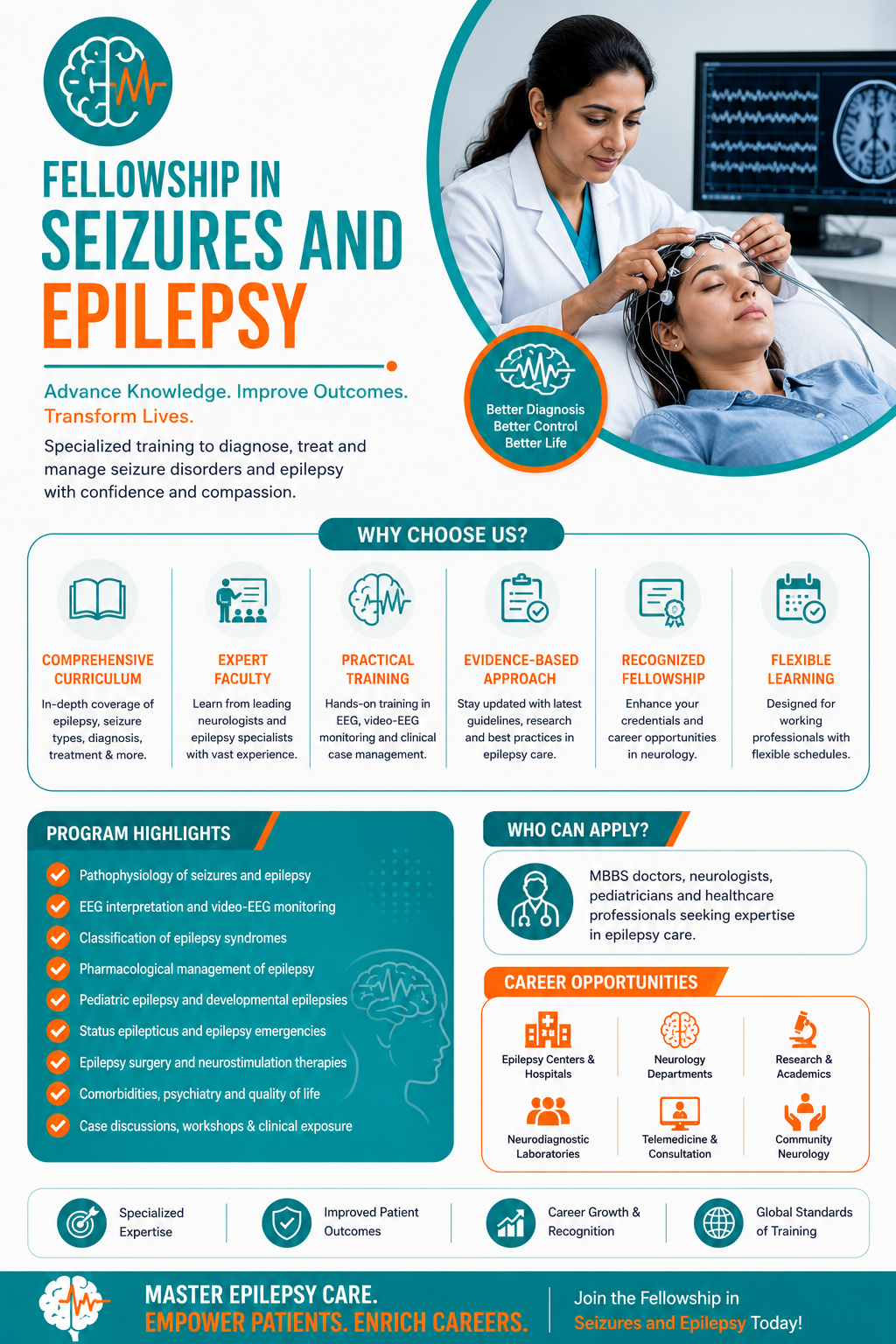

The Fellowship in Seizures and Epilepsy at Medova Medical Academy is an advanced training program designed for medical professionals who want to develop expertise in the diagnosis and management of seizure disorders and epilepsy. The course focuses on understanding seizure types, interpretation of EEG, modern treatment strategies, and comprehensive patient care.
Participants gain practical knowledge in evaluating patients with epilepsy, selecting appropriate anti-epileptic therapies, and managing complex neurological cases through case discussions and expert-led sessions. The program aims to enhance clinical skills and improve outcomes in patients with seizure disorders.
Training in epilepsy fellowships typically focuses on advanced clinical evaluation, EEG interpretation, and medical or surgical management of epilepsy.
The Fellowship in Seizures and Epilepsy is a comprehensive 52-week advanced training program designed for medical professionals, physicians, neurologists, pediatricians, and healthcare practitioners seeking specialized expertise in the diagnosis, evaluation, treatment, and long-term management of seizure disorders and epilepsy. As epilepsy remains one of the most common neurological disorders worldwide, affecting millions of individuals across all age groups, there is an increasing demand for healthcare professionals equipped with advanced knowledge and clinical skills to provide effective, evidence-based epilepsy care. This fellowship bridges the gap between foundational neurological training and specialized epilepsy management, empowering healthcare professionals to deliver high-quality patient-centered care.
The program provides an in-depth understanding of the neurobiology and pathophysiology of seizures and epilepsy, enabling participants to recognize the diverse clinical presentations of seizure disorders. Learners explore the classification of epileptic seizures and epilepsy syndromes, gaining the ability to differentiate between focal, generalized, and unknown-onset seizures, as well as distinguish epileptic events from non-epileptic conditions. This strong theoretical foundation supports accurate diagnosis and individualized treatment planning.
A major focus of the fellowship is the use of advanced diagnostic tools in epilepsy care. Participants receive comprehensive training in electroencephalography (EEG), video-EEG monitoring, neuroimaging techniques such as MRI and CT, and other neurophysiological investigations. The program emphasizes the interpretation of EEG patterns, identification of epileptiform abnormalities, seizure localization, and the role of diagnostic technologies in guiding treatment decisions. Through case-based learning and clinical discussions, learners develop confidence in utilizing these tools to improve diagnostic accuracy and patient outcomes.
The fellowship also provides extensive knowledge of pharmacological management strategies for epilepsy. Participants study antiepileptic medications, treatment selection, dosage optimization, adverse effect monitoring, drug interactions, and approaches to managing drug-resistant epilepsy. The curriculum highlights evidence-based treatment guidelines and personalized therapeutic approaches to ensure optimal seizure control while minimizing treatment-related complications.
Special attention is given to pediatric epilepsy and age-specific seizure disorders. Learners gain insights into neonatal seizures, childhood epilepsy syndromes, developmental epileptic encephalopathies, febrile seizures, genetic epilepsies, and epilepsy management during adolescence. The program also addresses epilepsy care in special populations, including pregnant women, older adults, and patients with complex neurological comorbidities.
For patients who do not respond adequately to medication, the fellowship introduces advanced treatment modalities, including epilepsy surgery evaluation, vagus nerve stimulation (VNS), responsive neurostimulation, deep brain stimulation, ketogenic dietary therapies, and other emerging interventions. Participants learn patient selection criteria, pre-surgical evaluation techniques, multidisciplinary treatment planning, and long-term follow-up strategies for individuals with refractory epilepsy.
The curriculum further explores epilepsy emergencies and neurocritical care, including status epilepticus, acute seizure management, seizure-related complications, and emergency stabilization protocols. Through practical case scenarios and evidence-based discussions, participants develop the skills required to manage neurological emergencies effectively and safely.
An important component of the fellowship is understanding the psychosocial impact of epilepsy on patients and families. Learners examine cognitive, behavioral, psychiatric, educational, and social challenges associated with epilepsy while developing strategies to improve quality of life, patient counseling, adherence to therapy, and long-term rehabilitation. The program emphasizes holistic care approaches that address both medical and psychosocial aspects of the condition.
Throughout the fellowship, participants engage in clinical case reviews, interactive discussions, research-oriented learning, and evidence-based practice activities. Exposure to real-world clinical scenarios strengthens diagnostic reasoning, critical thinking, and decision-making skills while fostering a multidisciplinary approach to epilepsy management. The curriculum also introduces current advances in epilepsy research, neurogenetics, precision medicine, and innovative therapeutic technologies shaping the future of neurological care.
Upon successful completion of the Fellowship in Seizures and Epilepsy, graduates will possess advanced competencies in seizure recognition, diagnostic evaluation, EEG interpretation, treatment planning, emergency management, and long-term epilepsy care. They will be prepared to contribute effectively to neurology departments, epilepsy centers, hospitals, academic institutions, research organizations, and specialized neuroscience practices.
This fellowship serves as an excellent opportunity for healthcare professionals seeking to advance their careers in neurology and epilepsy care. By combining comprehensive theoretical knowledge with practical clinical insights, the program equips participants with the expertise necessary to improve patient outcomes, support multidisciplinary care teams, and make a meaningful impact in the lives of individuals living with seizure disorders and epilepsy.
- 1 Section
- 1 Lesson
- 52 Weeks
- Seizures and Epilepsy1