
Fellowship in Psychiatry
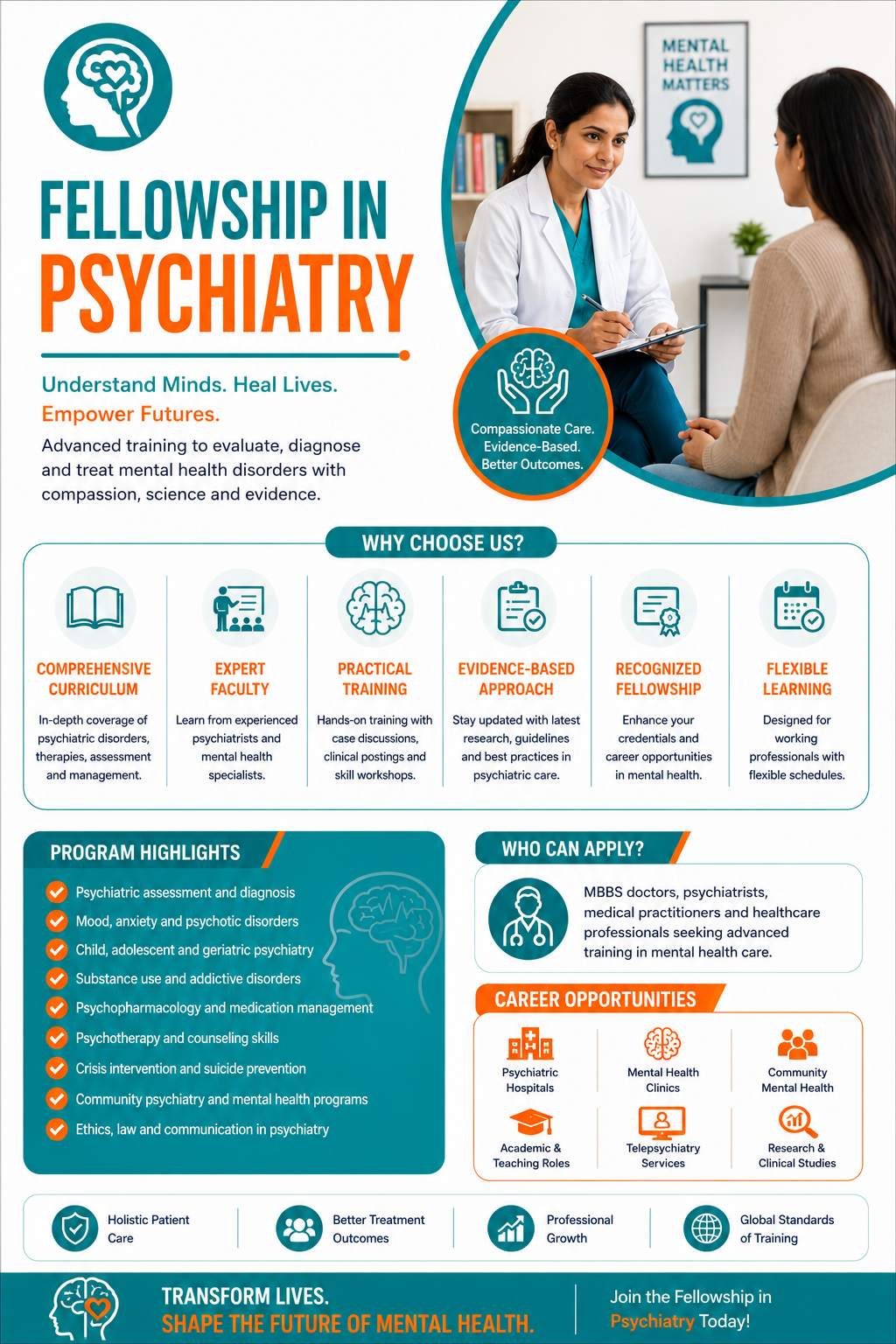

The Fellowship in Psychiatry at Medova Academy is an advanced clinical-academic training program, tailored for physicians and mental-health professionals looking to deepen their expertise and deliver comprehensive psychiatric care. This fellowship is designed not just for theoretical mastery, but for …
The Fellowship in Psychiatry at Medova Academy is an advanced clinical-academic training program, tailored for physicians and mental-health professionals looking to deepen their expertise and deliver comprehensive psychiatric care. This fellowship is designed not just for theoretical mastery, but for practical, real-world readiness — giving you the skills and confidence to diagnose and manage a wide range of mental health disorders effectively.
In this fellowship, you will explore core and subspecialty areas of psychiatry, including mood disorders, psychotic disorders, anxiety and trauma-related conditions, neuropsychiatry, geriatric psychiatry, addiction psychiatry, consultation–liaison psychiatry, and more. By studying under a globally-informed curriculum — enriched with case-based learning and clinical attachments — you’ll gain a nuanced understanding of psychiatric assessment, diagnosis, treatment planning, and long-term management.
A unique strength of the program lies in its holistic and biopsychosocial approach: drawing on internationally accepted practices, evidence-based therapies, psychopharmacology, psychotherapy, and psychosocial interventions to treat patients across age groups and clinical settings. You’ll learn to integrate biological, psychological, and social factors in assessment and management, which is especially vital in subspecialties like consultation–liaison psychiatry where mental health intersects with physical illness.
Our training emphasizes:
-
Comprehensive psychiatric assessments and mental state examinations across all age groups.
-
Formulating evidence-based biopsychosocial management plans, including psychopharmacological, psychotherapeutic, and social interventions. Managing complex and co-morbid cases — for instance psychiatric symptoms in medically ill patients via consultation–liaison psychiatry, neuropsychiatric conditions, substance use disorders, and more.Working effectively in multidisciplinary teams, collaborating with other specialists, allied health professionals, carers and families to provide holistic care and continuity.
-
Adopting best practices and research-informed care — fellows will be trained to evaluate and apply current research, stay updated with clinical guidelines, and deliver care with ethical, culturally sensitive, and patient-centered approaches.
By the end of the fellowship, you will be equipped to:
-
Diagnose and manage a broad spectrum of psychiatric disorders in adults, adolescents and special populations.
-
Provide crisis and emergency psychiatric care, and handle complex care needs including dual diagnoses and co-morbid medical/psychiatric illnesses.
-
Offer psychopharmacological and psychotherapeutic interventions, tailored to individual patient needs.
-
Work as a consultant psychiatrist, collaborate with other specialties (medicine, neurology, pediatrics, etc.), and contribute to mental-health multidisciplinary care teams.
-
Advocate for mental health, understand socio-cultural dynamics in patient care, and offer compassionate, holistic, and evidence-based psychiatric services.
Who Should Enroll
This fellowship is ideal for:
-
Practicing physicians (general practitioners, MDs, DNBs, MS) looking to specialize in psychiatry.
-
Medical doctors wanting to integrate mental-health competency into their practice.
-
Healthcare professionals seeking advanced training in psychiatric care, consultation-liaison, neuropsychiatry, addiction medicine, or community psychiatry.
-
Professionals aiming to work as consultant psychiatrists, mental-health specialists, or integrate psychiatry into general clinical practice.
Why Choose This Fellowship
-
Globally-aligned curriculum covering core and subspecialty psychiatric domains.
-
Balanced theoretical and practical training via case-based learning, clinical attachments, and exposure to real-world scenarios.
-
Multidisciplinary and holistic approach — merging biological, psychological, and social care principles.
-
Readiness for clinical practice post-fellowship, enabling smooth transition to consultant roles or integration into existing medical practice.
-
Focus on ethical, culturally sensitive, and evidence-based psychiatric care — preparing you to meet modern mental-health challenges effectively.
- 10 Sections
- 102 Lessons
- 10 Weeks
- Psychiatric Assessment7
- Personality Disorders9
- Schizophrenia and Thought Disorders7
- Mood Disorders10
- 4.1Depression: Definition and Pathogenesis
- 4.2Depression: Diagnosis and Symptoms
- 4.3Depression: Screening and Treatment
- 4.4Antidepressants
- 4.5Major Depression: Treatment
- 4.6Bipolar Disorder: Definition, Types and Diagnosis
- 4.7Bipolar Disorder: Causes, Assessment
- 4.8Bipolar Disorder: Diagnosis and Major Depression
- 4.9Bipolar Disorder: Treatment
- 4.10Mood Stabilizers
- Mood Stabilizers9
- Control Disorders13
- 6.1Substance-related Disorders and Addictive Disorder
- 6.2Alcohol and Delirium
- 6.3Wernicke Encephalopathy and Korsakoff’s Syndrome
- 6.4Substance-related Disorders and Addictive Disorders
- 6.5Substance-related Disorders
- 6.6Impulse Control Disorder
- 6.7Intermittent Explosive Disorder (IED)
- 6.8Gambling Disorder
- 6.9Pyromania
- 6.10Trichotillomania (TTM)
- 6.11Eating Disorders
- 6.12Bulimia Nervosa
- 6.13Binge Eating Disorder
- Mild and Major Neurocognitive Disorders13
- 7.1Assessing Cognitive Disorders
- 7.2Neurocognitive Disorders
- 7.3Neurocognitive Disorders: Causes
- 7.4Delirium
- 7.5Delirium: Diagnosis and Management
- 7.6Difference between Delirium and Dementia
- 7.7Childhood Development
- 7.8Disruptive Behavioral Disorders
- 7.9Attention-Deficit/Hyperactivity Disorder (ADHD): Diagnosis
- 7.10ADHD: Management
- 7.11Autism Spectrum Disorder
- 7.12Sexual Abuse
- 7.13Disorders and Treatment Considerations in Older Adults: Depression
- Dissociative Disorders13
- 8.1Dissociative Disorders: Overview
- 8.2Dissociative Amnesia
- 8.3Dissociative Fugue
- 8.4Dissociative Identity Disorder
- 8.5Depersonalization and Derealization Disorder
- 8.6Somatization
- 8.7Somatic Symptom Disorder
- 8.8Somatic Symptom Disorder Assessment
- 8.9Past Medical Illness
- 8.10Somatic Symptom and Other Disorders
- 8.11Psychological Factors Affecting Other Medical Conditions
- 8.12Body Dysmorphic Disorder and Pain Disorder
- 8.13Malingering
- Forensic Psychiatry4
- Psychopharmacology19
- 10.1Overview of Sedative and Hypnotic Drugs – Sedative Hypnotics
- 10.2Benzodiazepines – Sedative Hypnotics
- 10.3Barbiturates – Sedative Hypnotics
- 10.4Atypical Sedative Drugs
- 10.5Case Study – Sedative Hypnotics
- 10.6Questions – Sedative Hypnotics0 Questions
- 10.7Overview – Antidepressants
- 10.8Monoamine Oxidase Inhibitors (MAOIs) – Antidepressants
- 10.9Tricyclic Antidepressants (TCAs) – Antidepressants
- 10.10Heterocyclic Antidepressants (HCAs)
- 10.11SNRIs, Serotonin Antagonists and SSRIs – Antidepressants
- 10.12Review – Antidepressants
- 10.13Antidepressants: Case Study
- 10.14Overview – Antipsychotics
- 10.15Effects of Increasing and Decreasing Dopamine – Antipsychotics
- 10.16Bipolar Disorder Medication – Antipsychotics
- 10.17Psychotic Disorder Medication – Antipsychotics
- 10.18Clinical Uses of Antipsychotics and Drug Induced Dyskinesia
- 10.19Questions – Antipsychotics0 Questions
You might be intersted in

-
0 Students
-
52 Weeks
-
133 Students
-
52 Weeks
-
129 Students
-
52 Weeks
-
139 Students
-
52 Weeks