
Fellowship in Endocrinology
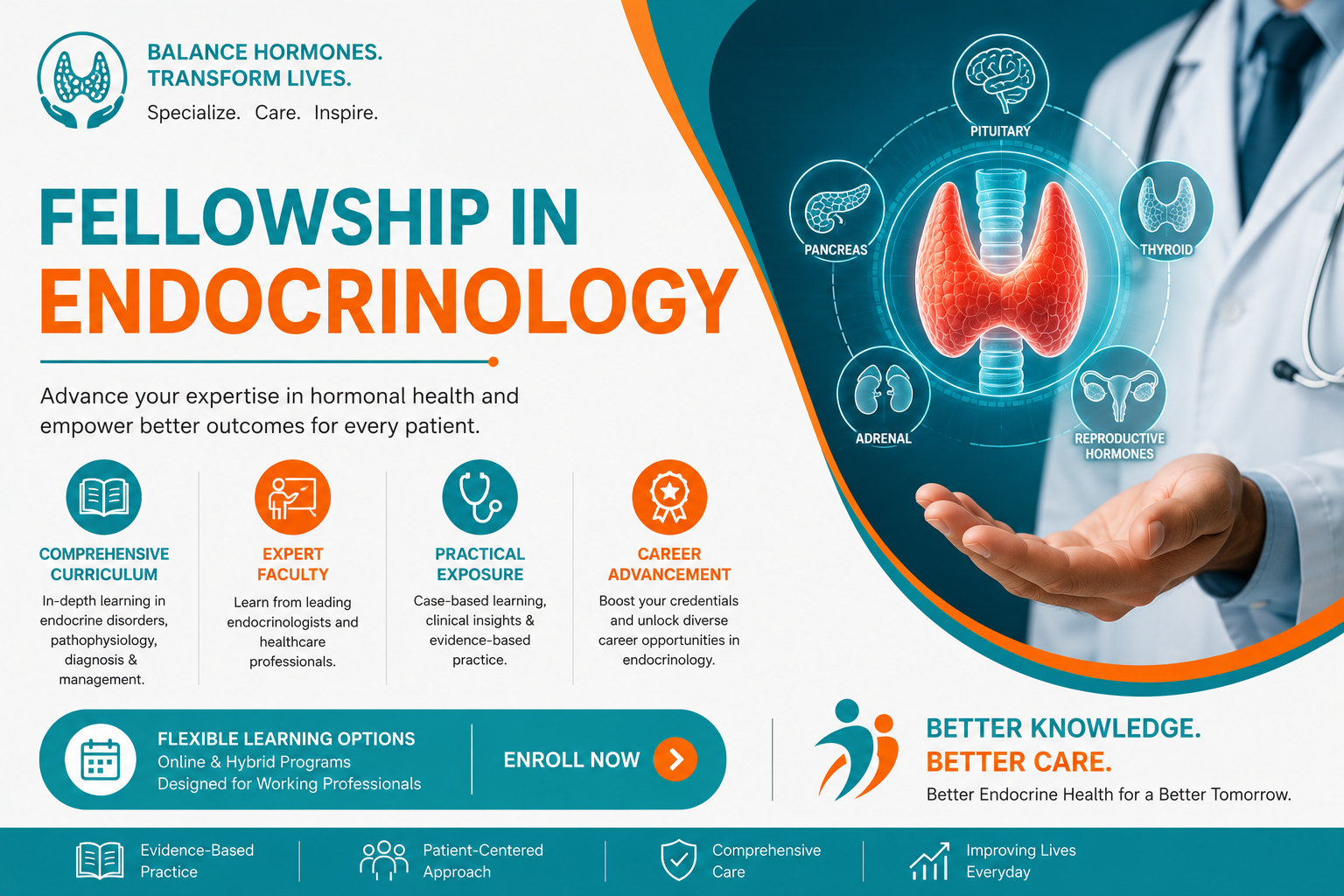

Advance your medical career with our Fellowship in Endocrinology. Learn to diagnose and manage complex hormonal disorders through case-based and clinical training.
The Fellowship in Endocrinology is an advanced academic and clinically oriented program designed for medical professionals seeking specialization in the diagnosis and management of endocrine disorders. This fellowship equips doctors with comprehensive knowledge and practical skills to confidently manage complex hormonal and metabolic diseases that are increasingly prevalent across global healthcare systems.
Endocrinology plays a pivotal role in modern medicine, addressing conditions related to the endocrine glands—including diabetes mellitus, thyroid dysfunction, pituitary and hypothalamic disorders, adrenal diseases, reproductive hormonal disorders, and metabolic bone disorders. The fellowship curriculum offers structured and in-depth exposure to each of these domains through a combination of theoretical teaching and real-world case-based learning.
The program features an internationally benchmarked curriculum that integrates foundational physiology, diagnostic reasoning, critical clinical decision-making, and emergency management. Participants benefit from numerous clinical case discussions included throughout all modules, such as cases on hyperthyroidism, thyroid cancer, myxedema coma, Cushing syndrome, acromegaly, pheochromocytoma, diabetes mellitus (Type 1 & Type 2), diabetic ketoacidosis, hyperosmolar syndrome, and complex reproductive endocrinology cases.
A strong emphasis is placed on practical orientation, enabling participants to translate classroom learning into effective patient care. The fellowship bridges theoretical knowledge and clinical practice through case-based pedagogy and structured clinical attachments at partnered hospitals, supporting hands-on exposure to real-life endocrine disorders and multidisciplinary treatment strategies.
By the end of the program, learners will be able to:
-
Diagnose and manage a wide spectrum of endocrine and metabolic disorders
-
Interpret hormonal test results, endocrine imaging, and dynamic testing
-
Manage critical endocrine emergencies such as thyroid storm, adrenal crisis, DKA, and HHS
-
Understand advanced diabetes care, insulin therapy, and chronic complication prevention
-
Confidently counsel patients and apply evidence-based treatment strategies
This fellowship is ideal for practicing physicians, general practitioners, pediatricians, gynecologists, and post-graduate medical students who aspire to build clinical expertise, enhance patient outcomes, and establish themselves as endocrine specialists—without stepping away from their ongoing practice.
The program concludes with a Fellowship Certification upon successful completion of academic modules and clinical requirements.
- 6 Sections
- 101 Lessons
- 140 Hours
- Thyroid Disorders16
- 1.1Review of Thyroid Physiology
- 1.2Thyroid Case: 38-year-old Woman with Insomnia, Anxiety and Hair Loss
- 1.3Hyperthyroidism and Thyrotoxicosis
- 1.4Thyroid Storm with Case
- 1.5Graves Disease
- 1.6Types of Thyroiditis with Case
- 1.7Toxic Adenoma and Multinodular Goiter with Case
- 1.8Hyperthyroidism – Summary
- 1.9Thyroid Nodules
- 1.10Thyroid Cancer with Case
- 1.11Thyroid Case: 52-year-old Woman with Weight Gain, Fatigue and Poor Concentration
- 1.12Hashimoto’s Thyroiditis and Subclinical Hypothyroidism
- 1.13Euthyroid Sick Syndrome with Case
- 1.14Euthyroid Sick Syndrome with Case
- 1.15Myxedema Coma with Case
- 1.16Hypothyroidism – Summary
- Pituitary and Hypothalamic Disorders14
- 2.1Review of Hypothalamic and Pituitary Physiology
- 2.2Pituitary Case: 54-year-old Man with Fatigue and Joint Pain
- 2.3Acromegaly
- 2.4Pituitary Case: 28-year-old Woman with Amenorrhea and Nipple Discharge
- 2.5Hyperprolactinemia
- 2.6Pituitary Case: 53-year-old Man after Transsphenoidal Resection of Pituitary Adenoma
- 2.7Syndrome of Inappropriate ADH (SIADH)
- 2.8Pituitary Case: 48-year-old Woman with Weight Gain, Easy Bruising, and Hypertension
- 2.9Cushing Syndrome and Cushing Disease
- 2.10Summary: Pituitary Hormone Excess
- 2.11Pituitary Case: 51-year-old Man with Severe Headache
- 2.12Hypothalamic and Pituitary Hormone Deficiency
- 2.13Pituitary Case: 28-year-old Woman with Excessive Thirst and Urination
- 2.14Diabetes Insipidus and Pituitary Tumors
- Adrenal Gland Disorders6
- Diabetes Mellitus27
- 4.1Types of Diabetes
- 4.2Diabetic Case: 9-year-old Girl with Thirst, Weight Loss, and Frequent Urination
- 4.3Type 1 Diabetes Mellitus (DM)
- 4.4Honeymoon Phase with Case
- 4.5Diabetic Case: 47-year-old Woman with Pain on Urination, Frequent Urination, and Urine Urgency
- 4.6Diabetic Case: 61-year-old Man with Weight Gain
- 4.7Prediabetes
- 4.8Diabetic Case: 36-year-old Primigravid Woman for Antenatal Care
- 4.9Gestational Diabetes
- 4.10Type 2 Diabetes Mellitus: Patient Education and Self-monitoring of Blood Glucose
- 4.11Type 2 Diabetes Mellitus: Hemoglobin A1c (HbA1c) Monitoring and Non-pharmacologic Approaches
- 4.12Bariatric Surgery with Case
- 4.13Type 2 Diabetes Mellitus: Rational Management
- 4.14Type 1 Diabetes Management with Case
- 4.15Diabetic Case: 19-year-old Man with Type 1 DM
- 4.16Diabetic Case: 75-year-old Man on Insulin Therapy
- 4.17Diabetic Case: 49-year-old Man with Elevated HbA1c
- 4.18Non-insulin Diabetes Mellitus Medications with Case
- 4.19Basal-bolus Insulin Therapy with Case
- 4.20Diabetic Ketoacidosis with Cases
- 4.21Hyperglycemic Hyperosmolar Syndrome (HHS) with Case
- 4.22Comparing Hyperglycemic Hyperosmolar Syndrome (HHS) and Diabetic Ketoacidosis (DKA)
- 4.23Diabetes Mellitus: Chronic Complications
- 4.24Diabetic Neuropathy with Case
- 4.25Diabetic Foot Ulcers with Case
- 4.26Hypoglycemia with Case
- 4.27Insulinoma (Whipple’s Triad) with Case
- Metabolic Bone Disorders27
- 5.1Pediatric Inflammatory Bowel Disease (IBD): Management
- 5.2Pediatric Inflammatory Bowel Disease (IBD): Basics
- 5.3Milk Protein Allergy in Children (Cow’s Milk Protein Intolerance, CMPA)
- 5.4Gastroesophageal Reflux Disease (GERD): Pathology, Signs & Symptoms
- 5.5Duodenal Atresia in Children
- 5.6Failure to Thrive (FTT): Management
- 5.7Failure to Thrive (FTT): History & Physical Exam
- 5.8Failure to Thrive (FTT): Pathology
- 5.9Pediatric Cholecystitis (Inflammation of the Gallbladder)
- 5.10Pancreatitis in Children: Signs, Symptoms, Diagnosis & Management
- 5.11Pancreatitis in Children: Pathology
- 5.12Intussusception in Children
- 5.13Pediatric Inflammatory Bowel Disease (IBD): Diagnosis
- 5.14Celiac Disease in Children
- 5.15Gastroesophageal Reflux Disease (GERD): Diagnosis & Management
- 5.16Intestinal Malrotation
- 5.17Congenital Hypertrophic Pyloric Stenosis
- 5.18Pediatric Meckel’s Diverticulum
- 5.19Appendicitis in Children
- 5.20Pediatric Choledochal Cysts
- 5.21Approach to Vomiting
- 5.22Pediatric Diarrhea: Pathology
- 5.23Pediatric Diarrhea: History & Physical Exam
- 5.24Pediatric Diarrhea: Lab Work & Imaging
- 5.25Conjugated Hyperbilirubinemia
- 5.26Alagille Syndrome
- 5.27Biliary Atresia
- Reproductive Endocrine Disorders11
- 6.1Reproductive Endocrinology: Course Overview
- 6.2Reproductive Case: 17-year-old Woman with Absence of Menarche
- 6.3Primary and Secondary Amenorrhea
- 6.4Reproductive Case: 34-year-old Woman with Hirsutism
- 6.5Polycystic Ovary Syndrome (PCOS): Clinical Presentation and Management
- 6.6Female Infertility
- 6.7Male Hypogonadism with Case
- 6.8Male Infertility
- 6.9Gynecomastia with Case
- 6.10Reproductive Case: 6-day-old Girl with Vomiting and Poor Feeding
- 6.11Congenital Adrenal Hyperplasia (CAH)
You might be intersted in
-
0 Students
-
52 Weeks
-
133 Students
-
52 Weeks
-
129 Students
-
52 Weeks
-
139 Students
-
52 Weeks